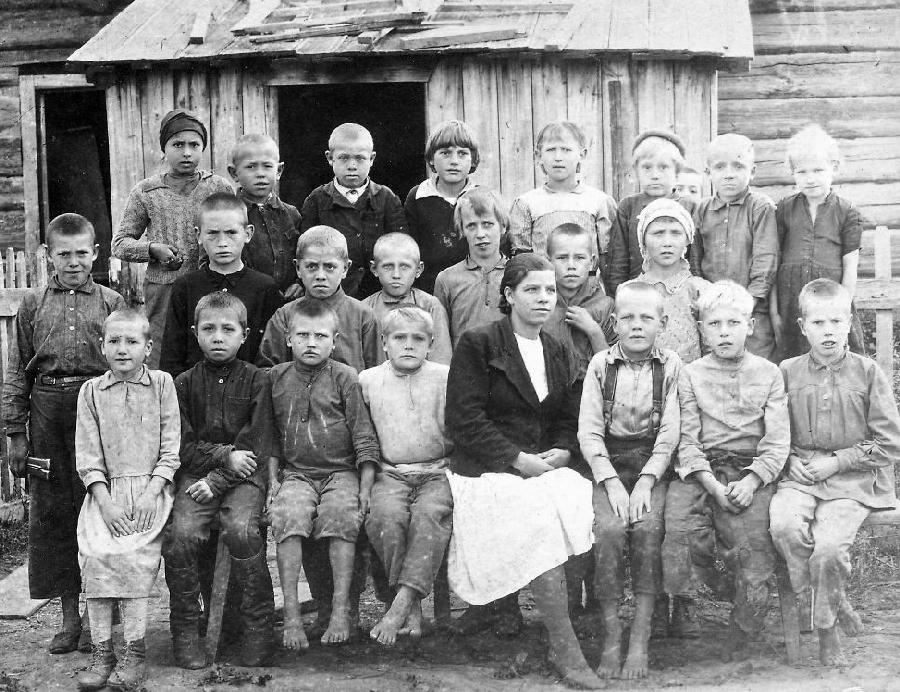
Figure 1.--This school photo was taken in 1945 among a German community in Siberia. The families had been deported by the NKVS to Siberia after the German invasion (June 1941). |

|
Stalin ordered the forced resettlement of large numbers of non-Russisn Soviet citizens before, during, and after World War II. After seizing eastern Poland and the Baltic republics (Estonia, Latviam and Lithuania), large numbers were arrested and their families deported. During the War large numbers of people, mostly Muslims were forcibly resettled to isolated areas of the Soviet Union. One estimate suggests over 1.5 million people. Those deported included Volga Germans and seven nationalities grom the Crimea and the northern Caucasus were deported (the Crimean Tatars, Kalmyks, Chechens, Ingush, Balkars, Karachai, and Meskhetians. There were also other minorities evicted from the Black Sea coastal region (Bulgarians, Greeks, and Armenians). Stalin was concerned about resistance to Soviet rule, desores for independence, and collaboration with the NAZIs. The possibility of a German attack was given as the reason for resettling the ethnically mixed population of Mtskheta, in southwestern Georgia. The Balkars were reportedly disciplined because it was alleged that they sent a white horse as a gift to Adolf Hitler. The KGB and other security forces rounded up and transported the deportees mostly railroad cargo to isolated areas in Kazakhstan, Kirgizia, Siberia, Uzbekistan. These were not well planned deportations. Little arrangements were made to recieve them. Most accounts suggest that about 40 percent of the deportees perished. The Crimean Tatars had an especially horrendous experience. About half died of hunger in the first 18 after having been deportment. After the War there were deportments of Poles to the Poland. Large numbers of people were deported from the former Baltic republics after they were retaken from the NAZIs (1944). There had been some colaboration with the NAZIs in the Ukraine, but there wasno large scale deportmet, probably because of the number of people involved. After Stalin's death (1953),
Nikita Khrushchev began the Destalinization process with a speech at the 20th Party Congress (February 1956). He condemned the deportations as a violation of Leninist principles.
Stalin was concerned about resistance to Soviet rule, desires for independence, and collaboration with the Japanese and NAZIs. The first Soviet actions were conducted in the border areas, by after the War began, national groups were trgeted throughout the Soviet Union.
An artifact od the Rissian Empire was the mixed ethnic composition of many areas, particulsrly border areas. Stalin cane to see this as a security threat, especially after Hitler's rise to powern (1933). Stalin ordered the NKVD to began 'cleansing' operations in European border area, especially the region around Lenningrad (1935). The initial cleansing operations were more selective and limited in scope compared to what was to follow. The NKVD deported some 3,500 Finnish, Latvian, and Estonian families living in or near Lenningrad to Kazakhstan, Siberia, and Tadjikistan (February-March 1935). [Martin 2001, pp. 333 ff.] Another 8,300 mostly German and Polish families (about 41,650 people) were deported from border areas of the Kiev and Vinnitsa area. Some were designated 'socially foreign elements'. This reflected the fact that nationality was not the only consideration, but social class factirs was also taken into consideration. The NKVD continued these cleansing" operations in 1936. Another 5,000 Finnish famikies were deported from the Lennigrad border regions (April-May 1936). Next the NKVD targeted 15,000 German and Polish families in the Western Ukraine were deported to Kazakhstan. (June and September 1936).
A number of Koreans lived in villages situated in Soviet territory along the border with Korea and Manchuria. The new Soviet Union took a relatively benign attitude towrd them. Chairman Rykov of the Council of People's Commisars signed the Charter of the Union of Koreans Living on the Territory od the USSR (June 10, 1924). The Koreans were granted expansive legal rights inckuding cultural rights. The Soviets created a national Korean region with 55 Korean village councils. [Rogovin, p. 13.] The first nationality to be targeted en mass by Stalin era was the Koreans. There were long-running tensions between Japan and the Russia that pre-dated the Soviet Union. These culminated in the Russo-Japanese War which was fought over Korea and Manchuria (1904-05). The Japanese hunger for raw materials turned them toward Soviet Siberia. And the Japanese along with thE Americans occupied Vladisvostock during world war I. After the War, the Japanese did not want to evacuate Vladisvostock. The Japanese occupied Manchuria (1931). This led to border incidents. As Soviet-Japanese tensions increased over Manchuria, Stalin eyed the Koreans in the Far East. An article appeared in Pravda titled �Foreign Espionage in the Soviet Far East�. It was the beginning of the first mass camoaign against a ethnic group in the Soviet Union. The author accused the Koreans of collaborating and spying for the Japanese. We are not sure just what caused this. Koreans were of course intensly anti-Japanese because Japan turned Korea into a colony (1909). We do not know if there were acttual incidents of anti-Soviet Koreans aiding the Japanese. The NKVD deported about 172,000 Koreans living in Siberian border areas (Vladivostok, Khabarovsk, and Birobidjan) to central Asia (Uzbekistan and Kazakhstan) (September-October 1936). It was a massive undertaking , The NKVD organized 124 railway convoys. [Polian, 2001: 87-92.] In addition to the deportations, the NKVD arrested 25,000 Koreans and 11,000 Chinese. Some of those arrested were shot, the other given lengthy terms in the Gulag. The deportees were consigned to 'special settlemebts' and were prohibited from returning home. The Central Committee of the Communist Party approved a secret resolution dated August 21, 1937, justifing this action on the basis that the Korean population constituted "a breeding ground for spies and diversionists for the Japanese secret service." A 1979 assessment estimated that 163,000 and 92,000 respectively still lived there (1979). We are not sure what has happened to these Koreans after the disolution of the Soviet Union. Japan and the Soviet Union fouht a major engagement on the Mongolian-Manchurian border just before the outbreak of World War II (1939). In the final days of World War II, the Soviet Uniin declared war on Japan (August 1945) and in a massive offensive, occupied Manchuria and Nort Korea.
The Soviets invaded poland at the onset of World War II (September 17, 1939). Hitler and Stalin partioned Poland. The Soviets took eastern Poland and the NAZIs western Poland. The NKVD carried out mass arrests followed by execultions and deportations. The murder of Polish army officers in the Katyn Forest is but one of the NKVD's murderous actions. Some estimates suggest that 2.0 million Poles were deported to Siberia, Central Asia, and other areas in the Soviet Union. We have little information about the deportments. We note a diary about the Soviet Gulag from a Polish patriot who fought both the NAZIs and Soviets [Sulkowska-Gladun] In many cases whole families were deported. This was in keeping with Soviet attitudes toward classes of people. If a perdon was a businessman, police officer, military officer, member of the imteligencia, ect. than his whole family was subject. As a resort among the depoetees were thousands of children. Guven the circumstances of the deportatiins, thousand of people (especially children and the elderly) perished because of hunger, exposure, and lack of care. After the Geman invasion (June 1941) Soviet policy changed. Negotiations were held between the British, Polisg Government in exile and Soviets. The Soviets agreed to allow Poles who wanted to leave the country. Polish refugees took the opportunity. The exit was very difficult and only Poles who enlisted in the military were provided food and supplies. Even so, civiliands made their way to Iran. Many died on the way. From Iran they made their way to facilities throughout British held areas as well as Mexico.
As in Poland, the Soviet Union after seizing the Baltic republics (Estonia, Latviam and Lithuania) inleased the
NKVD conducted terrible attrocities. Large numbers of people were arrested. Herevtherewere bindividuals udentified, but most were simply memvers of targeted groups deemed unreliable. This inckuded intrlectuuals, univrsity orofessirsm police =, nilkitary, givernent officuals, teachers, journlits, aristocrats, land owners, businessmen, and many more. Some were murdered, especially men. The Soviets as brutal as they were, unlike the Germans did not commonly shoot women and children and there was no gassing. The families of the men executed were commonly deported. This is one reason there were so many children among the deportees. While not shot, the deportations were conducted under such dreadful conditions that large numbers if the deportees perished. Unlike the German deportations, the Soviet deportations and killing operations were not extencibely photographed. The Germans were proud of what they were doing and wanted to capture imnages. The Soviets were not so proud. The NKVD banned photography. Of sourse the Soviets because of the poverty of the Soviet Union were less likely to have cameras. There are written accounts memoirs, but the bphotographic record is sparse. One particukarly moving acciunt is the story of Lina, a Lithuanian girl deported to Siberia. im her case a work canp above the Arctic Circle. [Sepetys] We have developed some unformation on the deportment of Estonians
Many Baltic German in the late-19th and early 20th century had emmigrated to Germany. Hitler in 1939 after seizing Poland ordered the remaining Baltic Volksdeutsche "heim ins Reich". Hitler proceeded to negotiate a treaty to bring the Baltic Germans back to the Reich. Stalin did not impede this. This was done before Stalin had yet seized control but had begun to pressure the Baltic republics. Virtually all of Baltic Germans complied. I am not sure if any restructions were placed on what they could bring with them. The architecture of many Baltic cities is all that remains in the Baltic today. The NAZIs as part of the Non-Aggression Pact were handing the Baltic Republics over to Stalin, but did not want to hand over the ethnic Germans. For Stalin the numbers were trifling and he probably saw himself as getting rid of a potential irritant in NAZI-Soviet relations. The Baltic Germans also provided a racially suitable population conviently available to persue German polivies in the East beginning with Germaizing Poland. The Baltic Germans had lived outside of Germany for centuries. Even so, most obeyed the F�hrer's orders, leaving their homes. Most of the Baltic Germans complied with Hitler's instructions. The NAZIs sent ships to Baltic ports to take on the Baltic Germans. There were about 12,000 repatriated. I'm not sure how families that had inter-married with Estonians were handled. The first group arrived in Danzig from Estonia October 20, 1939. They were held in dreary camps for extended periods while the SS Office of Race and Settlement Office. assessed their racial characteristics and prepared them ideologically. After this they were not allowed into Germany proper, but used to resettle areasc of western Poland. The Volkdeutsche meeting the SS racial standards were assigned areas in occupied Poland. The NAZIs in the Warthegau and other areas of occupied Poland were expelling the Polish population in order to make room for them. Polish farmers were forcibly evicted from their farms with no compensation and the Baltic Germans used to replace them. From there the Baltic Germans were later expelled themselves, this time by the Poles at the end of the War. Most of them finally settled in West Germany. [Bade]
The largest German population in the Soviet Union was the Volga Germans. I do not know if the NAZIs tried to get Stalin to allow them to return to the Reich after the NAZI invasion (June 1941). This was one group that was forced back to Germany after the War. The Volga Germns were one of several nationalities Stalin deported to isolated areas of the country. The Soviet Givernment ordered the total deportation of Germans from the Autonomous Republic of the Volga Germans (August 28, 1941). The deportations was conducted during the first two weeks of September 1941. Most of them were transported to a variety of locations in Siberia Most of the exiled Volga-Germans were at first put to work on kolkhozes (collective farms). Because of the military emergency most by early 1942 weee foeced into the "Trud-Army" (labor army). Many were used in forestry. Women except those who had many children and juveniles were transported north to various settlements to work in the fishing industry (Summer 1942). Soviet authorities next began assgning juveniles to the "Trud-Army" (1943). They worked at the oil and natural gas hauling plants in the South-Ural. The Volga-Germans who had survived the ardous cinditions in the "Trud-Army" were relaeased 1946. The "release" actually meant internal exile mostly in Siberia. They were not allowed to return to their former homeland. The KGB issue "personal exile files" on all adult Volga-German deportees (1946-47). Many were put under "special registration" wjoch meant having to appear for registration and periodic checks. Soviet officials released the Volga-Germans (as well as other German exiles)from exile (February-March 1956). They were not, however given any right to return" home. Many were not allowed to leave their internal exile until the dissolution of the Soviet Union (1991)
During the War large numbers of people, mostly Muslims were forcibly resettled to isolated areas of the Soviet Union. One estimate suggests over 1.5 million people. Those deported included seven nationalities from the Crimea and the northern Caucasus were deported (Balkars, Chechens, the Crimean Tatars, Ingush, Kalmyks, Karachai, and Meskhetians.
The Balkars were reportedly disciplined because it was alleged that they sent a white horse as a gift to Adolf Hitler.
The Russian relationship with Chechnya is a bloody one. Chechnya was conquered by the Russians with considerable bloodshed in the late 19th century. The largely Muslim Chechans harbored continued resentment toward the Russians and the Communist Soviet state. m in the 2Stalin concluded that the Chechens were sympahetic to the NAZIs. We are not sure just how valid this charge us. It is likely that many Chechens were anti-Communist because of their Islamic religion and Stalin's suppression of all religions. We do not know to what exten the Chechens supported the NAZIs wen the Wehrmacy moved into the Caucuses (1942). (Many Soviet citizens in the Baltics, the Ukraine, and other areas of the Soviet Union looked on the Germans as lineraors until their genocidal racial policies toward Slavs became apparent.) We do know that many Chechens served loyally in the Red Army. Stalin ordered that the entire Chechen people be exiled to Siberia. The action was coordinated by he NKVD and launched February 23, 1944. The 1 million Chenchens were brutally packed into box cars in the middle of the winter and deported east to Central Asia Siberia. Little provision was made for them either on the transports or in the camps to where they were deported. Accounts of the transports are harrowing. Chechen women in particular were mortified to being packed together in boxcars with men for the extended trasport. Some women were ashamed to relieve themselve in front of men and held their urine until their bladders burst. Anuyone who resisted was shot or executed n other ways. It is estimated that about one-third of the Chechen people were killed or died in the roundups and transport box cars, although no precise statistics are known to exist. Many more Chechens perished in the harsh conditions of their exile. The Soviet action against the Chechans was virtually unknown at the time outside the Soviet Union. Chechnya is of course well known to the world public.
The Crimean Tatars had an especially horrendous experience. Soviet authorities deported the entire population of Crimean Tatars, including Communist Oarty members (May 18-20, 1944). NKVD chief Lavrentiy Beria executing Stalin's orders oversaw the process. Many estimate the population at about 200,000 people, but we have seen numbers exceeding 430,000. An estimated 90 percent were women, children, and the eldely. [Allworth] This was because so many young men were in the fughting services. The Crimean Tatars who survived the German occupation of the peninsula in just in 3 days to remote rural locations in Central Asia (primarily Uzbecistan) and Siberia. They were transported in cattle cars. They were one of the ten ethnicities who were encompassed by Stalin's policy of population transfer in the Soviet Union. No provisions were preoared for their arrival. Some 100,000 of the deportees are believed to have perished mostly starving after arrival. A year later, after the end of the War as imprtantblments of the Red Army was demobilizing, Crimean Tatar soldiers who had fought the Germans were also sent into exile too. Stalin decided on the deportation as collective punishment for the perceived collaboration of some Crimean Tatars with the invading Germans. Soviet media identified the Tatars as traitors. Tatar nationalists deny this and charge that the deportation waspart of a larger Soviet plan to gain access to the Dardanelles and acquire Turkish territory. Tatars ethnic kinship as seen as a security threat.
The possibility of a German attack was given as the reason for resettling the ethnically mixed population of Mtskheta, in southwestern Georgia.
There were also other minorities evicted from the Black Sea coastal region (Bulgarians, Greeks, and Armenians).
The KGB and other security forces rounded up and transported the deportees mostly railroad cargo to isolated areas in Kazakhstan, Kirgizia, Siberia, Uzbekistan. These were not well planned deportations. Little arrangements were made to recieve them. Most accounts suggest that about 40 percent of the deportees perished. T
The Soviets after the War deported Poles from the former eastern areas of pre-War Poland annexed to the Soviet Union. The Polish nation was essentially shifted west. Former eastern German territory was transferred to Poland. The Germans there were deported to occupied Germany.
Large numbers of people were deported from the former Baltic republics after they were retaken from the NAZIs (1944).
There was a great deal of anti-Soviet feeling in the Ukraine. The assault against the Kulaks including the engineered famine had turned many in the Ukraine against the Soviet regime. There was as a result some colaboration with the NAZIs in the Ukraine. There would probably had been much more support had not the NAZIs genocidal appraoch to the Slavs turned many in the Ukrainde aginst them. There was no large scale deportmet, probably because of the number of people involved.
The Communist world was stunned in 1953 with the death of Stalin. Tass announced that he died from a stroke. We now know that he was poisoned. The Chief of
the NKVD, Lavrenti Beri (1899-1953), put rat poison in his wine. Beria was apparently concerned with good reason that diappointments in the H-bomb program
had caused Stalin to prepare for his arrest. Here Beria struck first. Stalin reportedly vomited blood for3 days. [Reed] Beria in the annals of the 20th century is a man
so monsterous thatb he is approached only by Jimmler. In the end it did him no good. Before Beria could effectively use the NKVD to placev hin in power, his
Politboro colleagues had him tried and executed.
After Stalin's death (1953), Nikita Khrushchev began the Destalinization process with a secret speech at the 20th Party Congress (February 1956). He condemned the deportations as a violation of Leninist principles. Khrushchev claomed that there were no mass deportments in the Ukraine "only because there were too many of them and there was no place to which to deport them."
The Soviet Government in 1956 began issuing decrees restoring the Chechen-Ingush Autonomous Republic and the Kabardino-Balkar Autonomous Republic. The Government also formed the Kalmyk Autonomous Oblast' and reorganized the Cherkess Autonomous Oblast' into the Karachai-Cherkess Autonomous Oblast'. This process did not cover all the people that had veen deported. The Government only partially rehabilitated the Crimean Tatars, Meskhetians, and Volga Germans. Most were not allowed to return to their former homelands until after the final disintegration of the Soviet Union (1991).
Allworth, Edward. (1998). The Tatars of Crimea: Return to the Homeland: Studies and Documents (Durham: Duke University Press, 1998).
Bade, Klaus J. ed. Deutsche im Ausland. Fremde in Deutschland (C.H.Beck Verlag: Munich, 1992).
Martin, T. The Affirmative Action Empire. Nations and Nationalism in the Soviet Union, 1923-1939 (Cornell University Press, 2001).
Martin, T. "The Origins of Soviet ethnic cleansing," The Journal of Modern History No. 70, (1998), pp. 813-61.
Polian, P. Ne po svoiei vole, Istoria i geografia prinuditel�nyx migratsii v SSSR (Moscow, OGI-Memorial, 2001).
Reed, Thomas C. At the Abyss: An Insider's History of the Cold War (Ballantine Books: 2004).
Rogovin, Vadim Zakharovich. Stalin's Terror of 1937-1938: Political Genocide in the USSR.
Seprtys, Euta. Between Shades if Gray. Seprtys is a Lithuanian-Americam writer specialising in historical fiction.
Te nook is based on interviews with many Lithuanian survivors who were themselves teenagers during the deportations and had a greater will to live than many of their adult counterparts at the time.

Navigate the Boys' Historical Clothing Web Site:
[Return to World War II: Soviet ethnic groups]
[Return to Main Great Patriotic War page]
[Return to Main World War II campaign page]
[Biographies]
[Campaigns]
[Children]
[Countries]
[Deciding factors]
[Diplomacy]
[Geo-political crisis]
[Economics]
[Home front]
[Intelligence]
[POWs]
[Resistance]
[Race]
[Refugees]
[Technology]
[Totalitarian powers]
[Bibliographies]
[Contributions]
[FAQs]
[Images]
[Links]
[Registration]
[Tools]
[Return to Main World War II page]
[Return to Main war essay page]
[Return to CIH Home page]