|
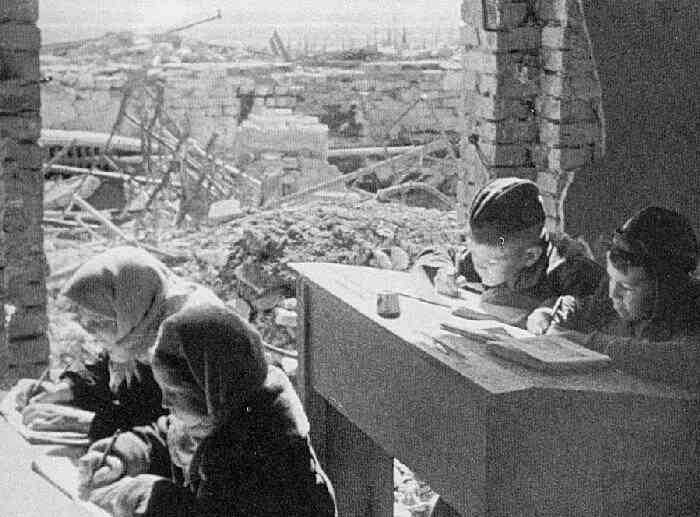
We do not know a great deal about the Soviet home front yet. The most significant aspect of the home front was Soviet war production. The Soviets were able to maintain and even expand war production despite the huge area conquered by the Wehrmacht during Operation Barbarossa. The NAZIs did not fully understand this. What the NAZIs failed to appreciate was that much of the areas conquerred were the non-Russian areas of the western Soviet Union (the Baltics, eastern Poland, Bylorussia, and the Ukraine). Enormous damage occurred n the occupied areas and the three great cities (Leningrad, Moscow, and Stalingrad) targetted by the NAZIs. Other areas of Ruddia were largely undamaged by the War. The Luftwaffe did not have a long0-range fleet of heavy bombers with which to conduct a strategic bombing campaign. Children cntinued to attend schools, although all supplies including teachers were in short supply. We have little information on the rationing system. Nor are we sure how Russia survived without the Ukranian bread basket. America provided substantial food supplies, but this was primarily used for the military. One huge problem encountered was large numbers of displaced children. This problem was especially severe in the occupied areas and had to be addressed when they were liberated.
The population of the Soviet Union was some 190 million people at the time of the German invasion (1941). That was more than double the German population of about 90 million aumented by areas of (Luxenbourg, France, and Poland) from the 85 million which with which Germany began the War. This looks to be a huge Soviet advantage, but as a result of Operation Barbarossa, the Germans had occupied vast areas of the Soviet Union reducing the population in the unoccupied region to some 110 million, not all that different from the German population. [Pennington] Over 10 million Soviets fled east, escaping the rapidly advanciung German Army. In addition, the Germans had allies which meant that in the Ostkrieg, the Axis actually had a larger popoulation base than the Soviets. The Axis allies and Finland (cobelligrent) had a population of over 80 million: Italy (43 million), Romania (20 million), Hungary (9 million), Finland (4 million), Croatia (4 million), and Slovenia (1 million). And this does not include Spain and the occupied countries which made limited contributions. In addition, while Japan (73 million in 1941 not including Korea and Taiwan) did not participate in the Ostkrieg, the Soviets had to mantain forces in the Far Eat. The idea that the Soviets had overwhelming, limitless manpower compared to ther Axis is not just exagerated, but fundamnentlly wrong. The difference is how the two sides used theuir manpower and conducted the War. The Soviets used women in combat roles and the work force in ways the Germans never did. The Germans who had to fight a war in the West, did not have the industrial power to adequately equip and support the Ostheer, let alone their Axis allies. As a result, the population of the German Axis allies were not fully utilized. German brutality and racial doctrine ment tht they could not use the anti-Soviet orientastion of many in the occupied territoiries. German brutality also steeled the fighting spirit and resolve of Red Army soldiers. The greatest mistake of the Axis was that they fought two almost totally separate wars instead of deciding, as the Western Allies did, what country was the greatest threat. If Germany and Japan had agreed to attack the Soviet Union jointly in 1941, the population differential would have been massively in the favor of the Axis.
The Soviet Union because it was such a closed society is difficult to compare with other countries, but assessments suggest that it had a total national output roughly comparble to Germany (about $15 billion). The Soviet Union was, however, much less economically developed than Western Europe. And Soviet enterprises were extremely inefficent as we saw after the disolutiin of the Soviet Union decades later. Because of the larger population, percapita income was only a fraction of European levels and living standards even lower because of the inefficencies in the economy. Soviet statistics show continued economic expansion during the Depression years of the 1930s. We are unsure just how to interpret these ststistics. As a result of Stalin's policies, beginning with the First Five Year Plan (1928), the Soviet Union had significntly expanded heavy industry, but seriously weakened its agricultural base. American companies had helped expand Soviet production of cars and trucks, importabt in preparing for a mechnized war. And the Soviet Union even before the NAZIs seized power in Germany had concentrated on military production. An extremely large share of national output was being directed to the military, meaning that the country had the largest army in the world and heavily armed with modern weapons. Unlike the Germans, the Soviets had vast deposits of natural resources, especially oil. Obtaining raw materials, unlike the situation in Germany, was not a major factor in Stalin's decesion to ally himself and his country with Hitler and the NAZIs to launch World War II (1939). Stalin's calculation was based on power politics and ideology. The Soviet Union on paper was better prepared for war than most countries. But Stalin's purge of the Red Army has seriously weaked the country's military. And various strategic and domestic policies made the country dangerously vulnerable. In addition, while heavily armed, many Soviet weapons, especially tanks and aircraft, were obsolete, but kept in service. The Soviet Union after the German invasion (June 1941) suffered enormous losses in men and material. Some 4.5 million men were killed or captured. The Soviets managed to move important war industries east of the Urals beyond the range of Luftwaffe bombers. It took time, however, to being the industries back on line. They began forming large numbers of new divisions. There were enormous shortages, especially in 1942 as the war plants moved east were not yet back on line. While poorly trained at first, they managed to stop the vaunted Whermacht in its tracks--albeit deep in the country. Food proved a critical matter as the Germans occupied much of the riches farm land and major grain producing regions of the country. As the Soviets began to resume production, the United States began to deliver important Lend Lease shipments. The Soviet Union after Britain were the largest recipients of Lend Lease aid. As with Britain, Lend Lease was just a fraction of overall Soviet output, but it not only plugged in major defincies in the the Soviet war economy, but assisted the Soviets in increasing their production.
German armies as a result of Barbarossa drove deep into the western Soviet Union, occupying the Baltics, Bylorussia, and the entire Ukraine. These of course were non-Russian areas. The Germans failed to occupy the Russian heartlnd. German units were on the outskirts of Moscow and attempting to encircle it. Lenningrad was cut off. But the Germans would advance no further into the Russian heartland. The Red Army counter-offensive (Sepember 1941) suceeding in driving the Wehrmacht out of most of the Russian areas of the Soviet Union. What the Red Army found as they liberated Russian villages (December 1942-March 1942), confirmed their worst fears about the nature of the NAZI enemy. The Red Army offensive wreaked enormous damage on the Wehrmacht and liberated a much of the Russian areas occupied by the Germans, but it left the Germans in control of large areas of the western Soviet Union. What the NAZIs failed to appreciate was that much of the areas conquerred were the non-Russian areas of the western Soviet Union (the Baltics, eastern Poland, Bylorussia, and the Ukraine). These areas included enormous resources, but the Russian heartland remained unoccupied and the Red Army rapidly began forming new divisions to replace those lost in 1941. Despite the German advances, control of the Russian areas of the Sioviet Union gave the Red Army to recruit abd build divisions at a much greater pace than the Germans. German intelligence significantly underestimated the Soviet capacity to form new divisions. Hitler for his part had expected his conquests in the East to feed the German war economy. In fact, the reources from the east barely fed the enormous German and Axis ally armies deployed there. It did, however, deny those resources to the Soviets. And the mot important was food. The area occupied by the Germans included much of the most productive agricultural land of the Soviet Union--the incredibly productive back soil district. This created enormous food shortages in the unoccpied Soviet Union. And as priority was given to the Red Army, Soviet civilians were forced to survive on extemely low rations. The situation was even worse in the German occupied areas. The German goal was to depopulate the East as part of Generalplan Ost and to destroy the industrial cites turning the East into a giant agricultural zone for German colonists. As a result the Germans had no desire to use available food to feed the population in the occupied areas. As a reult, rations were only assigned to those working for the Germans in some way. The Wehrmact attempted to get farms, mines, and even some factories back into operation to support the war effort. Those who did not work for the Germans faced starvation.
World War II was the greatest war in human history and by far the most destructive. The danage both human and phyusical inflicted on the Soviet Union by the Germns and the Soviet scorched Earth efforts was enormous--virtually defying belief. The Soviet Union was one of the most serverely if not the most damaged by the War. We initially thought this would be the China, but ome imprtant historian points out that Japanese destruction occured primarily at the ytime of conquest. [Weinberg, p. 501.] And Japanese murder was designed primarily to terrorize so as to achieve compliance. Wjile the Germans murdered as a major war goal so as to change the demaographic balance in Eastern Europe. Poland and Yugoslavia were two other countries massively damaged by the War.
No one knows how many Soviet citizens perished in the War. The number often given is some 25 million people, but this is only a riugh stimate. Many estimats are substantully greater, come as high as 50 million. Most were civilans as a result of German programs like Generalplan Ost and the Hungerplan. Killing Soviet civilians was actually a primnary German wae goal. Starvation was the big killer. We see huge attention being given to German civilians casualties during the War by people trying to villify the Allied war effort. In fact most German casualties were military casualties. Compared to countries the Germans invaded, German civilan casualties were relatively light.
Enormous physical damage also resulted frim the War. And unlike Workld War I, it was not just in battle aras. Te desestation in the East was far greater than in the West. The three great cities (Leningrad, Moscow, and Stalingrad) targetted by the NAZIs were severly damaged. Leningrad and especially Stalingrad were basically leveled. he areas of the Soviet Union not occupied by the Germans were largely undamaged by the War. The Luftwaffe did not have a long-range fleet of heavy bombers with which to conduct a strategic bombing campaign. The areas the Germans occupied is a very different matter. In the battleground areas the desestation essentially complete. One meruca estimate suggests that virtully all the wealth it gained from the Stalin's industrialization efforts during the 1930s were destroyed. The GDP fell some 20 percent (1941-45)( abddid not fully reciver to pre-War levels until the 1960s. One historian believes that the war damages toyaled about 25 years of the country's GNP. [Pauwels, p. 377.] A British historian estimates that some 40 percent of Soviet housing was damaged or destroyed. [Ponting] Another assessment claims that of te 2.5 million housing dwellings in the German occupied territories, over 1.0 million were destroyed, making some 25 million Soviet citizens homeless. [Varga-Harris, p. 4.] Soviet sources report that the Germans and othger Axis forces powers destroyed 1,710 towns and 70,000 villages, as well as 65,000 km of railroad tracks. [Lee, p. 307.] And the damaged was not confned to the cities. The agicukltur;l infrastructure was also destroyed including virtually all frming equipment and vehicles.
One of the great stories of World War not adequately addressed by historians is despite the enormous damage, both human and physical, the Soviet Union proved resiliant. And this in a society which had alienated many of its people. One historin tells us, "The capacity of the Soviet home front to sustain the war effort could be the single most imprtant factor in the defeat of NAZI German." [Pennington] It is clerly a topic that deserves close scrutiny. The Soviet home front was drawn into the war to a greater extent than any other country. One hustorian writes, "The ebormous casualties reached into every home even as the already low pre-war economy imposed terrible privations." [Weinberg, p. 501.] We are not sure if it was more severe than the demands on the Japanese home fromt, but surely to a greater degree than all the other major belligerent countries. A historian tells us, The Soviets did it "... by mobilizing a far greater percentage id there peoplev than any other socirty in the war, under worst conditions and truly demomsrrating what it meanbs to do more with less--mich less."[Pennington] A range of factors appear to be invoved.
First, what ever the brutality of the Soviet regime, it was clear that the NAZI brutalities were immesurably more barbaric than the Soviets.
Second, the Soviet Union was an even more effucent totalitarian state than the NAZIs. The Soviet regime made superficial changes. They eased resrictioms on religion.
Third, was the war effort was made a patriotic crusade to save Mother Russia--not the Communist class struggle. It became the Great Patriotic War. [Weinberg, pp. 501-02.]
Fourth, was thesize of the Soviet Union. Before the War, important industrial plants were situated deep in theSoviet Uniin, in places like Stalingrad on the Volga or even beyond the Urals. Still much of their industry was located in the western Soviet Union. Despite the rapid German advance, the Siviets managed yo move a subdtantial portion of their ijndustry east beyond the German grasp. One historian explains, "One of the incrdible things thay they did was to relocate hundrdes and hundreds of factories in advance of the German occupation In 1941 more than 1500 large-scale factories including more than 100 aircraft factories were moved from western areas of the Soviet Union to the East. About half went to the Ural Mountains and the rest went to the Volga, Central Asia, and Siberia. Then the factories were set back up, often in the most primitive conditions that you can imagine. And put back into production. The workers, at least half of which were women, lived in tents or holes in the ground summer and wnter until the end of the war." [Pennington]
Fifth, was American Lend-Lease whuch provided important support for the economy. Lemd-Lease was aimed at supporting the Red Army and industry, but it included food. The food mosrly went to the Red Army, but this added to the overall food suppoly which was citical given all the farm land seized by the Germans inthe Ulkktaine. It is also important that after the terrible defeats of the first few nonths, that the Red Army achived major victories, first before Moscow (Decmber 1941) and then Stalingrad (November 1942). After Stalingrad the front moved inexorably West. The cost was in blood and wealth was enormous, but the victories and steady drive west was cear to the Soviet people.
We are not entirely sure what happened to schools in the occupied areas. There were differences. Presumably the schools in the Baltics continued to function. In other areas, we are not sure. The NAZIs arrested university professors in Poland. Presumably the same occurred in the areas outside the Baltics. The NAZI plan was to eliminate many Slavs and turn thoe not killed into mannual slave laborors for German agricultural colonists. This was all skectched out in Generalplan Ost. Thus they saw little need to educate the children. Just to what extent they began initiating this system, we are not sure. We know they began killing the Slavic population, although not on the scale of the Jews. Those not working for the Germans did not receive food rations and this of course mean many children. They begn in Poland, but the securitysituation did not permit beginning to plant German colonists in the occupied Soviet Union. Children continued to attend schools in the unoccupied areas of the Soviet Union, although all supplies including teachers were in short supply.
The peasantry has played a key role in Russia from the very beginning of the Tsarist state. Peter the Great's expanding empire in many ways resembled that of another developing empire at the time--Prussia. The state in both countries developed essentially out of the need to build and support a modern army. The success of these two states largely is due to their effectiveness of doing just this.
The Tsarist state developed autocratically. The Tsar dominated an aristocratic landlord class which was force to fulfill state service and which was rewarded by being allowed to hold the peasantry in serfdom.
Tsar Alexander II emancipated the serfs (1861), but the landlord class was not destroyed until the Revolution (1917) and Civil War (1918-21). The Tsarist Army in World War I desintegrated as peasant soldiers deserted to return home and claim theur share of the old esates. The Bolshevicks promised land to the peasantry, but Stalin initiated a collectivization program that resulted in millions of deaths of peasants who wanted their private parcels. The greatest numbers of deaths occurred in the Ukraine becise of the Great Famine Stalin enginnered, but lsarge numbers if peasants were executed or committed to the Gulag. Stalin had various objectives. He wanted to gain control over agriculture. This was partof his desire to totally control economic activity. It also put him in a position to better redirect resources to the urban proletraiat as part of the 5 Year Plans to expand Soviet industry. As a result, the loyalty of the peasantry when the NAZIs invaded the Soviet Union was far from certain. And in certain areas the Germans were received more as liberators and greated with flowers rather than invaders. This varied greatly by area. The Germans were often well recrived in Belarus (which had been Poland before the Sobiet 1939 invasion) and the western Ukraine. They were less warmly received in Russian areas, but the Soviet offensive before Moscow (December 1941) prevented the Wehrmacht from penetrating deep into the Russian heartland.
Food was a difficult problem in the Soviet Union before World War II. Stalin for both ideological and political reasons decided to collectivize agriculture once he was in full command of the Soviet state. He hoped collectivuization because it aklso meant mechanization would increase harbvests. It was one part of the First Year Five Year Plan to rapidly industrialize, The idea was to extract more grain from the peasantry to feed industrial workers in the expanding cities. When the Ukranian peasantry resisted, he orcestrated the Ukranian Famine. Millions perished, including the Kulaks--the most prosperous peasants. They were the most prosperous of course because they were the best farmers. And as a result, instead of increasing harvests, food production plumeted. Soviet agriculture never fully recovered. It was further hampered by another of Stalin's ideological initiatives--supporting Trotim Lysenko. Lysenkoism put back Soviet genetucs, including developing hardy grain strains a generation. As a result food shortages existed in the Soviet Union before the German invasion. After the invasion, the food situation got much worse. Food was one of the most difficult problens faced by the Soviet Union during World War II. The phenomenal early successes of Barbarossa left the Germans in control of most of the best agricultural land of the Soviet Union--the highly productive black soil lands of the Ukraine and adjacent areas of Russia and Bylorussia. This had been one of the major attractions that had drawn Hitler to the East. Hitler believed that the vast tracts of productive land would feed the Reich during the War. It did not. It did meet the needs of the Whermacht, but very little food from the East reached German civilians. But it did deny food to the embattled Soviets, creating one of the Soviet regime's major problems. Thec Whermacht only fed the Soviets working for them. All other Soviets had to fend for themselves. No one really knows how mant Soviet citizens died during the War. Estimate generall range in the 25-30 million range. Some estimates are even higher. There were about 9 million military deaths. That number is fairly well accepted. Less clear is the mumber of civilian deaths. One of the leading causes of civilian deaths was starvation. The Germans starved civikians in the occupied areas and the Soviets Union simply did not have enough food to feed its population after the Germans occupied the Ukraine and other food producubng regions. We know that some 1 million Lenningraders starved. The numbers who starved outside Leningrad in iccupied and unoccupied regiions will never be known with any precissiion. Another 1-2 million surely starved. [Collingham, p. 317.] The actual total is probably higher, especially if you include causes that were brought on by starvation. While much of this occurred in the occupied area there are many reports of starvation in the unoccupied areas, bodies on thecstreets or peoopler collapsing as rthey worked in ae plabts. [Moskoff, p. 37.] One author contends that of war-related causes such as conditiins brought on or worsened by chromic malnutrition are considered, the death toll would be well over 30 million. [Miller, p. 284.]
Energy became a huge problem when the Germans invafed. The huhely importnt oil resources located deep into the Soviet Union. Importnt coal resorces and elrctrcal generating capacity. This mean that the Sovir Union had to operate with half the electriucity and a third of its coal. [Pennington]
Soviet propaganga at the onset of the War focused on Communist and the Marxist class struggle. Nationalism was not only deempasized, but generally seen seen as a negative force in the great proteriet struggle. The Soviets also actively suppresed religion through agressive atheist campaigns. And from the onset of the War , the Soviet Union was a NAZI ally. Propaganda attacked the American capitalisrs as well as the British and French. Posters from this era have not survived in numbers, because the Soviets after the War were ashamed about their alliance with Hitler.
This changed dramatically after the German invasion (June 1841). Marxism took a back seat to Russian nationalism which suggests where tghe hear of the Sussian people was at. In addition, the attacks on the religion cased, at least publically. The Great Patritic War became a modern day crusade against Fascism. Immages of women and children raveged by the NAZI invaders were meant to inspire the Red Army soldier. The images may seem over the top, only even the most graphic images do not capture the totality of what Hitler planned for the Russian people. Some Soviet war propaganda had an almost religious tinge to it. But in a way Communism in the Soviet state had in many ways the outward trapping of a state religion. But even more evident was the historicaal tone. Gone was class struugle. Patriotic images of great Tsarist military heros were a mainstay of Soviet war propaganda from the Napoleonic invasion back to the medieval era.
Stalin rushed to industrailize the Soviet Union through Five Year Plans during the 1930s. Small villages were turned into vast new industrial complexes. This was a priprity as the lack of industry was seen as the reason for Russia's defeat in World War I. In addition, a Communist state needed an industrial proleterit, not a peasant population. Many of the ne new heavy industry was sited deep in the Soviet Union east of the Urals. This meant that even with the German advances, they were out of range of Luftwaffe attacks because the German air force was built as a short range tactical force. Much of Soviet light industry, including the most sophisticated industry was located in European Russia west of the Urals. Here they were in great danger of being overrun by the German armies that were rapidly druving deep intio the country. This meant that important factories might be over run or bombed as the Germans advanced. The Soviet State Defense committee decided to disassemble and evacuate as many whole factories as possible. The areas of Poland annexed in and the Baltics bought a little time. The Soviets rapidly began dismantling the factories and shiping the equipment along with the industrail, workers east beyond the Urals. They were transported by rail and reassemble at secure locations. It was a gargantuan undertaken that had to be accomplished within a few months. It would play a major role in the eventual Soviet victory. While the factories were noved East, housng for the workers was not. The workers had to live in extridinarily primitive living conditiinx even during the Winter. In some cases, but not all, tents were provided. It took some time to reassemble the factories and get raw materials to them, but some were beginning to function in 1942 and in full production by 1943. In addtion to moving factries east, the Soviets built some 3,500 new factories with conditions no better than the relocated factories. [Pennington] The Soviets rapidly shifted over to war production when the Germans were still producing large quantities of consumer goods. The Soviet war ecomomy had only about one third of the steel and coal available to German industrty, but Soviet factories produced twice as much war material (1942). Many Soviet factories were constructed with dual production capabilities. A tractor factory was also capable of producing tanks. The German industry might have been able to match Soviet production, but Hitler and the Gaulitiers interfered with efforts to reduce production of consumer goods.
An account of Soviet women has a special place in any history of World War II. The role of women in both the economy (industry and agriculture) and the military far exceeeded that of any other country in history. This is part of the reason that the wife of a Soviet leader famously said, "Women know the price of war and peace." [Gorbacheva] And this is true for the Home Front and combat history of the War. The Soviet Home Front was stressed like none other in Europe. And because so many men were consripted for military service, it was primarily up to Soviet women to keep the home front functioning. Give the food situation this was an extronduinarily difficult task. And the Home Front, especially the miraculous productivity of Soviet industry, is a huge part of the Soviet victory in the Ostkrieg. Unlike other countries, Soviet women were a major part of the industrial work force. (This had occurred to some extent in the West duruing World War I, but after the War, most Western women went back to home keeping.) This was not the case in the Soviet Union. There was no culture shick or Rossie the Riviter phenomnon. [Pennington] Soviet women were already a part of the industrial work force. In 1940 some 4.5 million women were working in industry. Some 0.5 million women and o,3 million children (age 12-15 yerars) volunteered for war work (1944). The sane siccurred the followingh twear. Despite the major mobilizations, the nimber of women woirking in industry had hardly budged to 4.8 million women (1945)--primarily because of the loss of population in the occupied areas. [Pennington] The relarive proprtions were extridinary. In ibsustry the the rekarive proprtion of wimen rise fron 41 to 51 percent, transportation (21 to 40 percent), power stations (more than 50 percent), coal mines (25 percent), abd agricultural woekers (92 pecent). [Pennington] he only chznge is that they becme a much more important part of the inndustrial workforce. The sane was true in agruculture in the collctive farms. The idea of equal pay for equal work was well-established in the Soviet Union.
The role of Soviet women was not limited to the Home Front. The Soviets did not draft women for combat, but many voluntered for combat. No other combatant country used women in combat roles. This was not just the case of World War II, but as far as we can tell throughout hitory. The Soviet Union committed women to combat and dd so did so extensiuvely. The NAZIs used children to fight the War, but not women. They served in all three military baranches and both combat and support roles. Some 0.8 million women served in the Red Army alone. And the role of Soviet women was not limited to battkefield medics in which many served. And Soviet women served with the infantry, tankers, and air force. The exploits of women pilots and snipers were well publicized, especially during the War. The Soviets not only trained women piolots, but allowed them to fly in combat--the only World War II combatant pemitting this. The lives of swomen in most countries were poerfully changed by Workd War II, one historian claims that thecchnges in the Siviet Union were more profound, reaching 'rarher and deepoer than in any other country'. [Pennington] We are not sure about this. Certainly Soviry women were more involved in the economy than Western women. And threy were not as clustered in low income areas as western women, but Soviet women did not advance to power positions as we observe with Western women.
Labor was a major issue in the Soviet Union. As a result of the Germam invasion, the Soviet wirkjing popularion as cut from 85 million to 53 million.
As the country mobilized to ght the Germnans and expand the Red Army, 12-13 millios industrial and agricultural workers were drafted. This meant that there was a huge loss of workers and the potential work force. The number of industrial workers fell from 33 million to less thn 19 million in 1942. And did not recover until after the War. [Pennington]
Workers had to be found to keep the factories operating. And with terrible losses at the front, more and more workers were drafted. Not only were relacement workers needed for the draftees, but many factories were operated 24 hours to increase production meaning even more workers were needed. The American-British solution of mobilizng women wsas not as effective in the Soviet Union because Soviet women were aleady an important oart of the work force. The Soviets addressed the labor problem in a variety of ways.
First there was the Gulag system of slave labor.
Second, working hours were extended. One historian explains, "Work hours were long and arduuus. During the first week of the War [meaning after the German invasion], holday and vacation were abolished and compulsory over time up to 3 hours a day was introduced. That brought thevtypical wok week of 48 hours to 55 hours. And six days a week was the usual mumber for people in the Soviet Union although many people worked seven days a week for weeks on end following ???? over time.. [Pennington]
Third, everyone was required to work an this was backed up by the rationing system. Children were an kmpotant part of the new workers. Only young children did not have to work. After age 12 years, ations were cut to starbation levels. Everyone had to work to obtain higher rations. Even for worker, however, because of food shortages, the rations were far from generous.
Even so the factories were understaffed throughout the War. Not ibly were fctiries understaffed, but the worjkers in thiose factories were underfed. They worked 12 hours a day at most oplnts on half the calories of American workers. [Pennington] That is probably not a fair comparison. Soviet workers had far fewet calories than Amnerucan workers even before the war.
Most World War II histories focus on the Axis, mostly NAZI, concentration camp system. There was, however, another large conccentration camp system which operated furing the War--the Soviet Gulag. The Soviet Gulag held only about 0.1 million inmates during the 1920s. As Stalin seized control,of the Soviet state (late-1920s), he began to rapidly expand the Gulag. The initial major expansion resulted from Stalin's collectivization of agriculture and the resistance he encountered. This was followed by the Great Purges which targeted the Party and military. The Gulag is believed to have held 2-5 million inmates (1936). Estimates vary widely. This huge system contginued at about this size or somewhat larger throughout Stalin's rule. Besides recalcitrant (perhaps betterstated 'surviving') peasants, the Gulag consisted of purged Communist Party members and military officers, German and other Axis prisoners of war, suspect ethnic groups, saboteurs and traitors (meaning for the most part completely innocent individuals), family members or friends of those arrested, dissident (or more properly not fully engaged) intellectuals, clerics and other religious people, as well as common criminals. Many victims were absolutely innocent citizens arrested by the NKVD to meet their quotas. Some NKVD commandersc sought to please Stalin by exceeding their quota. With the out break of World War II (September 1939), the Soviet Union invaded or seized terririry from several neigboring countris. Beginning in Poland, the Soviets attacked or forced concessions on Finland, Estonia, Latvia, Lithuania, and Romania). Large numbers of people were killed, deported, or committed to the Gulag in the process of Sovietization. After the German invasion (June 1941), the Gulag like the Soviet economy as a whole was rapidlyh shifted to production of arms and supplies for the Red Army. Transportation projects such as the laying of rail lines was another priority project. Some purged military men were released to fight the Germans as well as Polish POWs. During the War, German and other Axis POWs entered the Gulag system. Despite the influx of Axis POWs, tghe Gulag populations fell sharply. The major reason was food shortages. Inmates began starving because of lack of food along with the heavy labor exertions forced on them. The Germans occupied much of the best agricultural lands of the Soviet Union createing terrible food shortages. One report suggests that a quarter of the Gulag's population starved during the terrible winter of 1941-42. [Appelbaum] Other sources estimate over 0.5 million Gulag imamtes died during 1941-43. [Zemskov, pp. 14-15.] Productivity at the Gulag camps never achieved the levels expected and the goals set, in part because the food shortages and harsh conditions. This caused the NKVD to increasepressure on the inmates leading to higher death totals.
After the War Soviet soldiers held as POWs and civilians brought to the Reich as forced labor were not liberated, but arrested by the NKVD and sentenced to the Gulag.
One huge problem which developed during the War was large numbers of displaced children. As a result of the fighting as well as NAZI attrocuities and pilligaing of Soviet resources, huge numbers of Soviet citizes were killed outright or died as a result of deprivation or mistreatment. No one knows precisely how many Soviet citizens were killed, but most estimtes exceed 10 million people. This includes many children, but it also includes many parents. The NAZIs also shipped large numbers of Soviets west to serve a slave labor in Germany. No provision was made for any children they may have. The result was a huge number of orphaned or displaced children. This problem was especially severe in the occupied areas. The NAZIs ignored the problem because their goal was to reduce the population of Slavs and the children in particular were of no economic value. Soviet authorities were thus left with a massive problem when they began liberating areas occupied by the NAZIS.
Applebaum, Anne Gulag: A History (Broadway Books, 2003), 720 p.
Collingham, Lizzie. The Taste of War: World War II and the Battle for Food (Penguin Books: New York, 1962), 634p.
Erickson, John. The Road to Berlin: Stalin's War with Germany Vol. II (Widenfield & Nichols: Lpmdon, 1983).
Gorbacheva, Raisa
Lee, Lily Xiao Hong. World War Two: Crucible of the Contemporary World (Routledge: 2016).
Miller, James R. "Conclusion: impact and aftermath of World War II," in Susan Linz, ed. The Impact of World War II on the Soviet Union (Rowman & Allanheld: Totowa, N.J., 1985), pp. 283-91.
Moskoff, William. The Bread of Affluence: The Food Supply in the Soviet Union during World War II (Cambridge University Press, Cambridge, 1990).
Ponting, Clive.
Pauwels, Jacques. The Myth of the Good War: America in the Second World War 2nd ed. (James Lorimer & Company: 2015).
Pennington, Reina. Surviving Total War at Home," World War II Symposium (January 18, 2014).
Solzhenitsyn, Aleksandr. The Gulag Archipelago (Harper & Row), 660 p.
Varga-Harris, Christine. (2015), Stories of House and Home: Soviet Apartment Life During the Khrushchev Years (Cornell University Press: 2015).
Weinberg, Gerhard L. A World at Arms: A Global History of World War II (Cambrige Universit Press: New York, 2005), 1178p.
Zemskov, Viktor Nikolaevich. "Gulag," Sociologičeskije issledovanija (1991), No. 6. Zemskov along with Solzhenitsyn is one of the most repected Gulag scholars. He published during 1990-92 the first precise statistical data on the Gulag which were based on the Gulag archives. There is, however, considerable debate as to Gulag scholars as to the size of the Gulag and the death toll at the camps.

Navigate the CIH World War II Section:
[Return to Main Great Patriotic War page]
[Return to Main World War II country page]
[Biographies]
[Campaigns]
[Children]
[Countries]
[Deciding factors]
[Diplomacy]
[Geo-political crisis]
[Economics]
[Home front]
[Intelligence]
[POWs]
[Resistance]
[Race]
[Refugees]
[Technology]
[Bibliographies]
[Contributions]
[FAQs]
[Images]
[Links]
[Registration]
[Tools]
[Return to Main World War II page]
[Return to Main war essay page]