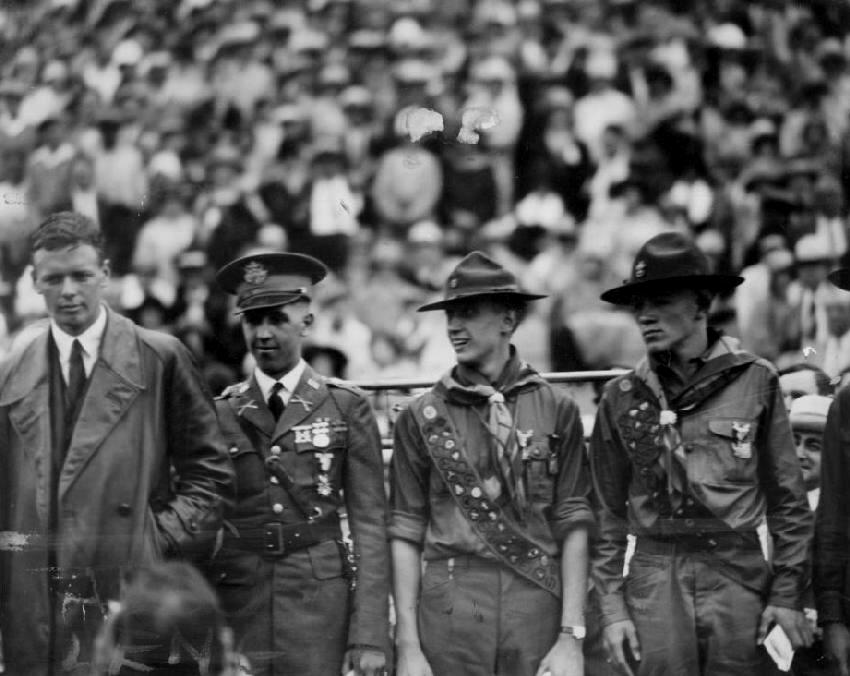
Figure 1.--The best known and probably the most influential of the isolationists was famed aviator Charles Lindbergh. After his solo-flight across the Atlantic, he became the first modern media sensation. Here shortly after sensational flight, he participates in a Chicago ceremony when Boy Scouts received medals (1927). Lindbergh would play a major role in the America First Committeee opposing President Roosevelt's efforts to resist NAZI aggression and aid Britain. It is one of the ironies of history that it was Lucjky Lindy who the chief image of an optimist future bringing Europe and American closer together became the chief spokesman for isolationism and abndoning Europe to a new Dark Age as Churchill eplained 'made more sinister, and perhaps more protracted, by the lights of perverted science'.
The isolationists were a large, vocal, and poweful challenge to President Roosevelt's efforts to fight the dictators. The isolationists were men and women from every walk of Americam life. The core of the movement was the Republican senators, many of which were from the progressive movement. There were also Democrats, but the most prominent isolationists were Sentate Republicans, men like William E. Borah (Idaho), Robert Marion La Follette (Wisconsin), Hiram Johnson (California), Arthur Vandenburg (Michigan), and Burton K Wheeler (Montana). The most vocal Senate Republican was Gerald Nye (North Dakota) who was the most fervant Senate spokesman for the American First Committee (AFC). The isolationist movement and the AFC obtained celebetity converts, especially famed aviator Charles Lindbergh who claimed to have technical competence in evaluating air forces. Notably absent, however, was Hollywood support. The isolations included both vicious anti-Semites like Father Couglin and racists like Senator Theodore Bilbo (Mississippi) as well as the more genteeel anti-Semitism of Lindbergh and Nye. There were also men fundamentally opposed to anti-Semitism and racism like Norman Thomas. Some ethnic groups like the German-American Bund were isolationists. Until the NAZI invasion of the Soviet Union (June 1941), the Communists were also involved. There were both important industrialist like Henry Ford and Robert Wood as well as critics of big business like Nye and Socialists like Thomas. It is difficult to imagine a more diverse group. They had varying motivations. Groups like the German-American Bund and Comminists were politically motivated. Others had a viseral hated of President Roosevelt. For the vast majority the primary motivation was an opposition to war. Here there was both a moral statement as well as a fear of war, especially a fear of NAZI Germany. What most did not understand and President Roosevelt did that Hitler and the NAZIs along with the Japanese militarists represented a fundamental challenge to Western civilization. The isolations could delay American entry into the war, but the delay would mean America would face an increasingly powerful Germany and the prospect of fighting a two-front war with Germany and Japan without allies.
Jane Adams (1860-1935)
Laura Jane Addams was born during 1860 in Cedarville, Illinois. She grew up in a wealthy family, the youngest of four surviving. Her father of John Huy Addams, owned a prosperous grist mill owner and Illinois state senator (1854-1870). Her mother was Sarah Weber ( -1863). Jane's mother died when she was only 3 years old. He father married Anna Hostetter Haldeman the next year and there two step-brothers added to the the family. Jane was given a first class education by her father, not that common at the time. She was an able student. Addams went to Rockford Female Seminary (Illinois) and in 1881 graduated as valedictorian. She earned a Bachelor of Arts degree in 1882. After finishing school, Jane traveled widely in Europe (1883-1885 and 1887-1888). She of course was an avid tourists, but she noticed more than just themain tourist attractions. She noted the urban poverty and efforts to address the needs of the urban poor. She was especially impressed with Toynbee Hall. After returning to America, Addams and an associate, Ellen Gates Starr founded Hull-House (September 1889). Hull house was created to serve the immigrants in Chicago's 19th ward, one of the poorest secions of the city. Immigrants were drawn to the Chicago--the big industrial city rising in the middle of the Midwest. This was the beginning of the settlement movement. The two women by 1893 had create an institution that offerred clubs, functions, classes, and a wide range of activities for the people in the neighborhood. Addams herself made Hull House her residence and lived there for 40 years. Hull House received international attention. Adams used Hull House not only to aid the poor, but to promote a range of social welfare policies, including immigrant issues, child labor laws and recreation facilities for children, industrial safety, juvenile courts, trade unions, woman suffrage, and world peace. Addams used her substantial inheritance as well as her income from books and articles to help finance Hull House. One of her best known books was Newer Ideals of Peace (1907) in which she promoted pacifism. She played a fole in the organization of the Women's International League for Peace during the War.
She was criticised after the United States entered World War I (1917). Public opinion changed strongly to pasifism and isolationism after the War. Adams was awarded the Nobel Peace Prize along with Nicholas Murray Butler (1931). By then, her reputation as the Mother of the World was firmly established. Addams died of cancer and was buried in her birthplace Cedarville, Illinois (1935).
Bruce Barton (1886-1967)
Brue Barton during the 1930s was one of the best known Americans, although he was only elected to two Congressional terms. He is best known today as an advertising man. Many American history textbooks mention when discussing the corprate mentality of the 1920s (rather like the 80s.) Barton co-founded the advertising agency that eventually became Batten, Barton, Durstine and Osborn (BBDO). The company came to symbolize the great adverising firms of Madison Avenue. There accounts included GM and GE which they turned into household names. He also edited a weekly magazine that was an early attempt at the Life and Look format. He wrote novels, magazine articles, and interviewed the notables of the day. His editorials focused on morl uplift.More than anything else, he was known at the time for his hugely popular book, The Man Nobody Know (1925). Baron in the book depicting an entrepreneurial Jesus as an executive in a corporation. Barton insisted that Jesus was the "founder of modern business", picking "up twelve men from the bottom ranks of business and forged them into an organization that conquered the world." As an advertizer he became involved in politics as a spin merchant. He worked in both the Coolidge (1924) and Hoover campaigns (1928 and 32). Barton ran for Congress himself. He won an election to replaced a Congressman who died in office. was elected twice (1936 and 38). His Congressional distruct was the "silk stockings district of Manhattan. He alligned himself closely with the Republican Paty leadership, opposing the New Deal. He identified with the isolationists. He also tended to vote against the increasing defense appropriations the President was sending to the Congress. Barton's tendency to vote with the Pepublican leadership (especially Joe Martin) earned him inclusion in Roosevelt's spirited, mocking litany, "Martin, Barton, and Fish" during the 1940 presidential campaign. He ran for the Senate in 1940 and was defeated. After the War his ad agency worked for Republican candidates, including Dwight Eisenhower. [Fried] Barton retired from BBDO in 1961.
Charles Beard (1874-1948)
One of the most respected American historians of his age was Charles Beard. He has been described as a "progressive" historian and emphasized economic facrors. He stimulated a major reassessmenent of the founding fathers. He published profusely and his work had a major impacr on school textbooks. He was at first a prominant liberal supporter of President Roosevelt and the New Deal. He broke with the President as he began to take a more assertive position in foreign affairs. Beard argued for "American Continentalism". He insisted that America had no vital national interests in Europe. And he believed that American involvement in another European war could give rise to dictatorship at home. Beard was thus one of the most important academic spokesmen opposing American interventionism. Unlike many liberals, Beard's opinions did not shift as the dangers from Germany and Japan and then the Soviet Union became apparent. He wrote a book after the war (President Roosevelt and the Coming of the War (1948). He charged that President Roosevelt lied and tricked America into the war. It was not well received. American and liberal opinion had shifted as a result of the War. The book was viewed as an apologist for isolationism and attempt to justify his support of isolationism before the War. Most historians saw how close the American and Western democracy has come to disaster and the critical role President Roosevelt had played in the Allied victory. Beard's once formidable reputation was destroyed.
Theodore Bilbo (1877-1947)
Theodore Gilmore Bilbo taught school for a few yeas in Mississippi. He became a lawyer and elected to the Mississippi legislature (1908). He served as lieutenant governor and governor before being elected to the Senate (1934). He was reelected in 1940 and 1946. He admired Huey Long and told voters that he intended to "raise hell with the money lords, the privileged few, the men who hold 90 per cent of the wealth of the nation." He was, however, a strong opponent od civil rights for blacks. Bilbo supported New Deal legislation, but joined with the isolationists. Bilbo's racism was extreme even for the America of the 1930s. He inroduced bills to fund the deportation of black Americans to Liberia. The Republican controlled Congrss refused to seat him (1947).
William E. Borah (1865-1940)
Senator William E. Borah was a major force in American politics for most of the first half of the 20th century. He was a progressive in domestic legislation, but a staunch isolationist in foreign affairs. Borah had entered the Senate from Idaho as a pro-Roosevelt progressive Republican (1907). He became known as the "Lion of Idaho". He had voted to enter World War I, but became one of the "irreconcilables" after the War in the fight with President Wilson over the League of Nations. Some Republican senators might have supported the League with reservations. The "irreconcilables", however, were adamantly opposed to the League in any form. They helped defeat Wilson's League of Nations. For unexplained reasons, Borah considered himself an expert on foreign relations. He had no acacademic or personal experience in foreign affairs. Nor had he ever been outide the United States. He took an essentially moral approach to foreign policy. Borah in the 1920s was extremely influential as the Chairman of the Senate Foreign Relations Committee. From this influential post he supported the Washington Naval Conference which attempted to limit naval construction and the Kellogg-Briand Pact. He supported Herbert Hoover for president (1928), but with the Depression became critical. He voted for much New Deal domestic reform legislation but became adamantly opposed to Franklin D. Roosevelt's foreign policy when he began to oppose Hitler and the NAZIs. He was the ranking Republican member on the Senate Foreign Relations Committe during the 1930s when the Democrats recaptured the Senate. Borah attempted to get the Republican presidential nomination in 1936. He was, however, a powerful voice for the isolationists as President Roosevelt worked to alert Americans to the dangsers posed by the NAZIS and Japanese militarists. He died in 1940. Borah was a good and decent man who was ill prepared to direct foreign policy. From his influential Senate post he advocated policies that placed America in mortal danger.
Charles Coughlin the "radio priest" was born and raised in Canada. He entered the priesthood and moved to Royal Oak, Michigan during the 1920s. His new church needed repairs and he conceived the idea of laubhing a brief radio program on WJR radio station in nearby Detroit. Commercial radio at the time was still very new. The program initially consisted of a short, traditional sermon and homilies followed by an appeal for donations. The program gradually grew in popularity. With the onset of the Depression and hard times, Couglin's tone and the subject matter of his sermons gradually shifted. Couglin shifted his program from religion to economics and politics.
He began to talk about socialism and became stidently anti Semitic. One of his most important themes was to �restore power to local communities and the individual� (Brinkley, 1983). Couglin promoted te idea of social justice based upon what he called his social gospel which a rejection of what he saw as an unjust distribution of wealth. He conceived the idea of a Jewish banking conspiracy. [Harvey & Goff, 2004.] Couglin ininitally was a strong supporter of President Roosevelt and the New Deal. Couglin's explanation was �Roosevelt or Ruin�. [Hadden & Swann, 2004.] Couglin proposed radical economic theories to the President and when they were not excepted, Couglin began to criticize President Rooselvelt and the New Deal.
Couglin organized the National Union for Social Justice and an associated political party--the Union Party. He made a major effort to defeat President Roosevelt in the 1936 elections.
He of course failed and Roosevelt won one of the most resounding political victories in American history. Even so Coughlin stood as an emensly influential voice during the 1930s. The difficult times created a public anxious for sollutions to their desperate conditions. He was an early master of the medium of radio and had an excellent voice for broadcasting. He also offered a plan to end the Depression, however, simplistic and influenced by anti-Semetic prejudices. Couglin's radio broadcast the Columbia Broadcasting Service (CBS) began to broadcast Coughlin nation-wide. He founded the the Radio League of the Little Flower. He was soon receiving 80,000 letters a week, many with donations. [Marcus, 1973.] The split with Roosevelt caused him to intensify his anti-Semetic retoric. He saw this as an example of Jewish financeers controlling the political process. After the 1936 election he stopped broadcasting, but resumed them again the next year. His anti-Semetic diatribes became so ugly that CBS insisted on reviewing his sermons before broacasting them. Couglin then organized his own network. Coughlin used his popular radio show to rally his listeners against another threat, urging the creation of a Christian Front to "combat Communism" (1938). Within weeks, Christian Front groups, characterized by fierce anti-Semitism, had formed in cities all over the country. His critism of President Roosevelt was primarily based on economics. As Europe moved toward war and isolatioists began to criticize Roosevelt's efforts to support the Allies, Coughlin became a powerful voice for the isolarionists. He had earlier spoke favorably of both Hitler and Mussolini for their efforts to address the Depression. Hitler's anti-Semitism also appealed to Coughlin who saw American confrontation of the NAZIs motivated by a sesire to save Jews. He told listeners �Must the entire world go to war for 600,000 Jews in Germany who are neither American, nor French, nor English citizens, but citizens of Germany�. One of the New Deal agencies, the Federal Communications Commission, eventually banned him from broadcasting.
Martin Dies, Jr. (1900-72)
Martin Dies, Jr. was born inColorado (1900), but was elected as a Democratic Congressman in Texas at the onset of the Great Depression (1930). He was appointed chairman of a Special Committee to Investigate Un-American Activities (HUCA) (1938). And as the first chairman, it is this wirk for which he is best known. The original intention was for the HUCA to investigate both left-wing and right wing political groups. Dies was a fervent ant-Communist and began focusing primrily on left-wing groups. Soon after his appointment the Ku Klux Klan cabeled, "Every true American, and that includes every Klansman, is behind you and your committee in its effort to turn the country back to the honest, freedom-loving, God-fearing American to whom it belongs." Dies claimed that many Nazis and Communists were exiting the United States because of his pending interrogations (July 20, 1938). Onewell known magazine charged that Dies who they described as 'cocksure' wouls target individ uals associated with the left. Dies although a Democrat announced that he planned to investigate aspects of President Roosevelt's New Deal which included many liberal Americans with a range of left-wing outlooks. The main objective of the HUCA became the investigation of left-wing groups. This included looking at the possibility of Communist infiltration. The HUCA was used as a method of blocking the progressive policies advocated by Franklin D. Roosevelt and the New Deal. The WPA Federal Writers Project was a favorite target. It is also true that left-wing individuals and groups were using tax funds to further their ideological view. And even more importantly, Soviet agents were developing very effective spy networks ained at penetrating the Federal Government and to secure nuclear secrets.
Hamilton Fish III was the son of a noted American statesman--Hamilton Fish who was a New York governor and senator before the Civil War and President Grant's Secretary of State. He ably put American and British relations on a more positive trajectory. A grandson charged up San Juan Hill with the Rough Riders and is said to be the first American killed in the battle. He had a son, a grandson and a great-grandson (all named Hamilton Fish) serve in the U.S. House of Representatives. One of them Hamilton Fish III was among the most outspoken isolationists. Fish was an accomplished collegiate athelete. He served during World War I as the commander of an all black regiment (ecept for white officers) known as the "Harlem Hellfighters". After the War, Fish was elected to Congress in a Republican sweep (1920). With the ellection of Franklin Roosevelt (1932), he became a staunch opponent of the New Deal. Ironically, Fish was Roosevelt's own Congressman. Fish not only opposed the New Deal, but also Roosevelt's efforts to ressist the dictators. Fish did cooperate, however, in helping Jewish refugees. Dr. Hans Thomsen was the Charg� d'Affaires at the Embassy of Germany in Washington. The United States after Kristallnacht recalled its ambassador in Berlin (November 1938). The German Government then recalled Ambassador Hans-Heinrich Dieckhoff. Thomsen appears to have accurately assessed the Roosevelt Administration and its anti-NAZI orientation. Like Ambassador Dieckhoff, he reported to Berlin on the President's hostility. While he was in charge of the Embassy, the Isolationist Movement in America gained strength. He did what he could to support the Isolationists and other Americans opposing involvement in another world war. [Thomsett, p. 151.] Thomsen saw an opportunity in the 1940 presidential election to replace Roosevelt with an isolationist Republican. He thus oversaw an effort at the Republican National Convention to pass an anti-war platform. [Stout] Thomsen cabeled the Foreign Ministry that a "well-known Republican congressman" had offered to take a group of 50 isolationists to the convention for a $3,000 payment. (June 12, 1940). [Wallace, p. 262.] He was apparently reffering to arch FDR-foe Hamiltion Fish. There is no collaboration that Fish actually solicited such a bribe. Thomsen asked Berlin for the requested funds as well as the money to arrange for full page advertisements in newspapers during the convention. The source of the finds of course was hidden. The ads were placed. They were written by George Viereck, a German agent working for Congressman Fish. The ads appear to have had some affect. Thomsen reported back to Berlin that the wording of the Republican Plank "was taken almost verbatim" from an ad which appeared in the New York Times as well as other papers. No one really knows, but there is no evidence indicating that Fish was involved with the German campaign. He certainly was an important isolationist and opposed in American particiption in another war. He directed the National Committee to Keep America Out of Foreign Wars, the group which sponsored the ads. Of course all this came to naught when the Republicans nominated Wendel Wilkie who shared Rossevelt's dislike of the NAZis.
Fish's staunch opposition to the New Deal made him a favorite target of the President. The President during the crucial 1940 election loved to taunt him with the often repeated refrain at campaign speeches--"Martin, Barton and Fish." The audiences loved it and often joined in. (Joseph Martin and Bruce Barton were two other important House Republicans who opposed the New Deal.) Like many other notable Congressional isolationists, Fish lost his seat in the reaction after Pearl Harbor. Fish managed to hang on in 1942, but was defeated in 1944. After the War he spoke extensively round the country. He usually ended his talks with, "If there is any country worth living in, if there is any country worth fighting for, and if there is any country worth dying for, it is the United States of America."
One of the most important American industrialists was Henry Ford. He became noted for paying workers a decent wage, but hated labor unions. He was also a pacfist and against war as well as a virulent anti-Semite. [Baldwin] He sponsored a peace expedition to Europe during World War I (1915). The Europeans of course did not take him ceriously and the mission was a complete failure. Once America entered the War, his company became a leading producer of ambulances, airplanes, munitions, tanks, and submarine chasers. Ford had said he would not profit from the War. In fact he profited greatly. He ran as a Democrat for the Senate, but was defeated (1918).
Ford took a paternalistic attitude toward his employees and tried to control their lives. [Wik] He hired thugs who attacked trade unionists and Ford was the last major U.S. corporation to accept collective bargaining. Ford joined the isolationists as Europe moved toward War. Ford had a range of reasons for joining the isolationists. He did oppose war in general as he had shown during World war I. He did not see Hitler as a great threat and his anti-Semitism helped excuse NAZI barbaities. Ford in fact received a medal from the F�hrer. Another reason was his hatred of Franklin Roosevelt which began early. (Roosevelt as Assistant Secretary of the Navy in the Wilson Administration has opposed Ford's peace expedition.) Ford developed
a relationship with Charles Lindbergh. Both passionately believed that the United States should stay not get involved in the European war and even aid Britain. Ford joined the America First National Committee (1940). Not all American Firsters were pleased about this as Ford was such a controversial figure. The AFC was concerned about being labeled anti-Semitic. Ford's anti-union reputation was also not helpful to the movement. The AFC thus voted to cancel his membership. We know that Ford and Lindbergh discussed the Jews in their private conversations. [Collier and Horowitz, p. 205.] Some believed that Lindbergh's speech for the America Firsters in Des Moines, Iowa during which he identified the Jews as one of the groups tring to drag America into the War. After Pearl Harbor and the disolution of the American First Committee, Ford offered Lindbergh, who had lost much of his popularity, a job with his company. Lindbergh accepted the offer. Again after Pearl Harbor, Ford Motors played an important role in the American war effort. Ford retired after the War (1945).
Newspaper magnate William Randolph came to oppose foreign influences and anything he saw as internatonalism. He was a fervant Isolationist and used his papers to fight Presidenr Roosevelt's efforts to resist NAZI totalitarianism in Europe. Isolationism in America was a powerful movement that tied President Roosevelt's hands for years, even after the NAZIs launched the War. It was also a movement with many roots and branches. The primary strength was pacifism, humanitarianism, and nativism. There were many other elements, including racism, anti-Semitism, anti-British sentiment, Catholic anti-Communism beliefs, and even Fascist sympathies. Hearst's isolationism verged on pro-NAZI sentiment. Here Hearst's often flagarant racism must have cloded his judgement about the NAZIs. He certainly took a vey different attitude toward the Japanese aggression in China. He had been a reformer during the progressive era. The American left during the 1930s began to see him and his media empire as reactionary. His opposition to American entry in the war in Europe was interesting giving the fact that he played sych a prominant role in promoting the war against Spain. There certainly is ample evidence that Fascism itself appealed to him. Hearst allowed his papers to publish paid-for columns by both Adolf Hitler and Benito Mussolini. Hearst denied he had Fascist sympathies, insisting that he was only an anti-Communist. He and Marion Davies made a grand continent tour and attended the Nuremberg rally (1934). He later completed a newsreel deal with Goebbels during the trip. Once Hitler launched the War (1939), the Hearst papers pursued a strong anti-interventionist editorial position. They sharply criticized President Roosevelt's efforts to aid Britain.
Rush D. Holt Sr. (1905-55)
Rush Dew Holt, Sr. was a stident Democratic voice among the mostly Republican Senate isolationists. Holt was elected U.S. Senator from West Virginia in a landslide Democratic by-election (1934). He was only 29 years old when elected and as a result of a Constitutional age requirement (30 years) could not take his seat when the new Congress convened (January 1935). He had to wait for his 30th birthday (June 1935). During the election Holt campaigned as a New Dealer. It is unclear if he only pretended to support President Roosevelt and the New Deal or had a miraculous conversion when he reached Washington. Once in the Senate, he became a vigirous critic of the New Deal and regularly voted with the Republicans. President Roosevelt was very popular in West Virginia and in particular with organized labor. The United Mines Workers became very critical of Senator Holt. Holt emerged as a staunch isolationist as Europe moved toward war. He strongly opposed President Roosevelt's efforts to aid the Allies as it might involve the United States in war. Having alienated many West Virginia Democrats, Holt was unable to gain the Democraric nomination in 1940--a rare occurance for a sitting senator. As a result, Holt became a Republican in heavily Democratic West Virginia. He ran for governor of West Virginia in 1952 and lost, even though President Eisenhower's victory in the presidential election helped other Republican candidates.
Herbert Hoover
Herbert Hoover established his credentials as a humanitarian during World War I. He was not the hard rock isolantist sometimes depicted. This is shown by both his humanitarian efforts and the fact that after the War he supported American participation in the League of Nations, although he thought that Wilson's uncompromising idealism had ruined the possibility of American adherence to the world body. His support for the League earned him enemies among the "irreconcilables" like Hiram Johnson. As president the Hoover Administration's protectionist trade policy caped by the Smoot-Hawley Tariff Act along with the Depression played an important role in the rise of Adolf Hitler. Hoover also used the Federal Reserve in "shutting down open market operations during the Great Depression." [Toma] Hoover's fiscal and monetary nationalism were an expression of the isolationism he expressed during the 1930s. His commitment to isolationism in the 1930s was inspired by both a fundamental economic nationalism and after his election loss to Franklin Roosevelt, a bitter resentment toward the new president. Hoover was a consistent critic of Roosevelt's New Deal. When President Roosevelt moved to confront Hitler, Hoover joined the isolationosts and the American First Committee. Life Magazine called him the nation's most effective isolationist. Yet unlike some isolationists, Hoover was not oblivious of the threat posed by the NAZIs. When the NAZIs unleashed their long-awaited Western offensive and the Panzers reached the Channel, he told a group of New York lawyers, "We are passing through the most serious momment in the history of the world since the year 410 AD--the year of the fall of the Roman Empire and the capture of Rome by the barbarian king Alaric."
Hiram Johnson (1866-1945)
Hiram Johnson was both born and raised in Sacramento, California. His father waged a political campaign against corruption and as a young man he carried a pistol to campaign rallies to protect his father. When he turned to politics himself he was committed to fighting graft as well as supporing progrssive themes.
He became a lawyer and attracted state-wide attention in a graft trial during which the chief prosecutor was shot and killed in the courtroom. Two years later, Johnson, politically as a progressive, ran for governor. He had never held public office before. He was elected 1911). He continud to be active in reform politics. He helped found the Progressive Party. He ran as the vice-presidential candidate with Teddy Rooselvelt in the Bull Moose campaign (1912). As California governor he helped enact a great deal of progressive legislation and was a major factor in the ticket winning California. He entered the Senate (1917). Johnson was an isolationist in foreign affairs and after the War opposed Wilson's League of Nations. He was one of the 'irreconcilables'. Although a Republican, Johnson during the 1930s generally supported Roosevelt's New Deal, but was opposed to his foreign policies as the President move to confront Hitler and the NAZIs. He became a strong voice for isolationism from his seat on the Senate Foreign Relations Committee. Johnson died at the end of World War II, but not before voting against the United Nations (1945).
Joseph P. Kenney was founder of an American political dynasty. He began as a taleted youth with meager resources in a country which still descrimated against Catholics. He was appointed manager of Hayden, Stone and Company (1919) There he became an expert securities trader. He made a great deal of money and got out of the market just before the Wall Street Crash (1929). He then began dabling in Hollywood films. Kennedy was active in the Democratic Party. Most Irish Catholics were Democrasts. President Roosevelt appointed him chairman of the Securities and Exchange Commission (1934). Kenndy's insights in securities trading assisted him draft new laws need to regulate the market and prohibir the speculative practices that had played a role in the Wall Street Crash. Roosevelt appointed Kennedy as the new United States Ambassador to Britain. I do not think that Roosevelt ever explained the appointment. It seems a rather strange one given the hostility in the Irish American community toward England. It was a prestigious appointment and Kennedy took the whole clan with him, including Joe Jr, Jack, Bobbie, and Teddy. Rifts began to develop between the President and and Kennedy. As the President was increasingly moving to confront Hitler, Kennedy's views became more isolationist. The President as the result often dealt with the British Government through channels outside the Embassy. Kennedy stayed in London during the Blitz (1940), but returned just before the election. Some isolationist expected him to speak out against the President. Roosevelt leading him to believe that a plum appointment was due, induced him to give an important campaign speech. In fact the President was disgusted by his isolationist views. After the election, Roosevelt wanted nothing more to do with him. Both his oldest sons served in the War. Joe (1915-1944) was killed on a dangerous bombing mission. Jack served corageously as a Motor Torpedo Boat (PT) captain. Kennedy's political career was ruined by his isolationist views. After the War, he focused on the political careers of his sons.
Robert Marion La Follette, Jr. was the son of the vennerable Robert Marion La Follette from Wisconsin. His father had been a leader in the progressive movement. He had voted against entering World War I and after the War became one of the 'irreconcilables' that opposed President Wilson's Treaty and membership in the League of Nations. Robert Jr. worked with his father and when his father died was elected to finish out his Senate term (1925). He was then relected as a Republican (1928) and subsequently in the Depression era as Progressive (1934 and 40). He became known as 'Young Bob' and a champion of organized labor and supported much New Deal legislation, a rare senator with Republican association that supported the New Deal. He received substantial naional recognition as chairman of a special Senate investigating committee, commonly called the La Follette Civil Liberties Committee (1936-40). The Committee exposed the objectionable techniques (surveillance, physical intimidation and other often illegal methods) used by corporations to prevent workers from organizing. While supporting President Roosevelt on New Deal legislation, he broke with President Roosevelt over foreign policy, particularly the President's move to stand aganst Hitler and the NAZIs. The breaking port was the 1938 naval expansion bill. (The bill which was to fund the carriers that stopped the Japanese after Pearl Harbor.) What might have thought thathis commitment to civil liberties might have affected his thinking about the NAZIs, but his opposition to war was much stronger. Like his father he was adamently opposed to war and did not appreciate the national security implications. He is an exmple of how an inately good man can do great harm, in this case weakning the ability of the President to confront totalitarian powers that threatend the very existence of Western civilization. La Follette became a prominent spokesman for the isolationists. He helped found the America First Committee that attempted to prevent American aid to France and Britain under seige by the NAZIs. After the War he returned to the Republican Party. His reputation was, however, badly tarnished by his role in the Isolationist Movement. He narrowly lost the Republican primary to Joseph McCarthy (1946). He served as a foreign aid advisor during the Truman administration. He shot himself and subsequently died (1953).
Anne Morrow Lindbergh is primarily known as the wife of famed aviator Lucjky Lindy--Charles Lindberg. She was an author and and aviation pioneer in her own right. And was was the subject of deep-felt sympathy afrer her little boy was killed in a never fully explained kidnp attempt (1932). Anne Spencer Morrow was born in Englewood, New Jersey (1906). Her father, Dwight W. Morrow, was a partner in the successful banking house of J.P. Morgan & Co. He is best know for hisservice asAmbassador to Mexico , heling to bring bout improved relations (1920s). He entered politics and was elected as a Republican to the Senate (1930), but died soon after. Anne's mother, Elizabeth Reeve Cutter Morrow, was a poet and teacher who later served as acting president of Smith College (1939-40). Anne attended the exclusive Miss Chapin's School in Manhattan, where the Morrows had an apartment. She enrolled at Smith College (1924). She married Charles Lindbergh soon after graduating rom Smith College (1929). To keep up with her new hisbnd, she got her glider pilot's license (1930_. Their first child was murdered (1932). She was not as outspoken as her isolationist husband, but went on to write more than two dozen works. Hr husband was accused of being a NAZI, but was rather circuvent in his statements usually focusing on the meed to stay out of the War btween Britain and Germany. He did say in Congessuinal testimony on Lend Lease that he did not see much differenc between Britaun and NAZI Germany (1940). Anne was much more ecplicit. She wrote a book that she would later come to regreet--The Wave of the Future (1940). At at a time that Luftwaffe bombs were falling on London she arge for accomodation. It was Isolationist, almost totalitarian, propaganda. She identifies Germany's Nazism, Italy's Fascism, and Russia's Communism as being "the wave of the future." She criticises democracy, balance of powers, and electionas impeding profress. She notes the excsses of the toltalitarians, but argues for ccomodation, ignoring the failure of Britain's appeasement of Hitler. Mrs. Roosevelt akso wrote a book in 1940-
She had a ling life after her husbnd died (1974). For 25 years he continued writing and edited her diaries for publication. She died February 7, 2001, in Passumpsic, Vermont (2001). .
Early Life
Writer and aviator was born on June 22, 1906, in Englewood, New Jersey.
Some like Charles Lindbergh, thought that America could not win a war against Germany's vaunted Luftwaffe. Lindbergh, the famed Lone Eagle who made the first solo flight across the Atlantic, was one of the most respected men in America. He was one of the most influential spokesmen among the isolationists. Lindbergh had been living in England. When the War began in Europe, he returned to America and entered the debate about American involvement. He began speaking at AFC events in April 1940 in protest of Roosevelt Administration efforts to support the Allies (Britain and France) against Germany. He was among the more restrained AFC spokesmen, but his fame brought him considerable attention. Roosevelt compared him to Civil War Copperheads (anti-War Democrats). Lindbergh in protest resigned his military commission. [Freidel, Rendezuous, p. 366.] Up until the Japanese attack on Pear Harbor, Lindbergh argued against American involvement in World War II and the measures taken by the Roosevelt Administration to confront the NAZIs and Japanese and to support the British. Mixed in with his promotion of isolationism were attacks on Jews. One of his most notable speeches was delivered in Des Moines, Iowa on September 11, 1941. He was speaking to support the America First Committee. He sharply criticized those that he accused of leading America toward war. He insisted, "If any one of these groups--the British, the Jewish, or the administration--stops agitating for war, I believe there will be little danger of our involvement." He told the audience that the Roosevelt Administration was acting against the country's interests. Lindbergh had visited Germany. He attended the Munich Games in 1936, a guest of Luftwaffe Chief Herman Goring. He was given a tour of Luftwaffe facilities doubted that the U.S. military would achieve victory in a war against Germany, which he said had "armies stronger than our own." Some agreed with him. Many Americans by this time, however, had come to side with President Roosevelt and saw the dangers represented by the NAZIs and Japanese militarists. There was, as a result, considerable criticism of Lindbergh. Some denounced as an anti-Semite. At a time that Jews were being massacred in unbelievable numbers by NAZI Einsatzgruppen in the Soviet Union, Lindbergh was attacking the Jews. Lindbergh was clearly anti-Semitic. German's anti-Semitic campaign including the excesses of Kristallnacht was well known. All that can be said in defense of Lindbergh is that the wholesale murder campaign of the Holocaust was not yet known.
Robert Rutherford "Colonel" McCormick (1880-1955)
The Isolationists were terribly wrong about the proper policy that the United states should take with the Dictators pursuing aggression. With the exception of a few like Father Coughlin, they were not villans. Terribly wring yes, but not villans. Robert Rutherford McCormick, known as Colonel, was arue American villan and essentially aaitor. McCormick purchased the Chicago Tribune newspaper, the most important Midwestern newspaper. McCormick abd the Tribune were an early opponent of President Roosevelt and the New Deal, arguing against the expansion of Federal power. The Midwest was the center of American isolationism. The Tribune gave him an enormous platform to express his isolationist, non-interventionist views. He strongly opposed American entry into World War II, most famously reporing on American military planning as evidence that President Roosevelt was preparing to draw America into the War. Criticizing the New Deal or even the efforts to aid the British after the onset of World War II, whatever their merits, do not bring ones patriotism into question. McCor,ick, however, took his viseral hated of President Roosevelt to a whole other level. McCormick published reports of the Midway Battle which essentially revealed that the United States had broken the Japanese naval code--the most important secret of World War II. Despite the importance of the Tribune, the Japanese never learned of this. McCormick should have been arrested and tried for treason becaue this could have cost thousands of American lives. The fact that he was not arrested probably reflects the fact that it would have called attention to the reports and ensured that the Japanese would learn that their codes had been broken.
Joseph Martin Jr.
Joseph Martin aws the leader of the House Republicans during the New Deal and World War II. The Republicans duringbthis long period were the minority party. Martin opposed News Deal programs. He was a staunch isolationist and also opposed many Roosevelt initatives to increase defense spending at the very timr that the threat from abroad was increasing. He was briefly Speaker of the House after the War when there were Republican majorities (1947-49 and 1953�55). His district was North Attleborough, Massachusetts. He proved to be the only Republican Speaker of the House in the long 64 year period following the onset of the Great Depression (1931-95). He styled homself as a 'compassionate conservative' while opposing the New Deal. He worked to build a conservative coalition of Republicans and southern Democrats. There were common grounds, especially on opposing labor unions. Martin initially worked as a newspaper editor and then moved into politic, winning lwcrions to both houses of the Massachusetts General Court. He then was election to the United States House of Representatives (1924). At the time the Republicans were the majority party. This changed with the Stock Market crash (1929) and ensuing Depression. He was elected House Minority Leader after the elections following the Roosevelt Recession (1938). He continued to hold the lead House Republican position (Speaker or House Minority Leader) for over 20 years (1939-59). Notavly this covred President Roosevelts war yearsc more than The Newc Deal Years. Hevwas the higest ranking Republucan spokesman for the Isolationists. During the 1940 presidential campaign, Martin wasthe target for President Roosevelt's famous denunciation of 'Martin, Barton and Fish'. (Barton and fih were fellow Republican House members. Martinnwas heavily involvedvin presidential politics, surpriingly supporting internationalists (Wilkie. MaArthure, and Eisenhower). He clashed with Mr Conservative Senator Robert Taft who accused of supporting Gen. Eisenhower. (As chairman of the nomimationg covention, there was an expectation of impartialiity.)
After Eisenhower won the 1952 election, Martin supported his internationalist foreign policy outlook.
One of the most important isolationist in the U.S. Senate was progressive lion, George W. Norris of Nebraska Although nominally a Republican, he was a strong supporter of President Roosevelt's New Deal. His isolationism dated back to World War I. Norris supported many of President Wilson's progressive firnms, but was staunch isolationist. This was related to his domestiv outlook that the northeastern bankers and railroad companies were unfair to farmers. Here he had considerable reason for his concerns. With the outbreak of World War I, he extended his outlook and began to think that that the big northeastern banks, led by J.P. Morgan, were pressuring the United States to enter the War. Now Norris was correct that Morgan and other bankers were lending huge sums to the Allies. There is no evidence, however, that they were had any impact on the Wison Administration. President Wilson's decision to seek a declaration of war from Congres was based on Germany's decision to seek a military sollution. American attitides toward the Germans has been adversely affected by their invasion of neutral Beligum and sinking of RMS Lusitania. German actions in 1917, however, inflamed public opinion, including resuming unrestricted submarine warfare and other hostile acts like the Zimmermann Telegram. These efforts created a rising anti-German tide in public opinion. Norris was one of only six senators to vote against the declaration of war (April 1917). Norris did not destinguish between the Allies and Germans. He insisted, "Many instances of cruelty and inhumanity can be found on both sides." Norris believed that the President decided to enter the war only because wealthy interesrs were financing the British war effort. He spoke in the Senate, saying that the only people who would benefit from the war were 'munition manufacturers, stockbrokers, and bond dealers.' He added, 'war brings no prosperity to the great mass of common and patriotic citizens.... War brings prosperity to the stock gambler on Wall Street–to those who are already in possession of more wealth than can be realized or enjoyed.' [Norris] Norris joined the Irreconcilables, who opposed ratification of the Versailles Peace Treaty, in large measure becauuse of the League of Nations (1919). Norris charges that American entry into the War was the work of the vmerchants of death was exhaustivly invesigated after the War and no evidence was found that the charges were valid. Morris was still in the Senate as the world moved toward another war (1930s). He at first remained a firm Isolationist. He criticised defense spending and wanted more money to be used for programs to deal with the Depression. There was, however, achange of mind when the Japanese invaded China(1937). Norris saw the famous photograph 'Bloody Saturday' showing a burned Chinese baby crying in a bombedout train station. He moved away from isolationist and non-interventionist stance. He called the Japanese 'disgraceful, ignoble, barbarous, and cruel, even beyond the power of language to describe'. [Paterson, Clifford, and Hagan] Senator Norris was 82 years old when he ran for election (1942). He was overwhealming defeated by the Republican candidate. This largely reflected the growing conservative, Republican sentiment of the electorate. His age could have been a factor, but the Senstor's support for the President's foreign policy, especially the pre-War resistance to the Axis was probably a factor. German-Americans voted overwheamingky for the Republican candidate. [Dalstrom] This did nor imply any affection for Hittler and the NAZIs, but despite Pearl Larbor, it seems to have been residual support for Isolationism and desire to avoid war.
Gerald Nye of all the Senate isolations was the one that Roosevelt most despised. He was on the short list with Martin Dies and Burton K. Wheeler. Nye was a product of the progressive movement in the Republican Party. They supported a great deal of useful legislation such as labor laws protecting women and children. He also felt large corporations were exploiting working people, especially farmers. But it is Nye's investion of war industries and opposition to President Roosevelt's efforts to oppose the dictators for which Nye is now best known. There is no doubt war is an evil thing. Yet Nye's opposition to war clearly threatned American national security. Opposing war might be understood as moral act, despite the dangers to naional security. But Nye does not seem to have changed his opinions even as the MAZi threat grew. And perhaps most troubling about Nye are his anti-Semetic statements and actions that seem to suggest an acceotance of Fascism. While the President won the key voyes in the Senate, Nye and his America First compatriots came very close to winning on dseveral occassions and did succeed in limiting President Roosevelts actions during 1939-41.
Janet Rankin (1880-1973)
Montana voters elected Republican Janet Rankin to the House of Representativesn. This made her the first woman elected to Congress. This was 4 years before the ratification of the 19th Amendment granting women the right to vote. (Some States acted before the Federal Government.) She was 1 of 50 Congressmen to vote against declaring war and entering World War I (1917). She had just arrived in Congress at the time. She became a leading pacifist and joined the isolationists who opposed President Roosevelt's efforts to oppose the Fascists in Europe and Japanese militarists in Asia. Rankin was still in Ciongress at the tinme of the Japanese carrier attack on Pearl Harbor. She cast the only descenting voice against entering Wold War II (1941). She helped organize resistance to the Vietnam War (1960s).
Robert Reynolds
Robert Taft
Senator Robert Taft of Ohio was a rising Republican star in the Senate. He complained that the president's policies would lead the United States straight to the battlefields of Europe. Taft was a major contender for the Republican nomination in the 1940 presidential election.
Norman Thomas (1884-1968)
Norman Thomas studied political science under Woodrow Wilson at Princeton University. Thomas did voluntary social work with the poor of New York City.
He studied theology at the Union Theological Seminary. He was ordained and became pastor of the East Harlem Presbyterian Church (1911). His Christianity became mixed with Socialism. He was particularly influenced by Christian Socialist movement that had become important in Britain. As a result he became a passionate socialist and pacifist. Thomas believed that World War I was an "immoral, senseless struggle among rival imperialisms".
Thomas founded and became the first editor of the World Tomorrow (1918). He help found the American Civil Liberties Union (1920).
Thomas was the Socialist Party's candidate for Governor of New York (1924). When Eugene Debs died, Thomas was nominated by the Socialists for president (1928, 1932 and 1936). While not an important candidate, some of his proposals were enacted durng the New Deal. Thomas became a prominent member of the America First Committee (AFC). Rhomas has been a pacifist, but after Pear Harbor supported the U.S. war effort. He did criticise aspects of the war effort, especilly the internment of Japanese Americans. He was critical of the role of major corporations in the War effort. Thomas ran as the Socialist candidate again in Party presidential candidate in 1940, 1944 and 1948. He was critical of Soviet communism, but also criticised American defense spending and Cold War policies. He spoke eloquently about poverty, racism and the Vietnam War. He died in 1968.
Arthur Hendrick Vandenburg was a respected and long-serving Republican Senator from Michigan. He was the editor and publisher of the Grand Rapids Herald, a staunchly Republican paper (1906-28). The Republican governor of Michigan appointed him on to fill the Senate vacancy caused by the death of Woodbridge N. Ferris (1928). Vnenberg proved popular abnd was elected (1928, 1934, 1940 and 1946). He served all through the New Deal/Depressiojn era when Republicans found it difficult to win elections. When he first arrived in the Senate he held beliefs that the United States should not have an active, especially interventionist foreign policy. Most Americans at the time shared that view. He thus as Presidenbt Roosevelt began to oppose Hitler sabd the NAZIs became prominent in the isolationist wing of the Republican Party. He won reelection in 1934, 1940, and 1946, and became one of the leading Republicans in the Senate. He was elected Minority Leader (1935). He served on the Senate Foreign Relations Committee where major legislation such as revision of the Neutrality Act was considered and became an influential isolationist spokesman opposing the vocally majority Democrats who backed President Roosevelt. Vandenberg was a dark horse candidate for the Republican nomination in the 1940 presidential election, but the Republicans in a major shift chose internationalist/interventionist Wendle Wilkie. The Japanese attack on Pearl Harbor bringing America into World War II radically changed Vandenberg's views and he shifted to internationalist views. Vandenberg was by the end of the War the leading Republican advocate of an internationalist foreign policy. After the War when the Republicans won the Senate he briefly served as chairman of the Foreign Relations Ciommittee. He used his position of as Chairman of the Senate Foreign Relations Committee to further his new approach (1946-47). There were Republicans who wanted a much more isolationist policy after the War, men like Senator Robert Taft. Vandenberg's support was important in ensuring that America would not withdraw from Europe as it had done after World War I. He was a delegate to the United Nations Conference at San Francisco (1945) and the United Nations General Assembly at London and New York (1946). He worked with former President Herbert Hoover on several issues, including famine relief legislation and government reorganization. Hoover and Vandenburg promoted Republican support for President Truman's foreign policy oppoinhg Soviet aggression, especially the Marshall Plan. The Plan was named for Marshall because it would never have passed the Senate if it had born Truman's name. This resulted in a rare period of bipartisan foreign policy which did not survive his death (1951).
Burton K. Wheeler (1882-1975)
Burton Kendall Wheeler served in the Montana House of Representatives (1910-12) and after losing a race for govenor was ellected as a Democrat to the U.S. Sente (1922). He ran on the Progressive ticket with Robert LaFollette (1924).
He was reelected to the Senate as a progressive Democrat in 1928, 1934 and 1940. He cosponsored the Wheeler-Howard Act (1934), which was aimed at improving the plight of the American Indians. He was an early supporter of Franklin Roosevelt, but broke with him early in the new deal over the National Recovery Act, but generally vited for New Deal measures until the Court Packing effort. Wheeler worked with Charles A. Lindbergh and Norman Thomas to turn the the America First Committee (AFC) into an influential national movement and the most prominent isolationist group. He opposed aid to Britain and subsequently to the Soviet Union. He advocated letting Hitler and Stalin to fight it out weothout entering the War. He explained, then "one would end in his grave, the other in the hospital, and the United States and the world would have been rid of two menacing tyrants." He also said, "The United States will undoubtedly enter the war with Germany and win. But mark my word, within 10 years we will be asking Germany to assist the West in controlling Russia." That in fact proved to be the case, but it was not NAZI Germany we asked. Right up until Pearl Harbor Wheeler opposed the military draft. Using the privlidge of the Congressionl Frank, Senator Wheeler mailed out a million post cards reading, "Write to President Roosevelt today that you are against our entry into the European war." These cards helped to fuel the OHIO movement--Over the Hill in October. It was an effort to proimote disertion. [Morgan, p. 599.] He failed in his 1946 election campaign in large measure because of his isolationist stance before the War. He died in 1975.
Robert E. Wood (1879-1969)
Robert Elkington Wood was a West Point graduate who served in the Philippines and Panama Canal Zone. He served in Douglas MacArthurs 42nd (Rainbow) Division.
He worked for Montgomery Ward and then played a major role in turning Sears into the country's most important merchandizer. He helped organize the American First Committee (1940). An executive committee of seven members ran the Committe. Wood was one of the directors.
Wood accept only an interim position with te AFC, but in fact continued as a dorector.cofirector until the committee disbanded after the Japanese attack on Pearl Harbor. Wood helped finance the Committee. Wood focused on Lend Lease in 1941. After the President submitted the Lend Lease bill to Congress, Wood promised AFC opposition "with all the vigor it can exert."
There were voices both within and without the Administration who argued against the shipments. Few fully understood what fighting the War would be like without the British. General Marshall opposed the shipments and made this plain to the President. His priority was equipping the U.S. Army. He did not, however, made his objections public. The Isolationists were primarily Republicans, but there were Democrats as well. Secretary of War Harry Woodring strenuosly opposed the shipments and did made his opposition public. Woodring had served as a second lieutenant in the Tank Corps during World War I (1917-18). He entered politics and was elected Kansas governor (1931), a notable achievement in a largely Republican state. politican who had The President appointed Woodring Assistant Secretary of War (1933). He focused on procurement matters which is one reason he opposed shipping military equipment still in short supply overseas. The President turned to his to be the Secretary of War (1936). He coninued the policies of his predecessor to increase the size of the Regular Army, National Guard, and Reserve Corps. He oversaw a revision of mobilization plans to bring personnel and procurement into balance and stressed the need to perfect the initial (peacetime) protective force. He was, however, a non-interventionist, Isolationism and non-interventionist feeling was especially pronounced in the Mid-West. The President was determined to aid Britain and asked Woodring to resign (1940). Disagreeing with the Presidentwas not the issue, it was doing so publicly. And it provided valuable fodder to the Isolationists at a very critical point. The Isolationists after Dunkirk were spreading rumors that Britain was planning to sue for peace just like France. The President's detractors charged that if the arms crossed the Atlantic they would soon fall into the hands of the Nazis. [Peters]
Young People
Among the isolationists and members of the American First Committee were many young men and women who would later become prominent in American life. Most would later repudiate their early isolationist sentiments. Among these were Gerald Ford, Seargent Shriver
Sources
Baldwin, N. Henry Ford and the Jews (2001).
Beard, Charles. President Roosevelt and the Coming of the War (1948).
Brinkley (1983).
Collier, Peter and David Horowitz. The Fords: An American Dynasty (New York: Summit Books, 1987).
Dalstrom, Harl A. "The defeat of George W Norris in 1942," Nebraska History Vol. 59 (1978): pp. 231-58.
Fried, Richard M. The Man Everybody Knew: Bruce Barton and the Making of Modern America (Ivan R. Dee, 2005), 304p.
Harvey & Goff, 2004.
Hadden & Swann, 2004.
Linfbergh, Anne Morrow. The Wave of the Future (1940).
Marcus (1973)
Morgan, Ted. FDR: A Biography (Simon & Schuster: New York, 1985), 830p.
Norris, George. Speech: ' Opposition to Wilson's war message', (April 1917) Record, 65 Cong., 1 Sess., pp. 212-214, 223-236.
Paterson, Thomas G., John Garry Clifford, and Kenneth J. Hagan. American Foreign Relations: A History since 1895 (Houghton Mifflin: 1999).
Roosevelt, Eleanor. The Moral Basis of Democracy (New York: Howell, Soskin, 1940).
Stout, David. "How Nazis tried to steer U.S. politics" New York Times (July 23, 1997).
Thomsett, Michael C. The German Opposition to Hitler: The Resistance, the Underground, and Assassination Plots, 1938-1945 (McFarland & Company: 1997).
Toma, Mark. "Review of Silvano A. Wueschner Charting Twentieth-Century Monetary Policy: Herbert Hoover and Benjamin Strong, 1917-1927" Economic History Services, Oct 25, 2000, URL : http://www.eh.net/bookreviews/library/0307.shtml
Wallace, Max. The American Axis: Henry Ford, Charles Lindbergh, and the Rise of the Third Reich (St. Martin's Press: 2003).
Wik, R. M. Henry Ford and Grass-Roots America (1970).