|
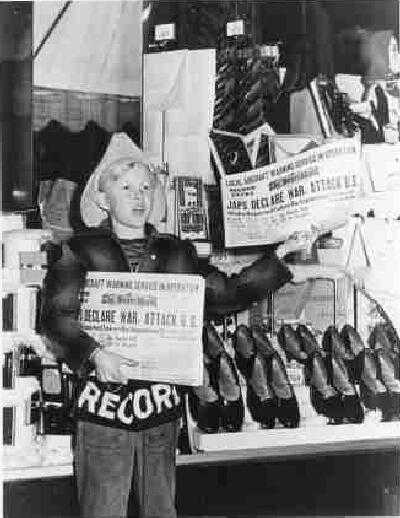
There has always been a strong isolationist streak in American political life. Americans separated by two great oceans resisted involvement in the war that broke out in Europe. NAZI and Japanese barbarities gradually and President Roosevelt's leadership gradually changed American sentiment. It was the surprise Japanese carrier attack on Pearl Harbor, however, that brought a suddenly united and outraged America into the War. The Japanese attack was a superbly executed military operation and one of the greatest blunders in world history. Neither Japan or Germany had any appreciation for the ability to wage war that American industry brought to the allied war effort. America became truly what President Roosevelt proclaimed, the Arsenal of Democracy in a miraxle of industrial production. Within a year of the Japanese attack, America was involved in offensive operations that began to change the tide of the War. America in the end rescued Europe not only from Fascism, but after the War from Communism as well. Most surprisingly of all was not only how the War changed America, but America's success in fundamentally changing the nature of German and Japanese society.
President Roosevelt was inagurated shirtly after Hitler rise to powe in Germany. And he was deeply duisturbed with rhe cgharacter of Hitler and the NAZis. And his view ionkly darkened as the NAZI regime created one ourrage afteranother. The Presiden's major concern, however, was the Deopressiin and effiorts to end it in America. Hitler used military spending as a way bto fight the Deoression. This was not a pimary policy usedvby President Roosevelt and the New Dealers. Many New Dealers were on the pacifust side of opublic policy. Here President Roosevelt was not anong those who saw World War I as a great mistake. Now while he was not able to launch a major rearmament program, he made important decesions. President Roosevelt of all the great World War II leaders interfered less with his military commanders than all the others. That said, he made a major decision in the 1930s that profoundly affected the outcome of the War. He understood that the world was a dangerous place and Japanese agressioin in the Far East and the arrival of Hitker on the workld stage was begconing more dangrous. The poicy Roosevelt adooted was to base American defense ion technolofy. This meant naval and airforces. Roosevel from the beginning was a navy man. He had been Assistance Sectrtary of State in World War I. He was, however, also interested in air power. The Presidentb in the face of a stronglyb isolationist envirment managed to launch a very imprtant peacetime naval rearmament that would mean that although not prepared for World War II, America was far better prepared than was the case in Workld War I. The Republican administrations after Workd War I motivated by both isolationism and austerity had cut military spebding to the bone, a policy receiving bipartisan support (1920s). This left the America military underresourced and incapable of defending America. The reduction in naval spending meant that shipyards were closing meaning that America was losing the capability of building ships even if it wanted to do so. And it was not just the shipyarsds, the comopanies and expertise that were needed fornaval construction (naval propulsion, engineering equipment, steel manufacturers, and others werre valso disappearing. 【Lindberg and Todd, pp. 214-15.】 Roosevelt's efforts were assisted led by Representative Carl Vinson. This a reversed a decade of neglect of the Navy and funding for a fledling air force. The Army for the most part continued to be neglected. Roosevelt managed to create a a balanced fleet, revitalized the American shipbuilding industry, and funded a fledging air force. By the time of Roosevelt's electiin, Naval commanders were increaingly thinking about air pwer and carriers. 【Allard, p. 37.】 President Roosevelt was commotted to American naval dominance. Only 2 months after his inagurati9on, the President unveiled plans for National Industrial Recovery Act -NIRA (May 193). NIRA included funding requetsv for naval construction. This amountd for $238 million fiorv the Nvy --seven times the previous annual budget. A baval histiruian calls this the rebirth of the U.S. Navy. 【Morrison, p. 20.】 This kled to the construction of aircraft carriers USS Yorktown (CV 5) and USS
Enterprise (CV 6). Followers of Pcific War battle know hiw imprtnt hose two ships were. here were also contracts for crusers, desrioyers and other ships. The Vinson-Trammell Act provided authorization, but nott appropriations, but it is sugnificasnt because it reversed 12 years of Americasn naval
retrenchment.
The Emergency Relief Appropriations Act (1935) provuded funding for construction on the
first 20 ships and 225 aircraft authorized in the Vinson-Trammell Act
Representative Vinson was key to the passage of the Vinson-Trammell Act (1934). This gavev the President permanent authority to build to treaty limits. Further constrution of crisers and another carrier, i>USS Wasp (CV 7) and additiionjl catt=ers followed. A major step was the Merchant Marine Act (1936^). This may not sound like nn important military step, but without a merchant marine, America had no way of applying its industrial power abroad.
The President did not aoporove fuirther nacakl expndin until Hitler and Stalin lunched world War II (1939). A factor here was the growing power of the Isolatuinists.
The U.S. Army Air Ciorps not only faced Congressuinlm limitations, but the bias of the rAmy commbders against air power. 【Jones】 Even as Congressional appropriations increased , the Army attempted to limit spending.
President Roosevelt was also interested in air power. And appropristions were invreased allowing the U.S, Army Air corps (USAAC) to develop new aircrafdt, the primary impact of this was the B-17 Flying Foortress.
The USAAC allocated $275,000 to Boeing to design and produce a four-engine bomber (1934).
Here the President acceed to his air commanders led by Hap Arnold, who used the increased, but still limuted spprpritiins to create a strategic boming force. 【Underwood】 Arnold led the commanders tht became known as the 'Bomber Boys'. The President took a serious interest in naval issues. With the air force, he rarely interfered and his primary interest was the number of planes produced. He left it up to Arnold and the Bomber boys to decide on tactics and planes. and early spurt to aircrftv produvtuins cane from he countries threatened bb the NAZIs. Spending invreased durung the Rooseveklt era, but it was only as war approcd did the paporoprituins become really suihnificant.
There has always been a strong isolationist streak in American political life. Americans separated by two great oceans have since the Revolution seen ourselves as different and apart from the rest of the World. From the beginning of the Republic, President Washington warned of entangling foreign alliances. For much of our history, Britain was seen as the great enemy of American democracy and of Manifest Destiny. World War I was America's first involvement in a European War and the United States played a critical role in winning that War. Had the Germany not insisted on unrestricted submarine warfare, in
effect an attack on American shipping, it is unlikely that America would have entered the War. Many Americans during the 1920s came to feel that America's entry into the War was a mistake. There was considerable talk of war profiteering. Many were determined that America should avoid war at any cost. This feeling was intensified with the Depression of the 1930s and the country's focus was on domestic issues. With the growing military might of a rearmed Germany, war talk in Europe began. Isolationist leaders opposed any war. Others such as, Charles Lindbergh, thought that America could not win a war against Germany's vaunted Luftwaffe. Many not only opposed American involvement, but even military expenditures. Against this backdrop, President Roosevelt who did see the dangers from the NAZIs and Japanese militarists, with political courage managed to not only support Britain in its hour of maximum peril, but with considerable political skill managed to push through Congress measures that would lay the ground work for turning American into the Arsenal of Democracy, producing a tidal wave of equipment and supplies, not only for the
American military, but for our Allies as well, in quantities that no one especially the Axis believed possible.
American diplomacy before and during World War II is commonly given short shift compared to the dramatic military campaigns of the War. The foreign policy if the United States was constrained by the fact that the great majority of the American people wanted no part of another world war. And as a result, the President in the presidentil election ran on a pledge, "We are not going to send your boys to fight in foreign wars." He usually added, "Unless we are attcked." Even so the Presidebt's foreign policy before Pearl Harbor largely assured the Allied victory before the first Japanese bombs fell on Pearl Harbor. This involved three major steps. First, the Administration steadfastly supported China and gradually increased that support from the purely diolmatic to material support. This so enraged the Japanese that it helped to swing the balance of power in Japan from the Strike North Faction to the Strike South Faction. Had the Japanese struck north at the Soviet Union to support their German ally, it is very likely the Soviet Uniion would have been defeated. Embargoing oil exports to Japan settled this issue and virtually guaranteed that Japan would strike south and seize the oil and other resources in the Southern Resource Zone. Second, President Roosevelt after Churchill became primeminister moved to form the Grand Alliance with Britain. This is arguably the most important and successful alliance in history. Third Lend Lease provided invaluable assistance to the countries fighting the Axis. Britain could not have continued the war without Lend Lease and it gave the Red Army the means to hotly persue the Whermacht in a series of offensives made possible by the victory at Kursk (July 1943). German diplomacy was primarily aimed at keeping the United States out if the war. Hitler wanted to complete his conquest of the Soviet Union before America entered the War. With the resources of the East, he believed that German dominance of the continent could not be challenged, even by the United States. The Japanese were primarily aimed at presenting a public image of seeking peace despite their aggressive actions. The Administration as a result of Magic was well aware of their true intentions.
Virtually unknown to the American people, President Roosevelt had launched an undeclared naval war in the North Atlantic against German U-boats. Americans were more engaged in saving Britain than the public knew. The United states was not just supplying material. There was an American pilot on the Catalina that found the Bismarck (March 1941). He was helping to train the British crew. As 1941 progressed, the U.S. Navy became more an more engaged escorting convoys. Eventually U.S. Navy destroyers were involved in a shooting war with the U-boats. They were of only marginal effectiveness, but they did complicate some U-boat attacks. Hitler was fully engaged in his invasion of the Soviet Union and wanted U-boat commanders to avoid conflict with U.S. ships. Commanders who fired torpedoes in self defense, however, were not punished. While Hitler did not want war with the United States at this stage, was furious with the American actions as well as with Lend Lease which sustained the British war effort. These were no doubt factors explaining his eventual declaration of war after Pearl Harbor.
The American Victory Program was a plan prepared by the American military as to what it would take for the United States to win the war in which it would soon be involved. President Rosevelt had decided that the United States should cooperate with Britain, already at war with Germany, and develop a joint strategic approach to defeating NAZI Germany, in the event America was drawn into the War. The President had not doubt that this would occur. Secret meetings between American and British representatives were held in Washington (January 29-March 29). Further contcts continued and Lend Lease aid to Britain began. And then the situation changed fundmentally when Hitler launchd the Panzers into the Soviet Union (June 1941). Subsequently the President ordered Secretary War Henry Stimson and Secretary of Navy Frank Knox to prepare a plan for the 'overall production requirements required to defeat our potential enemies' (July 9, 1941). Actually Secrtary Stimson was the motivating force as he wanted ckear instructions on what needed to be done. The first draft was submitted before America had actually entered the War. Army Chief of Staff Gen. Georce C. Marshall assigned Anglophobic Major Albert C. Wedemeyer, soon to rise in the Army hierachy, in the Pentagon War Plans Division the job of preparing the plan. It was to deal with how to organize the econony, the military, and the strategy to be adopted. This is something milataries, considering the probable contingencies, so that if war comes that they are prepared to act.
Wedemeyer nd his small staff prepared an amzingly detailed document, perhaps the most important document of World War II. Wedemeyer working around the clock nd produced a 147 page document which sketched the blueprint for industrial mobilization, a military build up, and plans to defeat not only Germany, but Japan as well. And central to the victory would be a strategic bombing campaign and cross-Channel invasion and drive into Germany's industrial heartland. Wedemeyer delivered his plan (September 25). The plan was a secret document. It was exposed by Roosevelt hating Chicago Tribune (December 4, 1941), just 3 days before the Japanese attack on Pearl Harbor. The plan was leaked to U.S. Senator and stident isolationist Burton Wheeler (Republican from Montana) who in turn gave it to the equally isolationist editor of the Chicago Tribune, Robert R. McCormick. The plan caused an uproar. The powerful isolationist movement seized upon it as evidence that President Roosevelt was intent on taking America to war. As it happened what could have been a najor controvery evaporated 3 days later when Japanese bombs fell on Pearl Harbor. Wedemeyer's initial plan was for a 14 million man military 215 manuuver combat divisions, bu this was based on his initil assessment thatthe Wehrmacht was going to largely destroy the Red Army. Eventually this was scaled back to 89 diviions. The rapid, draconian conversion of the economy was also scaled back. Simon Kuznets, Associate Director of the Bureau of Planning and Statistics, War Production Board successfully argued that ininital plans would disrupt the economy. Donald Marr Nelson (1888�1959) with Sears Roebuck took on the job of ovrseeing industrial mobilization. He served as director of priorities of the United States Office of Production Management--OPM (1941�42) and then chairman of the War Production Board (1942�44) when it replaced the OPM.
One aspect of Wedeneyer's Plan that did not change was the Anglo-Amrican commitment to Germny First. The major military change was shifting the cross-Channel invasion from 1943 to 1944. Here the major empetus was British reluctance to attempt the invasion until the Red Army had worn down the Germns in the East.
The Japanese destroyed the small, obsolete Chinese Air Force. Claire Chennault had failed in his effort to train Chinese pilots (1937-40). Madame Chiang sent him back to the United States to obtain American assistance. America was still isolationists, but attitudes were chnging. Japanese aggessions and cooperation with the Axis as well as occupation of French Indochina convinced the Roosevelt Adimistration that Japan would have to be confronted. President Roosevelt wanted to assist China. He saw China as a potentially ally to help curb Japanese expansion. The President hoped that American military assistance ptograms would enable the Allies to defeat the NAZIs and Japanese militarists. The policy became increasingly impractical after the fall of France (May 1940). The President after hearing from Chennault decided to help China build a modern air force. He signed an executive order 1940 which permitted U.S. military personnel to resign so that they could participate in a covert operation to support China (May 1940). He next approved the transfer of Curtiss P-40 Tomahawk fighters under the Lend Lease Program (1941). The planes were originally slated for the British RAF. The President also secretly approved the formation of the American Volunteer Group (AVG) to fly the P-40s. These were the first modern fighters ever deployed in China. The AVG's main task was to protect the Burma Road. The all-volunteer Group formed became known as Chennault's Flying Tigers. This covert operation provide the Chinese a creditable air capability for the first time. The Japanese attacked Pearl Harbor (December 1941) before the AVG could go into action.
The Japanese militarists having successfully taken on China (1894-95) and Russia (1904-05) and participating in World War I believed that in possession of a powerful fleet they could now enter World War II to complete their onquest of China
and expand their empire with the Southern Resource Zone. They thought that the rich, comfort loving Americans, distracted by the Germans in Europe would not have the will or capability of fighting a war in the Pacific. It was thus the stunning surprise Japanese carrier attack on Pearl Harbor that finally propelled America into World War II. On a bright Sunday morning, the six front-line carriers of the Imperial Navy launched 360 modern aircraft at Pearl Harbor, the base of the U.S.Pacific Fleet. Sleek Japanese carrier aircraft with a destinctive red circle thundered out of the sky just as the American sailors were waking up on a sleepy Sunday morning. They not only America, but the world for ever. While Pearl Harbor was a stunning tactical victory, it was a strategic blunder of incaluable proportions. It was a stunningly successful military success, brilliantly executed by the Japanese. Several hundred aircraft, most of Pearl's air defenses, were destroyed. Most on th ground. Eight battle ships, the heart of the American Pacific fleet, were sunk in additiin to thrre cruisrs and three destroyers. But by theslender thread of chance, the three American carriers, Yamanoto's principal objective, were not at Pearl. The Pearl Harbor attack was perhaps the greatest strtegic blunder in the history of warfare. The Japanese attack on the Pacific fleet instantly changed a diverse and quareling nation, strongly pacifistic into a single, united people with a burning desire to wage war and the vast industrial capacity with which to wage war with unprecedented intensity. The isolationism that President Roosevelt had struggled against for over 7 years instantly evaporated when the first Japanese bomb fell on Pearl Harbor. Even Lindburg asked for a commision to fight for the United States. America was finally at war.
When Hitler launched World War II by invading Poland (September 1939), most Americans were admently opposed to entering another war in Europe. Americans had come to believe it was a mistake to have entered World War I. President Roosevelt was hopeful that the British and French with material American support could defeat the Germans. The German defeat and occupation of France and the ensuing Blitz on Britain began a major reassessment in America. Gradually public opinion shifted and despite a vigorous national debate led by the Isolationists, American's came to support President Roosevelt's policy of national rearmament and support for Britain. At the time of Pearl Harbor, however, a majority of Americans still opposed entering the war. The public supported all support for Britain short of war. In the end, the national debate was settled by the Japanese militarists and Adolf Hitler. The decesion for war by Japan and Germany was radically different. The Japanese after more than a year of intense study had convinced thenselves that Americans were soft and would not fight. Few Japanese commanders had any knowledgeable about America and Admiral Yamamoto's misgivings were very rare within the military establishment. Crowds in Tokyo cheered the Pearl Harbor success. The reaction in Berlin was very different. Hitler was shocked by the failure of Barbarossa before Moscow. And President Roosevelt had been ahorn in his side sibce the War began. With the Wehrmacht falling back in Russia, in was the only aggressive step open to him. It would be the last major NAZI initiative. The War would be decided in 1942 and he would spend the rest of the War reacting to Allied moves. The German people received the bews very differently than the Japanese public. The Gernans had fought the Americans in World War I and were aware that American entry in the War had been the turning point. Only the most ardent NAZIs were enthusiastic with the news. And Hitler's announcement that he had declared war on America reached the German people at the same time as the news of the Red Army offensive before Moscow. Unlike the Japanese military, many German military commanders realized that Hitler's high stakes gamble had failed. Presidennt Roosevelt was shocked at the devestation suffered by the Pacific Fleet at Pearl Harbor. Inteligence reports had made in clear that the Japanese were preparing to strike, but Ameeican military commanders had not anticipated the blow would come at Pearl or that Japan had the military capacity to deliver such as powerful strike. Perhaps the most sanguine assessment was made in Britain by Primeminister Churchill.
The American military was virtuall non-existent, except for the U.S. Navy when Hitler launched World war II. Ut was so small that Hitler believed he could conquer Europe before America coukd create a sizeable Army and deploy it into the European theater. And he was in fact correct at the time. The U.S. Army was not only minisucle, but it was not armed with modern weapons. The United states did not even have a modern tank. The Japanese 2 years later made the same calculation. The Japanese somehow thought that their advantges achieved while their industry worked full time building military weaoons while American factories turned out cars and refrigerators would be unaffected once American entered the War. And many Japnese were convinced that America did not have the will to fight. Some like Admiral Yamamoto knew that the Jpanese advtage would be fleeting, but even American mikitary planners were astonished by the rate wuth which ameruca girded for War. Not only did the United States build a 12-million man military, but America became ib fact tge arsenal for democracy, equipping not only its own military, but that of its allies as well. Not only did the United States field a large army, but the Navy and Air Firces dwarfed the forces of its Axis adversaries. The Axis Alliance was designed to disuade the United States from waging a two-fromt war. As it worked out,it ws Germany nd Japan were bogged don in two-front ars. Most of the Japanese Army was committd in China and most of the vGermany Army was bogged down in the Soviet Union. While the United States looked in 1939 like a non-consequential military power, the rapid mobilization of manpower and speedy conversion of industry turned te United Srates into a formidable military powerhouse.
Britain and America during World War II formed the most important military alliance in the history of warfare. Never before had two countries so coordinated their industruial, scientific, and military operations to defeat a common enemy. There were important differences between the two nations Many World War II hidtories stress the common ties of language and culture that bound America and Britain and to often ignore the very real differences. The Alliance in fact was created out of mutual necesity. [Soybel] Differences between the two countries were resolved or put aside to achieve the overal objective--the unconditional surrender of NAZI Germany. America had the industry and resources to do that. The British at great cost had gained the expeience and the appreciation of NAZI strengths that America in 1942 still lacked. The Alliance was forned by the personal commitment of President Roosevelt and Primeminister Churchill. This personal relationship helped over come the very real differences between the two countries. The relationship began with aid to Britain, especially after the fall of France. A key factor in the Alliance was Lend Lease. Joint military planning began even before America entered the War and was based on agreement that the number one priority was the defeat of NAZI Germany. The Allied leaders met in a series of war conferences to make major decessions. The achievment of the alliance are very extensive and include victory in the North Atlantic, the key victory of the Western Allies. Specific achiievements of the Alliance are notable. The P-51 Mustang which broke the Luftwaffe was a marriage of an American air frame and a British engine. The very important code-breaking operation was an Anglo-American operation. Victory in the North Atlantic was an Anglo-Amerucan indertaking with an important Canaduian contribution. The British shared their scientific advances on radar abnd the United States devrloped the technology to mass produce radar sets. The D-Day invasion was a joint undertaking of brrsth tsking proportions. It succeeded in large measure because the British managed to delay it until 1944 and America provided the air power to drive the Luftwaffe out of France and the abundance of supplies needed to cross the Channel. The Manhattan Project creating the atomic bomb was another joint undertaking.
A glance at the map of the Pacific makes it clear that if Japan was to have an empire in Southeast Asia, it also needed the Philippines which sat astride the sea routes, Japan thus only a few hours after the attack on Pearl Harbor attacked the American forces in the Philippines. Bombers from Formosa (Taiwan) destroying most of the Air Corps planes on the ground at Clark Field, the center of American air power on the Philippines. Even though MacArthur had reports of the attack on Pearl Harbor several hours before the Japanese struck, no measure were taken to prepare for the Japanese attack. The Philippines was considered to be beyond the range of Japanese land-based air craft. As a result, the American and Philipino forces were able to offer little resistance to the Japanese invasion ar Lingayen Gulf to the north of Manila. MacArthur decided to base the defense of the Philippines on Bataan. He declared Manila and open city and concentrated his forces there. Tragically there was no time to transfer the needed supplies for his forces. The American and Philippino forces in Batan put up a valliant defense, but ran out of food and amunition. The devestated Pacific Fleet was unable to resupply them. Many military historians believe that the Japanese conquest of the Philippines was the most important American military defeat in American military history. President Roosevelt ordered MacArthur to Australia before General Wainright was forced to surrender. America soon learned of Japanese attrocities during the Bataan Death, further fueling American hatred of the Japanese.
Remarkable exercise in democracy occurred only a two months after Pearl Harbor. President Rooselvelt is remembered for his Fire Side Chats. They are primarily associated with the Depression and promoting the New Deal. They did not, however, end with the outbreak of the War. One of the most famous occurred shortly after Pearl Harbor. The timing was remarkable. It did not occur after a great American victory or offensive. It occurred at a bleak time of the War. The Allies were in the defensive everywhere. The Pacfic Fleet had been smashed at Pearl Harbor. The Japanese were achieving victory after victory in the Pacific. Singaporre had fallen and Batan was about to fall leading to the infamous Japanese Batan Death March. In the North Atlantic, U-boats were sinking Allied shipping. The Afrika Korps was on the move in North Africa. The German Wehrmacht was deep in the Soviet Union and preparing another huge offensive. Everywere the Allies were on the defensive and facing advancing Axis forces. The Axis powers did their best to hide negative war information from their peoples. Axis populations hearing nothing, but news of great victories were confused when they began to notice that the battles being fought were getting closer and closer. President Roosevelt took a different approach. He begab what has become to be known as 'The Map Speech' by informing the listeners, '... your government has unmistakble confidence in your ability to hear the worst without flinching or losing heart'. What followed was not only unprecedented, but no president has since laid out in greater detail a program of such complexity and perhaps most importingly with such honesty and absolute faith in the American people. That faith would be reciprocated. President Roosevelt asked American families to have a map to help follow what he was about to tell them, 'to follow with me the references I shall make to the world encircling battlefields of this war." In living rooms all over America, maps were spread out in front of the radio. The President took a rapt audiece through the battlelines and explained the Axis objectives. He noted centers of critical natural resources. At the end of the sppech, millions of Americans knew just where they and their country stood.
The news from the Pacific was an unrelenting series of disasters. America needed a victory. The only intact offensive force in the Pacific was Americais carriers. Army Air Corps pilot with B-25s trained for carrier take offs. The B-25 was a medium bomber never intended for carrier use. Carrier commander Afm. "Bull" Halsey led a taskforce made up of Hornet and Enterprise. It was a risky operation as it committed half of the Pacific fleet's carrier force to a very dangerous operation. The B-25s took off from Hornet. It was the first blow to the Japanese home islands. The raid was led by Lt. Col. Jimmy Doolittle. The physical damage was inconsequential, but the psychological impact was immense. Most of the Amrican aviators crash landed in China and were helped to reach saftey by Chinese Nationalist guerillas. The Japanese reprisals were savage. A estimated 0.5-0.7 million Chinese civilians were murdered. The Japanese Navy was so embarassed that they rushed forward Admiral Yamaoto's plans to bring the desimated American Pacific Fleet to battle at Midway Island.
President Roosevelt first used the term "Arsenal of Denocracy" on December 29, 1940 in one of his Fireside Chats, radio boradcasts, to the American people. He expalined the importance of supplying the people of Europe, at the time primarily Britain with the "implements of war". He said that the United States "must be the great arsenal of democracy". The very day he spoke, a Luftwaffe raid on London severly damaged famous buildings and churches in the city center and engulfed St. Paul's Cathedral in flames. [Gilbert, p. 356.] Hitler feared
America more than any other country, but was convinced that Britain could be defeated before America could be mobilized or American industry could be effevtiverly harnassed for the war effort. Neither the NAZIs or the
Japanese had any idea just how effectibely American production could be converted to war production. Air Marshall Goering sneared. "The Americans only know how to make razor blades." Four years later with the Luftwaffe in tatters, Goering said he knew that the War was lost when American P-51 Mustangs appeared over Berlin escoring waves of bombers. The record of American war production is staggering and in large measure determined the outcome of the War.
American children were not affected by World War II like children in Europe and Asia. The Atlantic and Pacicific Oceans acted as an affected barrier to the Germans and Japanese. Many American children lost their fathers, but unliked European children were not orphaned or displaced. American children, however, did particiapte in a variety of war-time activities to support the war effort. Children studied current events. Air raid drills and alerts were common. Both children and their families were involved with conservation and recycling of goods. The Scouts and other youth groups were actively involved in may home-front activities. Children often worked in sponsored rallies, parades and cultural events (such as dances) to raise money to buy war stamps and bonds to finance the war. Some children were more adversely affected by the war. Althiough not separated from their patents, Japanese Americans in Pacific coast states were interned in concentration camps. Italian and German families were also interned, but only those who parents were believed to have been involved in subversive activites.
The first important Allied effort to stop the Japanese sweep through the Pacific occurred in the Coral Sea. The Japanese planned to seize Port Moreseby, completing their conquest of New Guinea and a smaller operation in the Solomons at Tulagi. Port Moresby would have provided a launching pad for an invasion of Australia itself. (At the time, most of the Australian Army was in North Afric fighting Rommel's Afrika Korps.) The Japanese landing force was escorted by the front-line carriers Shokaku and Zuikaku. The Japanese naval task force en route to seize Port Moresby was intercepted by an American carrier force, alerted by American code breakers. It was the first carrirer to carrier engagement in history. The Japanese launched an attack on the Americans, but found only a destroyer and oiler. In the meantime the Americans sank the Japanese light carrier Shoho (May 7). The next day the two carrier forces fought a major engagement.
Midway proved to be the turning point of the Pacific War. It is notable because it was the only major Allied victory in whivh the opposing forces were superior. Admiral Yamamoto was determined to bring the American Pacific fleet to battle before America's industrial might could redress the strategic ballance. Yamamoto reasoned that Midway was an assett of such importance that Nimitz would have to commit his remaining assettscto defend it. The Japanese had many advantages. Unknon to them, however, surprise was not one of the advantages. The same American code breaking operation that had learned of the Port Moresby operatioin also warned Admiral Nimitz that the next target was Midway. Admiral Yamamoto was convinced that the remaining American carriers could be brought to battle and destroyed at Midway. The Japanese plans were based on achieving an element of curprise and on the fact that two American carriers had been destoyed in the Coral Sea, in fact the Yorktown, although heavily damaged had not been sunk. American code breakers had alerted the Ameicans to the Jaspanese plans. Admiral Nimitz positioned Enterprise and Hornet, along with the hastily patched up Yorktown northwest of Midway to ambush he Japanese.
The initial important naval battles were carrier battles. It was in the Solomon Islands that the U.S. Navy surface fleet first came to grips with the Imperial Navy. The Pacific Fleet with its battleships devestated at Pearl Harbor faced a far superior naval force. The Japanese after seizing the Dutch East Indies (Indonesia) took the Solomon Islands (mid-1942). Allied inteligence detected the construction of an airbase on Guadalcanal. This was a step of considerable importance as an airbase on Guadacanal would assist the Japanese in cutting off American troops and supplies fromn reaching Australia. Unlike the Americans, Japanese construction methods were slow, giving time for the Americans to prepare its first major offensive action of the Pacific War. The First Marine Division still training in New Zealand under Alexander Van der Grip dispatched in great secrecy. They reacged Guadalcnal undected by the Japanese. The Marines took Tulagi, a small island off Guadalcanal on Augut 7. They also landed on Guadalcanal and quickly seized the unfinished Japanese airfield, naning it Henderson Field after an aviator killed during the Battle of Midway.
British and Italin/Germany armies launches offensives which swung back and forth between Egypt and Libya. It looked like Rommel's Africa Corps might reach Suez in 1942, but the British stopped him at El Alemain. Here the two armies prepared for a dcisive battle. The Africa Corps supply lines crossed the Mediterranan where with the help of Ultra, the British destroyed large quantities of supplies. The British in turn had longer supply lines, but their new American allies delivered vast quantities of weapons and supplies. This enabled Montgomery's 8th Army to smash the Africa Corps (October 1942). This was followed by Operation Torch, Amercan and British landings in North Africa, driving east to link up with the Brish advancing west (November 1942). While generally given less attention than other campigns, the Anglo American offensive, joined by the French French played an important role in the Eastern Front. The Wehrmacht's strategic reserve had not yet been committed in November 1942. All rational calculations argued for it to be committed against the Soviets in the struggle over Stalingrad. Hitler instead used major components to hold Tunisia. The Luftwaffe was ordered to launch a massive operation to transport troops to Tunisia and support them. More than 1,000 Junkers transport planes were loss in the effort, planes and crews which could have been used to supply the 6th Army at Stalingrad. The Axis lost 200,000 soldiers at Stalingrad, but 250,000 in Tunisia--about Half Germans. These were losses of such magnitudes that the Germans could not replace them. [Atkinson] North Africa was also notable because the Anhlo-American military operation was worked out and the American army obtained its first combat experience.
Within weeks of Pear Harbor, American Air Force commanders began arriving in Britain to prepare for the creation and build up of the 8th Air Force. The 8th Air Force would not be fully operational until the end of the year. Britain had begun the strategic bombing campaign in 1940, but until the new Lancasters arrived in 1942 could not persue the campaign with any force. The Luftwaffe, fully committed in the Easternr Front and smaller Mediterranean front and without a heavy bomber force could not answer the British raids in force. The British launched a major night time campaign (April 1942) Churchill and Roosevelt issued the Cairo ditective authorizing the beginning of a around-the-clock bombing campaign (January 1943). The campaign proved costly for Allied air crews and achieved only limited results concerning the major goals of disrupting German war production and breaking civilian morale. The campaign, however, did largely drive the Luftwaffe out of forward French bases and back to Germany. It also helped to divert important resources from the Eastern Fronr. The effectiveness of the bombing campaihn changed makedly in 1944 with the arrival of long-range escorts, especially the P-51 Mustang.
The Allied invasion of Sicily, Operation Huskey, was the next step in the Mediterranean campaign after the Axis surrender in Tunisia. Control of sicily would mean Allied control of most of the Mediterranean. The Allies had two other goals. Sicily would provide critical bases for an invasion of Italy. An Allied invasion of Italy in turm would maintain pressure on Germany and force it to divert forces from the Atlantic Wall in France and the Eastern Front in Russia. The invasion was Operation Husky and involved risks. Unlike the Torch invasions, the Axis had strong forces on Sicily that could be expected to vigorous contest the landings. The landing flotilla had to brought from England exposing it to U-boats nd Luftwaffe attacks. The island was defended by the Italian 6th Army, with over 200,000 men, and two German divisions, the 15th an 90th Panzer Grenadiers. The Italians had performed poorly in North Africa. It was unclear how they would fight on actual Italian ground.
Marshall Bodaglio arrested Musollini (July 25). Bodgalio and the King tried to convince Hitler that they were committed to the War. Hitler did not belireve them for one minute and 12 divisions, despite the deteriorating conditions on the Eastern Front, were rushed south into Italy. With the Italian surrender, the Germans occupied Italy (September 1943). Several months of very diffifult fighting followed the Allied landinfs at Salerno. Kesserling very effectiently organized the German defenses. The Germans while in control of Rome seized more than 1,000 Jews who were deported to Auuschwitz. American intrcepts recently released reveal that Hitler himself overrode his local commanders on arresting the Jews. These intercepots also make it clear that Pope Pius XII's policy of silaence primarily stemed from a cponcern to protect the physical integrity of the Vatican. [Katz] Rome was liberated by the Americans on June 4, but the Allied failed to trap sizeable German units. The world's focus turned on July 6 to the coast of France and the D-Day invasion. The final NAZI defensive line in northern Italy, the Gothic Line in the Apennine Mountains was assaulted by the American 10th Mountain Division (February 1945). [Jenkins]
The next major American campaign was the Marianas and resulted in the Battle of the Phillipine Sea. The major islands were Tinian, Saipan, and Guam. The islands were taken by the Japanese 3 hours after Pearl Harbor (December 8, 1941). The Japanese built important defensive positions on the islands, including air fields. General Takashuina commanded a 19,000 man force. The Japanese planned an all-out naval counter attack in the Central Pacific called "Operation Z.� Vice Admiral Fukudome, Chief of Staff, carring the plan was in a plane crash over the southern Philippines. Filipino guerillas found the documents and relayed it to the Americans. The American offensive to take the islands was Operation Forager. The Marianas was the inner-ring of Japanese defenses. Unlike the earlier Gilbert and Marshall campaigns, the Japane Navy did sally out to oppose the invasions. Saipan and Tinian would bring the Japanese Home Islands within range of new B-29 bombers.
The invasion of Normandy, code named D-Day, was the single most important battle fought by the Western Allies in World War II. On the outcome of the battle hinged no less than the future of democracy and Western civilization in Europe. Failure at Normandy would have meant that the future of Europe would have been settled by the titantic struggle in the East between Hitler and Stalin, cerainly the two most evil men in European history. An invasion of France had been the primary goal of American military planners and President Roosevely since the entry of America into the War in December 1941. Churchill was less convinced. And largely at urging, the first joint Allied offensive was n the Meditteranean. The invasion was an enormous risk. All Allied victories in Europe were achieved by the weight of overwealing superority of men and material to badly over streached German forces. In France, the Allies faced some of the strongest units in the Gernany Army who would until several weeks into the battle be able to amass far superior forces. The Allies had to plan on naval and air superiority to protect the inital beach lodgements until powerful land forces could be landed and deployed. For over two years the Allies had been building a massive force in England which on June 6 was unleased on Hitler's Fortress Europe. The Allies struck withbthe largest armada ever assembled. First paratroop landings inland and then at after dawn came British, Canadian, and American landings on five Normandy beaches. It was a complete surprise, an incredible accomplishment for an operation of this size
The American capture of Cherbourg placed the first important French port in Allied control (June 27). While the Germans held in Normandy, a huge logistical enterprise was building up a huge army with emense capabilities. The Allies in the first 100 days after D-Day landed an incredible 2.2 million men, 450,000 vehicles, and 4 million tons of supplies. This was a force that the Germans could not begin to match and their situation was rendered untenable by the virtual complete lack of air support. The Allied offensive broke the badly streachedGermans in July. British and Canadian troops under Montgomery finally captured Caen (July 9). The major break through came further south. Patton's Third Army after a concentrated bombing pierced the German lines with armoured thrusts near St. L� and rapidly fanned out behind German lines. While American Sherman tanks were inferior to the German tanks, they were fastr and more numerous. Allied air power made it impossible for the Germans to contain the American offensive. German units were foirced to abandon their tanks and flee east. Efforts to surround an entire German army failed when SS units held an escape rour open at Falaise, allowing a substantial part of the Germany forces to escape. American airpower, however, wreked havoc on the retreating Germans. I The Americans landed another force on the French Mediterranean coast between Marseilles and Nice (August 15). The German hold on France was broken. The Paris Ressistance rose up against the German occupation forces as Allied armour divisions raced toward the capital and crossed the Seine. French Forces of the Interior (FFI)attacked Germans retreating through the city. Hitler ordered the city to be destroyed. The German commander refused to carry out the orders. Allied forces entred the city (August 25). The Allies pressed north into Belgium and liberated Brussels (September 2).
The Americans after liberating Paris pressed on north to Germany. The American First Army was the first to reach Germany. A few German cities were located west of the Rhine River. The First Army crossed the German frontier near Eupen, and American armored forces entered Germany north of Trier (September 12). German resistance stiffened as the Americans entered the Fatherland. As the Allied armies moved further from the coast supply lined becamne streached. German destruction of ports delayed taking advantag of fixed port facilities. The major geographic obstacle to entering Germany was the Rhine iver. Eisenhower acceeds to Montgomery's plan to seize the Rhine River bridge at Arnhem and cross the Rhine through the Netherlands. Available supplies were diverted toward this effort, Operation Markt Garden (September 17-26). The effort achieved some success, but failed at Arnhem. This allowed the Germans to stabilized their Western front as Winter approached. Meanwhile the American Seventh and the French First Armies moving up the Rhone Valley from southern France joined up with Patton's Third Army at Dijon (September 15). The supplies were, however, not available for a massive drive into Germany.
The Wehrmacht launched a carefully planned attack against weak Anerican ynits in the Ardennes (December 16, 1944). The offensive was commanded by Field Marshal Gerd von Rundstedt. The NAZI panzers stormed westward along a 60-mile front stretching from Saint Vith in Belgium south to Echternach in Luxembourg. The German goal was to break through the American lines, sweep through the Ardennes, and seize Antwerp. The port of Antwerp was essential to the Allied offensive. The major limiting factor to the Allie was supplies and the Allies were beginning to repair the Antwerp port facilities. With Antwerp the British and Canadians in northern Belgium could be cut off and encircled. The Allied thought the Wehrmacht was esentially defeated and incapable of mounting amajor offensive. The Germans were also careful to avoid sending messages bout the offensive electronically. Thus Ultra did not have a clear picture, although Allied commanders were given some warnings. The Germans forced the U.S. 28th Division to retreat from Wiltz (December 19). Eisenhower ordered the 101st Airborne Division to defend the vital crossroads town of Bastonge in Belgium. The German panzers pushed west. German Panther and Tiger tanks in many ways were superior to the American panzers, but they were slower and the Tigers could not cross many Belgian bridges, limited possible crossings. They also guzzled huge quantities of fuel and fuel ws the principal limiting facor to the Germand offensive. he German plans were contingent on capturing American fuel depots. When the German offensive began, George S. Patton's 3rd Army to the south was about to launch an invasion into the German Saar. In a brilliant movement, within 2 days, he turned the offensive on a 90� axis and struck northward into the German flank to relieve the 101st Airborne in Bastogne. The 3rd Army liberated Ettlebruck on Christmas Eve and broke through the German lines to relieve Bastogne (December 26). The U.S. 5th Armored Division conducted a surprise night crossing of the River Sure and liberated Diekirch (January 18, 1945). The Germans were pushed back to the positions they held at the start of the battle (January 28). The Whrmacht offensive in the Ardennes delayed the Allied offensive toward the Rhine by about 6 weeks. The llies i the campaign, however, destroyed virtually all of the Wehrmacht reserves and important panzer units as well as futher depleting the Luftwffe. This meant that the ability of the Germans to defend the Rhine and Berlin was significantly reduced.
Hitler with massive allied armies poised on the German eastern and western frontiers authorized Himler to form the Volkstrum (November 1944). Boys and old men were inducted to shore up Germany's crumbling defenses. The Soviets in the east gathered their forces for an all out attack on Berlin. The Western Allies by Februray 1945 had reducded the Bulge and solved their supply contraints. The Americans and British began to cross the Rhine, a firbidable challenge, but made easier by the capture of the Remagen Bridge in tact. The Allies rushed accross the Rhine and at many other sites where pontoon bridges were built. Within weeks the Ruhr, Germany's industrial heartland was surround and huge numbers of Germans soldiers surrendered in the Rugr pocket. Allied forces then began a race accross Germany toward the Russians pressing west.
The invasion of Okinawa was the first American attack on Japanese territitory. Okinawa, in the Ryukyu Island chain was strategically located between Kyushu, the southernmost Japanese island and Taiwan (called Formosa by the Japanese). American strategists saw Okinawa as a necessary base from which an American invasion of the Japanese home islands could be staged. Okinawa had several air bases and the only two important harbors between Formosa and Kyushu. The American invasion was code named Operation Iceberg. The greatest naval force in histoy was assembled for the invasion. Admiral Raymond A. Spruance's 5th fleet included more than 40 aircraft carriers, 18 battleships, 200 destroyers and hundreds of support ships. Over 182,000 troops participated in the invasion. The American invasion forced was surprised when the beach landings were unopposed. Okinawa was defendened by the 32nd Japanese Army and a garrison of about 110,000 men. The Japanes had drawn back from the onvssion beaches. The Japanese strategy was to bring as many ships as possible in close to the island to support the invasion. it was then that a major Kamakazi attack was unleased on the invasion fleet. The Japanese on April 6-7 employed the first massed formations of hundreds of kamikaze aircraft. The Japanese during the Okinawan campaign flew 1,465 kamikaze flights from Kyushu. They succeedd in sinking 30 American ships and damaged 164 others. Other ships were attacked nearer Kyushu and Formosa. The Army Air Corps had rejected a request to havily bomb these air fields as it was seen as a diversion from the strategic bombing campaign. One third of the invasion force was killed or wounded. Over half of the 16,000 Americans killed were sailors on the ships attacked by the Kamakazis. Virtually the entire Japanese garison died in the Okinawa campaign. Few Japanese soldiers surendered even after defeat was certain. Large number of civilans were also killed. The Jaoanese military reserved available food and supplies for its use and in many cases forced civilians to commit suicide. The American military saw Okinawa as a dress rehersal for an invasion of the Japanese Home Islands and anticipated even fiercer resistance. The extent of the casualties was a major factor in the American decission to use the atomic bombs.
The battle for Berlin fought in April 1945 was one of the most horific engagements of World War II. Stalin ordered the Red Army to take Berlin. After the Americans seized the Remagen Bridge and crossed the Rhine, Stalin ordered the time tble speeded up and at the same time lied to Eisenhowser that he was preparing to take the German capital. Losses on both the German and Russian side were enormous. Russian losses were in part due to the fact that Stalin had ordered that Berlin be seized bfore the Americans could reach it. Stalin's ordered resulted in a race to Berlin by Marshal Zukov and Koniev, both wanting the victor' laurels. It has always been wonderd why Stalin was so obsessed with Berlin and was willining to sacrifice so many Red Army soldiers to get to Berlin before the Americans. It has always been felt that it was primarily for the political value, to demonstrate the role of the Red Army in defeating the NAZIs. A British histoian argues that there was another important reason. Beria had learned of the American Manhattan Project to build an atomic bomb. Stalin as a rsult ordered a top secret Soviet atomic bomb project--Project Boradino. Located at Berlin was the Kaiser Wilhelm Institute, the center of the German atomic project. While the Germans were fa behind the Americans, the Russins obrained agreat deal of valuable information an 3 tons of uranium oxide. [Beavers] The Soviet conquest of Berlin proved to be a nightmare for the surviving women, almost all of whom were raped. It is estimated that 2 million German women were raped by Russians at the end of the War. Perhaps 0.2 million of those rapes took place in Berlin. The rapes included children, nuns, old ladies, and even Russian women brought to Germany to work as slave laborers. The Soviets denied the German civilian reports, but Soviet archieves leave no doubt as to what occurred. [Beavers]
The Germans already reeling from Soviet offenses collapsed less than a year after D-Day in May 1945. Before committing suiside, Hitler who was outraged by Himmler's and G�ring's attempts to become the second F�hrer, decided to appont the loyal Admiral Karl D�nitz to replace him. The two had bever discussed the possibility. After Hitler's suicide (April 30) Admiral D�nitz's took command (May 1). The appointment came as a complete surprise to Donitz. His primary concern was to buy time to allow as much of the Wehrmacht to surrender to the British and Americans pushing east. Doenitz and the German High Command were quite aware of what Germany had done in the East and were under no allusion as to the fate that awaitted them in Soviet hands. Finally Eisenhower set a deadline, threatening to stop accepting German surrenders. This forced the Germans to acceed to the terms of unconditional surrender set by President Roosevelt ar Casablanca (1943). D�nitz's regime was known as the Flensburg government as his headquarters was located there. The NAZI military surrender to the Western Allies was signed at General Eisenhower's headquarters in Reims, France (May 7).
Colonel General Alfred Jodl signed for Germany and Lieutenant General Walter Bedell Smith for the United States and Great Britain. General Eisenhower refused to attend the signing, vuiewing the Germabn military as war criminal. He appeared after the signing only to make sure the Germans understood the terns of the surrender. He refused to asknoledge the military salute of the Germans.
The Soviets required the Germans to repeat the surrender in Berlin, Germany (May 8). Field Marshall Keitel representing the German Highcommand (OKW) signed unconditional surrender terms at both venues. By this time the horrendous crimes of the NAZI regime had begiun to be revealed to an incredulous world.
News of the German surrender was immeiately broacast around the world resulting in celebrations in the major Allied countries.
Massive demonstrations spontaeously appeared in London. It was the British definance of Hitler that played a major role in his defeat. More than a million people flooded the streets of London to celbrate. There was a caenival amospher to the celebration which was celebrated by Londoners of all ages. The British still had to make do with rationing which in fact would last several more years even afer the War. But this was their day. The British people and Londoner in particular had eaned this day which was long in coming. The celebration took place in the very city that had defied Hirler's Blitz. Huge croeds appeared in Trafalgur Square and throungs crowded The Mall to Buckingham Palace. Here King George VI and Queen Elizabeth joined by Prime Minister Churchill appeared on the Palace balcony to the cheers of Londoners.
Churchill told the cheering crowds, "My dear friends, this is your hour. This is not victory of a party or of any class. It's a victory of the great British nation as a whole. We were the first, in this ancient island, to draw the sword against tyranny. After a while we were left all alone against the most tremendous military power that has been seen. We were all alone for a whole year. ..." Absent from the balcony were Princesses Elizabeth and Margaret. They managed to convince the King to allow them to join the cheering throng where they celebrated anonymously with the people of London. American reporter Edward R. Murrow broadcast from Piccadilly Circus just as he had broadcast to America during the Blitz.Joining in on the celebration were large numbers of American service personnel in London. A key part of the victory was the Anglo-American alliance--the most important militry alliance in history.
Joyous celebrations occurred in Paris with a parade up the Champs-Elys�es.
The VE celebrations in America lacked one great figure--President Roosevelt who had played such an important role in being about the Allied victory. President Roosevelt suffered a heart attack shortly before VE Day. President Truman in a radio address to the nation dedicated the victory to the memory of the former president. More raucous celebrations occured in major American cities, especially Chicago, Los Angeles, Miami, Philadelphia, San Francisco, and especially in New York City's Times Square.
The Soviets celebrated VE Day a day late on May 9 with a massive parade in Moscow. The Soviet people had paid a terrible price for the victory over the NAZIs. The celebration of that victory continues to be an almost religious event in modern Russia. Stalin was to ride a white stallion in the parade, but at the last minute decided against it because he was afraid of the horse. Marshall Zukkoc would ride the sallion, but Stalin never forgave him.
The air war in the Pacific began as in the European theater with mastery of the skies by the Japanese. The Chinese air force was vityually non-existant. The Japanese conducted terror bombing raid, first on Shanghai and then on other Chinese cities. Japanese aircraft, especially the Mitusubishi Zero, were so effective that they were able to achieve air superority during land and sea battles against Britain and the Unitd States beginning with the attack on Pear Harbor. This continued throughout much of 1942 and only did the arrival of ne American aircraft in large numbers did the Allies begin to gain the upperhand in the sky. The seizure of the Marianas and the deployment of of the new long range B-29 bombers brought the Japanese homeland within range of strategic bombardment. The initial raids wereinclonclusive. General Curtis LeMay devised a trategy of fire bombing which caused massive destruction in Japanese citis crammed with highly flameable wooden structures. When Japan refused to surender after the Yalta Conference, President Truman ordered the use of tha Atomic Bomb in August 1945. The Japanese surendered in September.
Over 0.4 million Americans were killed in World War II. Although an enormous number, it is a small fraction of the number of Soviets killed in the War. A substantial proportion of the Americans killed died in the last months of the War. This was because it was the last year of the War that the U.S. Army closed with both the Wehrmact and the Japanese Imperial Army. Many Americans died in the Battle of the Buldge which the Germans launched (December 1944). It along with the World WarI Meuse-Argon were the largest battles ever fought by the U.S. Army. There were also serious casualties on the Philippines and even more so Okinawa. Earlier the Americanshad attacked isolated and rather small Japanese island garrisons. On Okinawa the Army and Marines encountered a major, massively entrenched Japanese force. These escalating American casualties were one of many factors that went into the decession to use the atomic bomb.
The American Manhattan Program was the largest weapons development program in history. It was initiated by President Roosevelt when work done by German physicists led to concern that the NAZIs might build an atomic bomb. Important scientists in 1939 concluded that German scientists had begun to develop an atomic bomb for the NAZIs. These scientists enduced President Roosevelt to launch an American atomic bomb project. The project was, however, given serious attention only after the Japanese attack on Pearl Harbor bringing America into the war. General Leslie R. Groves (1896-1970), Deputy Chief of Construction of the U.S. Army Corps of Engineers, was assigned to oversee the project. The Manhattan Project us named after the New York borough where the first office headquarters was located and began June 1942. Groves had just completed another rush project, the construction of the Pentagon. He considered himself an astute judge of men and chose Robert J. Oppenheimer (1904-1967)to lead the scientific team. Oppenhimer was a respected, but reatively unknown theoretical physicist. Enrico Fermi and Leo Salard working in a converted squash court beneath the University of Chicago's carried out the first controlled nuclear reaction occurred confirming that nuclear fission could unleash huge amounts of energy. The major difficulty in building an atomic bomb was in obtaining the rquired quanity of fissionable material. A huge facility was built an Oak Ridge, Tennessee to separated the U-235 isotope needed for the bomb from the more common U-238 isotope. The Hanford Engineer Works was built in washington to produce plutonium. Groves chose Los Alamos, New Mexico as a location to acually develop and assemble the bomb or "gadget" a it was called. This ioslated town had by March 1943 been turned into a high-technology boomtown. The Y-12 Plant at Oak Ridge provided the bomb-grade U-235 used for the Little Boy bomb. The Harford plant provided the Plutonium used in the Fat Man bomb.
The success of the Soviet Army convinced even Imperial Army officers and the Ministry of war that defeat was inevitable. Emperor Hirohito on August 14 decided to surrender unconditionally. Even after the atomic bombs and the debacle in Manchuria, there were hardliners that were opposed to surrender. A group calling themselves the Young Tigers seized the Imperial Palace grounds and tried to prevent the Emperor's surrender broadcast. The attempted coup almost succeded. On what has become called "Japan's Longest Day" the attempted coup, bombing raid blackout, intrigues, killings, and sepukus determined fate of millions of Japanese people. It iwas a complicated series of events involving both great heroism and treason by officers convinced that they were behaving honorably. The Commander of the Eastern Army, however, remained loyal to the Emperor, dooming the coup. [PWRS] The formal surrender was held underneath the guns of the battleship USS Missouri in Tokyo Bay. Not knowing just what the Japanese were planning, the American carriers were standing at sea off Japan.
The United States deployed vast military forces aroound the globe. Unlike World war I it was not primrily one force to one theater. It was not only a much larger force, but one deployed on a much wider scale. The American military totled only 0.3 million men in 1939. This is one reason that Axis planners discounted it. And by the time that America entered the War had increased to only 1.8 poorky armed abnd inadequately trained men (December 1941). By the end iof the War, However, the American military consisted of nearly About 12.4 million superbly armed and trained Americans supported by an indudtrial base of imension proportions. [Peppers, p. 54.] The military included: the Army (8.3 million*), Navy (3.4 million), Marine Corps (0.5 million), Air Force ( ), and Coast Guard ( ) (1945). American units were deployed on every continent except Antartica. The largest number of men were deployd in Europe. Deployments in the Pacific were substantial, but Pacifi island combat, except for the Philippines and Okinwa were fought on a much smaller scale than European battlefields. American units were also deployed in Asia, the Middle East, Africa (mostly North Africa), and Latin America. Gettingbthem home woyld be an enormous logistical undertaking. For the most part once you entered the military you were in for the duration. The primary exception was the air crews participating in the strategic bombardment of Germany who could go home after 25 missions. Few of thecearly crews survived that long. After V-E Day (May 1945), the military prepared to ship units deployed in Europe to the Pacific. Only with the Japanese surrender (August 1945) could service people begin to think of coming home. The task of getting the millions of Americans deployed abroad was immense and complicated by the need to get to Japanese garrisons across the Pacific to accept their surrender and resuce Allied POWs and civilians interned by the Japanese. Not all of the men came home and American mikitary cenetaries dot the countries liberated by American firce of arms. Military authorities developed a system for getting the men and women home that survived the War. The wounded ahd POWs had the greatest priority. As points wereceaened for time in service. It was not untul well into 1946 that the vast American military force was repatriated. nd men had to be left in Germany and Japan for occupation duty. The first troop transports arriving in home ports often occssiined wild celebrations. But this some became a routine event. Coming home was an emotional experience for the men and their fmilies. Parents, sweethears, wives, and children all experienced emotional reunions. .
The last great action set in motion by the New Deal was the G.I. Bill of Rights which provided the financing for returning service men to obrain a college education. Before the War most American college graduates were the potestant descendents of the ealy American colonists. After the War. Americans with ancestries reflecting 19th century immigration (Irish, Italian. German, Polish, Scandinavian, and many other countries) began appearing in American universities--many with Catholic backgrounds. For the most partv they were first members of their family to enter college. Many of their parents had no completed their secondary education. This was to lead in fundamental changes in American society.
World War II changed peoples lives in a myriad of ways. The pattern varied from country to cuntry. In many of the major combatant countries, the coinsequences werehorebndous. This was not the case in America. Many Americans paid a terrible price. About 0.4 million Americans were killed and many others greviously wounded. For most Americans, hiwever, the War brought new experiences and opportunities. The war finally ended the Depression. Employment opportunities expanded dramatically, including opportunities for blacks and other minorities that had been previously been unable to obtain good paying jobs. And opportunities for women also opened up which would in part lay the fondation for the post-War woman's movement. Americans who had never traveled much beyond their immediate neigboirhood were all of the sudden involved in military operations in virtually every corner of the world. Than after the War, American of all classes through the G.I. Bill obtained access to higher education. The experiences of blacks in the armed frces and in defense industries played a role in the developing civil rights movement as did the reaction to NAZI racism. And adding to the diversity of American society were the war brides that arrived with the returning soldier.
Atkinson, Rick. The Army at Dawn: The War in North Africa, 1942-43 (Henry Holt, 2002), 681p.
Beavers, Anthony.
Davidson, Eugene. The Unmaking of Adolf Hitler (Univesity of Missouri: Columbia, 1996), 519p.
Domarus, Max. Hitler Reden und Proklamationen 1932-45 Vo. 1-2 (Neustadt a.d. Aisch: Velagsdruckerei Schmidt, 1962-63).
Fest, Joachim C. Hitler (Vintage Books: New York, 1974), 844p.
Freidel, Frank. Franklin D. Roosevelt: Rendezuous with Destiny (Little Brown: Boston, 1990), 710p.
Jenkins, McKay. The Last Ridge: The Epic Story of the U.S. Army's 10th Mountain Division and te assault on Hitler's Europe (Random House, 2003).
Katz, Robert. The Battle for Rome: The Germans, The Allies, the Partisans, and the Pope, September 1943-June 1944 (Simon & Schuster, 2003).
Peppers Jr., Jerome G.. History of United States Military Logistics, 1935-1985.
* The Army figure includes the Air Force (Army Air Corps) which organizatiinall was aart of the Army, but in fact acted as a separate service.

Navigate the CIH World War II Section:
[Return to Main World War II European campaign page]
[Return to Main World War II country page]
[Biographies]
[Campaigns]
[Children]
[Countries]
[Deciding factors]
[Diplomacy]
[Geo-political crisis]
[Economics]
[Home front]
[Intelligence]
[POWs]
[Resistance]
[Race]
[Refugees]
[Technology]
[Totalitarian powers]
[Bibliographies]
[Contributions]
[FAQs]
[Images]
[Links]
[Registration]
[Tools]
[Return to Main World War II page]
[Return to Main war essay page]