|
Some of the last Jews to get out of Germany were the children brought out through the Kindertransport. This was the transport of Jewish children out of Austria, Czecheslovakia, and Germany. The British Government, horrified at the outburst of violence in Kristallnacht agreed to eased immigration restrictions for certain
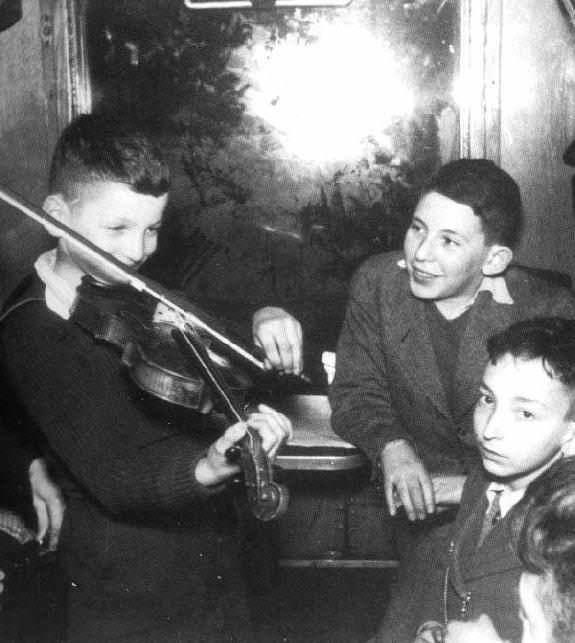
of Jewish refugees. Two charitable groups help organize the program: the British Committee for the Jews of Germany and the Movement for the Care of Children from Germany. Together these groups persuaded the British government to permit children under the age of 17 to enter Britain from Germany and German-occupied territories (at the time what used to be Austria and Czecheslovakia). The limit on the number of children was that private citizens or organizations had to guarantee to pay for each child's care and education. The British Government refused to accept any financial responsibility. The Government also insisted that the children would have to eventually emigrate from Britain. Not the most hostpitable conditions, but at least they were out of Germany. The Government agreed to permit the unaccompanied children to enter on a simple travel visa. Parents or guardians were not permitted to accompany the children. There were also a few infants cared for by the older children. About 10,000 children were saved--the largest group of children to be saved from the NAZIs. Most were aided by Jewish charitable organizations, but Quakers and other groups also helped. The experience was traumatic for the children, especially the younger ones, who did not understand why they were being separated from their parents. The children had to say a final goodbye to their parents and families for a long train journey to England and numerous checks by NAZI authorities. Most were never reunited with their families who were murdered in the NAZI death camps. The older children were put up on hostels, many of the younger children were adopted.
The first European Jews to be victimized by the NAZIs were the German Jews. Hitler and the NAZI's first approach to what they termed "the Jewish question" was to drive then out
of Germany, first stealing their possessions. A steady stream of harsh, discriminatory laws, assaults by SA Stormtroopers, random arressts and murders were designed to isolate Germa
Jews, steal their property, and hound then out of the country. Many Jews did leave. Many more would have, but had trouble finding countries willing to accept impoverishd
immigrants. The NAZIs had planned forced expulsions, but this was complicated again by the unwillingness of other countrie to accept German Jews. Some of the last Jews to get out of Germany were the children brought out through the Kindertransport. This was the transport of Jewish children out of Austria, Czecheslovakia, and Germany, amy during the summer of 1939 before the War broke out.
Kristallnacht or the "Night of Broken Glass" was a vicious NAZI pogrom directed at NAZI Jews. A Polish-born Jewish Jew, Sendel Grynszpan, wrote to his soon describing how he had been expelled to Poland and mistreated. His son Herschel was a 17-yearold boy studying in Paris. Disdraught by his parents' treatment, he shot the Third Secretary of the German Embassy, Ernst vom Rath. As a reprisal, Hitler personally approved a massive assault on Germany's Jews in their homes and attacks on Jewish stnagoges. The attacks began eary on November 10. Members of the Gestapo and other NAZI organizations such as the SA and the Labor Front were told to repprt to the local NAZI Party office and were given their instructions. They then moved out ramsacking Jewish shops and synagoges and setting firm to
them. Groups of NAZIs broke into Jewish homes, looting them and destroying property that they did not want. Pets were killed. About 100 Jews were killed. About 20,000 mostly men were dragged off to the Buchenwald, Dachu, and Sachsenhausen concentration camps. The orgy of violence exceed even what the NAZIs had planned. This was of concern because the NAZIs hoped to eventually seize the property. The Jews were thus required to repair the danage to their shops and homes. When the NAZIs realized that Jewish property was insured, Goering issued a decree requiring that insurance payments made to the German Government. An additional 1 billion mark fine was imposed on Germany Jewish community.
There were organizers both in Germany and in Britain. We know more about the British groups.
A reader with whom we have been discusing the Holocaust points out, "I must tell you that these were not organized by the British Government. They were organized and paid for by Jewish committees. I have to tell you this because I do refute your statements about Britain helping Jews. By 1938, the only country in the world to accept Jewish refugees was South Africa. Britain had no option but to accept the Kinder Transports - how could the public know that their government was allowing children to die? - and, as I mentioned on Quora, they accepted those Jews whom they considered the 'elite' - academics - but they too were sponsored by families (such as the Attenborough family), and not supported in any way by the government. Whether academics are necessarily the 'elite' of any society is a moot point." We think our readr is correct when assessing the adult Jews given refuge in Bitain. As far as the Kinder Transport chldren were involved, our understanding is that they were selected by the committess set up in Germany, Austria, and Czechoslovakia.
The transport and care of large numbers of children accross international boundaries was not an easy task.
The children had to be found, parental permission paid, exit visa obtained, funding, finding individuals and groups willing to sponsor the children, keeping track of the children, and other matters had to be sorted out by volunteers. David Cohen, Norman Bentwich, Gertruida Wejsmuller- Mejer, Lola-Hahn Warburg were major figures. Different charitable groups helped organize the program: the Inter-Aid Committee for Children from Germany, the Quaker, Rabbi Schoenfeld & other groups increased their activity. There were several reorganizations of the volunteer effort. The two major groups were the British Committee for the Jews of Germany and the Movement for the Care of Children from Germany. The comprised the Refugee Children's Movement (RCM). These groups persuaded the British government to permit children under the age of 17 to enter Britain from Germany and German-occupied territories (at the time what used to be Austria and Czechoslovakia). They sent representatives to Germany and Austria to organize the selection and transport procedures. The RCM in Britain broadcast a radio appeal on the BBC for foster homes. The boradcast immediately produced 500 offers. The RCM set about making visits to determine suitability.
Quakers played critical roles in both estblishinging the Kindertramjnsport and in the operation. This included Quakers in both Britain nd Germasny. German Quakers helped make the arrangements in Germany and accomopanied the children on the trains they accompanied children onto the trains and through the transit of the Reich. They did what the could when officious NAZI officials harrased the children in various ways. They even ensured that the children boarded the right ferries. In Britain they played a major role along with Jewish groups in persuading the Government to relax immigration requirements so that the children would be allowed to enter Britain. And once the program started up, British Quakers worked as volunteers to run the program. British Quakerts also hosted children. They helped finf homes and later helped secure jobs. Quaker meeting houses (churches) made theur facilities open to accommodate the children. Quaker schools took in children and waived the fees. Some of the parents at the schools contributed to help fund additiional places for the Kindertransport children.
The children were mostly selected by the emigration departments of Jewish central organizations in Germany and Austria. We do not know on what basis the selctiins here were made or even the number of children that parents attempted to enroll in the program/. As far as we know, the NAZIs did not interfere, but we do not have a lot of information on this. We believe that NAZI authorities did deny exit permits for a few of the children selected. We do not know on what basis this was done. The names were then forward to the RCM to obtain British approval. As far as we know British approval was pro forma. We do not know of any children refused entry. The Wehrmacht seized Czechoslovakia (March 1939). The RCM hastily organized Kindertransport groups in Prague. The selection process there was thus different. Bill Barazetti and Miss Warminer, ocersaw the Czech Kindertransport rescue operation from a Prague hotel room, Some Polish groups were organized (February and August 1939). We are not sure about the selection process there.
The limit on the number of children was that private citizens or organizations had to guarantee to pay for each child's care and education. The British Government refused to accept any financial responsibility. The Government also insisted that the children would have to eventually emigrate from Britain. Not the most hostpitable conditions, but at least they were out of Germany. The Government agreed to permit the unaccompanied children to enter on a simple travel visa.
Parents or guardians were not permitted to accompany the children, only children under age 17. Sending young childrn into the unknown must have been a terrible renching experience for the parents. In many cases the fathers were still encrcerated by the NAIs following Kritallnacht. There were also a few infants cared for by the older children. The children were often dispatched on very short notice. There were very difficult goodbyes at train stations in Germany, Austria, and occupied Czecheslovakia. Many of the children never saw their parents and siblings too old for the Kindertransport again.
France and the Netherlands had allowed larger numbers of Jews and others fleeing NAZI persecultion to enter the country. The British since the NAZI seizure of power (1933) had allowed very few Jewish refugees to enter the country. As a result, the Kindertransport was primarily a British operation. The vast proprtion of the children were taken in by Britain. The Dutch and French authorities were concerned aboyt dealing with the Jewish refugees already in the country. And bordering Germany, many Jews crossed the birder illegally. A small number of Jews were also taken in by Sweden as part of the Kinderstransport.
Kristalnacht coming only 2 months after the British abandoned Czechoslovakia at the Munich Conference (September 1938) shocked the British people. British Jewish leaders first approached Prime Minister Neville Chamberlain (November 15, 1938). Another delegation of Jewish and non-Jewish groups met with Home Secretary Sir Samuel Hoare. The delegation represented a non-denominational organisation called the Movement for the Care of Children from Germany. The British Government, horrified at the outburst of violence in Kristallnacht agreed to ease immigration restrictions for Jewish children. The British were not prepared to allow any number of adults into the country, but an exception was made for children. This was not an official British Government program, but the government did allow private groups to conduct it. Government cooperation was needed to allow the children into Britin. All the work and expenses was done by private groups which had to guarantee that the children would be cared for and not become wards of the state. The British Governenent at the same time concerned about the security of the Suez Canal issued a White Paper, drastically cutting back and restricting immigration to Palestine to apease the Arabs (May 1939). [Goepfert, p.48.]
Sweden before World War II had veryrestrictive immigration rules. Very few Germn Jews as the NAZIs amped up the percecution of Jews were able to find refuge in Sweden. This not change until Kristalnacht (November 1938) and the Swedes began to reassess their Jewish immigration policies. Some of the first beneficiaries of this reassessment was children that escaped Germaby through the Kinderstransport. The Heilmann sisters were two examples. A reader writes, "I am searching for an information about the kindertransport to Sweden from Germany in 1938. How many children? who arranged it? Are there some names?" HBC at this time has no information about Jewish children accepted by the Sweedes. We would be interested in any information that readers may have. A Kindertraport evacuee writes, "I was on that last transport to Sweden and understand that the children had to be very young, six years and under to be sent to foster homes arranged by the Pentecostal church of Sweden. I lived with such family for five years...arriving late summer 1939 - 1944 then shipped to a jewish orphanage in southern Sweden and fina,lly to a Jewish foster home in Stockholm and last, shipped to aniother foster home in the U.S. Very little information is available about this last transport." [Karger]
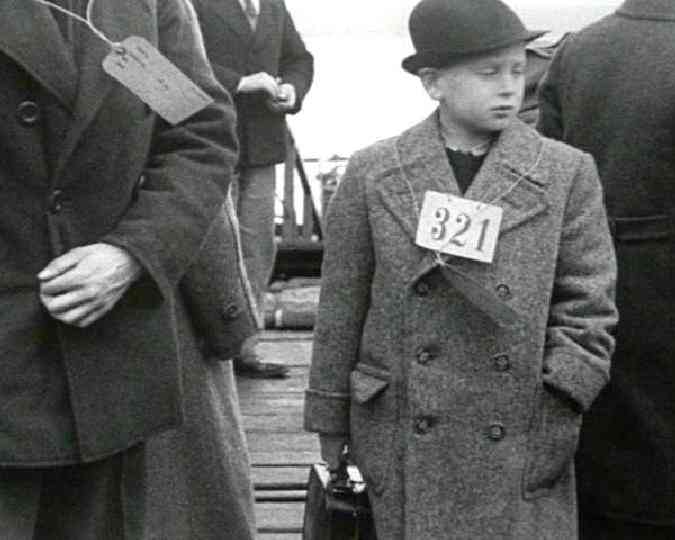
NAZI authorities made the process of leaving their families and traveling through the Reich needlessly cruel and terrifying. The children had to say a final goodbye to their parents and families for a long train journey to England and numerous harrowing checks by NAZI authorities. Some parents said goodbye to the children at train stations, often away from the general public. In some cities, parents were not even allowed to say goodbye at the train stations so as to avoid any public spectacle. The trains with the children were sealed. Each child had to wear an identification tag with a number which was carefylly checked by the NAZI authorities. The whole experience was traumatic for the children, especially the younger ones, who did not understand why they were being separated from their parents. Some of the older children tried to comfor the yonger children. Often some children were taken off the trains by NAZI officials for various reasons. The trains went from various cities within the Reich and occupied territories to the Netherlands. Apparently NAZI officials decided that they did not want their ports "sullied". Their very limited luggage was virtually torn apart by officials convinced they would find valuables being smuggled out. The atmosphere changed dramatically when the train crossed the Dutch frobntier. Once the trains reached the Netherlands, the children were greeted with open arms by Dutch women. Often Dutch mothers were waiting for them with hot chocolate and sandwiches. Dutch officials did not believe they could accept any of the children because they had already taken in so many refugees. In the end, this decession saved the lives of many of these children as the Netherlands proved a death trap for Jews after the NAZI invasion (1940). The Dutch Holocaust was once of the worst in Europe. Some of the Kinfertransport groups were also routed through Belgium.
|
The RCM was set up in Bloomsberry House and did their best to keep track and assist the children.
The first ferries with the Kindertransport children reached Harwich, England (December 2, 1938), Each group was about 200 children, although this varied. As the Kindertrasport progressed, about two groups of children per week landed. This picked up (June and July 1939). Groups began landing daily.
The last Kindertransport group left Germany (September 1), the day the Wehrmacht invaded Poland. This ended most of the Kindertransports. There was, however, one last group. A ship managed to make it out of the Netherlands (May 14, 1940). This was the day that the Dutch army surrendered to NAZI Germany. The RCM met the ferries when the children arrived. Each child had a numbered tag. This was his or her number in the group they were with. They found a variety of accommodation for the children. The children with prearranged sponsors were sent immediately on to London. The many unsponsored children were sent to Dovercourt and other transient camps until permanent arrangements could be made. The children were eventually dispersed throughout England, Wales, Scotland and Northern Ireland. They were taken in by Jewish and non-Jewish families. They were both billeted and fostered. Others were placed in orphanages, group homes, and other institutions. Soon the children appeared in schools throughout the country, most speaking very little English.
We are not precisely sure how schooling was handled. We believe that it was largely up to the host family. Many of the children were enrolled in British state primary schools. We do not know if the religuius schools (Church of England or Catholic) made any effort to help these children. Some of the more affluent families sent the children to private schools.We know of one host family that sent two boys to a prep school. This was the experience of the younger children. We believe almost all of them went to one kind of a school or another. The schooling of the older children was more complicated. Most British youngers in 1938-39 did not go to school past primary school (age 14). The Kindertransport included German youth 14-16 years of age. Many of these children at the time had been expelled from German schools, but were attending special Jewisgh schools that had been set up. We are not sure to what extent they were allowed to attend Britisj grammar schools (selective secondary schools). As most had only limited English-languafe schools this may have been difficult. Of course some of the younger children attending primary school may have after eventually qualified for grammar school placement by douing well on their 11+ exams.
About 10,000 children were saved--the largest group of children to be saved from the NAZIs. There had been optimistic hopes of saving 50,000 children, but the War intervened cutting off the Kindertransport escape route. Hitler as the war approached made it clear what his plans were for the Jews. He told the Reichstag, "In the course of my life I have very often been a prophet, and have usually been ridiculed for it. During the time of my struggle for power it was in the first instance only the Jewish race that received my prophecies with laughter when I said that I would one day take over the leadership of the State, and with it that of the whole nation, and that I would then among other things settle the Jewish problem. Their laughter was uproarious, but I think that for some time now they have been laughing on the other side of their face. Today I will once more be a prophet: if the international Jewish financiers in and outside Europe should succeed in plunging the nations once more into a world war, then the result will not be the Bolshevizing of the earth, and thus the victory of Jewry, but the annihilation of the Jewish race in Europe!" Hitler, January 30, 1939]
The final stage of the Holocaust began with World War II. Hitler did not immediately move against the Reuch Jews, but gradually new restrictions were enforced and ultimately they were required to wear yellow star of David badges. At about the same time, transports to the East began. Some went to the ghettoes established, mostly in Poland. Others went directly to the death camps. The children were the most vulnerable and the first along with the infirm and elderly to be selected for death.
Most were aided by Jewish charitable organizations, but Quakers and other groups also helped. The older children were put up on hostels, many of the younger children were adopted. The youths over 16 were interned as Enemy Aliens. This totaled about 1,000 youths. Around 400 were transported overseas to Canada and Australia, a somewhat perilous trip through U-boat infested waters. When this was publicized in the press, the internees were finally released and some of the deportees returned. Employment opportunities were very limited, mostly agriculture and domestic service. Youth-Aliyah and Hechalutz opened several training farms. Some of the children placed with Christian families converted. Some of the older boys joined the military. Some of the children adusted easily and were happy in their new envirinment. Others had a difficult time adjusting and required considerable assistance. Our general assessment is that like the subsequent evacuation from the cities when the War began, that most of the evacuees did well, but missed their parents terribly. Being from a different country of course magnified the problems. But the older children had undoubtedly had unpleasant experiences, especially at school and were thus relieved to be out of Germany. The younger children did not really understand what was happening to them. While most of the children got on as well as could be expected. Some children had difficulties. A reader writes, "I met someone who had been part of the Kindertransport to Great Britain when I was visiting my mother in Florida. Apparently some of the children were treated badly. Some were treated as maids and servants. I suspect the numbers were small because not much was written about it, but this was was surprising to hear. This person said many were taken in by Jewish families. And some families treated the children poorly." There were few family reunions after the War. Most of the children were never reunited with their families who were murdered in the NAZI death camps. [Goepfert]
Although not part of the Kindertransport proper, an indomitable Dutch woman, Geertruida Wijsmuller managed in the middle of the German invasion to get six bus loads of mostly German Jewish children to the port of Ijmuiden and on board a boat. They left the Netherlands on one of the last ships before the Dutch capitulated. One of the boys, Harry Jacobi, wrote, "At 10 to 8 in the evening we sailed away. A 9 pm news came through, picked up by the ship's radio. The Dutch had capitulated. My last impression of Holland were gigantic clouds of black smoke from the burning shell oil refinery, which the Dutch had ignited so as not to let them fall in the hands of the enemy." [Gilbert, p. 305.] This was a life and death matter. The Netherlands proved to be one of the most deadly place in Europe for Jews. Few Dutch Jews survived the Holocaust in the Netherlands.
We have begun collecting Kindertrasport experiences. The Kindertrasport experiences are as diverse as the children involved. We have ome details on a few of the children involved. The only common bond was that they were children and after Kritalnacht, it was clear that their lives were in danger. Most of the children came from Germany, but as Hitler was rapidly expanding the borders of the Reich, there were also children from what had been Austria and Czechoslovakia. Very few would have survived, had they not been chosen or the Holocaust. Most lost their parents and other family members. One often unmentioned aspect was that their parents without the need to care for younger children had a better change of escaping Germany and the NAZIs.
Perhaps the best documentary on the Kindertransport is "In the Arms of Strangers". It was released in 2000. It presents a tremendous archive of film and personal interviews describing the Kindertransport. There are scenes of the children in Germany, on the trains, and in the schools and homes in Britain. The interviews bring the temper of the times chillingly alive. The live of German Jews is depicted befor Hitler seized power. One woman rcounts that immediately following the NAZI takeover she had her birthday. Her mother always lovingly prpared party. Not one of the girls she had looked at as friends came. That was the first inkling as a very young girl that something was going wrong. The interviews describe how the childrn were tormented and asaulted in German schools before being expelled. One interviewer recounts how school mates through him through a plateglass window. Understandably he no longer wanted to go back to chool. Then there was the terror of Kristallnacht. Parting at train stations are described in details. Embarassed NAZIs scheduled the trains at night to reduce public views at the partings. The train trips and the tormnents of oficicious NAZIs along the way and at the border. The atmoshere changed when the trains crossed the Dutch border. There Dutch mothers were waiting with sandwiches and hot choclate. The varying experiences in England are also described. A very effective presentation. What is missing in this anbd other Holocaust films is interviews with the NAZIs. In this case interviews wih Hitler Youth classmates woul have added to our understanding. Such interviews of course, especially truthful interview, are no doubt difficult to obtain in Germany.
A British group is planning a Holocaust exhibition specially designed for primary school children in Nottinghamshire (2008). "The Journey" exhibition at the Holocaust Centre in Laxton is being funded by Heritage Lottery Fund and the Association of Jewish Refugees. It is scheduled to open in September 2008 and is thought to be nationally the first permanent Holocaust exhibition aimed at such a young age group. Centre spokesman David Brown explains that it focuses on the Jewish children who managed to escape. "It is a very emotional and upsetting subject and for young children obviously we won't be approaching this by trying for example to talk about the gas chambers or the full horrors of the Final Solution. But rather the idea is to take them on a journey, the experience of the children who were able to flee Nazi Germany as part of the Kindertransport." [BBC News]
A depressing subject. It is still hard to believe that such a thing happened. It makes you wonder at the depravity of the human race.
BBC News, "Holocaust Exhibition for Children," (May 24, 2008).
David, Rurh. A Child of Our Time: A Young Girl's Flight from the Holocaust (I.B. Tauris, 2003), 170p.
Gilbert, Martin. A History of the Twentieth Century Vol. 2 1933-54 (William Morrow and Company, Inc.: New York, 1998), 1050p.
Goepfert, Rebekka. (Der Juedische Kindertransport von Deutschland nach England 1938/39 Geschichte & Erinnerung (The Jewish Children Transport from Germany to England 1938/39 History and Memory).
Golabek, Mona, and Lee Cohen. The Children of Willesden Lane. Beyond the Kindertransport: A Memoir of Music, Love and Survival (Warner), 272p.
Hitler, Adolf. Speech to the Reichstag, September 30, 1939.
Karger, Gunther. E-mail message, September 8, 2009.
Novitz, Sheila. E-mail mesage, April 5, 2014.
Simpson, Max. E-mail message, October 3, 2008.

Navigate the CIH Holocaust Section:
[Return to Main Holocaust immigration page]
[Return to German holocaust page]
[Return to Main Holocaust page]
[Return to Main World War II page]
[Allies]
[Biographies]
[Children]
[Concentration camps]
[Countries]
[Decision]
[Denyers/Apologists]
[Displaced persons]
[Economics]
[Eisatzgruppen]
[German Jews]
[Ghettoes]
[Impact]
[Justice]
[Literature]
[Movies]
[NAZIs]
[Occupied Poland]
[Process]
[Propagada]
[Resistance]
[Restitution]
[Questions]
[SS]
[Special situations]
[Targets]
[Wansee Conference]
[World War II]
[Main mass killing page]
[Return to CIH Home page]