The Holocaust in Germany: Knowledge and Complicity
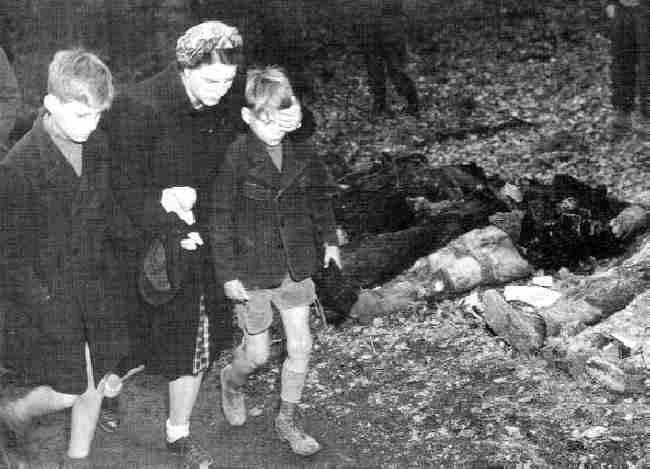
Figure 1.--Allied trrops arriving in Germany at the end of World War II found evidence of the most apauling cruelty and mass murder both inside and outside concentration camps. They often forced civilians to look at what had been done in their country's name so that the Germnans could not clame that it never occurred. Here officers of the U.S. 9th Army ordered German civilians to view 57 Russian men and a baby that had been executed by the SS. The mother shields the gaze of her younger son.
The question of how much the average German knew about the Holocaust and to what extent they were complicit in it is a much debated topic. It is one that few Germans have wanted to discuss. An American historian, Daniel Goldhagen has raised the issue and maintains that there was wide knowledge and that a kind of willing complicity. His books speaking engagements have attracted considerable interest, but many Germans are deeply resentful at him for raising the issue. There are some obvious facts. Most of the actual killing was done in Poland, the Soviet Union, and other Eastern European countries. In Poland where the death camps were located, most of the killing was done behind barbed wire where
the SS carried out the murders without public scrutiny. Many of the Jews that arrived had no idea as to the fate that awaited them. Others while they did not know the details had few illusions about the NAZIs. NAZI controlled media in Germany never published accounts of the killings. Even the Allied propaganda did not provide details on the Holocaust and what claims were mentioned were dismissed by many Germans as war propaganda. (The Allies, especially the British, had during World War I fabricated many lurid accounts of German atrocities, specially in Belgium.) While all this is true. There are other clear facts suggesting that many Germans knew. Public statements by Hitler, Goebbels, and other NAZIs while not specific made it very clear as to the regimes plans for the Jews. The NAZI Stormtroopers (SA) and Hitler
Youth had songs and chants with the words, "Death to the Jews". The NAZI pogrom of Kristallnacht was conducted in Germany in the full view of the German people. While the actual number of deaths were minimal compared to the later killings, there were killings and vicious beatings carried out in public view. After the War began, not only the SS but Wehrmacht units were involved in mass roundups and killings of Jews. Many must have talked about their experiences in the East. Jews were used as slave labor by large numbers of German companies and employees there would have been exposed to what was happening. The German railway system organized the transport of large numbers of Jews east. Many would have know about where they were being transported and the fate that awaited them. The subject is difficult to research, because interviews with Germans living at the time cannot be taken at face value. Many Germans benefited by the NAZI anti-Jewish campaign in the 1930s. Many got jobs that the Jews were dismissed from. Many got homes, shops, and other property that was stolen from the Jews. Many participated in small ways such as avoiding Jewish shops and ignoring or reporting on Jewish neighbors. School children ostracized or even physically assaulted their Jewish school mates. These are painful memories that few Germans want to admit and most want to forget.
Germany had one of the most assimilated Jewish communities in Europe. Jews had been established in Germany since the Middle Ages. They received full citizenship rights in Imperial Germany. Not all Germans agreed with this, but Chancellor Bismarck did. Germany had a historical tradition of anti-antisemitism. Such sentiment increased as a wave of Russian Jews fled to Germany in the late 19th century because of pogroms and a variety of government anti-Jewish measures. (Many Russian Jews fleeing Tsarist oppression also came to America.) Germany's loss in World War I came as a great shock to the German people. Many Germans were stunned and did not understand why after so much sacrifice that the War could have been lost, especially as victory had seemed so close in the Spring of 1918. The fact that Germany was not occupied and it was a civilian and not military government that asked for the armistice gave rise to a big lie--that Germany had been stabbed in the back by republicans led by socialists and Jews. After Germany's defeat in World War I, virulent anti-Semitism was a major feature of many right-wing nationalist groups. Many German Jews by the time o the Weimar Republic (1918-33) were fully assimilated. Jews were full citizens of the Weimar Republic. Some had converted to Christianity or married Christians. Many saw themselves as Germans who happened to be Jews. Few attended Jewish schools. There were, however, schools that Jews avoided, either because of the ant-Semitic beliefs of the staffs or students. The NAZIs were at first considered a fringe party, not representing the beliefs of most Germans. German Jews were disturbed with the rising popularity of the NAZIs, but did not believe they would ever gain power. Few in the 1920s had a premonition of what was to come. Some did especially by the early 1930s when the NAZIs had become a major political party. But even the most pessimistic had no idea of the enormity of the disaster that was about to befall them. One Jewish author growing up in Austria and Berlin writes, "We were on the Titanic and everyone knew it was hitting the iceberg. The only uncertainty was about what would happen when it did." 【Hobsbawm】
German Anti-Semitism
The NAZIs did not create Anti-Semitism. It has been a factor in Chrisendom since birth of the Church. Within the Roman Empire, Christianity and Judaism after the crusifiction of Jesus competed wuth each other, with Chruistianity gradually gaining the upperhand. The Empire was a free for all, awash with comopeting religions and mystery cults. The Empire was largely agnostic as long a the sherents sore alefience to the emperor. The Jews were seen as troublesom, but were accepted as an estabnlished relighion. The new Christon cult was less accepted because they refused to worship the Empeor as a god. The Jews were less willing to accept new members outside of the Hebrew people. Christisnity eventually became the established religion of the Empire. And despite the experience of persecution, began perscecuting other religions, eventually stamping them out. The only other religion tolerated was Judasism. But iver time that toleratuin declined and Judaism was created wuth increasing comntempt developing into hatred. One Germasn historian writes, the Jews were "an ancient cultured people" who practiced a reverence for learning and philosophical thinking centuries before the existence of the early Greek city-states or the Roman republic. When Jews entered into Europe in large numbers during the Middle Ages, "they found themselves living among primitive Western people who were repelled by their superior intelligence and their clever business acumen. There was mutual contempt and hate ... the two peoples were living geographically alongside each other, but they were immersed in different cultural stages." 【Fischer】 This reached a a level of exteme vilonece and prejudic by the time of the Crusades. This spread thrioughout Europe and Jres were expelled from most of Western Europe incliduing England, Portugal, and Spain. Sopain and Pofrtugal had been a haven, a artifact of the al Andaslus. Germany was a little different beczuse ot was divided into so mzany principalities. Italin principalities tolerated Jews to a degree, but dircd them to live in ghettoes. The Nethelands was a rare hsve for Jews. Another haven was Poland, a major power in early modern Europe. Polisish kings saw the Jews as a way of developing wildrebness lands. Living in Chruistian and Muslim lands, the Jews were a people apart, a small minority. They not only were a different religion, but they cultural differences, living sepatate lives, both by choice and by state regulations requiring them to do so. As a despised largely separate, the Jew were all too covinient scapegoats. The most common instance of this was the Black Death (14th century). Jew were accused of causing the epidemic, conttaminasting wells. Jews were massacered in countless locations, many in Germany. Times of economic collapse ao resulted in attacks on Jews. This often involved in attacks by the poorer classes. The ruling classes not uncommonly upported this, hsppt that the masses were attascking Jews rasther thsn the ruling claass. And this did not end with the Refomation, Luther was a virulnt Anti-Semite. Luther wrote, "Let the magistrates burn their synagogues and let whatever escapes be covered with sand and mud. Let them be forced to work, and if this avails nothing, we will be compelled to expel them like dogs ...." 【Luther】 Interestingly, Luther was nonotably antagonistic toward the Jews and hoped to convert them to his beliefs why the Roman Catholcism had failed. The Jews failed to embrsce his techings, prompting him to begin attacking them. Tne NAZI press in their campaign agasinst the Jews who heavilhy draw on Luther's writings.
Painful Question
The question of how much the average German knew about the Holocaust and to what extent they were complicit in it is a much debated topic. It is one that few Germans have wanted to discuss. An American historian, Daniel Goldhagen has raised the issue and maintains that there was wide knowledge and that a kind of willing complicity. His books speaking engagements have attracted considerable interest, but many Germans are deeply resentful at him for raising the issue.
There is no doubt that anti-Semitism was widespread in Germany. And there was indeed very substantial support for Hitler and the regime, even widespread support. A very large substantial portion of the population had anti-Semitic views, but this varied widely. And this does not mean there was wide-spread support for killing Jews. There was anti-Semitism of greatly varied intensity. of varying intensity. The intensity may have been stronger in Germany. So called 'scientific' anti-Semitism was more pronounced in Germany than in any other country. That said, the number of Germans who wanted to murder the country's Jews or Jews in other countries was a small minority. And probably a minority even within the NAZI Party. The numbers who wanted to reduce the influence of Jews or even expel Jews from Germany was much larger. But the numbers who wanted to actually murder European Jewry was relatively small. This of course very difficult to estimate with any precession. We are not sure even how to attempt to measure this. Even membership in the NAZI Party, which is known, did not mean that there was a desire to kill Jews, although there would have been a larger proportion than the population in general. Membership was relatively small until the NAZIs seized power, but peaked at 8 million in 1945. And Party membership expanded greatly after the NAZIs seized power as people saw the possibility for advancement. Membership in the SA, another known number is probably a better indicator, but also not a precise measure of people who fully supported mass murder. Membership in the SA my be a better, but again not precise indicator. SA membership peaked at about 2 million in 1934. There is now way to know the number of proponents of mass murder with any
certainty. We notice one estimate of perhaps some 0.4 million. A substantial number, but a very small portion of the
overall German population. 【McMillan】 There are authors who postulate a much larger group who actually supported
killing. 【Glass】
Perpetrators
One very misunderstood issue concerning the Holocaust is the number of actual perpetrators. Here we are not talking about the numbers of Germans who knew about the killing or were involved in roundups and deportations. The actual number of German killers was much smaller. Here the number is almost unbelievably small. The largest number was the Einsatzgruppen that killed Jews in the Soviet Union and Soviet-occupied East. The Einsatzgruppen were, however, only a rounding error in the Wehrmacht forces that stormed into the Soviet Union. The five Einsatzgruppen consisted of only about 3,000-4,000 Germans. Others were involved. Balts and Ukrainians were recruited for the security forces. And the Romanian Army committed terrible atrocities as did the Bulgarian Army in Greece and the Hungarian Army in Yugoslavia. The number of Germans involved in the death camps were also very small. Much of the camp work force was worker Jews or Soviet POWs, all slated for death themselves. There were also Ukrainians recruited for the security forces. The death camps unlike the labor camps were incredibly small. A large camp was not needed as almost all of the arriving transports were killed within hours of arrival.
Facts
There are some obvious facts. Most of the actual killing was done in Poland, the Soviet Union, and other Eastern European countries. In Poland where the death camps were located, most of the killing was done behind barbed wire where the SS carried out the murders without public scrutiny. Many of the Jews that arrived had no idea as to the fate that awaited them. Others while they did not know the details had few illusions about the NAZIs. NAZI controlled media in Germany never published accounts of the killings. Even the Allied propaganda did not provide details on the Holocaust and what claims were mentioned were dismissed by many Germans as war propaganda. (The Allies, especially the British, had during World War I fabricated many lurid accounts of German atrocities, specially in Belgium.)
Probably no other country has had so many films made about it by foreign film makers as Germany. Given the importance of Hollywood, popular images of Germans are in large measure influenced by these foreign depictions. This is perhaps difficult for Americans to understand as almost all important American images come from American-made television and movie programing. Many of those film focus on the NAZI and World War II film. HBC is struck by the lack of realism in these films. Many films, especially films made before the end of the War did not begin to display the true horror of what went on in Germany or the occupied countries. Many of the depictions of Germans in these films are perhaps understandably unflattering caricatures. Relatively few films have sought to show German characters as real people. HBC has wondered how Germans viewing World War II films view the scenes of American and British tanks entering German towns and villages. Most Germans would today at least intellectually say that they were liberated from the NAZI tyranny as much as the occupied countries. (The experience was different in the areas occupied by the Red Army.) We are curious, however, if the emotional reaction is perhaps not different from the intellectual reaction.
Common Assessment
The popular media has perpetuated the idea that the Holocaust was conducted by an all pervasive Gestapo and carried out by monsters. This is in part because it makes for dramatic portrayals in the media. As much as many Germans object to Hollywood portrayals of Germans in World War II, the depiction of the Holocaust as the work of NAZI-mad men and a Gestapo which terrorized Germans into complying. Most people have difficulty comprehending the Holocaust. It seems that the ordinary German citizen could have known about, let alone participated in something so evil. It makes one question the very nature of humanity. Thus the convenient Hollywood image that good Germans were terrorized by the all pervasive Gestapo is a comforting illusion.
Gestapo is a term used to describe the NAZI secret police. The actual organization is complicated and varied over time. Both Göring and Himmler as well as well as Heydrich and other NAZI luminaries played major roles in the development and administration of the Gestapo. The Gestapo was created by the NAZIs within in weeks of seizing power. The Geheime Staatspolizei (Gestapo--Secret State Police) was created by Hermann Göring. When Hitler was made Chancellor in January 1933, it was part of a coalition government. Hitler insisted that the NAZIs be given the Interior Ministry. (In America Interior many national parts and forests. In other countries Interior normally means the police, which of course is why Hitler insisted on it.) Göring, was made the Prussian minister of the interior. (Prussia was the most important German state.) Göring immediately reorganized the police by separating the espionage and political units of the Prussian police and staffed these units with committed NAZIs. Göring took command of this new police unit on April 26, 1933. While this was underway, Heinrich Himmler was reshaping the Party's small Schutzstaffel (SS-Protective Echelon) unit from Hitler's personal body guard to a powerful state security body. Himmler in April 1936 he was given command of the Gestapo which was then integrated within the SS structure. Himmler later in 1936 merged the Gestapo with the Kriminalpolizei (Kripo--Criminal Police). This newly integrated unit was named the Sicherheitspolizei (Sipo--for Secret Police). The former name of Gestapo, however, is generally used rather than Sipo. With the onset of World War II in 1939 the Sipo or Gestapo was again reorganized. The Sipo was incorporated into the intelligence branch of the Wehrmacht, the Sicherheitsdienst (SD--Security Service). Sipo became the Reichssicherheitshauptamt (RHSA--Reich Security Central Office) of the SD. Himmler put his trusted deputy, Reinhard Heydrich, in charge of the RHSA or Gestapo. These constant organizational changes mean that the responsibilities and priorities of the Gestapo varied over time and overlapped with other NAZI security units. In the months leading up to the invasion of Poland, the RHSA formed the notorious Einsatzgruppen (Task Force) which carried out mass killings of Jews in Poland and then on a larger scale in the Soviet Union after the 1941 invasion. The Gestapo operated without any legal restrictions. They were authorized to make arrests without any legal restraints. They also were authorized to use torture and even execute those arrested without trial. Many arrested by the Gestapo simply disappeared in the concentration camps. There were trials, but compliant NAZI judges guaranteed that defendants would be convicted.
Actual Situation
As much as many Germans, often for good reason object to World War II depictions of Germans, it is for many actually preferable to the more accurate explanation of the Holocaust. That is that the Holocaust was carried out by very ordinary Germans and assisted the Gestapo for the most part voluntarily. Despite the reputation of the Gestapo, NAZI Germany was not run as an oppressive concentration camp. For those who were not Jewish or involved in anti-NAZI activities, which were the vast majority of Germans, there was an atmosphere that conditions were improving under the NAZIs. Unemployment fell because of the expansion of military production and the Reich Labor Service with projects such as the construction of the Autobahns. This was during the Depression when there were very high levels of unemployment in America, Britain, France, and other countries. Not only did Germans have jobs, but the NAZIs put an end to street fighting and violence which had disturbed many Germans during the later years of the Weimar Republic. They accomplished this relatively easily, primarily because the NAZI SA thugs were the major perpetrator of the disorders. The other group involved in the disorders, the Communists, were quickly rounded up and arrested. Most Germans strongly supported law and order and thus approved of these actions.
Level of Knowledge of Persecution
NAZI persecution of the Jews was of course no secret, but widely publicized. Extra-legal action against the Jews not publicized. In addition, the NAZIs openly publicized often brutal legal actions taken against a wide range of individuals violating laws, including slackers, profiteers, political opponents, and many others. The press gave special coverage to crimes when a Jew could be identified. After the Nuremberg Laws were proclaimed in 1935, there were many legal action that the Gestapo could take against virtually any German Jew. It was common knowledge in Germany that individuals arrested were brutally treated in the concentration camps, although the full details were not publicized. One historian studying the NAZI press in the 1930s reports numerous stories concerning the institutionalized brutality to which those who were arrested were subjected. 【Gellately】 There were some Germans who were horrified at the perversion of the legal system. But Germans rather than being terrorized into accepting this, appear to have on the whole supported it. The level of support is difficult to assess, but what seems safe to say is that there was no serious opposition or rejection of it. A good example is the auction of household possessions of Jews deported to the East, meaning the ghettoes and death camps in Polnd. Not all Germns knew what was happening there, but few seems to have cared. And many were more than happy to take advntage of the deportation to acquire the possesions of the deported Jews. We note a scene in Hanau in Hesse during 1942. Scenes like this occurred in cities throughout Germany. According to one historian, "On balance, repression and persecution won far more support for the dictatorship than they lost." 【Gellately】
There are other facts suggesting that many Germans knew. Public statements by Hitler, Goebbels, and other NAZIs, while not specific, made it very clear as to the regimes plans for the Jews. The NAZI Stormtroopers (SA) and Hitler Youth had songs and chants with the words, 'Death to the Jews'. The NAZI pogrom of Kristallnacht was conducted in Germany in the full view of the German people. While the actual number of deaths were minimal compared to the later killings, there were killings and vicious beatings carried out in public view. After the War began, not only the SS but Wehrmacht units were involved in mass roundups and killings of Jews, especially in the Soviet Union. Many must have talked about their experiences in the East. Jews were used as slave labor by large numbers of German companies and employees there would have been exposed to what was happening. The German railway system organized the transport of large numbers of Jews east. Some would have know about where they were being transported and the fate that awaited them, but it is difficult to know how many. Many would have bought the idea that they were being resettled in the East. And after Barbarossa most of the killing was done in death under high security conditions. Recordings made by the British of German POWs show that the killings of Jews was common knowledge among the Wehrmacht officer corps, but the killing that came up in conversation was primarily the public killings in the Soviet Union and not the industrialized death camp killings. 【Netzel】 As best we can tell, this was less commonly known even among the officer corps. If so, it would have then been known by a relatively small number of Germans. And we are less sure about the average enlisted Wehrmacht soldiers. And here we also need to discriminate between the men which participated in Barbarossa (summer 1941) and the young conscripts called up subsequently (1942-45). It is, however, a question that needs to be pursued in more detail.
Knowledge is one thing, complicity is quite another. And of course there are various levels of complicity. Most of the killing was done by the SS. This is true. Killing was also committed by another important group, the military force of Axis allies, especially the Romanian and Bulgarian Army and the Croatian Ustaše. Some would have us believe that the Holocaust was conducted by the SS and that the Wehrmacht had clean hands. This simply not the case. It is true that most of the killing was dome by the SS or Germany's Axis allies, especially the Romanians. But the Wehrmacht was also involved in some the killing, especially in the east when the killing was done mostly by bullets. But the more important role of the Wehrmacht was in rounding up Jews so they could be efficiently killed. The SS by itself did not have the capability of rounding up 6 million Jews so hey could be killed. They could have rounded up many because they had the assistance of the police and other authorities in France and other countries. Some of these groups like the French police did not do the killing, but they actively participated in the rounding up with very little encouragement from the Germans. Even so, there were not enough SS men or the logistical infrastructure to round up 6 million victims. This was the indispensable role played by the Wehrmacht. Another level of complicity are individuals who reported on or helped identify Jews. Here we get into civilians both German and foreign. And here because of widespread anti-Semitism in Europe, especially Eastern Europe, there were many people willing to inform on Jews and even participate in old fashioned pogroms, encouraged by the Germans who wanted it to seem that the local populations were lashing out at Jews. And there were large numbers of people who participated in efforts to steal Germany property, which helped to isolate and separate Jews from the general population. And even those who did not personally act or even benefit, their associations and attitudes toward Jews helped build the climate that led to the Holocaust. These included neighbors who stooped speaking to Jews. Teachers brought Jewish children to the front of the class to point out 'Jewish facial features' or even worse humiliations. Boys beat up Jewish classmates. Girls called Jewish classmates 'dirty'.
The number of German complicit with the Holocaust or aware of the killing phase is a matter of considerable historical controversy. Our preliminary assessment is that many of the estimates are probably high. All Germans knew that Jews were being persecuted, encouraged to emigrate, and finally deported. A much smaller number knew about mass murder. A historian who has studied this subject in detail makes this point. He makes the point that the number of actual perpetrators were in the thousands. This is an astonishingly small number given the millions killed. In contrast the number of Germans who watched and regarded the disappearance of Jews is in the tens of millions with cold indifference is the most damning charge that Germany will have to live with for the rest of history. 【McMillan】 As with many aspects associated with the Holocaust, there are those who reject the indifference assessment, charging that there was more support for the killing than mere indifference. 【Glass】 complication here is that complaining or aid Jews could get one in trouble. Neighbors might even report people to the Gestapo. We are not sure just how important a factor this was. We do not know of Gestapo records quantifying this. We get the impression, however, that not a great deal of police action was required. Most Germans already had various degrees of anti-Semitic attitudes and intense NAZI propaganda only heightened that. And NAZI policies of separating Jews from national life cut many ties between Jews and other Germans well before the deportations began. Thus most Germans seem to have simply not cared what happened to the Jews. Probably most had no problem with expelling the Jews from Germany, although that is very different than supporting murder.
Research Difficulties
The subject is difficult to research, because interviews with Germans living at the time cannot be taken at face value. Many Germans benefited by the NAZI anti-Jewish campaign in the 1930s. Many got jobs that the Jews were dismissed from. Many got homes, shops, and other property that was stolen from the Jews. Many participated in small ways such as avoiding Jewish shops and ignoring or reporting on Jewish neighbors. School children ostracized or even physically assaulted their Jewish school mates. These are painful memories that few Germans want to admit and most want to forget.
Reader Comments
A European reader writes, "It is so easy to accuse and condemn a country or people for
their misdeeds. I believe that there is no country in the world that has a clean record as far as human rights are concerned. We all know the history of slavery and the treatment of the Indians in the United States, the plight of the natives in India under British rule, the same of the Indonesians under Dutch colonialism, not to speak of the atrocities the French committed in Algeria, the Italians in Abyssinia, the Belgians in Congo, the Australians in their own country (they nearly wiped out the aborigines), etc. History is full of it. In many ways the world has advanced. A war between European nations is unthinkable now. We still have to fight for human rights however. I think that it is about time that we re-evaluate a country like Germany. We are now in the 2000s and Germany is a (as you also mention) prosperous, democratic country. The fast majority of the population was born after the War and played no role in what the NAZIs did. Still there are many people who want to concentrate on those horrible 12 years of Hitler's Third Reich that was supposed to last a thousand years, a shameful page in Germany's history book indeed. But Germany also has contributed immensely in science, the arts (music!) and education, long before Hitler came to power. The Aftermath of the War involved terrible suffering in Germany. The country managed to absorb and integrate 12 million ethnic German "Flüchtlinge" (refugees) expelled from other countries after the War in a time when the whole country was destroyed. The American public doesn't know about that. People who still had a roof over their head were forced to share it with others who had nothing. It happened and it worked. Denazification was necessary, but I always have been bothered by the hypocrisy of the American government in the case of the rocket scientists they captured and brought to the U.S. in order to help develop the American space program. Nearly all of them were members of the NAZI party, out of conviction or not, but America could use them. When the Russians started with their sputnik the German scientists were immediately made American citizens and put to work. Without them the U.S. could not have achieved men on
the moon so soon."
Sources
Berenbaum, Michael. The World Must Know (Ed. Arnold Kramer. Boston: Little, Brown, & Company, 1993).
Fischer, Klaus P. Nazi Germany: A New History (1995).
Gellately, Robert. Backing Hitler: Consent and Coercion in Nazi Germany (Oxford University Press, 2003), 380p.
Glass, James M. "Against the indiference hypothesis: The Holocaust and the enthusiasts for murder," Political
Psychology B=Vol. 9, No. 1 )March 1977), pp. 129-45.
Goldhagen, Daniel
Hitler, Adolf. Mein Kampf.
Hobsbawm, Eric. Interesting Times: A Twentieth-Century Life (Pantheon: 2003), 448p. Hobsbawm was born in Egypt of an English father and Austrian mother. He was raised in Vienna and Berlin. As a teenager he became a Marxist and was recruited to a communist youth group. He engaged in anti-NAZI activities, but he and his parents left Germany within weeks of the NAZI take over. He writes that he remained a Communist in later years out of loyalty to his young friend who fought the NAZIs--few of who survived the Third Reich.
Luther, Martin. "Concerning the Jews and Their Lies" (1543).
McMillan, Dan. How Could This Happen: Explaining the Holocaust.