|
The history of the NAZI Holocaust is vast and varied greatly from country to country. Some countries cooperated with the NAZIs. Others resisted with varying degrees of success. We have collected the following information on the Holocaust in the mostly European countries that were occupied by Germany and Italy or came under Axis influence. We have also added several countries that were threatened by the Axis, but not actually occupied.
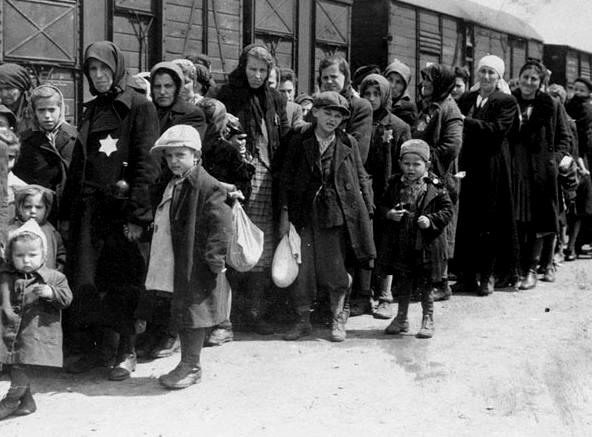
The story of the Hungarian Jews is one of the most tragic in the sad history of the Holocaust because they almost survived. The Hungarian Governent, allied with the NAZIs, introduced anti-semitic measures (April 1939). The Government cancelled the benefits awarded the veterans and widows and orphans of Jewish World War I veteransho had fought in the Austro-Hungarian Army. Prohibitions were enacted on Jewish employment. They were barred from the civil service, newspapers, movies and theater. Nor could Jewish laborers participate in working associations. Liberals in Parliament attempted to descredit Prime Minister Bela Imredy. When it was found that he had Jewish ancestors, he resigned. The new Prime Minister Count Paul Teleki oversaw the enactment of these laws, but did not go further. Hungarian Jews were not forced into ghettos. The pro-NAZI Arrow Cross demanded futher measures, but were in a minotity in Parliament. Hungarian Jews despite the ecoonomic privations, until 1944 they were relatively untouched by the NAZI violence and there had been no transports to the death camps. The Hungarin Jews were the last to be killed at Auschwitz before it was demolished and evacuated as the Red army approached. SS commander Adolf Eichman went to Hungary in 1944 to personally oversee the liquidation of the Hungarian Jews. Eichmann supervised the collection and transport, rushing to accomplish his mission before the Germans were expelled by the Red Army. Despite the pressing war time needs. Priority was given to the transports of the Hungarian Jews to Auchwitz.
India is not a country commonly associated with the Holocaust, but the Undian Army played a major role in saving Suez from the Italian attacks after Italy entered the War. The Indians also played an important role in preventing pro-NAZI Irqi Army officers from seizing control of Iraq. Had suez and the Germans were able to add a southern front to Barbarossa, countless additional Jews would have perished in the Holocaust. A small number of Polish Jewish orphans managed to find refuge in India. The Soviet Red Army invaded Poland from the west as a NAZI ally (September 1939). The NKVD arrested large numbers of Poles in their occupation zone. LIke the NAZIs, they arrested officials intelectuals, army officers, college professors, priests, and other believed to be the mainstay of Polish national life. Some were shot. Others were transported to central Asia. Along with those transported were Jews which had escaped from the NAZI occupied areas. They were deported in family groups, but large numbers of people died because of the primitive conditions. An orphanage was established in Samarkand. Soviet policy changed after the German invasion (June 1941). Tghey allowed many ofthe interned Poles to leave. One convoy journeyed for 2 1/2 months and more than 1,300 miles through present-day Iran, Afghanistan, Pakistan and into India. Some 750 Polish orphans eventually reached India. Maharajah Jam Saheb Digvijaysinhji Jadeja allowed them to stay at his summer estate in Balachadi, a village northwest of Mumbai. It became known as the Polish Children's Camp. [Kuttler]
Indo-China was a French colony comprising modern Cambodia, Laos, and Vietnam. It was occupied by the Japanese after the fall of France to the Germans (June 1941). This was done in two stages and resilted in American sanction, especially the Japanese seizur of South Vietnam which would serve as a staging area for Japanese milirary operatiojs after Pearl Harbor (December 1941). Unlike other colonies, the Japanese kept the French colonial government in place because of the Vichy Government's relatons with their German ally. There was a small Jewish community in French Indo-China, mostly what is now Vietnam. Frencj authoritues implemented Vichy anti-Semitic laws. As a result, they were subject to a range of represive actions. They were removed from government positions and had aange of prohibitions placed on their activities.
Current Iranian officials claim that their country was not involved in the Holcaust and now are involved in an effort to prove that the Holocaust necer occurred. Like much that comes out of Teheran, there is often some accurate statements mixed in with outlandish lies and convuluted reasoning. It is true that Iran was not involved in the Holocaust, but left unsaid is that this is because the Allies deposed the pro-NAZI Government at the beginning of the War. Persia which the country was called when Hitler seized power in Germany, developed links with the new NAZI regime. The basic factor here was the anti-British attitude of the Persian Government. Reza Shah Pahlavi proved to be an earlier admirwe of Adolf Hitler anbd the NAZIs. The NAZIs were seen as a powerful rival to British colonialism.
As in the Arab world, the Shah Prsian leaders do not seem to have considered what would have happened to their county in a NAZI-dominated world. The Shah was also attracted to the NAZI concept of a master race to which he included Persians. The Shah even renamed his country Iran, which in Farsi means Aryan. This was a pointed linage to the Proto-Indo-European lineage that NAZI racial theorists and Persian ethnologists concocted. Persia admitted Gestapo agents and other German operatives who p[erated openly in Tehran. The NAZIs saw Persia as a potentially useful base to cause trouble for the British as well as to persue their campaign against Jews. The most notable NAZI agent was Fritz Grobba, Germany's primary spokesman in the Middle East. He is sometimes referred to the "the German Lawrence" because he proposed a new Caliphate state stretching from Casablanca to Tehran.
Pan-Arab nationalism grew in Iraq during the 1930s. A major factor was the British role in Iraw as well as British and French control of several Arab states. Another factor here was the anti-Zionist agitation in nearby British-controlled Palestine. The influence of Arab nationists was growing, both in government circles and the Army. A series of coups after 1936 in particular strengthened the influenece of extreme nationalists in the army. Arab agitation in Palestine against both the British and Zionists affected Iraq creating resentment toward both the British and Iraqi Jews. Relations between Arabs and Jews were basically amicable. The reports of Zionist expansion in Palestine began to become an issue in Iraq after the Paestinian disorders and British attempos to restore order.
Iraq's Jewish comminity played an important role in the economy. The Government moved to marginalize the Jewish community. Arab nationalists charged that Iraqi Jews were Zionists. The trends were exacerbated as Palestinians who attacked the British abns Zionists sought refuge in Iraq, acting to radicalize the Iraqis. The Grand Mufti of Jeursalem, Amin al-Husaini, who played a major role in promoting the attacks on the British and Jews was one of those refugeees (late 1939). The Grand Mufti became influebntial in both government and military cirrcles. He played a major role in making anti-Semitism an important element in Iraqi pan-Arab nationalism. Another development in the 1930s was the rise of NAZI Germany. This provided a potential European country withe power to help evict the British and French from Iraq and the rest of the Middle East. The Granbd Mufti's role in making anti-Semitism an important aspect of Aran nationalism made the NAZIs an even more attractive potential ally. Iraqi Prime Minister Rashid Ali al-Kailani was a Iraqi nationalist who resented Britain's role in Iraq. I'm unsure as to his attitudes toward the Jews. Four officers known as the 'Golden Square' ;largely controlled the Army. Even before arriving in Iraq, the Grand Mufti had attempted to obtain NAZI assistance. The Fall of France (June 1940) was a turning point for the Iraqi nationalists. They were convinced that The NAZIs would win the War and they could drive a weakened Britain out of the Niddle East. The result was a military revolt seeking to break ties with Britain and join the Axis. This was potentially critical and the British Dessert Army and Naval forces in Egypt relied on Iraqi oil. Defeat of the Deset Army would have exposed the Jews of the Middle East to the NAZI Holocaust.
Ireland can perhaps be excused for not taking up arms and remaining neutral in World War II. They paid a heavy price in World War I and as a result of the historical experience with Britain there was lingering ill-will against the British. Less clear is why the Irish strove to maintain correct relations with the Germans after they became aware of the nature of the NAZI regime and the horendous attrocities they were perpetrating. Taoiseach (roughly prime minister) Éamon de Valera knew that the Germans were killing Jews in large numbers. Historians differ on precisely when de Valera learned. Some believe it was as early as 1942. There is no doubt that he knew by early-1943. [Girvin, p.50.] One source claims that Rabbi Issac Herzog in Dublin informed de Valera, a personal friend, that Jews were being systematically exterminated in German ghettoes and camps. Other information reached the UIrish Government. To their credit, de Valera and his government made some effort to rescue Jews. They were especially interested in helping children. The most intense effort was to rescue a group of German Jews held at Vittel in Vichy France. They already had obtained visas for different South American countries. De Valera and the Irish ambassadors in both Berlin and Vichy intervened on their behalf. The Vatican also attempted to help. There were subseqquent efforts to help Dutch, Hungarian, Italian and Slovakian Jews. None of these efforts suceeded. German officials were unwilling to turn over any Jews to Irish custody. We do not know how the Irish entreties were handled by the Germans. We do know that the German Foreign Ministry did intervene on the behalf of some neutral countries. Foreign Minister Ribentrop wanted to maintain correct relations with neutral countries, especially as the War began to go against Germany. He even contacted some neutral countries to inquire about their Jews in German custody. We are unsure why the Irish enteties were ignored. We suspect it may have been because the Jews the Irish tried to save were not Irish nationals. The Irish diplomats involved seem to have been ubnder the mistaken impression that Jews with Irish visas would be imprisoned, but not sent to the death camps. The Vittel Jews, included the children, however, were transported to death camps. [Tracy] The only known Irish Jew killed by the Germans was Esther Steinberg and her son who was born in Paris. The father was Belgium. They were transported from Paris to Auschwitz (1942). Even after the War there was a failure to see the Allied cause as an honorable crusade against evil. An editorial was published in the Limerick Leader complaining that "The campaign against war criminals is strangely confined to those who happen to fight on the wrong side. Allied atrocities cannot excuse the monstrous barbarism of the Reich." Much worse appeared in other Irish newsppers. A letter to a Kilkenny newspaper in 1945 charged that newsreel footage after the British liberated Belsen was "all propaganda" and had been faked by the British using starving Indians. A account of a Kilkenny fancy dress ball recounts how the first prize went to 'the Beast of Belsen'. [Fisk, pp. 430-31.] Jewish groups, after the war, attempted to care for Jewish children in DP camps that had survived the Holocaust. A London Jewish charity in 1946 brought 100 Jewish children from Poland to Clonyn Castle in County Meath. [Institute for Jewish Policy Research] Another Jewish group encountered difficulty in getting the Irish Government to grant refugee status for displaced Jewish children that had survived the Holocaust. At the same time, the Government quickly approved a plan to admit more than 400 displaced Catholic children from the Rhineland encountered no difficulties. The Iish Department of Justice released an official statement in 1948 complaining that, "It has always been the policy of the Minister for Justice to restrict the admission of Jewish aliens, for the reason that any substantial increase in our Jewish population might give rise to an anti-Semitic problem." De Valera over-ruled the Justice Department and the 150 refugee Jewish children were allowed to enter Ireland.
Mussolini was not strongly committed to anti-semitism. Mussolini only imposed the first anti-Jewish regulations in 1938, after prompting from Hitler. Italy had a relatively small Jewish popularion of only about 45,000 people. The Italian people and Catholic clergy, however, managed to hide most of their Jews fron the NAZIs and Fascists. Italian Jews were thus spared the full force of the Holocaust and many managed to survive. The worst time came after Mussolinin was deposed and Italy surrenderedc to the Allies. The Germans quickly disarmed the Italian Army and occupied the country. They used the opportunity to begin rounding up and transporting Jews to the death camps. The Germans only managed to deport and kill about 15 percent of Italy's Jews, the lowest ratio in among occupied countries. This is especially surprising given the fact that Italy was an Axis partner. The lack of commitment on the aprt of Mussolini to genocide and the realtively short paeriod of German occupation are factors in the survival of Italian Jews. Considerable controvery surrounds the role of Pope Pious XII. Despite considerable anti-semitism among Catholic clerics, the clergy played a major role in saving Italian Jews. Ilalian priests, nuns, and monks hid Jews in monasteries, convents, schools, and churches. Jewish families were sheltered and fed at great risk to the individuals involved. One historain describes "massive support" on the part of the clergy often without orders from their superiors for the rescue effort.
Japan, NAZI Germany's Axis partner in the Pacific, does not receive as much attention as the German's in World War II discussion of attriocities and war crimes. In fact, Japanese attitutudes of racial supperiority and commitment to imperial expanion piled up a body count that appears tio have exceeded that of the Germans in Europe. And the nature of the killing appeas to have exceeded the Germansn savegery. The lack of attention is in part because thiose killed were Asians who are not only less familar to Americans, but who published less about their war time experiences. And the Japanese, unlike the Germans, after the War have perpetrated the mythat that they were actually victims of tghe War rather than the central players in a vast historical crime of unpreceded dimensions. Many Japanese people share this opinion and to the extent World War II isaddrssed in Jaopanese schools, the images that Japanese children are left with is that of Hiroshima rather than the Rape of Nanjing (where far more people were killed than at Hioroshima) and other terrible attrocities. Amid all the bllod abd gore inflicted on the wotld by the Japabese, there is one slender ray of light. In a rare exception of Axisupport for the German Holocaust, Japan not only did not slaishly comply to with German missives, but absolutely refused to participate in the Holocaust. As aesult not only were Japanese Jews safe, bit several thousand European Jews escaping the NAZIs were saved.
The holocaust in Latvia began with the NAZI invasion of the Soviet Union. Within dys the Wehrmacht swept through Lithiania and reached Latvia. Both Germans and Latvians, who participated in the murder of Jews. Many of the The Latvian Jews were killed before the NAZI death camps in Poland were opened. Jews at Rumbula were killed November 30, 1941. The Jews in Riga were killed December 8, 1941. The SS Einsatzgruppen entered Latvia with clear orders to kill as many Jews as possible. Einsatzgruppe A coomanded by Brigadefuhrer Walther Stahlecker entered Latvia. In Latvia the Einheimische (locals) playeda major role in the killing. Heydrich ordered Stahlecker to instigate local pogroms, this desguised the NAZI holocaust as local actions against Jews and Bolsheviks. When this did not produce the desired results After the pogrom policy failed to produce the desired results, the NAZIs took more direct measures. The Arajs SD Commando was organized by Brigadefuhrer Stahlecker to kill Jews. Numerous other Latvian auxiliary police units also played a role. Most of the Latvian Jews were killed by the Arajs unit. Not all NAZI government agncies had identical plans for the Jews of the Soviet Union. Reichskommissar of the Ostland, Hinrich
Lohse ordered Jews to be concentrated and used for slav labor. Stahlecker and the Einsatzgruppen began killing Jews in lage numbers as soon as they entered the Soviet Union.
Italy occupied Libya in 1911. After World War I, Mussolini oversaw a vicious military action using poison gas to quell an Arab revolt. Jews in Italy had full civil rights and the small Jewish community prospered under Italian colonial rule. This changed as Mussolini aftter the Italian invasion of Ethiopia (1935) moved closer to Hitler and NAZI Germany. Mussolini's anti-Jewish regulations imposed in 1938 theoretically applied to Libyan Jews. They were unevenly applied, but gradually severly affected Libyan Jews. Italy after the Germans had essentially defefeated France, declared war on Britain and France (June 1940). A massive Italian Army invaded Egypt from Italy (September 1940). The British smashed the Italians and drove into Libya (December 1940). The Germans arrived in Libya to bolster the Italias (February 1941). Rommel's Afrika Korps waged a sea-saw campaign with the British 8th army until defeat at El Alemaine (October 1942). Eventually about 5,000 Jews in Libya were interned. Conditions in these camps was very harsh. [Arbitol] Some Libyan Jews were deported to the death camps. [Ward] Defeat of the Axis and British occupation saved the bulk of the Libyan Jewish community.
This tiny independentbprincipality is situated between Austria and Switzerland. Traditionally it was associated with Austria, but after World War I because of economic problems fomed a customs union with Switzerland. This is presumably why the NAZIs did not seize the principality along with Austria during the Anschluss or later during World War II. We have little information about conditions for Jews in Liechtenstein. We do know that NAZI security authrorities complained to Liechtenstein officials about Jews using hotels and restaurants. They reported that they had received complaints from German and Swiss tourists. We have little information on actions taken againt Liechtnstein Jews. One repot suggests some 240 Jewish refugees found safety from the NAZIs in Liechtenstein. Officials allowed 144 Jews to become citizens 'in return for high fees'. Most of these new citizens (Neubürger) never lived in Liechtenstein, but their Liechtensteiner status made emigration to other countries easier. One tudy rports that suring th critical 1938039 period at least 132 Jews were denied entry. The total number would be much lrger. Liechtenstein accepted motly wealthy Jews who woulf benefit the economy of the oprinciplity. Liechtenstein reportedly tightened its immigration laws (1938). Liechtenstein's policy can therefore be compared to that of other countries. There have been reports of stolen Jewish property being laundered through Liechtenstein during and after the War. The family of Liechtenstein's Prince Franz Josef II bought property and art objects taken from Jews in Austria and Czechoslovakia. They also paid the SS for the labor of Jewish inmates from a NAZI concentration camp near Vienna. The Jewish slave workes were employed on nearby royal estates. [Study]
Lituania was annexed by the Soviets in 1940 under the terms of secret protocols in the NAZI-Soviet Non-Aggression Pact. Sempo Sugihara, the Japanese Consul in Kaunaus (the inter-war capital of Lithuania), issued over 1,600 transit visas to Jewsish refugees fleeing Poland, allowing them to transit the Soviet Union. The NAZIs occupied Lithuania in June 1941 in the opening phase of Operation Barbarossa--the invasion of the Soviet Union. The specialized killing units the Eizenstazgrupen were deployed with chilling effiency. Almost at the inception of NAZI occupation ther were mass executions of Jews. The first was the killing of about 1,000 Jews at Vilijampole (June 25-26, 1941). Lithuanian collaborators enthusiastically embraced NAZI anti-Semitic propaganda. The attempted to identify Jews with Communism and the attrocities committed by Stalin during the Soviet occupation (1940-41). Many insisted that undoing Soviet rule and Communism required liquidating Jews. They began the same process persued in Poland by the NAZIs. While the NAZIs were unavle to find collaborators in Polnd, they were able to do so in Lithusnia. The local authorities subjected the Jews to a series of repressive measure designed to humiliate them, marginalize them. steal their propery, and ultimately kill them. Those not likked immeiately after the NAZI invssion were hearded into gettos like those formed in Poland. Most of the country's 240,000 Jews were killed. This was 90-95 percent, the highest mortality rate in NAZI occupied Europe.
Germany occupied Luxenbourg in May 1940 as part of its Western Offensive. Occupation authorities applied the Nuremburg Laws to Luxembourg (September 1940). The NAZIs had not yet fully commited themselves to genocide. German authorities encouraged the Grand Duchy's 3,500 Jews to leave during the first months of the occupation. This was of course very difficult. A few manged to get visas for refuge in Portugal. Others were able to find temporary sanctuary in unoccupied (Vichy) France. The Jews who stayed in Luxembourg where confined in a concentration camp near the railway junction of Ulfligen and were deported to death camps in Poland where almost all perished.
Abitbol, Michel. History of the Jews of Arab Lands (In Hebrew, Merkaz Shazar).
Cohen, Frederick. The Jews in the Channel Islands during the German Occupation.
Eizenstat, Stuart. Imperfect Justice.
Fisk, Robert. In Time of War.
Fraser, David. The Jews of the Channel islands and the Rule of Law, 1940-1945.
Gilbert, Martin. A History of the Twentieth Century Vol. 2 1933-54 (William Morrow and Company, Inc.: New York, 1998), 1050p.
Girvin, Brian. "De Valera's Diplomatic Neutrality," History Today Vol. 56, No. 3 (2006).
Goñi, Uki. The Real Odessa (London, 2002).
Gumble, Peter.
Institute for Jewish Policy Research and American Jewish Committee. Anti-semitism in Ireland
Kuttler, Hillel. "When a maharajah came to the rescue: India's role in saving a small group of Polish Jewish orphans during the Holocaust remains little known, even to experts of the Shoah," The Times of Israel (July 1, 2012).
Irish Department of Justice. Memorandum 'Admission of One Hundred Jewish children,' (April 28, 1948).
Laskier, Michael. The Jews of the Maghreb in the shadow of Vichy and the Swastika (Hebrew, Univ. of Tel Aviv, 1992).
Michaelis, Herbert and Enst Schraepler. eds. Ursachen und Folgen, Vol. 18. (Belin Dokumenten-Verlag Dr. Herbert Wendler & Co, undated).
Noakes, Jeremy and Geoffrey Pridham. ed. Documents on Nazism, 1919-1945.
Tracy, Robert. "The Jews of Ireland," Judaism: A Quarterly Journal of Jewish Life and Thought (Summer 1999).
Ward, Seth. "The Holocaust in North Africa," May 10, 1999.
"Study: Liechtenstein has mixed record on WWII efforts," The Jewish News Weekly (April 22, 2005).

Navigate the CIH Holocaust Pages:
[Return to Main holocaust country page]
[Return to Main World War II page ]
[Main Holocaust page]
[Allies]
[Biographies]
[Children]
[Concentration camps]
[Countries]
[Decision]
[Denyers/Apologists]
[Displaced persons]
[Economics]
[Eisatzgruppen]
{German Jews]
[Ghettoes]
[Impact]
[Justice]
[Literature]
[Movies]
[NAZIs]
[Occupied Poland]
[Process]
[Propagada]
[Resistance]
[Restitution]
[Questions]
[SS]
[Special situations]
[Targets]
[Wansee Conference]
[World War II]
[Main mass killing pagel