
The Holocaust: El Salvador
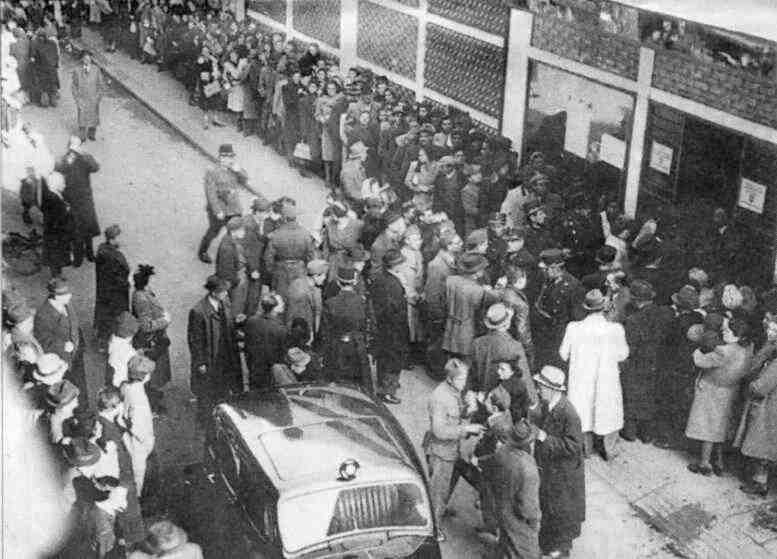
Figure 1.--Here is the Swiss safe house in Budapest which was called the Glass House because it was an old glass factory. It was run by Swiss diplmat Carl Lutz. Jews with documents with any kind of official cachet, including the Salvadoran nationality certificates, could gain entry. Note the Jews with baboes in arms attempting to gain entry. Once in side they were safe. Even Eichmann and his agents were not allowed to seize the Jews inside because of the need to maintain relations with the Swiss. Source: Salvadoran Ministry of Foreign Relations.
|
|
El Salvador is the smallest of the Latin American republics. At the beginning of the War the president was sympathetic to the Germans, as was the case in several other Latin American regimes. And the population was as was the case throughout South and Central America had a largely anti-Semetic attitude. Despite this a Salvadoran diplomat helped save about 30,000 Hungarian Jews. Col. José Arturo Castellanos before World War II while on official business in Europe before the War met a Hungarian Jewish businessman, George Mandel. The two become friendly. After Hiler launched the War (1939), Col. Castellanos is posted to various European cities. Mandel as Hitler succeeds begin his conquests and receives accounts of NAZI actions begins to understand the danger. He contacted Col. Castellanos who made him an honorary Salvadoran diplomat and passport. Mandel changed his name to Mandel-Mantello to make it more Spanish sounding. Castellanos began to issue small numbers of Salvadoran visas to other Jews. Unlike other Latin American diplomats he did not sell these visas for large sums. Col. Castellanos with the Germans begining large-scale killing, brought Mandel to Geneva and made him First Secretary without authorization of his government. The two decide to issue Salvadoran documents to help save Jews. This began with small numbers which is probably why the NAZIs did not complain to the Salvadoran Government and have Col. Castellanos recalled.
Salvadoran Jews
Jews were not allowed in what is now El Salvador during the Spanish colonial period. A few Jews emigrated to El Salvador during the early 19th century, mostly Sephardic French Jews. El Salvador’s first know Jew was Alsatian-born Bernardo Haas (1868). He incouraged his nephews Lazaro and Julian Dreyfus (related to Captain Alfred Dreyfus) to join him. Leon Liebes was the first documented German Jew (1888).
President Martinez openly supported Fascism during the 1930s. The NAZIs seized power in Germany (1933).
El Salvador's small Jewish population attempted to aid their relatives by obtaining entry visas for them.
This was especially the case after the Niremberg Laws were encted (1935) and conditions became even more difficult for German Jews. The Government made emigration difficult for Jews and cloesed it off entirely (1939). Salvadoran Jews tried to get entry vusas for their relatives from less histile Latin American governments. President Martinez personally blocked the entry of 50 Jewish refugees on the German ship Portland (July 30, 1939). The refugees had paid $500 for Salvadoran entry visas in Budapest and Amsterdam, but thee President had them declared “fraudulent” and the refugees were forced to returned to Germany.
The small Jewish community founded the Comunidad Israelita de El Salvador (1944). They opened a Jewish community center (1945). The situation for Jews improved after the War. A small number of Ashkenazi refugees emigrated to El Salvador. El Salvador recognized the State of Israel (1948). The Jewish community opned the country's first synagogue (1950). Salvadoran Jews founded the Instituto Cultural El Salvador-Israel (1956). There are believed to be about 200 Jews in El Salvador.
Martínez Dictatorship (1931-44)
General Maximiliano Hernández Martínez seized power in a military coup (1931). EI Salvador's Communist Party under Farabundo Marti 6 weeks later was quickly supressed. President Martinez began a bloody operation to purge the country of Communists and Communist sympathizrs. The resulting massacres left 40,000 peasants dead and virtually wiped out the country's indigenous (Native Anerican) culture. The Army raided hotels looking for Communists and other subversives. Men with blond hair were suspected of bring Russians. Prisoners were forced to dig pits and were then shot.
Martínez was an admirer of Benito Mussolini and Adolf Hitler when he seized power in Germany (1933). This was not uncommon in Latin America at the time, especially among military officers. And the military at the tim had enormous influence throyghout the region, actually governing several countries. Martínez was known to preside over celebrations of Hitler's birthday. Once in power, Martinez’s admiration of Hitler and Mussolini gave way to actual govrnment polivcies supporting NAZI Germany nd Fascist Italy. Germans in El Salvador were divided. Some found the NAZIs abhorent. Others were enthusiastic supporters and joined the German Embassy’s parties and Ausland organisation, promoted by the NAZI Party. Nazi Party Foreign organization meetings. Martinez admired Axis adances and promotion of the military. He accepted Axis (German and Italian) military aid. Martínez appointed two pro-NAZI German citizens to important posts. Baron Wilhelm von Hundelshausen was both German consul and manager of the government-owned Banco Hipotecario (Mortgage Bank). General Eberhardt Bonstedt was put in charge of the Escuela Militar, the Salvadoran Military Academy. Martinez even found an Italian aviator to train Salvadoran airmen. Martínez became known in Washingtn as a fascist sympathizer. His actions were also noted in Berlin. Trade with Germay increased. With the outbreak of the Spanish Civil War, the Martinez Government supported Gen. Franco diplomatically. When a El Diario de Hoy editor praised democracy in France on Bastille Day, he was suspended for 15 days (1938). The Editor-in-Chief was exiled to New York. Most reporters opposed Martínez, but did not dare criicize him openly. The university newspaper, Opinión Estudiantil was closed throughout the Martínez era. There was a public celebration for Hitler's birthday (1939).
World War II (1939-45)
President Martinez at the beginning of the War was sympathetic to the Germans, as was the case in several other Latin American regimes. And the population, as was the case throughout South and Central America. had a largely anti-Semetic attitude. While President Marinez was openly suportive of the Germans and Italians, with Pacific coast, he was not in a position to offer any assistance to them. U.S. President Franklin Roosevelt had from an early point of his administration, announced the Good Neighbor Policy (1934). An element in that policy was no interference in the internal affais of Latin American countries. This changed with the outbreak of the War. The Roosevelt administration pushed for “Pan American Solidarity”. Given that several Latin American governments, and not just El Salvador, were pro-Axis, this required the Administration to do just what it had pledged not to do. Not only was Martinez pro-Axis, but it took 3 years for the United States to recognize his government. The United States pushed Latin American governments to move against Axis agents. This was a somewhat ham-fisted efforted as the United states was asking Latin American countries to deport German nationals which in some cases included German Jewish refugees. The American pressure worked. Martinez shifted his policies and moved against Axis agents. He shut down a NAZI radio station and associated presses. Only a few days after Pearl Harbor, El Salvador declared war on the Axis countries (1941).
Col. José Arturo Castellanos
During the Martínez dictatorship, military officers were appointed to many government positions and this included the diplomagic corps. One such officer was Col. José Arturo Castellanos. Castellanos Contreras was born in the city of San Vicente, El Salvador to a well-to-do family (1893). His parents sent José at age 16 years to the prestigious Escuela Politécnica Militar (Military Polytechnic School) (1910). This began a 26 year creer in the Salvadoran military. He rose to the rank of colonel. He served as the Second Chief of the General Staff of the Army of the Republicm making him the second most important Army commander. His Army career could not go any futher. He was known to be critical of President Martínez, both his fascism and his bloody repression of disuidenhts. Castellanos influence in the military and family connections protected him as long as he did not openly oppose Martínez. But Martínez decided that it would be a good idea ti get him out of the country. The result was a career change. Castellanos accpted a diplomatic posting. He was made the Salvadoran Consul General in Liverpool, England (1937). He was then reassigned to Hamburg, Germany (1938). He arrived in Hamburg in time to see the vicious Kristalnacht pogrom with shops looted, synagogues nurning, Jewish homes and shps vandalized, and men arrested. Castellanos was appaled. We do not know to what extent he had given much thoughtbto whst was happening to Jews. His reaction seemscto have been his deep-seated Catholic faith. He wrote to Foreign Minister Miguel Ángel Araujo (January 2, 1939). He described what was happening in Germany and asked permission to grant visas to Jews desperate to flee Germany.
The Foreign Minister flstly refused his request. The Government wanted friendly relations with Germany and as a result of centuries of conservative Catholicism, Jews were disliked in El Salvador--although few Salvadorans had ever met a Jew. This was especially true of the pro-NAZI eklemnt. Other assignments in Europe followed. It is at this time that he met a Hungarian Jewish businessman, George Mandel. They became two became friendly. Col. Castellanos was ultimately moved to Switzerland (1941) made Genereral Consul in Geneva (1942). We are not sure what promoted the transfer. Castellanos had been submitting highly critical reports detailing NAZI attricities. The Salvadoran Government may not have wanted him in Germany stirring up trouble. Tiny El Salvador did not have a lot of commerce with Switzerland, but it was one of the few places in Europe that was safe from the expanding war.
George Mandl
György Mandl was a Jew born in Lekence, Transylvania. This was a province that was claimed by both Hungary and Romania and in just the 20th century had been switched three times by the two countries. As a result of World War I, Transylvania was largely part of Romania. Mandl moved to Bucharest, the Romanian capital. He opened a textile company. He thought Romania would be safe and avoid any coming war. Like m,any Europeans, he was terribly wrong. The National Legionary State seized power (September 6, 1940). This was a one-party totalitarian pro-NAZI dictatorship controlled by the fascist Iron Guard in cooperation with Prime Minister Ion Antonescu who commanded the Romanian Army. The Iron Guard was not only pro-NAZI, but virulently anti-Semetic. They quickly allied with the NAZIs. Some 0.5 million German troops deployed into Romania (October 8). The Iron Guard launced an anti-Jewish pogram (January 20, 1941). Mandl and his family managed to flee to Switzerland where he sught ut his friend Col. Castellanos. Switzerland was neutral, but itvhad very strict refugee laws, especially concerning Jews. As it bordered Germany, Swiss officials were concerned about a possible German invasion. It was thus not anxious to upset its NAZI neighbor. Bor was there any particular concern with the plight of Jews. At the time the Holocaust was in full swing, the Swiss were activekly deporting Jewish refugees to NAI Germny. The Mandl family risked deportation.
Preliminary Efforts
Col. Castellanos acted to save his friend Heorge Mandl and hus family. He made him an honorary Salvadoran diplomat and issued a Salvadoran passport. Mandl changed his name to Mandel-Mantello to make it more plauably Spanish sounding. Col. Castellanos acted on his own authority. He did not seek permission from the Foreign Ministry are infiorm them of what he had done. He also began issue small numbers of Salvadoran visas to other Jews. Other Latin American diplomats had been doing this, mostly selling the visas for substantial cash paymnts. Col. Castellanos did not do this. His only interest was saving people. When Castellanos learned of the mass killings in the East, he Mandel to come to Geneva and work as his First Secretary. He did not inform the Salvaoran Foreugn Ministry what of this action. They would not have approved. .
Pearl Harbor (December 1941)
The Japanese carrier attack on Pearl Hsrbor changed the diplomatic landscape. Latin American countries. including the Salvadoran Martínez Government began declaring war on Germany's Axis ally, Japan (April 8, 1941). As with El Salvador this included governments that had been favorably disposed toward the Axis. The Roosevelt Government after Hitler and Stalin launched Wiold War II began a diplomatic ffort to win over the Latin Americans. The deciding factior was British and Amerucan control of the seas. The Latim Americans had commodity export center economies. And they could not trade with Germany ev if the Grmnbs had the fireign exchnge to ourchased needed imports. The United States abd Britin to a klesser extent were willing to pay good prices for the commodities thst the Latin Americans had to export. Three days later after Hitler declared war on America, President Martínez who previously has ideolized Hitler and Mussolini, authorized his Government to delare war on Germany and Italy. President Martínez did not have a sudden change of heart. It was a simple matter if economics. America offered a vast market fir Salvadoiran coffee and other products. It was not possible to ship to Germny which in ny case hd little foreign curreny to purchase Latin American eports. The declaration of War meant tht Salvadoran documents did noit hve the same vlue as befire, but they were not meaningless as the Internstional Red Cross still honored them as well as some Governments such as the Hungsrian Government. . .
Geneva Plan
When Castellanos learned of the mass killings in the East, he Mandel to come to Geneva and work as his First Secretary (1942). In reality this was a position which did not exist. He did not inform the Salvaoran Foreugn Ministry what of this action. They would not have approved. The two decide to issue Salvadoran documents to help save Jews. Col. Castellanois again appealed to his government for visas. The Foreign Ministry again refused. Col. Castellanos began issuing small numbers anyway. There were only small numbers of Jews who made it to Switzerland. So they began issuing Salvadoran citizenship papers to Jews in Eastern Europe. As only a few could reach Switzerland, they mailed them. The mailings would have had to have gome thriugh the German mail system. Florian Manoliu, Counselor of the Romanian legation in Bern, traveled between Switzerland and Romania, distributed the Salvadoran documents to Hungarian Jews. The relatively small number involved and the fact that the NAZIs do not seem to have been fully aware that Col. Castellanos was working without his Government's approval . We believe that some 13,000 citizenship papers were issued to entire families in Bulgarian, Czech, Hungarian, Polish, and Romanian Jews making them Salvadorans. It is unknown how many people were actually saved. The ruse did not always work., but it often did. It is part of the horror of the Holocaust that 13,000 citizen ship papers were in NAZI terms a small amount.
German diplomacy during the 1930s sought to bring Hungary within the NAZI orbit. The NAZIs used financial enducements as well as the growing strength of Fascist elements in the country. Hungary also had territorial claims on neighboring countries which it hoped to avhieve through cooperation with the NAZIS. Hungary which had fought with Germany (as Austro-Hungary) in World War I, joined the Axis (November 20, 1940). Hitler rewarded the Hungarians with a substantial slice of Romania at the Vienna conference (November ? 1940). The Hungarians cooperated in the NAZI invasion of Yugoslavia (April 1941). Admiral ordered Hungarian military units to occupy territory claimed by Hungary in Yugoslavia. These areas had ethnic Hungarian populations. Hungary subsequently annexed a part of Vojvodina. German successes in the early phases of World War II convinced many in Europe that the NAZIs would prevail in the War. This strengthened the position of right-wing Fascist elements in the country. Admiral Horthy named right-wing politician Laszlo Bardossy to succeed Teleki as primeminister. Bardossy as a NAZI ally led Hungary into World War II. Hungary played a modest role in Basrbarossa (1941), but after the Soviet Winter ofensive (December 1941), the NAZI compelled Hungary to mobilize additional forces in the German Summer offensice (1942). The Soviets devestated the Hungarian Second Army as part of its Stalingrad offensive. Hungary subsequently withdrew its army rom the Eastern Front (April 1943). Hitler fearing that Hungary was preparing to sign a separate peace occupied the country (March 1944). When the Red Army arrived (September 1944), Hungary became an intense battlefield. Hitler rushed in reserves, but in doing so depleted the forces needed to defend Berlin.
NAZIs Seize Hungary (March 1944)
A furious Adolf Hitler decided to occupy Hungary, exacperated with Hungarian duplicity. He concluded that this was the only way of precenting the Hungarians from withdrawing from the War and signinging a separate peace and to ensure that Hungary continued to support the war effort and the to get his hands on the surviving Hungarian Jews. Kallay eluded the Germans and took asylum in the Turkish embassy. Hitler engineered the appointment of Hungaian Fascist Dome Sztojay, as prime minister. The new government began arresting political opponens, banned labor unions, and resumed the deportation of Jews. The attempt to assasinate Hitler (July 1944) caused some confusion. Admiral Horthy replaced Sztojay with General Geza Lakatos and stopped the deportation of Jews from Budapest (August 1944). Budapest at the time had the only significant population of Jews that had not yet been deported.
Saving Hungarian Jews
Most of th killing of Jews took plsce in the East. Col. Castellanos had no way of ssisting Jews there. He could not do much even in Switzerland as any widespread effort would have resulted in him being recalled by the Foreign Ministry. All of this changed in 1944 as the NAZIs bgan to tatget Hungarian Jews, the last major group of Jews left in Europe.
By this time of the War, it was ckear tht the NAZIs had lost the War. Even the Martínez Government could see that there was b=no benefit in courting the NAZIs. And then the Martínez Givernment fell (May 1944) and was replaced with a Government not only favorable to the Allies, but also the plight of refugees. In addition, Cstellsnos and Mandl found a like-minded Swiss diplopmat. Carl Lutz was the Swiss Vice-Consul in Budapest, Hungary. He began handing out Swiss Safe-Conduct papers to Jews and opened safe houses for them. All without the approval of the Swiss Government. The NAZIs had a very German bureaucratic mindset. This was one reason that the Nurember IMT war crimes trualshad such a mountain of documentation to wirk with. An official looking Government document was often treeated at face value. This was especiallt true of foreign documnts became Foreign Minister Ribentrop was desperaremly wirking to maintain diplomstc relatiins with other countries, breaking relatins abd decklaring war as the NAZI situation looked increasingly desperate. Lutz did not get permission from the Swiss. His superiors either did not know what he was doing or turned a blind eye. In addtion, Lutz worked with other diplomats, some of whom came up with their own versions of theSwiss Safe-Conduct papers. Mandel-Mantello and Contreras had their own version. The documents granted holders protection under the International Red Cross and the Swiss Consul in Budapest. When the NAZIs invaded Hungary to prevent them from defecting from the War (March 1944), and communication becme increasingly difficult. Mandel-Mantello and Contreras bgan semding dicuments without names, but ith the porper signatures and seals. The jews were were instructed to stick on their own photigraophs and fill in their names. The new Government in San Sakvador even officially asked Switzerland to recognize their new Eastern European “citizens” and extend diplomatic protection to them. This has some negative consequences. The new Giovernment declred war on Germany. This mean that Salvadoran diplomacy no longer had any value, but of course the Salvadoiran Government nevere intervened in favor of Jews to begin with.
Salvadoran Nationality Certificates for Hungarian Jews
The NAZIs by 1942 were intent or murder. Thus visas were useless. Castellanos and Mandel began issuing Salvadoran nationality certificates. And with the NAZI takeover in Hungary, they began issuing them in large numbers. This was made possible in part because of the ouster of President Martínez May 1944). He had changed allegince after Pearl Harbor, but this did not mean that he allowed any action to assist Jews. The new ProvisionalGovernmennt was prepared to do so. The documents were hurridely prepared. They were issued to Jews names that had not a hint of a Spanish name. Sometimes documents were forwarded with blank entries to be filled in upon receipt. They were typed in Geneva and shipped via diplomatic corrier to Budapest. [Montgomery] The NAZis from the beginning of their murderous regime operated outside of the law. Even so there remained a strong bent toward formalities and documents. This and the NAZI Government's desire to maintain diplomatic relations with the few countries that still maintained relations (especially Sweden and Switerland), gave the make-shift Salvadoran operation a chance. Castellanos convinced the Swiss government in Hungary to look after individuals with Salvadoran nationality certificates. Julio Enrique, Salvadorian Foreign Relations Minister of the Provisional Givernment formalized Castellano's request to the Swiss. The Hungarian government reacting to internstional pressure and a warming from Presidenbt Roosevelt. approved the bilateral agreement.
Swiss Role
El Salvador uwa offivally at war with Germany. Thus Col. Castellanos could not travel to Budapest himself. He had secured the cooperation oof Swiss diplomsrts abd finally the Swuss Giovernent. The NAZIs at the time were anxious to maintain relations with neutral goivernents, especilly the Swissabd Swedes. Swiss diplomats carried the Salvadoran documents to Budapest. They also set up safe houses where Jews with proof of foreign nationality, including the Salkvadoiran dicuments, could seek protection. [Montgomery] Eichmann and his agents were not allowed to enter the safe houses. The Swiss program in Budapest was run by Carl Lutz. Swedish diplomat Raoul Wallenberg conducted an even more aggressive operation. The Swiss safe house was called the Glass House because it was set up in an abandoned glass factory.
Results
So it was that El Salvador, the smallest of the Latin American republics and once a string supporter of Hutler and the NAZIs, played an important role in saving Hyngarian Jews. We are not sure how many visas and naturalization certificates were issued. Estimares range from 9,000 to 13,000. But as the certificates were often issued for whole families, a single certicate could cover several people. Some historians beliece that Col. Castellanos and Mandel saved about 30,000-40,000 Jews.
Sources
Montgomery, David. "Unsung savior: A Salvadoran diplomat in Nazi Europe Lent his nations's protection to Hungarian Jews," WAshington Post (Juky 15, 2008), pp. C1-2.
CIH -- Holocaust

Navigate the CIH Holocaust Section :
[Return to the Main Holocaust country page]
[About Us]
[Allies]
[Biographies]
[Children]
[Concentration camps]
[Countries]
[Decision]
[Denyers/Apologists]
[Displaced persons]
[Economics]
[Eisatzgruppen]
[Eugenics]
[German Jews]
[Ghettoes]
[Impact]
[Justice]
[Literature]
[Movies]
[NAZIs]
[Occupied Poland]
[Process]
[Propagada]
[Resistance]
[Restitution]
[Questions]
[SA]
[SS]
[Special situations]
[Targets]
[Wansee Conference]
[Return to the Main World War II]
[Return to Main Holocaust page]
[Return to the Main mass killing page]
[Return to CIH Home page]
Created: 7:27 AM 7/16/2008
Last updated: 12:23 AM 6/30/2018