
German Treatment of World War II Prisoners of War (POWs)
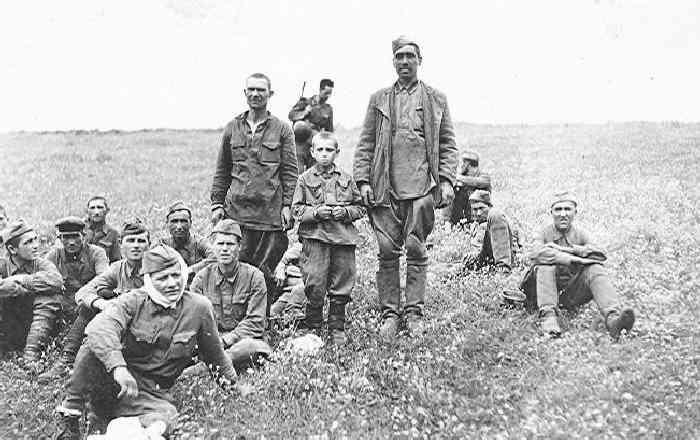
Figure 1.--The Red Army was stunded by the German invasion (June 1941). Whole armies surrendered. The German treatment of Polish and Soviet POWs, however, was barbaric and many died from starvation, exposure, and mistreatment. The German policy was in part a planned method of elimination and in part their inablity to deal with the massive numbers involved. Notice the very young boy who was taken prisoner here. Also the German soldier in the background.
|
|
The Germans were the first country to acquire large numbers of POWs. German policy varied as to the nationality of the POWs. Here a primary factor in the German mind was race. The Germans treated French, British, and later American POWs relatively correctly. The internment of the French and some British POWs was for almost the entire war as they took large numbers of POWs in 1940. I note some reports from American soldiers that they tried separate Jewish POWs from the general POW population and subjected the Jewish POWs to brutal slave labor. I am unsure if they did this to the British and French as well. POWs were also used to some extent as forced labor. The German treatment of Polish and Soviet POWs, however, was barbaric and many died from starvation, exposure, and mistreatment. The German policy was in part a planned method of elimination and in part their inablity to deal with the massive numbers involved. German tretment improved somewhat as they began to use Soviet POWs for forced labor, but it was still brutal. At some camps the Soviet POWs were not even provided barracks and other structures and were exposed to the elements. While in terms of fatalities, the worst time for POWs was in 1941 when the German took huge numbers of POWs. Conditions began deteriirated seriously for all POWs in late 1944. There were in German hands in late 1944 a very large number POWs. Most were Soviet and French. There were also anout 0.3 million American and British POWs. Part of the reason that conditions deterirated in late 1944 was the bitter Winter. Other factors were the Allied air campaign and German policies. Conditions became caotic in 1945. Allied planes were destroying the Reich's transportation network. Compounding the problem was civilian refugees fleeling east from the advancing Red Army and the retreating Wehrmacht. There were also SS columns of starving inmates from the death camps. The Germans were also emptying the POW camps in the east. The Germans in late 1944 also evacuated POW camps in the East about to be liberated. The POWs, many weakened by mistreatment and poor diets, were forced to make long marches in sometimes bitter weather. For the weakened and often emaciated men, these were often death marches. Straglers were shot. [Nichol and Rennell]
The Germans were the first country to acquire large numbers of Kriegsgefangenen (POWs). German policy varied as to the nationality of the POWs. Here a primary factor in the German mind was race. The Wehrmacht treated French, British, and later American POWs relatively correctly. The greatest numbr of Western POWs were the French. Large numbers of French soldiers were taken prisoner during the German western offensive and the resulting fall of France (May-June 1940). The Germans after the French surrender (June 1940), interned the French Army in POW camps in the Reich. Vichy hoped that the Germans would release them, but the never did. The SS was a different matter. The internment of the French and some British POWs was for almost the entire war as they took large numbers of POWs in 1940. The German treatment of Polish and Soviet POWs, however, was barbaric and many died from starvation, exposure, and mistreatment. Few of the Polish POWs taken in 1939 survived the War. The German policy was in part a planned method of elimination and in part their inablity to deal with the massive numbers involved. German treatment improved somewhat as they began to take fewer POWs and began to use the Soviet POWs for forced labor, but it was still brutal.
Our information about German POW guards and camps is incomplete. The Wehrmacht was theoretically responsible for POW camps. Both the Heer and the Luftwaffe set up POW camps. We are unsure about the Kriegsmsrine. There would have been very Allied POWs taken by the Kreigsmarine. The German guards at those camps were usually older men who were physically fit for front line combat duty. There were instances of sadistic guards, but these were an exception to the rule, unlike the SS concentration camps. We also notice RAD youth being used for guards. This may have been for work assignments outside the camps. The POW camps were separate from the SS-run concentration camp system. And while life in the POW camps was not pleasant and food was short, they were not death camps. There were differences in the camps, depending on nationality. The Germans mistreated and starved Polish and Soviet prisoners. I am not sure if the camps with Polish and Russian prisoners were run by the Wehrmact or the SS. We do not that some Allied POWs were housed next to Russian POWs. We also notice Soviet POWs being used as labor in SS-run camps, including the death camps. The Germans attempted to find Jewish POWs and when they did, they were transferred to SS concentration camps. Some problen prisoners may have also been turned over to the SS. Many French POWs were used for farm labor. We are not entirely sure how they were housed. American and British POWs were used in various ways, including cleaning up after air raids. We are not entirely sure who guarded them on these details, but believe the guards included Hitler Youth and RAD boys as well as military guards.
Jews were among the POW taken by the Germans in their various campaigns. There were variation from country to country as to how the Germans treated the Jewish POWs. Por information on German efforts in this regard is still limited. We note labor brigades formed from Polish Jewish POWs. One Jewish POW reports that he was in a group of Polish Jewisg POWs that were about go be gassed. He was among a few who were still heatlty that a A SS officer selected out from the group. Those selected were used as a slave labor unit in Aktion 1005. The Danish and Norwegian armies were very small. The Dnish Army was not interned. There would have been only a handful of Jews. The Dutch POWs were allowed to return home. We do not know if there was any attempt to select out Jews. The Belgian POWs were interned. Again we do not know about efforts to elect out Jews. Nor do we know about the Fench Jewish POWs. There were very few British Jews so the Germans took few British Jewish POWs. Our information on Yugolav and Greek POWs is also limited. We know more about Red Armyb Jews after Hitler invaded the Soviet Union. Red Army Jews were basically subject to the Commisar degree. This authorized any Wehrmacht soldier to shoot any Jewish soldier after he surrendered. Some commanders shot anyone who looked Jewish. Other were more restrained in how they complied with the Commisar and other extermination orders. Even if not shot at the front, there were other selections to find elected groups such as Commisars, intelectuals, and Jews. Here the Germans do not seem to have been as meticulous as the NKVD when they selected the Poles to muder as part of the Katyn masacres. The Germans did not take many American POWs. A few were taken in North Africa and then air crews during the strategic bombing campaign. We note some reports from American soldiers taken during the Bulge campaign. German propaganda blamed Jewish monied interests for Ameican hostility toward Germany. Germans tried to separate Jewish POWs from the general POW population. When Jews did not identify themselves, some officers went thriughthe rabks and seoarated out anyone who looked Jewish. Dog tags could also be used to identify Jews. The Jewish POWs were then subjected to brutal slave labor and internment in SS concentration camps rather than POW camps.
German treatment of POWs was one of te great attriocities of World War only eclipsed by the Hollocaust and ovrall Hunger Plan. It was in fact one of the key elements of the Hunger Plan. And much of the killing was done by the Wehrmacht, not the SS, in Whermacht camps. This is one of the less reported German attrocities because the victims were mostly Polish and Soviet POWs. The Germans conducted the killing by simply putting th men behind barbed wire enclosures and providing them very little food or even basic shelter. Many Soviet POWs received at most a ration of only 700 calories a day, a fraction of what was needed to sustin life. The Wehrmacht called this a 'subsistence' ration. The POWs were often given special 'Russian' bread concocted from sugar beet husks and straw flour--having virtually no nutritional value. Soviet POWs began dieing even before the winter weather setin. Some POW camps had only pavilions (basic structures with roofs but no walls). Some camps did not even have pavilions. Emaciated and exposed to the winter weather, the Soviet POWs died in apauling numbers. Only a small fractin of the POWs taken in Barbarossa srvived the War. The Germans only moderaed their genocidal policies when the War began togo against them. More Germans had to be conscripted, creating a labor shortage. The POWs that managed to survive could be used as slave labor. Western POWS were trated more correctly, although Jewish POWs were separated out. The German treatedment of POWs was severe, but not genocidal. There were, however, exceptions. The SS was especially prone to shooting POWs. Americans are most famiiar with the Malmedy massacres. There were other similar instances. Another attrocity was the shooting of men involved in the Great Escape. The Hollywood film is based on an actual event. Some 76 Allied airmen (Mostly British) broke out of Luftwaffe Stalag Luft III near Berlin. It was the largest breakout of World War II POWs. Only three of the escapees actually made it to safety. The Germans recaptured 73 men and on Hitler's direct ordes, the Gestapo shot 50 of the men. When the British Government learned what had hppened Primeminister Churchill ordered an investigation and pledged to bring the perpetratiors to justice. After the War, a team of military police headed by Squadron Leader Francis P. McKenna was dispached to Germany to track down the perpetrators. [Read]
Situation in 1944-45
Conditions began deteriorating seriously for all POWs in German hands during late 1944. The Germans in late 1944 held a very large number POWs. Most were Soviet and French. There had been a sbstatal number of Poles, but ny 1944 most had perished. There were also about 0.3 million American and British POWs, many were srviving air cres shot down over Germany. Part of the reason that conditions deterirated in late 1944 was the bitter Winter. Other factors were the Allied air campaign and German policies. Conditions became chaotic in 1945. Allied planes were destroying the Reich's transportation network. Compounding the problem was civilian refugees fleeling east from the advancing Red Army and the retreating Wehrmacht. There were also SS columns of starving inmates from the death camps. The Germans were also emptying the POW camps in the east. The Germans in late 1944 also evacuated POW camps in the East about to be liberated. The POWs, many weakened by mistreatment and poor diets, were forced to make long marches in sometimes bitter weather. For the weakened and often emaciated men, these were often death marches. Straglers were shot. he first evacuation was Stalag Luft VI in East Prussia (July 1944). Prisoners were shipped across the Baltic to Gros Tychow in Pomerania. Then in the middle of Winter they were forced marched for 86 days covering 500 miles (February 1945). They had only rags against the winter and were given almost no food. When Allied soldiers got to them they were in the same condition as concentration camp inmates (april 1945). There were many other instances. The American and British POWs in Stalag Luft III were evacuated at night during a blizzard and marched for 8 days in freezing weather. Even the prisoners in camp were in danger. Stalag XIIID was near the Nurembrg, an important communications center that the Allied targeted iin the strstegic bombing campaign. The POWs being evacuated was also indanger from Allied fighters hitting military columns. The caos in Germany during 1945 also made it difficult for the Red Cross to get parcels through. These parcels toward the end of the War these parcels (entering the Reich at Lubeck by ship and arriving at Munich by train and truck) were often all that kept the POWs from starvation. [Nichol and Rennell]
Sources
McCracken, Isabella. "A lesson in living with fear," The Washington Post May 29, 2004, p. W10.
Nichol, John and Tony Rennell. The Last Escape: The Untold Story of Allied Prisoners of war in Europe, 1944-45 (Viking, 2003).
Read, Simon. Human Game: The True Stiory of 'The Great EScape' Murders and the Hunt forthe Gestapo Gunmen<./i> (2012), 320p.
Stueck, Rudi. E-mail message, June 27, 2005
CIH

Navigate the CIH World war II Section:
[Return to Main World War II POW page]
[Biographies]
[Campaigns]
[Children]
[Countries]
[Deciding factors]
[Diplomacy]
[Geo-political crisis]
[Economics]
[Home front]
[Intelligence]
[POWs]
[Resistance]
[Race]
[Refugees]
[Technology]
[Bibliographies]
[Contributions]
[FAQs]
[Images]
[Links]
[Registration]
[Tools]
[Return to Main World War II page]
[Return to Main war essay page]
Created: October 30, 2003
Last updated: 6:06 PM 11/5/2012