|
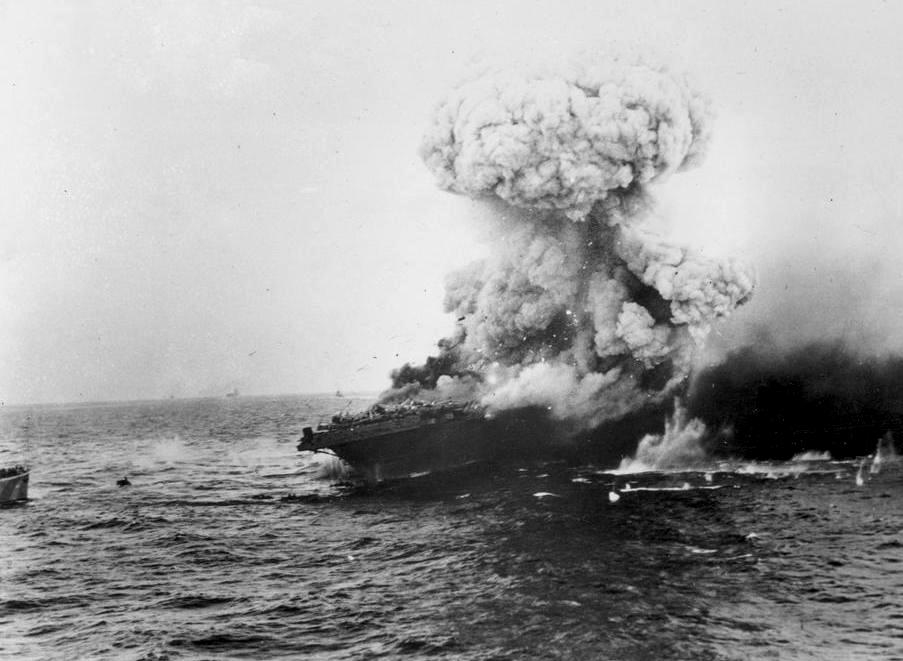
It would be on New Guinea that the Allies first succeeded in stopping the Japanese advance. The first important Allied effort to stop the Japanese sweep through the Pacific occurred in the Coral Sea (May 3-8). The Japanese planned to seize Port Moreseby--Operation MO. This would have completed their conquest of New Guinea. There was also a smaller operation in the Solomons at Tulagi. Port Moresby would have provided a launching pad for an invasion of Australia itself. (At the time, most of the Australian Army was in North Africa fighting Rommel's Afrika Korps.) The Japanese landing force was escorted by the front-line carriers Shokaku and Zuikaku. The Japanese naval task force en route to seize Port Moresby was intercepted by an American carrier force, alerted by American code breakers who were cracking the Japanese naval code--JN-25. The Coral sea was the first carrier to carrier engagement in history. The Japanese launched an attack on the Americans, but found only a destroyer and oilier. In the meantime the Americans sank the Japanese light carrier Shoho covering the invasion fleet (May 7). The next day the two carrier forces fought a major engagement. The Japanese succeeded in sinking Lexington and heavily damaging Yorktown (May 8). The Americans heavily damaged Shokaku and devastated the air crew of Zuikaku. The substantial Japanese pilot casualties was very significant. Despite the American losses, the Japanese invasion force turned back, the first major Japanese reversal of the War. The Japanese assessment of the battle was that not only was Lexington sunk, but that Yorktown was either sunk or so badly damaged that it could no longer be deployed. This affected planning for the Midway operation. The engagement appears to have convinced Japanese naval planners that the American carriers were no mach for the Japanese carriers. The Japanese failed to perceive that the American carriers effectively fought the battle or that the surprise appearance of the American carrier in the Coral Sea to oppose the invasion of Port Moresby resulted from American code breaking. It also meant that they had lost a carrier, and large numbers of planes and pilots. This effectively removed two front line carriers from the Japanese order of battle. This reduced the available carriers for the Midway operation. Combined with the British damage to the First Air Fleet in the Indian Ocean, Admiral Yamamoto had allowed their carrier forces to be significantly weakened in operations of marginal importance. This was critical because if Japan was to win the War it had to be done in 1942 when they had overwhelming superiority in the Pacific. If the War developed into a war of attrition, the far greater industrial resources of the United States would prevail.
The Japanese Greater East Asia Coproperity Sphere was a propaganda concept to gain the support of subject peoples in European Asian colonies. The slogan coined by the Japanese was "Asia for the Asians". The propaganda impage promoted by the Japanese was a grouping of independent Asian nations liberated by Western influences. The Japanese concept was very different, including two basic concepts. First was the racial and cultural superiority of the Japanese people. Second was obtaining access to the resources of the region, especially the petroleum of the Dutch East Indies. As it
And as it function in the areas conquered, the Japanese established puppet governments with the primary purpose of exploiting local resources for the Japanese war effort. The concept originated with General Hachiro Arita, while serving as foreign minister. The Japabese plans were first enunciated by Foreign Minister Matsuoka Yosuke (August 1, 1940). It was a concept long discussed by strategic thinkers in Japan. Influential Japanese educator Fukuzawa Yukichi described his concept of "Japan's Mission in Asia" (1882) jystifying Japanese imperialism and the 'manifest destiny' of Japan to be the leading Asia nation. Secret socities such as the Black Dragon Society and Kita Ikki proved influential, especially among military leaders. The idea of a righteous war to expel Europeans from Asia achieved increasing currency. The concept was essentially Japan displacing the Europeans and not freeing the Asians. As Japanese Word War II conquests unfolded, they were not infrequently met as liberators in the European colonies they conquered. Local populations, however, soon experienced the brutality of Japanese occupiers and enthusism for the Japanese quickly declined.
The Asian colonies occupied by the Japanese soon found out the difference between Japanese propaganda and actual plans. Japanese oaccupation and military leaders proved more haughty and and more brutal than the former European colonial officials. Just how Australia and New Zealand fit into Japanese plans is unclear. Some Japanese theorists argued that the Europeans should be ousted from Australia and New Zealand. The Pacific War launched at Pearl Harbor, however, was a war launched with limited goals. Just what those goals were, however, are not entirely clear and I am not sure the Japanese militarists who launched the War clearly defined them.
After imobilizing the American Pacific Fleet at Pearl Harbor (December 7, 1941), the Japanese swept over southeast Asia and the southwest Pacific, in fact creating the East Asia Co-Prosperity Sphere that stratehic Japanese thinkers had long advocated. The Imperial Navy won a series of seal victories against weak Allied naval forces. After seizing Wake and Guam and Hong Kong the Japanese went after better defended targets. Singapore, the Dutch East Indies, and Philippines and achieved stunning success. The Durch East Indies provided the oil resources that Japan so desperately needed. Malaya and surounding areas provided the bulk of the world's rubber resources. Next the Jpanese focused on New Guinea and seized the western part of the island and northeastern coast. The southern coast was more diffivult because of the rugged Owen-Stanley Mountains which prevented the Japanese from easily moving south from their newly won bases along the northern coast.
Japanese militarists after the stunning successes during the first months of the War debated their next steps. Admiral Yamamoto argued for an invasion of Australia. Other opportunities were Ceylon, a push into India, or possibly joining the NAZIs and striking north into Soviet Siberia. The fascinating aspect of Japanese stratehic thinking is that the obvious target did not receive priority and that was using their enormous naval advantage to focus on what was left of the U.S. Pacific Fleet in Pear Harbor. That the Navy dispatched a fleet into the Indian Ocean and was promoting an invasion of Australia befpre completely destroying the U.S. Navy is difficult to understand. General Tojo was against the invasion of Australia, primarily because of limited available forces. The Imperial Army at the time was heavily commited in China and pushing toward India in Burma. Perhaps more importantly, the NAZIs were preparing for the 1942 summer offensive that might destroy or fatally weaken the Soviet Union. Thus powerful forces had to be maintained in Manchiko prepared to seize Siberia. The Japanese estimated that at least 10 divisions would be needed to take and occupy Australia. Thus Tojo decided that the Japanese should try to knock Australia out of the War during 1942 by Operation FS. [Frei, p. 172.] The objective was to isolate Australia from its only possible source of support--the United States. This lead the Japanese into New Guinea and the Solomons. The Japanese believed that they could then force the Australians to surrender so that the country could be added as another compliant pupet state in their Great East Asia Coprosperiy Sphere. Operation FS involved one a bombing campaign launched by New Guinea based planes. For this Port Moresby was needed. Secondly a naval and air campaign to cut Australia off from the United States. Here bases would be built in the Solomons. The major naval base would be Rabaul, which could sustain a naval campaign to cut the sea lanes with America. Air bases could be built in the southern-most Solomons to support this effort. This would eventually result in the battles over Guadacanal and the Slot.
After seizing control of the Dutch East Indies the Japanese quickly initiated an air campaign attacking the Australian mainland, domestic airspace, offshore islands, and coastal shipping. There were some 100 such attacks (February 1942 - November 1943). The first and deadliest ttacks, was a strike of 242 aircraft on Darwin (February 19, 1942). Some 235 people were killed. There was immense damage, ships were sunk, and Darwin had to be abandoned as an important naval base. Subsequent attacks were smaller in scale and varied, large-scale raids by medium bombers, torpedo attacks on ships, and strafing runs by fighters. In response, the Australians began building air bases in northern Australia. American transports arrived with supplies and equipment, incliding aircraft like P-39 air cobras, and P-40 War Hawks. The Australians began building bases in Northern Australis. This effort had just begun at the vtime of the Coral Sea Bsttle. There was an air base at Port Moresby. The Australians also built an emergency air strip at Hood Point near Port Moresby. We are not entirely sure when it was built, but it appears to have been built and equipped with Air Cobras at the time of the Japanese Coral Sea--MO Operation (May 1942). The nair base nat Port Moresby was both involved in air defense and a in attacks on Japanese force in New Guinea.
Operation Mo ( 作戦 ) was the Port Moresby Operation was code name of the Japanese plan to seize the Australian Mandate Territory of New Guinea (eastern New Guinea) and other adjacent South Pacific targets (such as Tulagi) during the Pacificwar. The goal was to isolate the British Dominions of Australia and New Zealand from the United States. Neither Dominion had the industrial capacity to manufcture heavy or advanced weaponry. MO was developed by the Imperial Japanese Navy before the war. It was part of an overall war plan supported by Admiral Isoroku Yamamoto, the commander-in-chief of the Combined Fleet. The Japanese Navy executed its plan for the the New Guinea Campaign (air strikes against Lae and Salamaua, disembarkation in Huon Gulf, New Britain (Rabaul), New Ireland (Kavieng), Finch Harbor (also called Finschhafen), and the capture of Morobe and Buna). This was achieved with little or no opposition by the Australians--the Mandate country. Japanese strategists envisioned those territories as support points to implement the most important objective--the seizure of Port Moresby. The executiom of these operations was assigned to the Japanese Naval task force led by Admiral Chūichi Nagumo who had led the Pearl Harbor strike. After completing the seizure of the Dutch East Indies with their vital oil resources. The Japanese and Adm. Nagumo shifted the focus to New Guinea. The Japanese seized Christmas Island (March 1942). The Japanese were abled to seize the Island without a fight because the Indian garrison mutinied against their British officers. The American submarine Seawolf damaged the Japanese cruiser Naka. The Japanese Navy General Staff concepulized Operation Mo (1938). Seizure of Port Moresby would provide importnt air bases to bomb Australia and would support the next step--Operation FS to isolate Australia and New Zealand.
The first important Allied effort to stop the Japanese sweep through the Pacific occurred in the Coral Sea. The Japanese planned to seize Port Moresby, completing their conquest of New Guinea and a smaller operation in the Solomons at Tulagi. Port Moresby would have provided a launching pad for an invasion of Australia itself. (At the time, most of the Australian Army was in North Africa fighting Rommel's Afrika Korps.) The Australian Army laid land mines along the shore of the inlet near Port Moresby. Port Moresby indeed was a target. A Japanese landing force was escorted by the front-line carriers Shokaku and Zuikaku with powerful air squadrons headed for Port Moresby.
American code breakers had cracked the Japanese diplmatic Purple code more than a year before Pearl Harbor. The Imperial Navy JN-25 code proved much more difficult. Allied code breaakers, especially Station Hypo at Pearl gradualy began to break into the Imperial Navy JN-25. For the moist part intercepts could be only partially read, but enough to make some sence of Japanese intentions. American and British code-breakers first intercepted Japanese Navy signals which revealed a planned operation toward Australia (March 1942). Code-breakers at Station Hypo led Commander Joe Rochefort poduced a decrypt that revealed a naval force from Rabaul would target Australian controlled areas of New Guinea (April 3). The precise target was not revealed, but Commander Rochefort assessed the targets as Port Moresby and the Solomon Islands. Another decrypt revealed the presence in Truck of a carrier strike force to be used for Operation MO along with the RZP invasion force at Rabaul (April 9). This confirmed the target. British and American code-breakers had previously learned that "RZP" was the Japanese code for Port Moresby. British code-breakers in Ceylon intercepted and decrypted the final piece of the MO puuzzel (Mid-April). The British informed Nimitz that two of Admiral Nagumo's first-line carriers had been temporarily detached from the First Air Fleet--Shokaku and Zuikaku. The Allies now knew that the Japanese naval offensive would be the Coral Sea to the east of Australia's Cape York and the strength of the covering carrier force.
Nimitz finally decided to deploy his carriers to engage the Japanese carriers. This was a risky commitment because the Japanese carriers outnumbered the American carriers. They also were more exoperiebced and had superior aircraft. But he now knew that he could hit two of their carriers and not the entire carrier force could be ebgaged. Nimitz reasoned that the intercepted Japanese messages gave him time to deploy his carriers so as to take on an equivalent Japanese force and with the element of surprise. And surprise and the ability to deliver the first blow was vital in carrier engagements.
Tulagi sometimes called Tulaghi, is a small island (5.5 km by 1 km) in the southern Solomona. It is located just off the south coast of Ngella Sule (Florida Islands). But more importntly was near Guadalcanal. The town of Tulagi was the capital of the British Solomon Islands Protectorate (1896-1942). This ended when the Japanse seizedthe Solomons. Today it is the capital of the Central Province. The capital of what has become the independent Solomon Islands was moved to Honiara, Guadalcanal, after World War II. Tulagi was originally chosen by the British as a comparatively isolated and healthier alternative to the disease-ridden larger Solomon islands. The Japanese seized Tulagi. They immediately set up a sea plane base. The Japanese had nothing like the U.S. Navy Seabees which could very rapidly cut a operational landing strip out of the jungle. A seaplane base, however, could be set up very rapidly as the planes could land well chosen protected waters. American carrier aircraft attacked the new seaplane base on Tulagi (May 4). Important for the future, Tulagi was close to Guadacanal which the Japanese had not yet occupied. The Japanese repaired the damage and began using the seaplane base on Tulagi. After Nidaway and the loss of the carriers, the Japanese decided that they needed an airbase in the southernSolomons to projec air power over the sea lanes est of ustralia. Tey dispatched a largely Korean construction crew to begin working on what would become Henderson field on Guadalcanal.
The Japanese naval task force en route to seize Port Moresby was intercepted by the American carrier force, alerted to the Port Moresby MO operation by American code breakers. It was the first effective American operation against the Imperial Fleet as well as the first carrirer to carrier engagement in history. The Japanese launched an attack on the Americans, but found only a destroyer and oiler. In the meantime the Americans sank the Japanese light carrier Shoho (May 7). The next day the two carrier forces fought a major engagement. The Japanese succeeded in sinking Lexington, but the crew was saved. The Japanese also heavily damaging Yorktown (May 8). The Japanese air crews report that they left both carriers buring and sinking. The Japanese concluded that they had sunk both. The Americans heavily damaged Shokaku and devestated the air crew of . The substantial Japanese pilot casualties, especially from Zuikaku, were very signigicant. It put the carrier out of operation even though it was not damaged.
Despite the American losses, the Japanese invasion force turned back, the first major Japanese reversal of the War. The Japanese unablr to seize Port Moresby by sea, proceeded to launch a land attack, but wre forced to oenetrate some of the most rugged and isolanted erraine in the world--including the formidable Owen-Stanley Mountains.
The Japanese assessment of the battle was that not only was Lexington sunk, but that Yorktown was either sunk or so badly damaged that it could no longer be deployed. This affected planning for the Miday operation. The engagement appears to have convinced Japanese naval planners that the American carriers were no match for the Japanese carriers. The Japanese failed to preceive that the American carriers effectively fought the battle or that the surprise appearance of the American carrier in the Coral Sea to oppose the invasion of Port Moresby resulted from American code breaking. Here Victory Disease was a major factor. From the point of view of the Japanese Navy, Coral Sea had been a success, even though the army amphibious opeation at Port Moresby had to be postponed. But the Japanese thought they had sunk two of the American carriers, most of the Pacific's fleet offensive capability after Pearl Harbor. The loss of a light-carrier, air crews, and damage to Shokaku seem a reasonable cost for such a stunning achievement. What the Japanese do not seem to have focused on is why the American carriers all of a sudden appeared in the Coral Sea to block the Port Moresby operation. The Pacific is a very big place. The chances that the American carriers had encountered the Japanese task force by accident were remote. This can npt be emphasized enough. Readers who have studied navy engagements over time know that the most difficult part of operations in remote areas is finding the enemy fleet. The best example is Nelson chasing around the Mediterreranean looking for Napoleon after he set out for Egypt. It would be one thing for a destoyer or even a cruiser to happen upon the Japanese. But this was two American carriers, the most valuable assets in the Pacific Fleet. For this to occur by chance so far from Pearl would strained the credulity of even the most minimally trained annalyst. Of course a great deal had changed by Wotld War II, but technology had not yet solved the detection problem. Why Yamaoto and Nagumo did not focus on this question is unclear. The reported success in sinking two American carriers may have destracted them. The Japanese later referred to this mindset as 'Victory Disease'. Some in the Imperial Navy suspected that the Americans had broken their codes. A change in codes was overdue, but had been delayed because of of the wide-spread operations that the Navy had had to conduct. Despite the suspicions, senior commanders did not inist on the code change. It proved to be a mistake that would decide the Pacific War.
The Battle of the Coral Sea It also meant that they had lost a small carrier, had a front-line carrier damaged, and lost numbers of planes and pilots. This effectively removed two front line carriers and one small carrier from the Japanese order of battle. This reduced the available carriers for the Midway operation. Combined with the British damage to the First Air Fleet in the Indian Ocean, Admiral Yamamoto had allowed their carrier forces to be significantly weakened in operations of marginal importance. This was critical because if Japan was to win the War it had to be done in 1942 when they had overwealming superiority in the Pacific. If the War developed into a war of attrition, the far greater industrial resources of the United States would prevail.
The Japanese military assessment continued to be that the Unitted States had been so badly battered and that its capabilities to respond to Japanese offenses in force were severly limited. They severly underestimated how rapidly America would mobilize and convert its economy for war. Japanese anaysts fid not forsee an American offensive of any strength until mid-1943. Thus little thought was given by eith the Navy or Army about possible American ofensives. But they wanted to both expand theorouter island defensive shield and complete the conquest of Australia beforeAmerica was in a position to strike back. Thu MO, MI, and FS dominated Japanese thinking in mid-1942 and very little thought to possible American counter offensives.
Midway proved to be the turning point of the Pacific War. Admiral Yamamoto had gabled at Pearl Harbor that Japan could win a quick victory with a decisive blow. That gamble was lost at Midway. It is notable because it was the only major Allied victory in which the opposing forces were superior. Admiral Yamamoto was determined to bring the American Pacific fleet to battle before America's industrial might could redress the strategic balance. Yamamoto reasoned that Midway was an asset of such importance that Nimitz would have to commit his remaining assets to defend it. The Japanese had many advantages. Unknown to them, however, surprise was not one of the advantages. The same American code breaking operation that had learned of the Port Moresby operation also warned Admiral Nimitz that the next target was Midway. Admiral Yamamoto was convinced that the remaining American carriers could be brought to battle and destroyed at Midway. The Japanese plans were based on achieving an element of surprise and on the fact that two American carriers had been destroyed in the Coral Sea, in fact the Yorktown, although heavily damaged had not been sunk. American code breakers had alerted the Americans to the Japanese plans. Admiral Nimitz positioned Enterprise and Hornet, along with the hastily patched up Yorktown northwest of Midway to ambush he Japanese. The American carrier victory at Midway dealt a crippling blow to the Imperial Navy. The Americans sank four first-line Japanese carriers, killing many of the well-trained crews. The weakness of the Japanese in fire safety and fire suppression was notable. While the Imperial Navy still held an advantage, it was no longer an overwhelming one. The stunning American carrier victory at Midway, significantly reduced the strike capability of the Imperial Navy and meant that the U.S. Navy would be able to slug it out with the Japanese in the Solomons (August-December 1942). Meanwhile American shipyards were turning out the new Essex-class carriers that would reach the Pacific Fleet in 1943 and permanently shift the strategic balance.
Operation FS is the designation for seizing South Pacific islands east of Australia (Fiji and Samoa), but like Operation MO, the real objective was Australia. Japan launched Operation MO (early-May 1942). It was possible because most of the British Royal Navy had been withdrawn from the Pacific to fight the Battle of Atlantic with the German U-boats. And the primary British bastion, Singapore, fell to the Japanese (April 1942). The next month, Japanese amphibious forces embarked to seize Port Moresby on the southern coast of New Guinea and Tulagi Island in the southern Solomons. The dates for Operation FS to be launched after Port Moresby and Midway were in Japanese hands were set for New Caledonia, Fiji, and Samoa (July 8, 18, and 21). The First Air Fleet was to be deployed to support the island invasions. The goal was to cut Australian and New Zealand life lines to America. Japanese operations througout the Pacific Wae began with curring off targets from supplies and reinforcement (The Philippines,Mayalya, Singporte, and Burma). This was the srategy adopted for Australia. The Japanese demanded that Australia surrender (January and February 1942). Primeminister Curtin rejected their demands. General MacArthur had escaped from Corredidor and was overseeing the Allied build-up in Australia (March 1942). Men and supplies were streaming out from America. They could not reach the Americans in the Phiilppines, they could reach Australia. The situation was, however, still precarious. The Australian Army was still largely in North Africa fighting the Afrika Korps with the British. General Tojo speaking in the Japanese Diet issued a final warning to Australia (May 28, 1942). One historian explains, "Japan was now tightening the noose on Australia." [Frei, p. 172.] Shortly after Japanese midget submarines staged an attack on Sydney Harbor (May 31). The failure of Operation MI with the First Air Fleet's loss of four fleet carriers at Midway (June 4) radically changed the balance of forces in the Pacific and prospects for FS. Midway meant that Japan's desimated First Air Fleet was no longer had the capability of supporing FS. So the Japanese placed a greter emphasis on seizing islands and building air fields to help sever the all important sea lanes with America. It is at this time that Guadalcanal enters into history. The Japanese chose the southern-most island in the Solomons as the location of a key air base--Guadalcanal. And Japan at the time still had the naval, air, and army forces to seize the FS islands. The issues would be resolved on Guadalcanal by outnumbered and poorly supplied Marines and a series of fierce naval battles fought by the battered U.S. Navy around Guadalcanal -- before the large number of ships underconstruction in American shipyards had begun to reach the Fleet.
When the Japanese Operation MO naval landing forced was turned back, the commnder involved was censured. The Japanese remained focused on Australia nd the need to seize Port Moresby. The Miday disaster mean that an amphibious assault was now questionnle. rather than bandon their goal, the Jonese dedcided on an overland assault over the formidable Owns-Stanley Mountains. This made it impossible for the Japanese to strike quickly or deploy the considerable strength along the northern coat. They were first opposed by Australian Militia battalions. The young Australians involved in the defense of Port Moresby had little training. Neverless they resisted supperior Japanese forces attempting to advance along the Kokoda Track. The further the Japanese advnced, the more accoplished the Australians became and the better the supply situation became. The New Guinea bearers were a major source of support. As for the Japanese, losses were not replaces and the supply situation worsened. The New Guinea bearers disappeared into the jungle. The Australians managed to hold back te Japanese just short of Port Moresby. They were finally relieved by the Second Australian Imperial Force, brought back from North Africa (August 1942). Very few of the Japanese soldiers who advanced up the Kokoda Trail survied the ordeal and made it back to the northern coast.
Frei, Henry. Japan's Southward Advance and Australia.

Navigate the CIH World War II Section:
[Return to Main World War II naval campaign page]
[Return to Main World War II South Pacific campaign page]
[Return to Main World War II page]
[About Us]
[Aftermath]
[Biographies]
[Campaigns]
[Children]
[Countries]
[Deciding factors]
[Diplomacy]
[Geo-political crisis]
[Economics]
[Home front]
[Intelligence]
[POWs]
[Resistance]
[Race]
[Refugees]
[Technology]
[Totalitarian powers]
[Bibliographies]
[Contributions]
[FAQs]
[Images]
[Links]
[Registration]
[Tools]
[Return to Main World War II page]
[Return to Main war essay page]
[Return to CIH Home page]