|
World War I began as a war of movement, but after the Miracle on the Marne became a war of attrition as the Aliies and Germans built a parallel system of trenches from the Swiss border to the English Channel. New weapons such as the machine gun, poison gas, tanks, and airplanes appeared, but the war was largely an infantry war, decided by the superior resources of the Allies and the arrival of the American infantry. The horrors of trench warfare caused military planners to focus on new weapons to restore mobility and to avoid a future war resulting in mass losses of foot soldiers. It was the Allies that developed tanks and won the World War I air war. It was the Germans, however, that after the War gave the greatest attention to developing new weapns, especially the tanks and air planes that would dominate the World War II battlefield. Other countries also worked on these weapons, but the NAZIs after seizing power (1933) launched upon a massive military spending program that provided them for a ime the world's most poweful air force. German commanders also conceived of an inovative method of effectively employing the new weapons, a combined arms tactic which has come to be known as Blitzkrieg. The NAZIs seemed to have believed that racial superiority meant that Germany would be able to create the most poweful weapons. I am not sure Hitler believed this, but his strategy was to divide potential enemies and striking before his targets were prepared for war. Unfortunately his failure to defeat Britain and the Soviet Union meant that major industrial powers had the time to develop weapms that could match the Germans and the industrial power to produce them in quanties beyond the capability of Germany, But it was not just tanks that were needed for mobilr warfare, it was other tracked vehicles and the prosaic truck. Blitzkrieg not only involved panzers to pierce the enemy front line. Tanks were vulnerable. They needed infantry soldiers to protect them as well as to exploit the gaps opened in the enemy line. And the infantry as well as the needed supplies had to move as rapidly as panzers. The Wehrmacht, however, was not fully motorized. It did not have the trucks needed to fill the logiistical demand of Blitzkrieg. This weakness was not immediately apparent in the short early campaigns conducted on relatively small areas. This changed dramatically with the invasion of the Soviet Union (June 1941).
What Hitler and the Japanese failed to fully assess in launching World War II is that two factors are involved in a war economy. First, is developing weapons systems. Second is the industrial capacity to produce them in meanginful numbers. And in this regard, Germany and Japan was seriously weak. It is one thing to develop modern weapons, but that is meaningless without the industrial capacity to produce them. Hitler was not unaware of the potentuial power of the United States and thus pursued policies to keep America neutral and provided support to American isolationists. The Japanese made another calculation. They concluded that martial spirit was even more important than industrial producrion. Hitler and the Japanese were so intent on war, that they decided to gamble. They calculated they could win the War quickly before the industrial capacity of their opponents could be mobilized. Hitler suceeded with France, but failed with the other major industrial powers (America, Britain, and the Soviet Union). The Japanese despite their spectacular successes never even threatened the industrial base of their adversaries. They thus were left to fight a war against an industrial giant. The result for both Germany and Italy was national destruction.
Optimal tank operating environment is flat or rolling ground without natural barriers to slow the tank or to create defensive positions. Flat terraine allows the tank to fully exploit one of its major features--mobility. This explains in part why all the great tank battles of World War II were all fought in Europe, primarily Eastern Europe. There were no important tank battles during the early years of the War before Hitler invaded the Sovoet Union. The early German victims except the Czechs did not have important tank formations. The Czechs, however, chose not to fight after the British and French deserted them. The French did have tanks, but French military doctrine was to divide them up to support infantry divisions rather than combine them into powerful armored divisions like the German Panzers. There were tank battles in the flat treeless environment of North Africa, but the numbers of men and ranks was relatively small. The primary importance of North Aftica is that Rommel essentially taught the British and Americans how to conduct modern mechanized warfare and effectively use their tanks. It was a painful lesson, but it was larned in a combat environmebt that the Germans did not have the strength to win. All the great armored battles were fought in the Bloodlands of Eastern Europe on the great Russian/Ukranian Steppe. The ultimate tank battle was of course fought here--Kursk (July 1943). Here enormous numbers of men and tanks were pitted in remorseless battle on flat terraine. The battles included the best tanks of the War, the Soviet T-34s and KV-1s and the German Panthers. And because of the huge extent of the battlefield and the relatively small size of the oposing air forces, the battles were often primarily tank on tank backed with anti-tank guns. There were of course tanks employed in the West with the D-Day landings. There were not, however, pitched battles between Allied and German tanks. The number of German tanks in the West by 1944 were limited and any attempt to mount massed armored attacks were disrupted by American air power. The Sherman M-4 tank had a number of attributes, especially numbers and mobility, but it was not on a par with the German tanks. American artillery and personal anti-tank weapons also impaired German armored attacks. The Brokage country of Normandy, especially the Hedgerows, prevented the Americans from using their superior number of tanks to break out. The open country of France beyond Normandy provided much better tank ground for armored warfare. And the limitations of the Sherman were made up for by American airpower. Only supply limitations and the Rhine stopped the Allies in 1944. There were no tank battles of any importance in the Pacific. The Chinese did not have tanks and the Japanese tanks were very poor. They could be used effectively against the Chinese, but not effectively against the Allies. The combat environments of Southeastern Asian juggle and Pacific islands were not optimal for tank operations. Tanks were used, but there were no pitched tank battles as was the case in Europe. The only one was on Sapan, but it was miniscule by European standards.
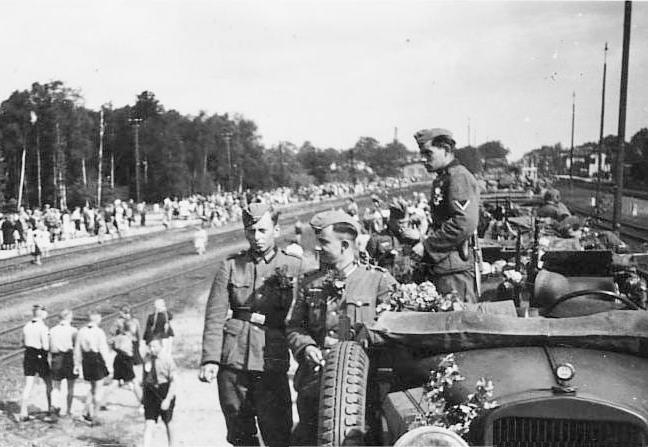
Since time immemorial mobility had been a critical factor in warfare. The introduction of the horse revolutionized warfare (2000 BC). This did not change for millenia. The first major change was the railroads (mid-19th century). Next came wheeled/tracked vehiles. Both the railroads and vehicles required industrial economies. The British inroduced tanks and the Americans trucks in World War I. The Germans lagged in both areas because of limited industrial capacty and lack of petroleum resources. The Axis powers led by Germany decided on war even though they continued to lag in both areas, industrial capscity and petroleum resources. After the fall of France, Germany developed the reputation for the most modern military in the world with rapidly moving tanks slashing through enemy defenses. Thismade he headlines. Lost in the headlines ws the need for trucks to supply the anks and motorized infntry. In reality, Britain had the only fully mechanized army at the time of World War II and the French had excellent tanks. What the Germans had was a superior combat doctrine--doctrine. This brought them victory in the West (1940) and command of much of Continental Europe. But it did not change the fundamental weaknesses. Germany did not have the industrial capacity to fully mechnize its army. Nor the petroleum resources to adeuately supply its military. The expansion of the German Grossraum did not change this as it did not huge change the country's industrial capacity, in part because it ctually weakened the energy situation. The only action that would fundamentally change the fundamental weaknesses of NAZI Germany was to destroy the Soviet Union and seize its resources. But the Whermacht that was sent into the Soviet Union in the Barbarossa offensive has to do so with inadequate petroleum resources and an inadequate fllet of trucks, cobbeled together from German trucks and cars and trucks seized from the occupied countries. The Germans had to rely heavily on hrses to both move artillery and supplies. And failing to defeat the Red Army in a short summer campign as Hitler expected, the Whermacht had to slog it our with the Red Army and Western Allies that had the industrial capacity to provide their armies the mobility that the wehrmacht could only dream at.
World War I began as a war of movement, but after the Miracle on the Marne became a war of attrition as the Aliies and Germans built a parallel system of trenches from the Swiss border to the English Channel. New weapons such as the machine gun, poison gas, tanks, and airplanes appeared, but the war was largely an infantry war, decided by the superior resources of the Allies and the arrival of the American infantry. The horrors of trench warfare caused military planners to focus on new weapons to restore mobility and to avoid a future war resulting in mass losses of foot soldiers. It was the Allies that developed tanks and won the World War I air war. It was the Germans, however, that after the War gave the greatest attention to developing new weapns, especially the tanks and air planes that would dominate the World War II battlefield. All the major countries worked on moderizing werapons, but the NAZIs after seizing power (1933) launched upon a massive military spending program that provided them for a ime the world's most poweful air force. It was, however, a tactical or ground support airforce. Germany did not have the industrisl capcity to build a strategic air force. Germany developed many of the highest quality, most techically weapons used during the War. The problem for the Germans was that many of their weapons were complicated and difficult not only to mass produce, but to maihntain in the field. In addition, Germany did not have the same industrial capacity as the Allies (America, Britain, and the Soviet Union). And the NAZIs found to their horror that other countries could develop effective military weapons and in far greater quanities than Germany.
The Germans not only began rearming by building weapons, but once the weapons had begun to roll off assembly lines, they reintroduced conscription (1935), the critical step in Hitler's preparations for war. It was a flagrant violation of the Versailles Treaty, but neither Britain or France reacted beyond inefectual diplomatic protests. This is when they could have raected, failing to do so meant that war was inevitable as soon as the Wherrmacht was armed and trained. Germany had many weaknesses that had to be overcome in waging another war, including limited industrial capacity and the klack of natural resources, including iron ore and oil. But a often overlooked weakness was that few German boys, bith city and farm boy, had experience with motorized vehicles, either driving or maintaining the engines. As World War II would be a war of movement, opearting and maintaing mototvehicles from jeeps to tanks aswell as aircraft and naval engines would be a vital part of the war effort. The Germans addressed this problem by creating a special unit of th Hitler Youth (HJ) to train motor vehicle specialists--the Motor HJ. While less well known than the Fliegr (air) and Marine HJ specialized units, they non the less played an importantb role in Germany's preparations for war and what would become gthe greatest military conflict in human hisrory, the war in the East. Here vast numbers of motorized military vehicles were reeded as the Whemacht and Red army fought igt out on the vast Eur-Asian Steppe. As drivers and mechanics were needed in large numbers. This was a special problem for the Germans as so few young men had grown up around cars and other motor vehicles and the Whermacht used such a hodgepodge of vehicles and engines in the East. America as late as 1941 had not mobilized for war. As the Panzers neared Moscow and the decisive battle of the War would be fought, the vast armadad of American motor vehicles needed to fight the war did not yet exist. What did exist was the largest reservoir of mechanically savy talent in the world--American youth. More Americans knew about motor vehicles, both how to drive them and even more importantly, how to maintain and repair them, than the mechanics in all the rest of the world combined--something rarely mention in World War II histories.
World War II soldiers in addition to weapons were issued with a range of equipment. This mean items issued in combat environments, but often not part of the standard uniform. Here there is some crossover with the soldier's uniform. The most obvious piece of equipment was the helmet which can also be considered an uniform item. The steel helmet is a piece of equipment that first appeared in World War I. And the various styles are the single most important piece of equipment which can be used to idntify soldiers. All the major combatants had different styles. They were in several instances the same as World War I (Britain, France, and Germany). Two countries introduced entirely new style (Soviet Union and United States). Other imprtant pieces of personal equipment include basically the same as World War I. Another imprtant item was webbing including various types of load carrying items such as belts and suspenders. It was important for the soldier to carry a range of items , but thirthat his hnds be free to handle his weapon. The web belt was especially important innovation. It was not entirely new in World war II, but became standard issue durin the War. Webbing in World War II tended to replace leather items commonly used by soldiers through World War I. Webbing was less expensive and more useful for a range of purposes. Particularly important items to carry in the field were haversacks/packs, canteens, ammunition carriers of different types, and cannisters. Many of these items had holders whih could be attched to the webbing, especially the belt. We note a lot of German trrops carrying cilindrical cannisters. This seems an item especially characteristic of the Germans. Banoliers were also used. Other imprtant pieces of personal equipment included entreching tools and gas masks.
It was the Germans who first conceptualized and employed how to most effectively use the new weapons systems (especially tanks and aircraft) developed during World War I. German commanders srtuggling to explain why they lost World war I, conceived of an innovative method of effectively employing the new weapons, a combined arms tactic which has come to be known as Blitzkrieg. In many was Blitzkrrieg involved employing the new weapons in the historically aggresive tactics and high mobility of the Prussian Army. The NAZIs seemed to have believed that racial superiority meant that Germany would be able to create the most poweful weapons. We are not sure Hitler believed this, but his strategy was to divide potential adversaries and striking before his targets were prepared for war. Unfortunately his failure to defeat Britain and the Soviet Union meant that major industrial powers had the time to develop weapons that could match the Germans. And the entry of the United Srtates into the War meant that the enemies Hitler created had had the industrial capacity to produce weapons in quanties beyond the capability of Germany, beyond rge capacity Germany could only dream of building. But it was not just tanks that were needed for mobile warfare, it was other tracked vehicles and the prosaic truck. Blitzkrieg not only involved panzers to pierce the enemy front line. Tanks after the early Blitzkrieg victories proved vulnerable. Infantry weapons were developed allowing a single infantryman or pair to destroy a rtank. Tanks thus needed infantry soldiers to protect them as well as to exploit the gaps opened in the enemy line. And the infantry as well as tanks needed supplies that had to move as rapidly as panzers. The achelies heel of the Wehrmacht was that 1) it was not fully motorized and 2) Germany lacked domestic petroleum resources. The Wehrmacht did not have the trucks needed to fill the logiistical demand of Blitzkrieg. This weakness was not immediately apparent in the short early campaigns conducted on relatively small areas. This changed dramatically with the invasion of the Soviet Union (June 1941) and the declaration of war on the United States (December 1941). Barbarossa was Hitler's supreme gamble and it failed lsrgely because of the Whermacht's logistical weaknesses. It was Germany's undefeated adversaries that had the industrial capacity to build both armored vehicles andctrucks in huge numbers. The United States mot only supplied vehiches in large numbers to its own military, but to the Allies as well. While the Wehrmacht did not have the mobility needed for Blitzkrrieg against an adequately prepared abn armed opponent, the armies fiekded by the Allies did. The Soviets were not impressed with American tanks, but they were with American trucks. The NAZIs in 1944 stull held much of Europe, but the fully mobilized Allied armies in the east and west by the end of the year with the mobility provided by American trucks brought the war to the borders of the Reich.
Defensive fortifications in warfare hav been important since the first city walls appeared in ancient Mesopotamia. Their importance varied overtime as technology changes. Gunpowder and artillery amdse the meieval castle obsolete. Some countries needed fortresses more than others. China needed protection from the foierce warriors of the Steppe and built the Great Wall. The United States had two oceans and a long history peaceful relatiins with Canada. Countries bordering on Germany had more need of defensive emplacements. The Czech's built a defensive line in the mountenous Sudetenland. The British and French abandoned the Czechs, however, and they were forced as aesult of the Munich Conference to turn it over to the Germans (October 1938). The World War I trench system proved virtually impossible to breach during World War I. As a result, the French built the Maginot Line. A substantial portion of the French military budget went intombuilding it. It was actually never tested. The Germans simply went around it, striking through Belgium. Surprisingly given the German victory over France and the limited value of the Maginot Lines, the Germand who began the War with Blitzkrieg proved to be the grestest builders of the War. Hitler became a great advocate of concrete and steel defensive emplacements. The most extensive of all ws the Channel Islands, surprising because they were of no military value. The major project of course was th Atlantic Wall, pillboxes, protcted gun positions, beach defenses, and other measures. Despite the emense concrte and steel construction. The Atlantic Wall only held the Allies up 4 hours. The Gothic Line in Italy was more of an ad hocand included emplaced tank turents. The final German defensive line constructed by the Germans was the West Wall. There were also special-purpose fortificatiuins, including U-boat pens, V-weapon sites, and flak towers. [McNab] The Japanese also built defensive positions after the destruction of their carrier force and the Americans began cutting off their Pacific island garrisons. They turned these islands into defensive bastions bristling with guns defensive entrenchments, hoping that a well-armed garrison could defeat an amphibious landing force. The most impressive was Iwo Jima which was turned into one massive underground fortrress. Iwo was honeycombed with undergound bunkers and gun emplcements. These well-entrenched garrisons proved capanle of bleeding the Americans, but not defeating the landing forces. On Iwo, the Americans suffered more causualties that duing the D-Day landings that breeched the Atlantic Wall. At Okinawa the JapanesecausedOn Okinawa they built the Suri Line.
McNab, Chris. Hitler' Fotresses:

Navigate the CIH World War II Section:
[Return to Main World War II technology: combat environments]
[Return to Main World War II technology/tactics page]
[Return to Main World War II page]
[Biographies]
[Campaigns]
[Children]
[Countries]
[Deciding factors]
[Diplomacy]
[Geo-political crisis]
[Economics]
[Home front]
[Intelligence]
[POWs]
[Resistance]
[Race]
[Refugees]
[Technology]
[Bibliographies]
[Contributions]
[FAQs]
[Images]
[Links]
[Registration]
[Tools]
[Return to Main World War II page]
[Return to Main war essay page]