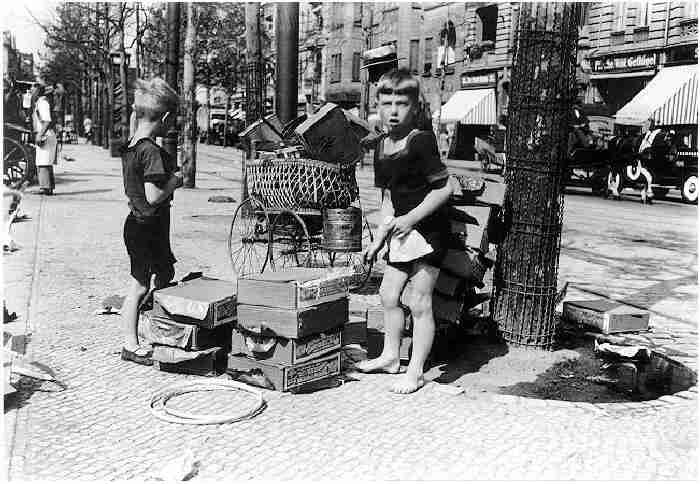
Figure 1.--German children were severely affected by their parents' economic perdicament, especially their fathers losing their job. Here two children are collecting paper or anything else they can find after a Berlin stree market in 1929. |

|
The Depression played an important role in the NAZI sizure of power and in the image that Hitler built in Germany once he seized power. Tragically for Germany, the most serious period of the depression followed the New York Stock Market crash (1929) through Hitler's seizure of power (1933). The impact on Germany was especially severe because the German financial situation was still fragile and depended to a great extent on the United States. In addition to the pain and suffering of unemployment. Germany had an important export sector. Thus when the Anmerican and other European countries experienced an economic decline, export orders dried up. German companies began laying off workers. Many middle-class families had savings to fall back on, but this was less true of working-class families. This meant families unable to oay for the bare essentials. The Depression had a profound phsycological impact on many Germans. There was briefly hope in the mid-1920s that Germany was recovering and the propsperity of pre-War Germany could be gained. The Deression dashed these hopes for many. And there was concern not only for the immediate problems, but many Germany believed to despair of the very idea of progress. They not only became convinced that the prosperity of pre-War Germany was irevocably lost, but that Germany was on a downward spiral giving rise to concerns over the future and an all pervasive insecurity. [Gilbert-Large, p. 241.] This provided fetile grounds for the growth of political extremism and their programs of massive political and social change as well as demogogery and scapegoating. The Depression reached crisis levels in Germany (1931). The Austrian Keditanstalt failed declared insolvenct (May 1931). This was the most important bank in Austria. Concerned that there money was not safe, Germans began withdrawing money from their banks, many of which also became inslovent and had to close. Germany more than any other European country was affected by the American financial crisis. American loans were a major factor in Germany's economic recovery by 1925. Amerivan banks had also made substantial loans to German companies. Low wages in Germany had enabled companies to offer high interest rates to obtain short-term loans. Reichbank President Schacht had advised against financing through high-interest short term loans. Since the Stock Market Crash, American banks began demanding their loans repaid and refused to grant further credits. [Gilbert-Large, p. 243-44.] The resulting finacial crisis was disastrous for many Germany companies, a number of which were forced to close. Unemployment skyrocketed. And desperate people were likely to turn to the extremist parties offering drastic action to address the economic crisis.
The Depression played an important role in the NAZI sizure of power and in the image that Hitler built in Germany once he seized power. Tragically for Germany, the most serious period of the depression followed the New York Stock Market crash (1929) through Hitler's seizure of power (1933). The impact on Germany was especially severe because the German financial situation was still fragile and depended to a great extent on the United States. Germany had an important export sector. Thus when the American and other European countries experienced an economic decline, export orders dried up. German companies began laying off workers. There were 0.7 million unemployed before the Wall Street crash (September 1928). This increased to 1.3 million (September 1929) and 3.0 million (September 1930). Most, though not all, of the unemployed were male as most married women did not work outside the home, were homemakers. These men were family men who now had no way of supporting their families. And they desperately needed money for food, coal to heat the home, clothes, and other essentials. Families were unable to pay for the bare essentials. Many middle-class families had savings to fall back on, but this was less true of working-class families. They might be able to make do
for a few months, but when the Depression extended more than year and only got worse caused real desperation.
In addition to the pain and suffering of unemployment. The Depression had a profound phsycological impact on many Germans. There was briefly hope in the mid-1920s that Germany was recovering and the propsperity of pre-War Germany could be gained. The Deression dashed these hopes for many. And there was concern not only for the immediate problems, but many Germany believed to despair of the very idea of progress. They not only became convinced that the prosperity of pre-War Germany was irevocably lost, but that Germany was on a downward spiral giving rise to concerns over the future and an all pervasive insecurity. [Gilbert-Large, p. 241.] This provided fetile grounds for the growth of political extremism and their programs of massive political and social change as well as demogogery and scapegoating.
The Depression reached crisis levels in Germany (1931). The Austrian Keditanstalt failed declared insolvenct (May 1931). This was the most important bank in Austria. Concerned that there money was not safe, Germans began withdrawing money from their banks, many of which also became inslovent and had to close. Germany more than any other European country was affected by the American financial crisis. American loans were a major factor in Germany's economic recovery by 1925. Amerivan banks had also made substantial loans to German companies. Low wages in Germany had enabled companies to offer high interest rates to obtain short-term loans. Reichbank President Schacht had advised against financing through high-interest short term loans. Since the Stock Market Crash, American banks began demanding their loans repaid and refused to grant further credits. [Gilbert-Large, p. 243-44.]
The finacial crisis was disastrous for many Germany companies, a number of which were forced to close. Unemployment skyrocketed. The unemployment roles reached 4.4 million (September 1932, 5.1 million (September 1932) and 6.1 million (January 1933). And desperate people were likely to turn to the extremist parties offering drastic action to address the economic crisis.
Davidson.
Gilbert, Felix with Duncan Clay Large. The End of the European Era, 1890 to the Present (Norton: New York, 1991), 598p.
Hanby, Alonzo. For the Survival of Democracy.

Navigate the Boys' Historical Clothing Web Site:
[Return to Main German Depression page]
[Return to Main World War II economic page]
[Return to Main World War II page]
[Introduction]
[Activities]
[Biographies]
[Chronology]
[Clothing styles]
[Countries]
[Bibliographies]
[Contributions]
[FAQs]
[Glossaries]
[Images]
[Links]
[Registration]
[Tools]
[Boys' Clothing Home]