|
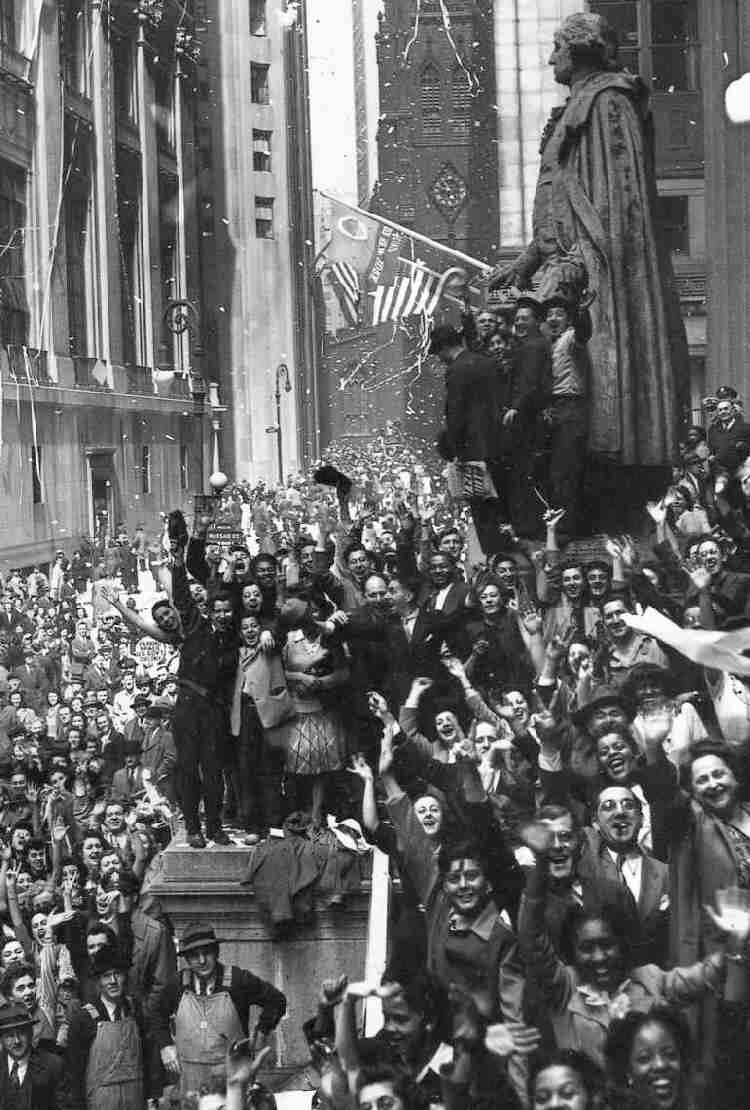
News of the German surrender was immeiately broacast around the world. Celebrations ensued throught Europe--except of course Germany. Celebrations occurred in the major Allied countries. The VE celebrations in America lacked one great figure--President Roosevelt who had played such an important role in being about the Allied victory. President Roosevelt suffered a heart attack shortly before VE Day. President Truman in a radio address to the nation dedicated the victory to the memory of the former president. It is sad that the President was not able to travel to Britain to celebrate the grat victory with Prine-minister Churchill. Flags in America were still at half-mast. President Truman in his remarks said that he wished "Franklin D. Roosevelt had lived to witness this day." He told the American people, "Our rejoicing is sobered and subdued by a supreme consciousness of the terrible price we have paid to rid the world of Hitler and his evil band. Let us not forget, my fellow Americans, the sorrow and the heartache which today abide in the homes of so many of our neighbors whose most priceless possession has been rendered as a sacrifice to redeem our liberty. If I could give you a single watchword for the coming months, that word is work, work, and more work. We must work to finish the war. Our victory is only half over," referring to Japan which was still holding out. Joyous celebrations broke out thougout the country. Raucous celebrations were reported in major American cities, especially Chicago, Los Angeles, Miami, Philadelphia, San Francisco, and especially in New York City's Times Square. Thousands thronged ito Times Square. New Orleans looked like Mardi Gras with citizens dancing in the streets. Church bells rang in both small towns and major cities. One American newspaper reported, "After shadow boxing for a couple of weeks with rumors, news scoops, and unconfirmed announcements, Cincinnati is expected to receive the official announcement of V-Day with a minimum of excitement." President Truman's announcement came almost as "an anticlimax after yesterdays almost official announcement of victory." [Cincinnati Enquirer] It was not only the big cities that celebrated. There were smaller celebrtions throughout the country.
Cincinnati Enquirer (May 8, 1945).

Navigate the Boys' Historical Clothing Web Site:
[Return to Main World War II Victory in Europe Day national celebrations page]
[Return to Main World War II Victory in Europe Day page]
[Return to Main World War II essay page]
[Introduction]
[Activities]
[Biographies]
[Chronology]
[Clothing styles]
[Countries]
[Bibliographies]
[Contributions]
[FAQs]
[Glossaries]
[Images]
[Links]
[Registration]
[Tools]
[Boys' Clothing Home]