**
war and social upheaval: World War II strategic concepts
World War II: Strategic Concepts
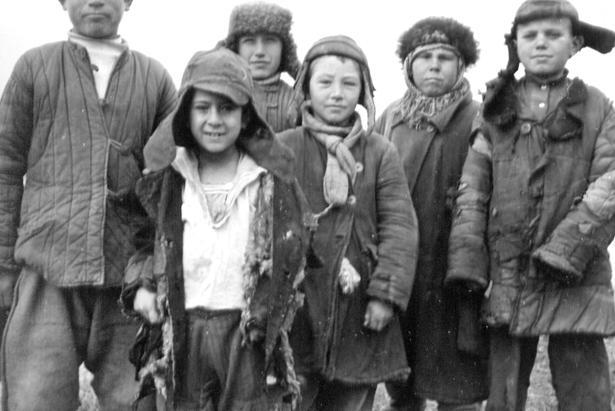
Figure 1.--Anglo-Americans generally focus on the campaigns in the West. It was, however, in the East that World War II was decided. Hitler and conceived years before the War, even before seizing power that Germany's future lay in Lebensraum that could only be achieved in the East. It was the agicultural and mineral resources of the East that would make Germany invulnerable and able to fight a war against the Anglo-Americans alliance. The British Empire and the United States had enorous resources. With the resources of the East, Germany could at last match the Anglo-Americans. This was Hitler's central srategic concept of the War. While Hitler wanted the resources of the East, he did not want the Slavic and Baltic people living there like the boys here. The SS developed Generalplan-Ost to resolve the problem. Essentially one third of the popultion would be killed. one-third driven beyond the Urals (and largely perish), and a third subjected to Hellot-like slave labor. The Holocaust was essentially a small-scale dress rehersal for what Hiler and the NAZIs planned.
The two countries most responsible for launching World war II were NAZI Germany and the Soviet Union. Both countries began the War by invading Poland as Allies (September 1939). As it was, Japan would have never attacked Britain, let alone the United States had the Germany not achieved enormous military successes in Europe. Luckily for the world, the goals of the Soviet Union and Germany fundamentally conflicted. The strategies adopted by the principal combatant countries are not entirely known. This in part because German and Soviet strategy was entirely devised by Hitler and Stalin who only shared his plans with a small number of associates and then often not in complete detail--especially Stalin. After the bloodletting of World War I, few in Europe wanted war. This was true in Germany as well. Hitler did spell out his strategic vission in Mein Kampf. World War II was essentially the creation of German Führer Adolf Hitler who and Soviet dictaor Joseph Stalin who were prepared to go to war and invade other countries. Geography meant that only Hitler would confront the Western democracies. Major decessions by Hitler were made on the basis of largly imagined racial doctrine. Combatant decessions were also made on the basis of very poor understanding of their adversaries. Hitler appears to have diverged from basic military doctrine as he seems to have convined himself tht NAZI propaganda of German sperority was correct. Americans badly under estimated Japanese capabilities. The Japanese for their part deasically understimated the American character and the potential of American industry.
America
America's strategy in World War II was greatly complicated by the desire of the American people to avoid war and failure to recognize the mortal danger posed by NAZI Germany. From the very beginning of the Rossevelt Administration, the President saw Hitler and NAZI Germany as the greatest threat to the United States. The rise of Japanese militarism was seen as a secondary threat. As Europe moved toward war in the 1930s, President Roosevelt hoped that America could stay out of the War and meerly support Britain and France with supplies and equipment. The German victory in the West and the fall of France (1940) ended thisapproach. This meant that America would have to save Britain or face the prospect of fighting the NAZIs without allies.
before Pearl Harbor, President Roosevelt and his military advisers like General Marshall were convinced that America must focus on the war in Europe and defeating NAZI Germany. Roosevelt play a key role in the defeat of the NAZIs when he took the enormous political risk of supporting Britain in an effort to keep her in the War. Japan's attack at Pearl Harbor brought America into the War, but complicated the Europe first doctrine. The President would have had difficulty convincing the american people to concentrate on NAZI Germany when attacked by Japan. Fortunately Hitler solved the President's quandry by declaring war on America a few days after Pear Harbor. America's basic strategy against Germany was first to participate in the strategic bombing campaign that Britain had already begun and second to launch a cross-channel invasion. Here there were differences between America and Britain. American military commanders wanted an invasion in 1942 and then 1943. There is considerable reason to believe that had America attempted toinvade France in 1942 or even 1943 that the invasion would have failed. Here Churchill's caution probably prevented dissaster. hile delayed, the central American comcept was to take the shoertest route into the heart of Germany, cross the Channel and drive east.
Britain
Britain did not want a war and as a result, when it arrived was ill prepared for it. The British were determined not to repeat World war I where a whole generation fell in mass battlefields. Rather the concept was to wage a technological war, using sea and air power. The British reinstituted a naval blockade seeking to deny raw materials to the German war industries. This was ineffective at first because the Germans could loot material from the occupied countries and as a result of the NAZI-Soviet Non-Agresson Pact, the Soviets delivered huge quantities of strategic materials to Germany. The Navy permitted the British to marshall the resources of the Empire, but the fall of France significantly shifted the strategic ballance. The British planned to employ aerial warfare to destroy German war industries, but were hesitant to do this in the early monts of the War. After the fall of France the ability to reach Germany was severly restricted until more modern bombers could be built. After the fall of France, the basic British strategy was to hang on until America entered the War. Here Lindburg and the Isolationists were correct. This was precisely what Churchill hoped. What the American isolationists did not understand was that Hitler intended to wage war and that fighting the war without a British ally would have been a closal strategic blunder. President Roosevelt kept Britain in the War through Lend Lease. Hitler appears to have reached the conclusion that with American support he could not defeat Britain and that the potential of Soviet power was a factor in keeping Britain in the War. This appears to be more rationaslization. What he wanted frim the beginning was land in the East for Lebensraum. Churchill was quck to offer aid to the Soviets when Hitler invaded. Even so, without America as an active partner, however, Britain could have never rentered the European continent. The Japanese resolved this impasse when they attacked Pearl Harbor.
China
China was not a modern country in 1937. It's military forces were weak. Corrupt generals siphoned off the limited funding for the military. The Japanese Army sliced through Chinese units in the initial battles with desestating efficency. And China was divided by an internal Civil War. Chang's response was to withdraw into China's vast interior where the Japanese would find it difficult to bring their military supperority to bear on the Nationaist Army. As a result, the Japanese found themselves bogged down in China. The bulk of their Army was committed there. They controlled the major population centers, but were unable to get at either the Nationalist or Communist rmies in the interior. The Chinese strategy became one of just holding out until the Japanese tired of the war and seeking help from the Allies.
France
France based its strategic doctrine on the Maginot Line, named after a Minister of Defense. Huge sums were spent on a series of fixed defenses along the German-French border. It was essentially the same as British thinking -- avoid actual combat. Let the Germans expend their forces in trying to break through the Maginot Line. Whatever the defenses, an Army with an ethos of avoiding combat is unlikely to perform well when war arrives. Based on World War I experiences, they would suffer huge losses. And then as the Allied naval blockade gradually ruibed the German economy and food shortages developed, Germany would implode as it did in World War I. A key weakness in French defense thinking was that the Maginot Line ended at the Belgian border. Incresibly, the Fremch seem o thonk that Hitler and the NAZIs would respect Belgian neutrality. France built tanks, but devloped no effective concept for using them. The French militry also hasd an antiquate system of basttlefield communications. France was especially defecit in developing a modern airforce, again not in aircraft, but teactical doctrine and communications.
Germany
Hitler's strategy for his war was to pursue the same strategy that he had pursued in his rise to power, namely to divide his enemies and defeat them one by one. Central to this concept was to avoid a two front war. Heb ad said over and over that this was the Kaiser's great mistake. Thus the NAZI-Soviet Non-Agression Pact was central to the successful launching of his war in Europe in cooperation with Stalin (September 1939). This allowed him to attack Poland having accurately assessed that Britain and France would not attack in the West. He did, however, mistakingly believe that the British and French would not declare war. Having defeated Poland, the Non-Agression Pact (actually a pact to allow both totalitarian dictatorships to commit aggression with abandon) with the Soviets not only left Hitler free to strike in the West, but provided Hitler the oil and other resources he needed. The highly effective Blitzkrieg tactics effectively using tank and air formations achieved a spectacular success. One author down plays the importance of Blitzkrieg. [Mosier] Only the Channel and American support saved Britain. At this stage of the War, flush with spectacular successes, Hitler diverged from the basic strategic concept that has guided him — to avoid a two-front war. There seems to be sharp dichotomy between Hitler's strategic decision making behavior before and after his great achievement — the fall of France. After the fall of France, Hitler seems to have concluded that the War was won and that caution was no longer necessary.
He was now convinced that the Germans were indeed supermen and that he was a military genius that could overcome any remaining obstacles. It is incredible that Hitler's decisions leading up to the fall of France were invariably successful. After defeating France his decisions were almost invariably wrong. Within the space of 6 months he unbelievably not only invaded the Soviet Union creating the two-front war he had carefully avoided, but also declared war on the United States while the British and Soviets were still undefeated. Hitler seems to have convinced himself was that the only way to defeat Britain supported by America was to destroy the Soviet Union which supposedly offered hope to the British. Hitler believed that fortified with oil and other resources of the Soviet Union, his position would be unassailable--if he could destroy the Red Arny. Unfortnately with Barbarosaa he was able to extract from the Soviet Union only a fraction of what Stalin was delivering before he invaded. Hitler's decisions were not carefully thought out by military experts. There was no aseessment of Germany military potential. Only decisions Hitler made and orders issued by fiat. No one really knows on what basis he made these decisions only the ideas he formulated two decades earlier in 'Mein Kampf’ and expressed with his synsofants. Hitler's decesion to invade the Soviet Uniin relected his feeling that he was being wedged in by the Soviets and British backed by America. And as America rearmed, he was losing the advanyage achuieved by hs 1930s rearmanent program. The decision to declare war on the United States after Japan attacked Pearl Harbor is more dificult to understand (December 10). Invading the Soviet Union was one thing, declaring war on America was quite another. It flies in the face of all logic and his key strategy of defeating his oponnents in detail. He sealed his fate by creating the great combination of forces that destroyed the Reich. It is unknown if he actually made any serious calculation that German boys toughened by the Hitler Youth and the Führer principle could beat the soft Americans boys weaked by racial mixing and decadent swing music. Certainly he felt that way. Other NAZIs dispairaged America. Göering is reported to have said, "The only thing the Americans can make is razor blades." It is likely, however, that Hitler's decision was more of an emotional reaction than a reasoned calculation. President Roosevelt had been a thorn in his side since the emerged as natinal leaders (1933). And since he launched the War (September 1939), for for 2 years in a very unneautral way oppsed German aggression. merican began supplying the British with weapons and lending moral support as well as ordering the American Navy into the North Atlantic to engade U-boats, all while claiming to be be neurtral. There was no treaty requirement in the AXIS Alliance with Japan obliging him to declare war on America It seems an incredible step at the time, while locked in a mortal struggle with Russia to declare war on the United States. Actually America was the only country on which he ever declared war. In the final analysis, Roosevelt almost certainly would have been able to convince Congress to decalare war on Germany as well, but Hitler saved him what would have been a potentially contentious undertaking. After declarin war on America , Hitler pursued a stratEgy of girs defeating the Soviets in the East (1941-43) and than after Kursk (July 1943) of focusing on the Western Allies in the East (1943-44). He and his generals tought they had time for new secret weapons to be developed and deployed. The strategic bombing campaigned slowed f\down the productiin of the new weapons. And the massive Soviet succeses in the East covered vast diatances and the succesful D-Day landings in the West broght the War home to the Reich much sooner than Hitler and his generals anticipated.
Italy
There is no evudence that Italy had any real coherent strategic concepts when the country entered the War (June 1940). The decession was made by Mussolini personally without any assessment by his military chiefs. Mussolini simply acted to take advantage of Germany's spectacular successes. Mussolini's goal was recreating the Roman Empire. Entering the War was a terrible risk for Italy. Mussolini was afraid that he woulld be cut out of the spoils of war if he did not join his Axis partner. Italy as a peninsular country, was exposed to the strong point of the British--the Royal Navy. Britain had no real ability in 1940 to bring the Royal Navy to bear on Germany except through a blockade, This was very different for Italy. And even with Britain emperiled with invasion, Prime Minister Churchill maintained strong Royal Navy forces in the Mediterranean to do battle with the Italian Fleet, Italy's one modern service.
The Japanese faced a quandry. They had achieved sucess after success in China, but still the war dragged on. The war in China put substantial demands on the Japanese economy. To make matters worse, their primary source of resources to conduct the war in China as the United States. This was especially true of petroleum. Japan would have to end the war in China or find alternative supplies of natural resources. German successes in Europe opened up the prospects of seizing the resource rich British, Dutch, and French colonies in Southeast Asia. But situated between the Home Island and those resources were the American Phillipine Islands and the implied threat threat of the Pacific Fleet which President Roosevelt had moved forward to Pearl Harbor. One of the not yet fully inderstood questions of World War II is why the Japanese did nor strike north at the Siviets after the Germans had destroyed much of the Red Army. Once the Japanese had decided on war with America. Their focus became the Pacific Fleet at Pearl Harbor. The Japanese strategic concept was to smash the Pacific Fleet and seize a huge empire with the resources it needed and then fortify it so that it would be enormously costly for the Americans to retake. The resources from the empire which the Japanese called the Greater East Asia Co-Prosperity Sphere were to be used to support the Japanese military. The Japanese with little knowledge of America were convinved that America would never make the sacrifices needed to retake the Japanese conquests. This strategic concept was fataly flawed. First, the attack on Pearl Harbor was a starteling military success, but a strategic blunder of incakcuable proportions. The attack turned a biterly divided America into a unified, mortal enemy. Second, the Japanese strategy had no provision for attacking the industrial base of the United States, an industrial base far exceeding the industrial capacity of Japan. This industrial base allowed American to build a military force that Japan could not possibly match. Third, the Japanese were unprepared for the American submarine campaign, a campaign which by 1943 was beginning to deny Japanese industry the resources from their newly won empire. The Japanese found their army bogged down in unwinnable campaigns in China and Burma and morooned on isolated Pacific islands that they could no longer supply or even defend. Nor could the resources of their empire be brought back to the factories on the Home Island. Japan at the time of its surrender in 1945 was approaching starvation.
Soviet Union
The strategic concepts of the Soviet Union were essentially judgements made by Marshall Stalin. The Soviets joined the Popular Front to resist the NAZIs, but the Allies caving in to Hitler at the Munich Conference (October 1938) seems to have undermined the idea of relying upon them in any coming war. Stalin seems to have seen the Allies as adopting the poiicy of allowing the Soviets and NAZIs of to bleed each other in any future war. The Polish campaign showed that the French Army was not about to come out of theprotection of the Maginot Line. As a result, Stalin was receptive when the NAZIs approached the Soviets. The result of course was the NAZI-Soviet Non-Aggression Pact. Stalin appears to have seen the benefits of territories he could bring under Soviet control as well as the benefits of allowing the strategic benefits of allowing the NAZIs and Allies to bleed each other in the West. Unfortunately for the Soviet people, the NAZI vicgtory in the West came very quickly and at very modest cost. Thus Stalin in 1941 found himself facing a huge NaZI military machine and unlike 1914, this time there was no French Army in the West to divide Germany resources. Stalin after the German invasion (June 1941) would repreatedly demand a second front. Unsaid was the fact that it was his diplomacy that had played a major role in the destruction of the French Army that could have provided the backbone of a second front.
Sources
Mosier, John. The Blitzkrieg Myth: How Hitler and the Allies Misread the Strategic Realities of World War II (Harper ollins, 2003).