|
German mail order catalogs and other sources such as fashion magazines and advertisements offer a wealth of time line information on changing fashion trends. The ad copy also provides very useful information on sizes, color, styling, fabrics, prices, and other useful information. The catalog information provides useful information to help us better understand the fashions displayed in the photographic record. German fashion trends are very important. They strongly influenced fashions throughout Central and Eastern Europe and Scandanavia. Many of these countries were quite small and thus did not have major mail order catalogs and fashion magazines. Thus the German catalogs are useful in understanding fashion trends in mny of these countries as well. This of course changed with the Cold War and the Soviet erection of the Iron Cutain (1945). This prevented commercial transactions as well as normal personsl travel and media. Of course the Soviets had their own share of Germany behind the Iron curtain. We are not sure if East Germny has fshion catalogs like the west Germans, but the East German fashion/garment inusty does seem to gve ffected fashion within the Soviet bloc.
We have found a page from an unidentified German catalog All we know is that it was dated 1874. It seems to include shirts and underwear. As it is in German, it is difficukt to figure out.
We have been unable to find many German catalogs from the 1880s. We do not know how common they were ot even what companies were involved. We suspect that store catalogs were the most common. We do not know if Germany in the 1880s had mail order catalogs like Sears and Wards in America. I think mail order catalogs were largely an American invention. Germans were more likely to live close to towns and cities with stores. We have found a few individual items, but know little about the catalogs. The illustrations we have found seem nore detailed than the illustrations in American mail order catalogs, but comparable to some store catalogs.
Sailor suits were the heigth of fashion for German boys in the 1900s, although there are some fashions showing an army influence as well. Some catalogs shows boys wearing mostly knickers blousing at the knee worn both with socks and long stockings. Sailor caps also were very popular.
The 1910s in Germany as in other European countries were domianted by World War I. We do not yet have many entries from German catalogs from the 1910s. We do have a page from an unidentified catalog with a variety of Leibchens (stocking supporters).
There were major changes in boys' clothing following Woeld War I. We have some information from the Breslauer Hausfrau, a German woman's magazine, offering Norgolk suits, sailor suits and Alpine suits in 1923.
We have an interesting page, I think--a page from a German catalog of boys' and children's clothing published in 1935. It was for winter clothes. I don't know the name of the catalog, but I suspect it might be Quelle. The top panel shows various kinds of boys' overcoats and outdoor wraps for boys and girls . Notice the cape. All the boys wear the standard flat cap. Unfortunately we do not have any of the ad copy from the page descibing the clothing.
The 1940s were domianted by World War II. we have very little information on German catalogs or advertisements from the 1940s. We do note a Kinder Korselett in an unidentified 1940 catalog or periodical advertisement. It seems like more of a Leibchen. We know that large quantities of consumer goods, including clothing, were obtained in Frane as part of the German exloitation of France during the occupation (1940-44). We do not know if any of these shipments appeared in catlogs. The War began to go ahainst Grmany (December 941) and this affected the availability of consumer goods. We do not have catalog items, however, to follow this. With the destruction of German industry in the final year of the war, companies presumably ceased printing catalogs. Of course large numbers of dactories including textile and garmnt plants were destroyed. We motice a magazine article after the War advising mothers how to make a boy's school suit, a short ants vest suit, out of father's old clothes. It reflected the scarcity of consumer goods and limited income of German families after the War.
The German economic miracle occurred in the 1950s. Germany in 1950 was still emerging from the devestaton of World War II. Germany by 1959 was one of the most prosperous countries in the world. The German Economic Miracle stunned the world. Increasingly stylished clothing was available in Germny. Catalogs and magazine advertisements by 1959 were offering a wide range of clothing to an increasingly properous German consumer. Some store were still offering knicker suits for boys in the early 1950s, but most boys wore short pants or long pants in the winter. Some children still wore long stockings, but companies began introducing tights in the early 50s. They were marketed for both boys and girls.
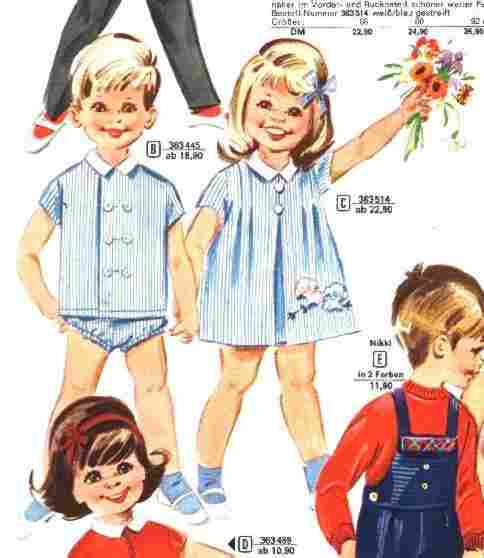
German clothing catalogs show a major shift in German boys' clothing in the 1960s. Bous no longer wore short pants to dress wear. Shorts were increasingly becoming casual wear. I am not sure precisely when mail order catalogs first appeared in Germany. A French reader writes, "Note the boy suit B. This model was in fashion in France during 1958-65. It was called " Costume bloomer " It tended to take place of the traditional rompers. This model was made for boy 1-4 years. In fact there was two types of this garment. One like theillustration here in the German catalog. The other was worn with a very short dress.
This later was allmost the same as the outfit for a girl, except the lengh of the dress and with buttoning at the croch of the bloomer for boy. The model for girl had a little ordinary bloomer too (figure 1, item C). These suits were very popular as Sunday clothes. They were worn a long period of the year in the south of France, the Antilles, and Guyana. It was also made in wool and above all in velvet for cold days. For older boy 3-6 yrs they had a similar style, but with short cut short pants--always with suspender or buttoning at the blouse. My Parents had made and sold in Antilles a big quantities of these articles. It was necessery to use a special sewing-machine to made the pants. Normaly it was my job - when time permitting - to do the adjust of these machines."
One catalog company in 1973 offered colorful shirts, ties, pants, and socks. Flare pants were popular as well as square-toed shoes. Polyester was also all the rage. We note a variety of colorful kneesocks were available. They even appeared for girls. Lederhosen and other folk styles appear to have been popular in the 1970s. One catalog in 1979 offered a variety of lederhosen for casual wear. There were even drnim shorts made to look like lederhosen.
Denim was a popular fabric in the 1980s. We note denim bib-front shorts for younger boys. Denim jeans were popular for boys of all ages. We note moderate flares in 1980, but not the wide flares popular in the 1970s.
The 2002 Neckermann catalogue offered boy's tights ( Jungen- Strumpfhose ). Blue appears to have been a popular color.

Navigate the Boys' Historical Clothing catalog/magazine pages:
[Return to the Main German mail order page]
[Main photo/publishing page]
[Store catalogs]
[Fashion magazines]
Navigate the Boys' Historical Clothing Web Site:
[Introduction]
[Activities]
[Biographies]
[Chronology]
[Clothing styles]
[Countries]
[Topics]
[Bibliographies]
[Contributions]
[FAQs]
[German glossary]
[Images]
[Links]
[Registration]
[Tools]
[Boys' Clothing Home]
Navigate the Boys' Historical Clothing Web Site:
[Sailor suits]
[Sailor hats]
[Buster Brown suits]
[Eton suits]
[Rompers]
[Tunics]
[Smocks]
[Lederhosen]