
|
George Eastman introduced the Kodak Brownie in 1900. This revolutionalized photography. The average person could now take photographs anywhere he wanted, around home or on vacation. This moved photograpy out of the studio. Thus in the 20th cenyury we not only have studio portraits, but increasing numbers of amatuer family snapshots showing children in more more animated poses and natural settings. Girls wore white dresses as well as colored ones. Many girls wore pinnies. Hairbows were very popular and sometimes quite large. For the most part girls still only wore dresses. The 1910s were dominated by World War I. The early 1910s are similar to the 1900s, but the austerity of the War years is followed by major fashion changes. There are large numbers of images of girls outfits, almost all dressess, archieved on HBC, both in America and Europe. White dresses were popular as were sailor outfits. Often girls wore their dresses with pinafores. Major fashion changes followed World War I. The flapper dress is the most definitive fashion statement of the 190s, but this was for older girls and young women. Girls still wore dresses are comparable skirted garments almost exclusively. Hems rose. There was also a tendency to seek a boyish look. The old pre-World War styles had by the 1930s largely disappeared. Girls still mostly wore dresses. Pinafores are still worn, but less commonly. Middy blouses are a popular style. For casual wear we begin to see girls in pants or shorts--especially in America. The 1940s were dominated by World War II (1939-45). Like World War I, World War II had a major impact on fashion. Girls still mostly wore dresses, but for play clothes shorts became popular. The fact that many mothers and teenagers worked in war plants undoubtedly had a significant impact on fashion. The 1950s were a mixed decade with girls wearing many older fashions, but a variety of new styles appearing. Girls still wear dresses to school and when dressing up. Major changes occurred in the 1960s. Dresses began the decade at knee length, but by the end of the decade were much shorter. The traditional dresses still common in the early 1960s began to give way to jeans and other casual styles by the end of the decade. American girls began to commonly wear jeans and shorts to school. Mini-skirts were also popular. Designer jeans came into style. Along with designer jeans the Hippy influence made tattered looking jeans popular as well. Many American girls by the 1980s no longer wanted to wear dresses. Some American parents report a struggle trying to get their daughters to wear desses, even for special occasions. This attitude was not maintained by all girls.
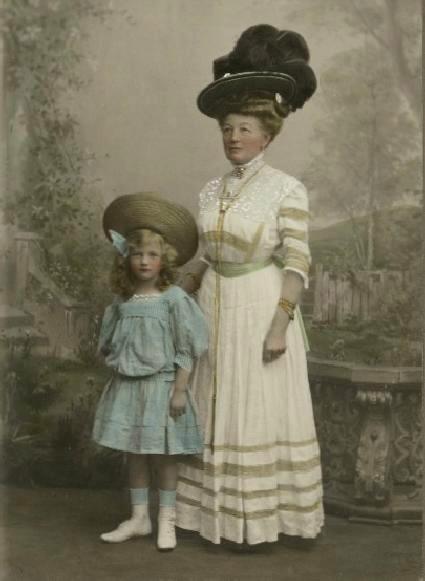
George Eastman introduced the Kodak Brownie in 1900. This revolutionalized photography. The average person could now take photographs anywhere he wanted, around home or on vacation. This moved photograpy out of the studio. Thus in the 1900s we not only have studio portraits, but increasing numbers of amatuer family snapshots showing children in more more animated poses and natural settings. Girls wore white dresses as well as colored ones. Many girls wore pinnies. Hairbows were very popular and sometimes quite large. For the most part girls still only wore dresses.
The 1910s were dominated by World War I. The early 1910s are similar to the 1900s, but the austerity of the War years is followed by major fashion changes. There are large numbers of images of girls outfits, almost all dressess, archieved on HBC, both in America and Europe. White dresses were popular as were sailor outfits. Often girls wore their dresses with pinafores. Girls also commonly wore smocks. We are less sure to what extent girls wore tunics and rompers. Hair bows were especially popular--some remarkably large.
Major fashion changes followed World War I. The flapper dress is the most definitive fashion statement of the 190s, but this was for older girls and young women. Girls still wore dresses are comparable skirted garments almost exclusively. Hems rose. There was also a tendency to seek a boyish look. This was reflected in bobbed hair and the wearing of garments with a manish look.
The old pre-World War styles had by the 1930s largely disappeared. Girls still mostly wore dresses. Pinafores are still worn, but less commonly. Middy blouses are a popular style. For casual wear we begin to see girls in pants or shorts--especially in America. Little girls might wear quite short dresses as shown by Shirley Temple in some of her early movies. Kneesocks and ankle socks become common and fewer girls wear long stockings. Gym slips are a poular school uniform style. Perhaps influenced by movie style, pants are depicted as stylish casual clothes, but they are worn by few women and girls. Spme girls do wear shorts for play during the summer.
The 1940s were dominated by World War II (1939-45). Fashion went on hold for the early 40s, but there were changes in everyday clothes. Like World War I, World War II had a major impact on fashion. Fashionable clothes became more simple. Play clothes becme more utilitarin. Girls still mostly wore dresses, but for play clothes mote casual garmens like shorts became popular. We even see some girls wearing long pants, mostly during the Winter. The fact that many mothers and teenagers worked in war plants undoubtedly had a significant impact on fashion. Even so when going to school or dressing up, girls still always wore dresses. Saddle shoes were very popular in America.
The 1950s were a mixed decade with girls wearing many older fashions, but a variety of new styles appearing. Girls still wear dresses to school and when dressing up. Party dresses and white gloves might still be worn even at birtday parties--at least by girls from affluent families. Girls by the 1950s have begun to wear pants at least for play, especially in America. Girls fashions were more traditional in Europe. We note teenage girls wearing shorts in the summer for play. We also notice girls wearing jeans with bobby socks and saddle shoes, a style wich began in the late 1940s. We also notice girls wearing Capri pants.
Major changes occurred in the 1960s. Dresses began the decade at knee length, but by the end of the decade much shorter lengths were fashionable. The traditional dresses for girls still common in the early 1960s began to give way to jeans and other casual styles by the end of the decade. Schools in America had increasing difficulty enforcing dress codes requiring girls to wear dresses. European girls still wore dresses to school, although the Paris School Riots signaled the beginning of changes in Europe. The riots had a major impact on French fashions and culture. As France plays such an important role in world fashion, the impact of the riots were much broader than just France. Smocks were still worn to school, but were declining in popularity. The Soviet Union was unaffeced. In fact they became even more traditioal Girls wore dark uniform dresses with white pinafores.
American girls began to commonly wear jeans and shorts to school. Mini-skirts were also popular. Designer jeans came into style. We begin to see pant sets/suits. We see plaids and bright colors with fun accents like bows and buttons. We see more pnts, including flared styles. Pleated skirts became verypopular, often paired with pullover vests and blouses with detailing. We see lots of multi-colored prints and paisley. Designer jeans nrcome a major style. The Hippy influence made tattered looking jeans popular. These trends gradually reached oyher countries. Jeans were becoming increasingly popular in Europe as well, but not as common in school as in America. The Russians and Eastern European Communists resisted these trends girls continued to wear rather formal clothes such as pinafores to school. They also finally changed from long stockings to tights. Eventually girls behind the Irion Curtain began picking up pn these trends.
Many American girls by the 1980s no longer wanted to wear dresses. Some American parents report a struggle trying to get their daughters to wear desses, even for special occasions. This attitude was not maintained by all girls. Some preferred dresses. In other countries, even Candada, dresses were more common.
1980s: School uniform: English boys and girls
1980s: School dresses and pinafores: Soviet girls
1982: Dresses, white knee socks and strap shoes: English girls
1983: Irish step dancers: American boy and girl
About 1985: School uniform: Scottish boy and girl
1986: School class: Canadian Boys and girls
Early 1990s: Cub Scout uniform: English boys and girls
1995: Summer dress: Tajik family

Navigate the Boys' Historical Clothing Web Site:
[Return to the Main girl's chronology page]
[Return to the Main girl's page]
[Introduction]
[Activities]
[Biographies]
[Chronologies]
[Clothing styles]
[Countries]
[Essays]
[Theatricals]
[Bibliographies]
[Contributions]
[FAQs]
[Glossaries]
[Images]
[Links]
[Registration]
[Tools]
[Boys' Clothing Home]