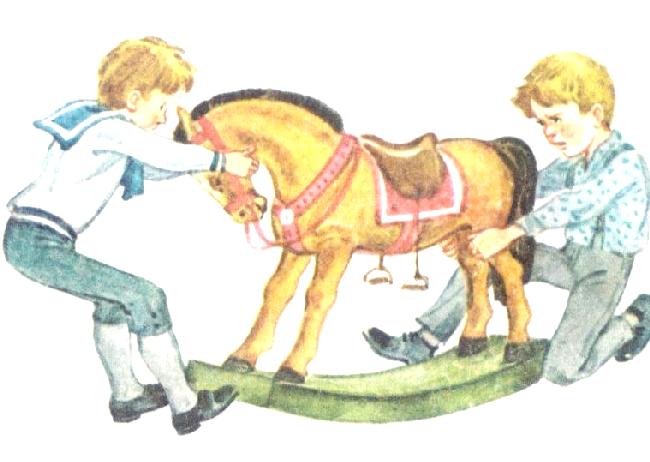
Figure 1.--his is an illustration from a Soviet school primary text book published 19??. Two boys are shown fighting over a rocking horse. One is wearing a sailor suit. I'm not sure what the text was associated with this illustration. |

|
Soviet children's publications followed the same basic patterns as in Western Europe. There were periodical publications as well as fiction and non fiction books. Two major periodicals Kolkhoznye Rebiata (Children of the Kolkhoz) and Pioneriia in the early and mid 1930s appear to glorify Soviet Communism with illustrated articles, stories, and photography. Most Soviet books seem to be single issue works. Some examples of early Soviet books Books such as Marshak's Otriad (Detachment, 1933) was about Young Pioneers having a good time at camp. Politschuk's Prigoda (A Happening, 1931) shows Young Pioneers in a factory. [McGill] We do not know of the children's series that were so popular in America and Britain. There were of course also school textbooks. Many of the textbooks for younger children were beauifully illustrated.
Children's magaines appeared during the 19th century and were popular during the 20th century. There were such magazins popular during the Soviet Era, although we know little about them. Soviet children's publications followed the same basic patterns as in Western Europe. There were periodical publications. Two major periodicals Kolkhoznye Rebiata (Children of the Kolkhoz) and Pioneriia in the early and mid 1930s appear to glofify Soviet Communism with illustrated articles, stories, and photography. A reader mentions a Soviet children magazine "Chizh" ("a siskin") fim the 1940s. Hopefully Russian readers will be able to tells us something about these and other Soviet periodicals. We note that Alexander Pahomov did illustrations for the magazine. The illustration by Alexander Pahomov here was in a 1940 issue. Note the boy wearing a Red Army uniform. The Red Army in 1939-40 had invaded Poland and Finland and was in the process of seizing the Baltic republics (Estonia, Latvia, and Lithuania) and regions of Romania. We do not know much about the content of the magazine yet. Another reader mentions Murzilka (Мурзилка). The magzine was founded during the during the Sovie era (1924) and continued to be publised today in modern Russia. It was noted for both its lterary and artistic content. It was aimed at children 6-12 years of age. The inspiration for the title came from pre-Soviet writings.
There were also both fiction and non fiction books. Most Soviet books seem to be single issue works. Our information on Soviet children's books is still quite limited. We have only begun to acquire information on individual books. The Soviets do seem to have had a very active publishing industry aimed at the younger reader. Few of these books have been published and distributed in the West. Some examples of early Soviet books Books such as Marshak's Otriad (Detachment, 1933) was about Young Pioneers having a good time at camp. Politschuk's Prigoda (A Happening, 1931) shows Young Pioneers in a factory. [McGill] We do not know of the children's series that were so popular in America and Britain. There were of course also school textbooks. Many of the textbooks for younger children were beauifully illustrated. A good example of a non fiction book is A Journey to Artek", a little booklet about life at a Soviet summer camp, in thos case the prestigious Artek camp. It was published by the Novosti Press Agency Publishing House. in 1976.
Russian culture lagged behind Western Europe through the 18th century. This chganged in the 19th century. We are not surely why, but probably relects the legacy of Tsar Prter the Great and the engagement with Europe. The first enormous leap was he Golden Age of Russian poetry ot the age of Oushkin. (early-19th century). Some of the great novels of all times followed later in the 19th century. This was followed by the Silver age of Russian poetry in the early-20th century. All forms of literature suffered during the Soviet era. The Communist Party stifeled creativity. Art inclusing literature were expected to serve aocial function--supporting the revolution and Communist Party. Authors who failed to do were subject to arrest and confiment to the Gulag. During the Great terror there were executions. Not the best circumstances to grow the creative spirit. And to make matters even worse, it was not always clear what Stalin wanted as well as shifts ijn the Party Line. Authors thus tend ed to be very cautious, often jit exploeing proven thems. The same was true of poetrtry. Here there waa a greatwr acceptanceod creativity becaise poetry by its very mature was more imaginatove than nove;s and short stories. anf his was especially true of children's poetry, not to mention the fact that censors did not take childrn's poetery a seriously as adult literature. Thus we see more creativity and imagination in poetry--especially children's poetrt..
McGill University, Rare Books and Special Collections Division. "Children's books of the early Soviet era," 1999.

Navigate the HBC literary pages' Historical Clothing Web Site:
[Return to the main Main Soviet children's literary page]
[Return to the main Main literary page]
[Return to the main Main Russian page]
[Return to the main Main children's literary page]
[America]
[England]
[France]
[Greece]
Navigate the Boys' Historical Clothing Web Site:
[Introduction]
[Activities]
[Biographies]
[Chronology]
[Clothing styles]
[Countries]
[Bibliographies]
[Contributions]
[FAQs]
[Glossaries]
[Images]
[Links]
[Registration]
[Tools]
[Boys' Clothing Home]