|
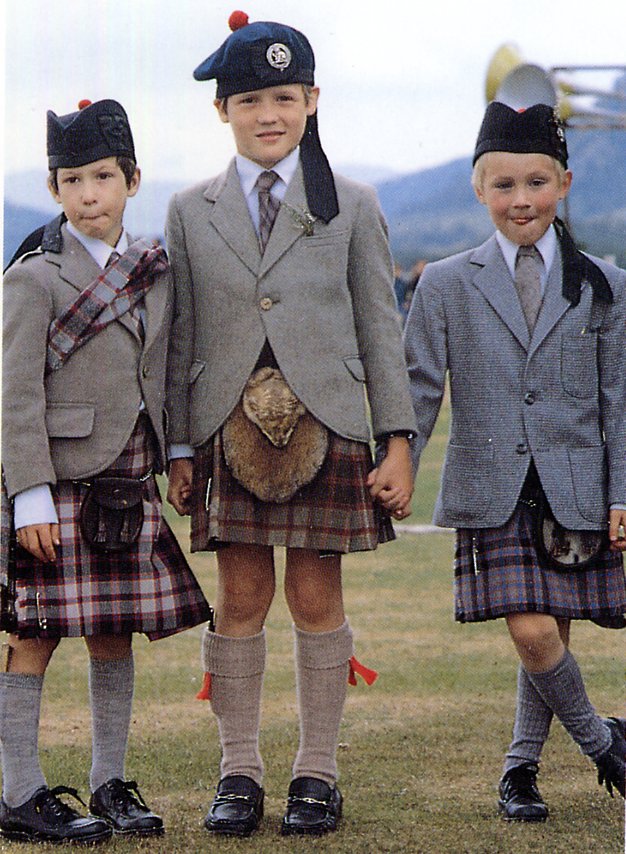
Plaid is a fabric having a pattern of different colored stripes or even black and white crossing at right angles. It is usually a woolen fabric, but has come to mean any fabric of different colored yarn in a cross barred pattern. Plaid (pronounced "plad") is the name of the material which is used for making kilts. It isn't the name of the pattern on the material, this is called "tartan". In the United States, plaid is sometimes pronounced 'plaid' and usually refers to the material--plaid and tartan are interchangeable terms there, they aren't in Scotland. Plaid (pronounced "plad") is the name of the material which is used for making kilts. It isn't the name of the pattern on the material, this is called "tartan". In the United States, plaid is sometimes pronounced 'plaid' and usually refers to the material--plaid and tartan are interchangeable terms there, they aren't in Scotland. 'Plaid' is also the specific name for the tartan 'cape' worn over the shoulder in full 'highland dress', e.g. by pipers. Plaid is most commonly associated with kilts, but other garments were also made in plaids.
Plaid (pronounced "plad") is the name of the material which is used for making kilts. It isn't the name of the pattern on the material, this is called "tartan". In the United States, plaid is sometimes pronounced 'plaid' and usually refers to the material--plaid and tartan are interchangeable terms there, they aren't in Scotland. 'Plaid' is also the specific name for the tartan 'cape' worn over the shoulder in full 'highland dress', e.g. by pipers. This was indeed called a "plaid" and not a 'plad'. Dwelly wrote in 1901 under the entry for 'fe/ileadh-bhreacain' The kilted plaid. This consisted of twelve yards or more of narrow tartan, which was wrapped around the middle, and hung down to the knees. It was more frequently fastened round the middle by a belt, and then it was called "breacain-an-fhe/ilidh" or "fe/ilidh-bhreacain". The breacain, or plaid part of this dress, was, according to occasion, wrapped round the shoulders, or fastened on the left shoulder with a brooch (brai\sd) of gold, silver or steel, according to the wealth of the wearer. By this arrangment there was nothing to impede the free use of the sword-arm
Plaid apperas to have ancient predecessors. The oldest example was found with the remains of “Cherchen Man,” a mummy of Caucasian descent found buried in the western Gobi desert. The modern palid appears to have origniated in Scotkland (16th century). The Scots called in tartan sand populrfized its use in Western fashion. It was first used not for kilts, but rather an outer layer of clothing worn across the left shoulder. Initially this was probably to keep warm, but evetually bacame more of a ecorative item. The main use of plaid bercmed the kilt. The tgerm trtan appeared wjn mericn znd British msznufcturers began producing plaid cloth. Plaid was a purely fashon item until the 18th century. Scotland beczame part of the United Kingdom by the Act of Union in pzart thriugh bribery (1707). Not sll Scotts were etralld with the idea.
James Francis Edward Stuart’s 1714 rebellion against the now British English monarchy involved plaid-clad Scottish soldiers. Thus plaid want from Scottish family symbol to a military regalia. And even more serious rebellion ensued three decades later. The Scotts did not do as well as the Americans. Bonny Prince Charley's plaid clad army was crushed at Culloden Moor (1746). After which the English banned multi-colored plaids and kilts. Slowly they retrned, rather ironically in the British Army. Scottish regiments, the kilt, and pipes were present at Waterloo. A plaid known as Black Watch Plaid became associated with the Royal Highland Regiment, is one of the best known units in the British Army. Joined by Scottish poets and authors as well as a British princess helped chanbnge the image of plaid. Victgoria and Aalbert drssed th young princes in plid kilts creating a fahion xddnsation. And plid is an enduring fashion even to this day, lthough more for girls than boys.
A tartan is a pattern, properly for a wool garment, having varicolored stripes or lines at right angles forming a distinctive pattern--particularly that worn by Scottish higlanders. Plaid and tartan both contain horizontal and vertical lines that intersect at 90 degree angles. The imprtantbdifference is tartan is plaid associated with a clan. Whereas plaid holds no association with a historic clan. While every clan has a tartan today, this is a relatively recent development. Most tartans were only adoprted in the 19th Centurty. Before that tartan patterns were more varied. Parti-coloured cloth was used by the Celts from earliest times, but the variety of colours in the breacan was greater or less according to the rank of the wearer. That of the ancient kingshad seven colours, that of the druids six, and that of the nobles four. In the days of Martin the tartans seemed to be used to distinguish the inhabitants of different districts, and not the members of different families as at present. He expressely says that the inhabitants of the various islands were not all dressed alike, but that the setts and colours of the various tartans varied from isle to isle. As he does not mention the use of a special pattern by each family, it would appear that such a distinction is a
modern one, and taken from the ancient custom of a tartan for each district, the family or clan originally most numerous in each part eventually adopting as their distinctive clan tartan the tartan of such district. Martin's information was not obtained on hearsay, he was born in Skye and reared in the midst of Highland customs.
Plaid is most commonly associated with kilts, but other garments were also made in plaids.
Scottish Higland kilts almost always have a plaid pattern. Each
clan has developed their distibctive tartans. Irish kilts, however,
are usually solid colors rather than plaid.
One term used for a kilt in Scotland was the "plaid" "philibegs".
The original kilts were apparently about 6-8 yards of rectangular
material. The kilt was worn in this way:
1. Find a space 6 yards long in a sheltered position. Stand at one
end of the space.
2. Lay a belt out with the inside facing upwards and the buckle
away from you
3. Lay the plaid out in a line with the near end on top of the belt.
on top of the belt.
4. Kneel down at the end and grasp either edge of the plaid about
2 ft 6 in along the plaid.
5. Pull the two edges fairly taut and move your hands towards you to
form a pleat of about 3 inches.
6. Continue like that folding the plaid over to form pleats. The
pleats should overlap a lot but not be piled right on top of each
other.
7. Continue to make pleats until there is about 2 feet left at the
far end which is not pleated. Stop pleating!
8. You now have a pleated plaid except for 2 feet at either end.
Lay on plaid with your feet to the right so that the pleats run
head to foot. The bottom (formerly right hand) edge of the plaid
should be about knee length.
9. Wrap over the two unpleated ends (corner 4 over 2) and, whilst
lying prone, fasten your belt
10. Stand up!
11. Adjust the *plaid* for length so that your knees are just
showing.
12. Take the top half of the plaid which is hanging down over your
belt and find the two corners. The Scots tend to do this by
throwing the top part of the plaid over their head to straighten
it out. These will be the two corners from the former left hand
side (corners 1 & 3). Fasten the two corners with a pin or tying
around left shoulder. Tuck any spare bits into belt making folds
of fabric round your waist which can be used as pockets etc.
There does not seem to be any set pattern for this.
Scotish sources report that sporrans are not authentic. Clan tartans are not authentic. An eye witness who saw the
Jacobites in 1745 observed that no two tartans were the same.
Clan tartans are a later invention. Underwear is not authentic.
Trews are authentic. Trews appear to be cut with
the tartan on the legs going at the opposite diagonal to the body.
The fly fastening seems to be an overlap with buttons to the side.
A long rectacular piece of cloth, usually with a plaid pattern, worn about the shoulders by Scottish Higlanders. Higland dancers usually
wear this plaid. Irish sancers also wear this shoulder cloth, but in
a solid pattern.
After the Scittish kilt became a fashionable boy's garment in the
mid-19th Century, girls dresses began to be made in plaid. This
continued to be a popular style until after the Civil War. Plaid
by the 1880s was much less used for girls' dresses, but plaid was
still used for boys' dresses. Plaid again became popular in America for girls' school dresses and skirts in the 1950s. Plaid skirts and jumpers are still popular school uniform styles in America. Plaid is
no longer fashionable, but few children's clothes catalog are issdued
without some plaid dresses or skirts, often referred to as kilts.
Tres are the plaid short pants worn under kilts. I'm not
sure when they began to be worn. I think it is unlikely that
Scottish Highlanders wore them with traditional kiklts. Presumably
trews appeared in the 19th Century.
Scottish men have worn plaid trousers instead of kilts. I'm not
precisely sure when this fashion begun. Men did not generally wear trousers until the second decade of the 19th century so presumably
plaid trousers were not worn before that period, but I can not yet
confirm this.
Plaid shirts became popular winter shirts for men, but I am not sure
about the chronolgy of this. I believe that plaid was a popular
pattern for boy's school shirts since the 1940s, perhaps earlier.
Many American boys every September were bought new corderoy knickers or long pants to be worn with a warm plaid shirt for the new school year. Plaid in the 1990s has become associated with what teenagers
refer to as "geeks" or kids that are considered "cluless" about
fashion and hip behavior--meaning they do not confirm to the
conteporary fashion and behavioral trends.
A variety of features are asoociated with skirted garments. These were options available to dressmakers. We have only begun to prepare a list. These featured were employed in both the bodice and skirt parts of skirted garments. We notice smocking on the bodice. Smocking was a embroidering technique used on smocks, dresses, and other skirted garments. There was pleating employed on the skirt part. Another decorative feature is patterns. And especially important in America is plaid. The reason for this of course is that plaid is associated with the Scottish kilt--a male garment. Thus apprently in the American mind made skirted garments more appropriate for boys. This suggsts tom us that there was some second thoughs about the centuries old convention about boys wearing skirted garments. Interestinglu modern school garments including school uniforms include pleated plaid skirts for girls, but this was not the case in the 19th centyry. The most common plaid skorted garemnt for boys besides the kilt was dresses. We also see palid tunics, although not nearly as commomly as plaid dresses.
Plaid is commonly associatd with the kilts worn by Scottish men and boys. There were also pants called trews done in plaid, but the kilt was more common. Women's highland dress is also based on the clan tartan, variously either that of her birth clan or after marriage optionally her husband's clan. Women and girls do not wear kilts but at some point began wearing ankle-length tartan skirts. There were color-coordinated blouses and vests. A tartan earasaid, sash or tonnag (small shawl) were also worn. We are not sure just when all of this began. We suspedct the mid-19yth century as Queen Victoria helped popularize all things Scottish. We also notice tartan dresses in America from the earliest photographic record (Mid-19th century), suggesting it was a well estsblished fashion in Scotland (we are not sure about England) during the early-19th century. Just when plaid dresses were first worn we are not sure. We see girls of all ages and younger boys wearing plaid dresses. We had thought plaid dresses were most common for boys to signal their gender. But we have found several imsges of girls wearing plaid drsses and now we are not so sure. We do know thsat plaid became a very popular girl's pattrn in the 20th crnury for both dresses and skirts. Boys on ghe other hand to some extnt wore plaid shirts, influnced perhps by the association with lumberjacks. We do see some younger boys wearing plaid shortalls.
FOREVER PLAID is the story of four unlikely heros crooners, who performed in plaid jackets. Their dreams of
musical glory come true when they miraculously return to earth. This
endearing harmony group was "snuffed out mid coda" in a collision with a school bus of eager teens who were on their way to see the Beatles' debut on the Ed Sullivan show in 1964. Now, through a hole in the ozone layer and some "astro technical stuff" these nerdy crooners with angelic voices come back to do the show they never got to do in life.

Navigate the Boys' Historical Clothing Web Site:
[Return to the Main fabric page]
[About Us]
[Introduction]
[Activities]
[Biographies]
[Chronology]
[Clothing styles]
[Countries]
[Girls]
[Theatricals]
[Bibliographies]
[Contributions]
[FAQs]
[Glossaries]
[Images]
[Index]
[Links]
[Registration]
[Tools]
[Main HBC Topic page]
[Boys' Historical Clothing Home]
Navigate the Historic Boys' Clothing Web chronological pages:
[The 1840s]
[The 1900s]
[The 1930s]
[The 1940s]
[The 1950s]
[The 1960s]
[The 1970s]
[The 1980s]
[The 1990s]