**
food and clothes rationing during World War II : England
Rationing during World War II: England
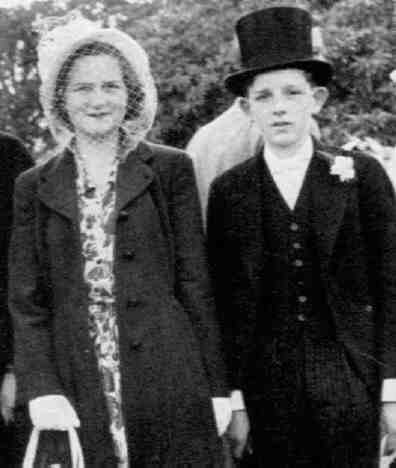
Figure 1.--Rationing was actually welcomed by many people, to ensure tht rich people could not buy up the available supply of scare foods. Wartime clothing coupons led to the demise of the Eton boys' famous tophats. However, the topper was sometimes resurrected for the Fourth of June celebrations, as in this scene from the late 1940s.
The British Government at the outbreak of World War II initiated a strict rationing program (1939) which got stricter as theWar progressed. All imports would be in short supply, as were much of home grown and manufactered commodities. Food and clothing were strictly rationed in Bitain throughout World War II. The British beginning early in the War, because of necessity, reduced domestic consumption far below comparable levels in Germany. In fact consumption levels in Germany remained at high levels until the War began to go against the Germans (1942). German food consumption was maintained because they were shipping food from the conquered territories back to the Reich--despite often disateous consequnces for the people in thise cointries. Even then, British consumption levels were lower than those in German until the disastrous last year of the War. The British had two problems. First the War bankrupted the country. Only American Lend Lease permitted the country to continue the War. Second. shipping was limited and priority had to be given to vital war material. Consumer products like food. Imported products like sugar and coffee had to be strictly rationed. Larger numbers of British children spent several years of their childhood without chocolate, oranges, and bananas. The shipping problem was worsened by the German U-boat offensive in the North Atlantic. The British did not, however, go hungary. Sweets, meat, and fats were in short supply, but there were plenty of starchy foods, bread, potatos, macaroni (pasta), and vegetables so caloric intake was maintained. Rationing was most severe in Britain England, especially after the fall of France giving the U-bpats access to Atlantic ports (June 1940). During the dark days of the battle with the U-boats in the North Atlantic, British officials were not sure that Britain could maintain food supplies, but The Royal Naby anided by the Canadians kept the sealanes pone until America enntered the war. And thriughoy the war, the younger children got their milk. It is the food rationing that is most remembered today, but clothes were also rationed. Rationing in Britain did not end with the War in 1945. It is commonly thought that reason rationing continued was that Britain was so weakened by the War. This was certainly a factor, but it is not the only reason that rationing had to be continued for several years after the War. This is obvious because rationing continued in Britain longer than Germany and Japan which had pulverized by the strategic bombing campaign. The other major factor was that the British people elected a Labour Government in the 1945 General election following VE Day. The result was that large segments of the economy were nationalized and thus became ineffucent and unproductive.
Britain declared war on Germany in September 3, 1939, after NAZI Germany invaded Poland. Englad within months initiated a rationing system. One of Germany's principal strategies in the War was to launch a naval blockade which centered on u-boats. The fall of France in June 1940 enabled the Kriegsmarine to significantly intensify that campaign. Even with American help befor the United States entered the War, the Royal Navy was hard pressed to keep the Noth Atlantic sea lanes open. The Government was forced to drastically reduce food and clothing consumption. England was not self suffient in food production. Just to feed the nation, large quantities of food had to be imported. Concernng clothing, all of the cotton, the primary raw material for clothing, was imported. All of the country's oil had to be imported. If the German's could cut the Atlantic sea lanes, they could not only prevent America from effectivelky entering the War, but they could actually force Britain to surender. It was not just the u-boats, the enormous cost of the War was another factor in the rationing. I had thought that the British Government in 1939 at the outbreak of World War II initiated a strict rationing program. We are having a difficult time determining just how the British approached rationing. Rationing was introduced January 8, 1940. Meat rationing began March 11. More and more foods were added to the list. Not only were food tuffs hard to obtain, but quantities were limited. Many felt hungry and housewives comlained about the time they waisted queuing for food. The ration book became were issued for every man, woman and child, ensuring a fair distribution of what meagre essentials were available. All imports would be in short supply, as were much of home grown and manufactered commodities. It was the food rationing that is most remembered today, but clothes were also rationed. During the dark days of the battle with the U-boats in the North Atlantic, British officials were not even sure that Britain could maintain food supplies. Clothing was severely rationed. Every Britain, man, woman and child, were issued with a ration card and a National Registration card (an indentity card). The ration cards were presented to shopkeepers who cut the appropriate number of coupons for the rationed item at the time of purchase. The number of coupons cut was determined by the Ministry of Food. Sometimes more or less were taken depending on the supply of any particular commodity. Much use was made made of factory canteens or cafes near by the work place. Where meals could be had without surrendering of precious food coupons. Clothing and footwear were made to a standard. All items conforming to a war time standard had a special brand mark. One HBC reader asks, "I'm trying to find out this a question about rationing. A contemporary soure indicates, `On June 1st 1941, each British person was issued with 66 clothes coupons to last a year.' My question is, how many coupons would youn need for a woollen dress and a man's overcoat?" HBC not at this time has only limited details, but hopefully we will eventually learn more about the rationing system. The Board of Trade issued prescriptive regulations to manufacturers concerning the quality of fabrics, length of hems, and other such matters. Shirts could not have double cuffs. Jackets had to be single breasted. Trousers could not have turn-ups. Girls were more affected by the regulations than boys, as their dress styles were seriously curtailed to preserve fabric. School uniforms were affected, but some schools insisted on retaining traditional uniforms. World War II saw the demise of the top hat at Eton, at least as a part of the everyday uniform although toppers continued to be sported at the Fourth of June celebrations. Norman Longmate wrote a book about life in Britain during the War. He was at school at Christ's Hospital in the war years and greatly disliked the bluecoat uniform. In the book he bemoans the fact that although the "ridiculous and impractical ensemble, dating back to the Spanish Armada' took up all of a boys" clothing coupons and more, the school insisted that the bluecoat costumes were retained. (The quote is from memory, so these may not be the author's exact words.) There was a black market. One coud pay extra in some shops and get rationed items. Or you could descretely buy rationing cupons.
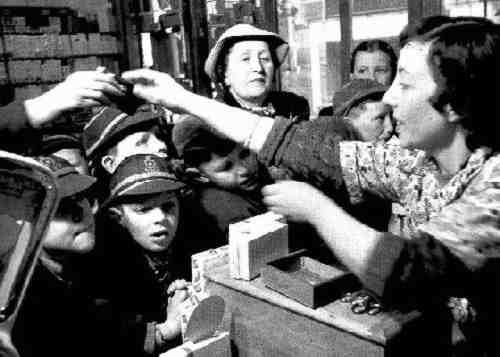
Figure 2.--Rationing of sweets came to an end in Britain in the early 1950s. This famous picture depicts
the rush to an unrationed sweet shop where the eager schoolboys can now buy as many gobstoppers as their pocket money will stretch to.
Britain was so weakened by the War, that clothes continued to be rationed for several years after the War. Faced with postwar shortages and the problems of reconstruction, Attlee's government encountered severe financial difficulties, despite American assistance. Rationing continued to be a necessity, economic recovery was slow, and the cost of rearmament increased the strains on the economy. Tobacco was a special case. People wanted cigarettes very badly. But as the climate was not appropriate, tobacco had to be imported an Britain had limited foreign exchange, especially for non esentils. A reader writes, "In your rationing pages you mention tobacco. I remember that upon my return to the UK in 1945 ,there were a considerable number of people who grew tobacco in their back gardens, it was taken very seriously there were clubs where the growers used to compare types of leaf , mixtures etc, they would put things like honey or rum in the mix. It was mostly smoked in the pipe, but some managed to make cigarettes." [Carpenter] Rationing was still in effect when Elizabeth II came to the throne. In one village, where every Coronation since perhaps the 13th Century had been celebrated with a community Ox Roast, special dispensation had to be obtained for the 1953 event! Clothes rationing ended in 1949. Food continued to be rationed until 1954 when meat at last came off the ration--9 years after the end of World War II.
Guppy, Alice. Children's Clothes 1939-1970 (Blandford Press: Poole, Dorset, 197?). There is a good description of the regulations and the advent of common sense.