|
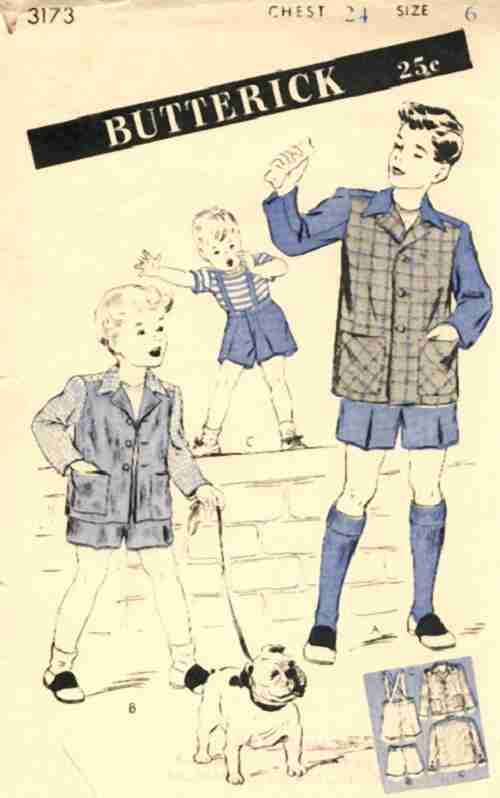
HBC has wanted to begin a section on patterns for some time. Very little information is available at this time. Patterns are, however, an important topic. Many 19th-century fashions were not avialable as ready-made clothes, but rather as patterns. I believe that mass-market patterns were first added to the fashion magazines that became so popular in the late 19th century. I believe the first magazine to dothis was The Delineator. Soon they were a regular feature of fashion magazines. Soon the pages were full of illustrations for patterns which could be purchased. I'm not sure just when companies
like Buternick began marketing them. Patterns for boys' clothes were never as common as for girls and women. After the turn of the century ready made clothes became more common then patterns. Many mothers sewed in the first half of the 20th century, but it was more common to sew for their daughters than sons. Patterns for younger boys were popular, but clothes for older boys were mostly bought in stores.
Many 19th-century fashions were not avialable as ready-made clothes, but rather as patterns. I believe that mass-market patterns were first added to the fashion magazines that became so popular in the late 19th century. I believe the first magazine to do this was The Delineator. Soon they were a regular feature of fashion magazines. The pages were full of illustrations for patterns which could be purchased. Often a free pattern was actually included in the magazine. After the turn of the century ready made clothes became more common than patterns. Home sewing, however, continued to be very important during the first half of the 20th century. After World War II, women became a steadily increasing proprtion of the work force. Moms who worked, had less time for home sewing,
Seceral magazines began regularly including inserts of selactive patterns. Some magazines were created with this expressed purpose. Here there is an overlap between fashion and pattern magazines. We are not positive when the first patterns appeared in magazines, perhaps the 1870s. The Belineator was especially important. The best known today is probably McCalls. Some of the patterns were multi-printed patterns, as well as templates for interior design elements, lace, needlework and crafts. These patterns had all the pattern pieces for several garments laid out on top of each other, and require tracing off of the pattern sheet, grading for size, and adding seam allowance. Illustrations offered a much larger number of patterns for sale. At the time ready-made clothes were still limited--especially stylish fashions. Mothers would purchase a pattern and then either make it or have a seamstress make it.
We do not yet have very much information on companies offering sewing patterns. We are not yet sure just where and when companies begn selling patterns. A major American company was Buterick. Another important company was Simplicity. We begin noticing Simplicity patterns in the 1930s, but still know little about the company. It is a major distributor of patterns and sewing books in the 2000s. There were of course also companies in sevral other countries, but e have very little information on these companies.
Patterns for boys' clothes were never as common as for girls and women. Many mothers sewed in the first half of the 20th century, but it was more common to sew for their daughters than sons. Patterns for younger boys were popular, but clothes for older boys were mostly bought in stores.
I believe the idea of including patterns in magazines was an american inovation. American companies have also been the first ones to mass market patterns. The idea, however, was quickly picked up by companies in other countries.
HBC has compiled the following information on specific patterns for various types of garments. Ww have found patterns for quite a range of different garments. These tend to be large images and this nay it difficult to arvive them on HBC. We now haw a host which offers much greater storage capacity. So we can now archive some of these large images. There are patterns for jist about every type of garment.
Many more sewing patterns were done for girls than boys. There were a range of reasons for this. Mothers were often more interested in dressing up girls than boys and girls were more interested an appreciative of these garments made my mother. Also dresses were easier to make for home sewers than boys garments like suits. Mothers in the 19th century often dealt with ther younger boys rather like girls. And indeed many boys were dressed in skirted garments like dresses and skirts/kilts. We note an English sailor outfit that could be done as a frock or suit and with trousers and kilt frock. There is no indication as to the company that prepared the patterns. It is also undated, but we would guess was made in the 1890s. There is no indication as to who profuced the pattern or gender appropriateness, The trousers and kilt frfock were for boys, but the frock may have been made for girls as well as younger boys.
Tunic suits were called by many varied terms. We have noted them referred to as pleadted blouses, Russian blouses, Buster Brown suits and many other terms. For organizational clarity we have chosen the term tunic suits. Surprisingly we have noted very few patterns for these garments. They were popular garments and realatively simple to make. Thus one would think would be especially suitable for home sewing. One pattern we do note appeared in a 1878 American magazine.
The difficulty of sewing varies greatly from garment to garment. One of the most difficult items were suits. There were patterns for men and boys' suits, but this was more pronounced in the 19th century. By the 20th century sewing suits became much less common, but it was still done, but most commonly for younger boys. I'm not precisely why this was. Presumably mothers were more willing to devote time and eergy into sewing for younger children. Also making garments in smaller sizes is a simpliier matter than in larger sizes. It may also be that younger boys wear what they are told to wear where older boys by the mid-20th century may have not been as happy with clothes sewed by their mothers. By that time it was nmuch easier to buy ready-made clothes and how much satisfactioin could a mother get in making a pair of jeans.
We notice patterns for for three styles of boys' blouses offered in the Ladies Home Journal in 1910.
We note some patterns that do not fit into the established garment categories. One of these was bell-hop uniform patterns for boys working in hotels. We always thought that the hotels gave the boys their uniforms. But we have found a Butterick bell-hop pattern for boys 6-17 years of age. This suggests that at least some mothers seem to have sewed the uniforms. We suspect this may have been for smaller hotels because larger hotels had very defenite uniform styles and not a generic style like the one here. The pattern is not dated, but looks like the early-20th century.
There are many sources of patterns for traditional boys' clothing. Many can be easily found through a simple internet search. An epecially good source are companies servicing reenactors. Here the Civil War era is the best covered, but there are also other sources providing patterns for classic boys styles. We will collect some vof the better links for interested HBC readers. Please let us know if uou find an especially good source of these patterns.

Navigate the Historic Boys' Clothing Web Site:
[Return to the Main topics page]
[Introduction]
[Activities]
[Biographies]
[Catalogs]
[Chronology]
[Clothing styles]
[Countries]
[Bibliographies]
[Contributions]
[Essays]
[FAQs]
[Glossaries]
[Images]
[Links]
[Registration]
[Tools]
[Boys' Clothing Home]