
Historical Photographs: The Holocaust--Tsvi Nussbaum
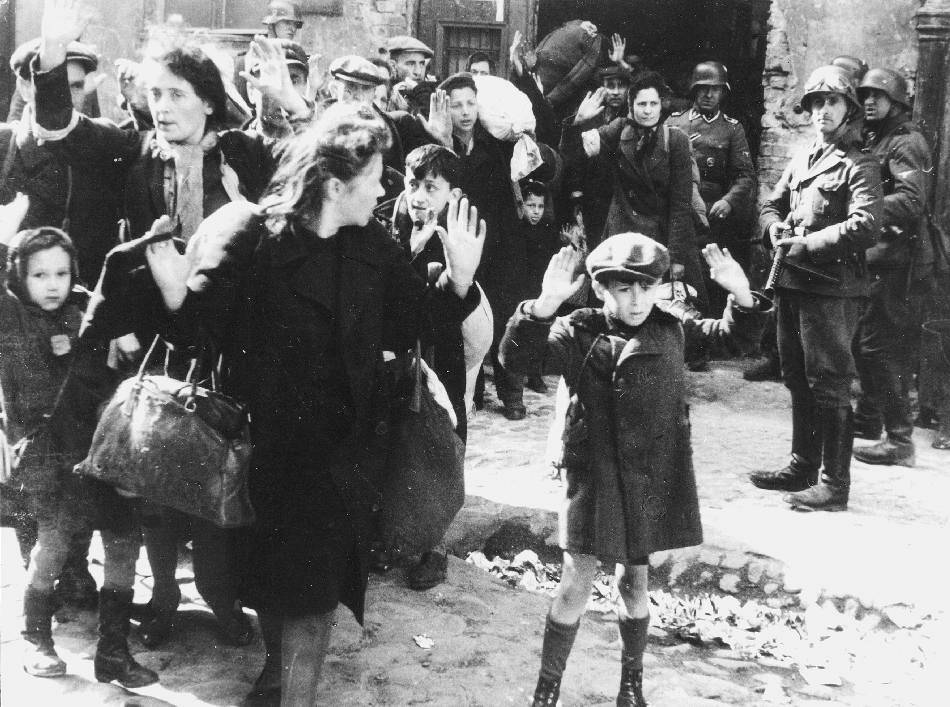
Figure 1.--This photograph more than any other has come to represent the Holocaust. The little Jewish boy was arrested in Warsaw in 1943. Somehow he survived. This was unusual as children and the eldely were the first ones the Germans killed at the death camps. His name was Tsvi Nussbaum. Whilke the focus is usually on Tsvi, there were several Jewish children in this horrifying image who did not survive.
|
|
The NAZis did not like photographs taken in the Gettos or the Concentration camps or of the actual killing of the Jews. The Holocaust was, however, conducted on such a vast scale by such enthusiastic NAZIs that many pgotographic images were taken and quite a few survived the War. This photograph more than any other has come to represent the Holocaust. The little Jewish boy was arrested in Warsaw during 1943. By this time, most Polish Jews had already been murdered by the NAIZs, including most of his family. Somehow he survived. This was unusual as children and the eldely were the first ones the Germans killed at the death camps. His name was Tsvi Nussbaum.
Photography
The NAZis did not like photographs taken in the Gettos or the Concentration camps or of the actual killing of the Jews. The Holocaust was, however, conducted on such a vast scale by such enthusiastic NAZIs that many pgotographic images were taken and quite a few survived the War. This photograph more than any other has come to represent the Holocaust.
The little Jewish boy was arrested in Warsaw during 1943. By this time, most Polish Jews had already been murdered by the NAIZs, including most of his family. Somehow he survived. This was unusual as children and the eldely were the first ones the Germans killed at the death camps.
The NAIZs targetted Jewish children and adults with murderous intent. Less well known is that the NAIZs also targeted Polish gentile children. They wanted Polish children with Aryan features for Eindeutschung (Germinaztion). NAZIs considered these children to be stolen genetic property. Badly outnumered in population and unable to significantly increase the German birth rate, the NAZIs saw this as an expedient way of adding to the Aryan population. These concerns were ibcreased as the War began to turned against the NAZIs in late 1941. Many of these children were rounded up in mass and later rejected after a more careful racial examination. The children rejected were usually sent to concentration camps where most died. Hitler thought individuals with Aryan blood in occupied countries were a potential danger to Germany.
Warsaw was the cultural center of Jewish life in Poland. About 30 percent of the city's population was Jewish. It was the largest Jewish community in Europe.Frank ordered all Warsaw Jews on October 3 to move to the predominately Jewish part of the city which was now called the Warsaw Ghetto (Otober 3). He then ordered it to walled off. The entarnces were then sealed off from the rest of the city and closely guarded by the NAZIs. Jews had previously moved throughout the city without restruction. There had been about 0.25 million Jews in the Jewish section. Now 0.15 million more had to find acommodation there as well as for those arriving in future transports. Many within the Ghetto had to move. Jews had to abandon their property except what they could carry on bring in a hand cart. The Germans administering the Ghetto delighted in humilitaing the Jews in the initial phase of the Ghetto. Jews would be ordered to kiss the pavement or search for bits of paper in mud, all the time being beaten. [Gilbert, p. 345.] Much worse was to come. Some 500,000 Polish Jews were are forced into the Warsaw ghetto. The Warsaw Ghetto Uprising was the single most important Jewish act of defiance against the NAZIs (April 1943).
The Warsaw Ghetto Uprising was the single most important Jewish act of defiance against the NAZIs. We have found various estimates of the number of Jews remaining in the Ghetto. Estimates vary widekt, 35,000 to 80,000 survivors of the earlier transports. They were used for various slave labor projects. Surprisingly the Germans gave them permission to build some bomb shelters. Presumably their labor was useful. SS and police units returned to Warsaw Ghetto (January 1943). There orders were to transport the remaining Jews to forced-labor camps specifically for Jews in Lublin District. The Jews in the Ghetto understandably assumed that this was another transport to Treblinka. They resisted the SS and police with small arms that they had managed to smuggle in from the city. After seizing about 5,000 Jews, the relatively small SS and police force, suspended the deportation operation and withdrew. At the time, because of the Stlingrad crisis, combat units were not available to back up the small deportation force. A stronger SS and police force deployed outside the ghetto walls (April 19, 1943). This time they arrived with heavy weapons. They were ordered to liquidate the ghetto and deport the remaining Jews to the forced labor camps in Lublin district as originally intended. The Ghetto Jews again resistance the Germans and managed to inflicting casualties on the much better armed SS and police units. Organized resistance broke down after a few days, but the Jews continued to resist deportation as individuals or in small groups for four weeks. Finally the NAZIs terminated the action (May 16). The SS and police deported approximately 42,000 Warsaw ghetto survivors to the forced-labor camps at Poniatowa and Trawniki and to the Lublin/Majdanek concentration camp. At least 7,000 Jews died in the fighting or while hiding in the Ghetto. The NAZIs sent the remaining 7,000 Jews to the Treblinka death camp.
The main camp, Auschwitz I was located on the outskirts of the Polish city Oswiecim. The sub camp Birkenau was in a suiburb called Zasole near Brzezinka, about 2 miles from main camp. Himmler visited Auschwitz (March 1941). He ordered the Camp Commandant Hoess to expand Auschwitz I to hold 30,000 prisoners. He also ordered the creation of a new camp (Auschwitz II) with a capacity of 100,000 people at Brzezinka (Birkenau). The Germans began construction Birkenau after the invasion of the Soviet Union (October 8, 1941). It was a mnassive undertaking and conducted during the winter of 1941-42. The Russian POWs worked in terrible consitions. About 10,000 Russiahs are believed to have perished in the construction of Birkenau. When finally completed, it was larger than Auschwitz I which served as the administrative center of the overall Auschwitz complex. More people passed through the Birkenau gates than than those at Auschwitz I. Hundreds of thousands of people were imprisoned here and over 1 million people, mainly Jews, were murdered here with poison gas, mostly soon after arrival. There were two purposes for Birkenau. First was to to ease congestion at the main camp. The NAZIs did know what to do with the the vast numbers of Soviet prisoners of war (POWs) taken as a result of Operation Barbarossa. The second purpose was to operate as a Vernichtungslager (extermination or death camp) to carry out the NAZI Final Solution of the Jewish Question. Birkenau was organized into several descrete camps. There was a camp for new arrivals and those to be sent on to work at other camps, mostly sub-camps in the Auschwitz system. Several specialized facilities were established. There was a Gypsy camp. The SS a set up a section for Gypsies, camp BIIe (February 1943). There was also a so-called family camp. Thiswas a section for Czech Jews deported from Theresienstadt. A camp called Kanada was set up to hold and sort the possessions of the people on the incoming transports. There was also a women's camp. The SS set up In March 1942, a women's camp is established at Auschwitz with 6,000 inmates (March 1942). The SS moved it to Birkenau (August 1942). There were 27,000 women there (August 1944) in section B1a. While Auschwitz was primarily a work camp, Jews and otheres were killed here on an industrial basis. The NAZIs carried out the largest numbers of murders by gas in an industrial fashion at the Birkenau killing opperation. Birkenau was one of the many sub-camps, but the most infamous one. Auschwitz-Birkenau became the the NAZIs premier killing center. Auschwitz when fully operational had the capacity to murder 10,000 people in 24 hours.
Tsvi Nussbaum
The little boy's name was Tsvi Nussbaum and he was 7 years old. Most of us who first saw this photographed assumed that the terrified little Jewish boy was murdered like most Polish Jews. Incredibly he somehow managed to survive. Tsvi C. Nussbaum, came to America after the War and is a physician living in Rockland County, New York. Tsvi and his aunt were arrested in front of a Warsaw hotel. On that day, a group of Jews with foreign passports had gathered to find a way to escape Poland. The date was July 13, 1943. He was told
to put his hands up, "I remember there was a soldier in front of me and he ordered me to raise my hands." [Bülow] We also know the identity of the German soldier in the photograph. He was Josef Blösche, a particularly sadistic man. He was known in the Ghetto as "Frankenstein". After the War he attemted to hide his barbaric acts. He was recognized in the Soviet occupation zone. Survivors from the Warsaw Ghetto recognized him. He was put on trial. After conviction of murder he was executed.
Actually Tsvi's family immigrated to Palestine (at the time a British colony) in 1935. But because they found life there very hard at the time, his father made a serious mistake. He brought the family back to their home town of Sandomierz, Poland, in 1939. Jews outside of Germany in 1939 did not fully appreciate the dangers posed by the NAZIs. When the Germans invaded Poland in September 1939, Tsvi's parents were murdered before the Jews were rounded up and put in ghettos. His brother disappeared meaning it is not known how and where the NAZIs murdered him. Tsvi and his aunt went to Warsaw and because of their appearance managed to live there as gentiles for over a year.
When caught in 1943, Tsvi and his aunt were deported to the Bergen-Belsen camp in Germany--one of the few Jews to be deported from Poland to Germany. Tsvi Nussbaum and his aunt necause of their resodence in Palestine had foreign passports and were thus sent to Bergen-Belsen as exchange Jews. The family had emigrated to Palestine in 1935, but returned to Sandomierz, Poland in 1939 just before World War II started. Bergen-Belsen was not a death camp although large numbers of people died there. The death camps where millions of Jews were killed were located in Poland. It was unusual for Polish Jews to be sent to a camp in Germany rather than one of the camps the Germans built in occupied Poland to carry out the Holocaust. It was Tsvi's foreign passport that saved his life. If Tvsi had been sent to Auschwitz where most of the Warsaw Ghetto Jews were sent, given his age, he would have been murdered within hours. The NAZIs in 1943 established the so-called "residence camp" of Bergen-Belsen on a portion of the site of the prisoner-of-war camp. This enclosure housed several thousand Jewish prisoners under the pretext that they would be exchanged for German nationals held by the western Allies. The NAZIs hoped that such exchanges would facilitate peace negotiations with American and British officials. By July 1944, over 4,000 of these "exchange" Jews were detained in Bergen-Belsen. In December 1944 the Germans redesignated Bergen-Belsen a concentration camp.
Few of the Jewish detainees were ever actually exchanged. [Bülow] Tsvi almost died a few days before the camp was liberated in 1945. A German doctor reportedly stayed at the camp to treat him and other inmates after the SS guards fled.
Nussbaum went to Palestine in 1945 and spent 8 years there during which the state of Israel was created. He came to America in 1953, not speaking more than a few words of English. He was especially good at science. He eventually went to medical school, becoming an ear, nose, and throat specialist, un part because he wanted to help his uncle, who contracted a speech defect because his larynx was damaged in the concentration camps. [Bülow]
Reader Comment
A French reader comments, "What a terrible image of a child, aiming a gun at him!
Normaly the human race should protect the children!" This was symbolic of NAZI policy. The children were especially targetted. They were often killed within hours of reaching the death camps.
Sources
Bülow, Louis. E-mail message, October 10, 2002.
Bülow, Louis. Tsvi Nussbaum, accessed October 10, 2002.
HBC

Navigate the Boys' Historical Clothing Web Site:
[Return to:Main historical photography page]
[Return to:Main 20th century children in history page]
[Introduction]
[Activities]
[Biographies]
[Chronology]
[Clothing styles]
[Countries]
[Topics]
[Bibliographies]
[Contributions]
[FAQs]
[Glossaries]
[Images]
[Links]
[Registration]
[Tools]
[Boys' Clothing Home]
Created: October 9, 2002
Last updated: 7:58 AM 6/20/2012