|
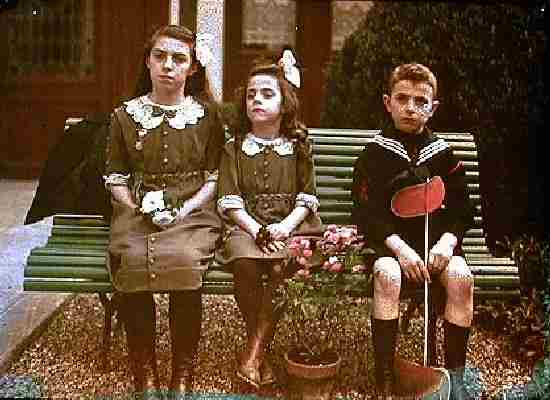
The Autochrome process was invented by the Auguste and Louis Lumière in 1904 and was the world’s first practical color process. This example here of a group of three French children probably dates from the late 1930s. They replaced the screen used by Joly with color dots. These were made from colored potato starch particles which had a diameter of only 15/1000 of a millimeter. The screen processes, good as they were, also had their faults. They were relatively insensitive. This meant that it could only be used in bright sunshine. When all went well with the exposure and processing and the results were then stored properly, the process bequeathed us some surprisingly vivid and fresh-looking images.
The Lumière brothers, Auguste (1862-1954) and Louis (*1864-1948), were two of the pioneers of the photographic industry. They began the careers after photography was invented, but invented several important processes advancing the industry to a new level. The brothers were sons of Antoine Lumière, a respected portrait painter who became interested in photography. The boys were separated bybonly 2 years and thus developed a close personal friendship growing up together. Both as boys demonstated an interest in technology and tinkering. At school they were particularkybinterested in science and excelled in their science classes. Their father sent them to Technical School. As in many European countries, France had a secondary school system offering different curriculums. Antoine has some interest in painting also was fascinated by the technology of photography. Noting the financial possibilities of growing photographic industry, Auguste decided to establish a business manufacturing and supplying photographic equipment. Joining him in this venture was Louis who began experimenting with the photographic equipment his father was manufacturing. In the process while only 17 years old, Louis developed an improved dry plate process--the Etiquette Bleue' process (1881). This helped his father improve sales and a factory was built to meet the demand. Thus was just the beginning. The brothers developed the Autochrome process, the first commercial color photography process (1904). They also played an important role in the new motion picture industry.
The Autochrome process was invented by Auguste and Louis Lumière and was the world’s first practical color process (1904). They patented the process in America (1906). Their process reached the market in 1907. This example here of a group of three French children probably dates from the 1910s (figure 1).
The Lumière brothers replaced the screen used by Joly with color dots. These were made from colored potato starch particles which had a diameter of only 15/1000 of a millimeter. These were first colored in
batches of orange-red, green and cyan. After complete drying, these colored powders were mixed such that the resulting powder did not show any discernable color at all. Then, this mixture was applied to a sticky glass plate with a very fine haired brush. This had to be done very carefully to obtain a single layer of the starch particles. The resulting open spaces between these particles were closed with pulverized charcoal. With 3 years of further research, they were able to devise a commercially feasible process to produce these plates for the photography market in 1907. It is interesting to note that the emulsions of these plates were only
about twice as thick as those of modern color films.
The screen processes, good as they were, also had their faults. They were relatively insensitive. This meant that it could only be used in bright sunshine. One source report that the Autochrome process, for instance, required 50 times more exposure than the black and white emulsions which it was used with. An HBC reader researching Autochromes reports that autochrome was rated at ASA 4 and that the fastest emulsion at the time was around ASA 125. This suggess that the exposure would be 5 times greater. He asks, "Am I right? or am I missing something in my calculation?" [Walker ] Here HBC is unsure and would be interested in any reader insights on this matter. Another problem with autochrome was that the images could not be enlarged very much without showing the screen texture.
|
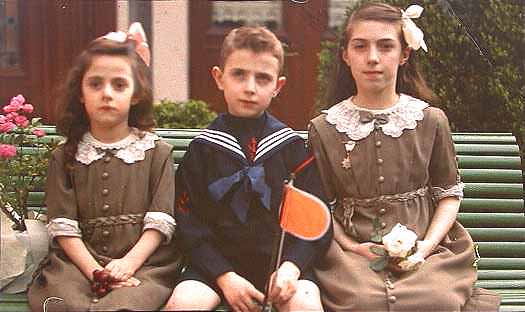
One of the fascinating aspects of the internet is the interesting people that it allows you to meet. We received the message from a HBC reader, "I happened on the "Color Photography" page of your Boys' Historical Clothing site in the course of a search on photographic topics. In case you don't already have it, attached is the mate to the Autochrome plate you illustrate. This shot cuts everyone off at the knees but is a much better representation of the color rendition typical of early Autochromes. When all went well with the exposure and processing and the results were then stored properly, the process bequeathed us some surprisingly vivid and fresh-looking images. Unfortunately, they are difficult to rephotograph and reproductions usually give the impression that murky, muted color is the best that it could do. Both of these plates were sold on eBay last year, but not to me. The one attached was said by the seller to date from 1913, this apparently derived from a label on the binding tape. To my inexpert eye this date seems correct for the girls' outfits." [Karas] Bright sunlight seems importnt to achieving good color results. Some photographers using Autochrome reported results that gave a kind of dream-like, impressionistic qulity that they rather admired. The dyed starch grains used in the Autochrome plates were rather coarse, larger than what Agfa and Koak would use. This gave a somewhat hazy affect. Some authors have likened it to pointillist paining. One color ptoblem was areas of stray colors. We note greeish areas in ome images. This was an especially severe problem in open light areas. Sky areas could be a special problem. Even so, the dream-like quality caused some photographers to continue tobuse Authochrome even after higher quality film became available tht was faster and capable of greater resolution.
We are not sure how popular the Autochrome process was. It did produce the first commercially viable color prints. It was,however, not suitable for home photography. There was no Autochrome film. They were glass plates. Thus only the most advanced amateur photographer could use them. They could be used by professional photographers. It may have needed sunlight as flash bulbs could have affected the color balance. This may have affected its use. We suspect it may have ths been a expensive proposition, but our information is very limited. We note images from different counries. But we do not note large numbers of Autochrome images. We do not know how many autochrome images were made, but we rarely see them for sale. This suggests that they were not made in large mumbers. The examples we have found do provide a wonderful glimse of color to an otherwise black-and-white world. National Geographic photographers used Autochrome glass plates.
Autochrome was the only color film on the market until the German Agfa company introduced the similar Agfacolor (1932). A reader tells us, "According to my references, Autochrome plates were discontinued in 1932, although a film-based version (Lumiere Filmcolor) was introduced at about the same time and was evidently still in use in France as late as 1942. I collect specimens of early color processes, but regret to report that I have nothing else showing boys' clothing -- since this seems to have rarely been very colorful, and since boys are naturally ill-disposed to hold still for the long exposures which pre-1930s color materials required, boys are a very uncommon subject in these media." [Karas]
Production apparently was suspended during the German World War II occupation. We do not know why, but war time shortages and the difficult economic conditions were likely the porincipal reasons. Production was resumed after the War, but finally ended (1955).
Most autochromes seem to be held in Museum collections, particulary in France. French banker Albert Kahn collected some 72,000 Autochrome photographs taken between 1909 and 1931. Thgey document life in France and some 50 other countries. This provides some of thge earlidt color photograpohs fom mny countries. The collection is believed to be the largest archive of Autochromes. It is held by the Albert Kahn Museum near Paris. The National Geographic Society nd the Library of Congress also have collections of Autochromes.
Karas, Russ. e-Mail.
Walker, Scott. e-Mail, February 20, 2003.

Navigate the Boys' Historical Clothing Web Site:
[Return to:Main color photography page]
[Return to:Main photo/publishing page]
[Return to:Main French photo pricesses pagee]
[Introduction]
[Activities]
[Biographies]
[Chronology]
[Clothing styles]
[Countries]
[Bibliographies]
[Contributions]
[FAQs]
[Glossary]
[Images]
[Links]
[Registration]
[Tools]
[Boys' Clothing Home]
Navigate the Boys' Historical Clothing Web Site:
[Sailor suits]
[Sailor hats]
[Buster Brown suits]
[Eton suits]
[Rompers]
[Tunics]
[Smocks]
[Pinafores]