|
Lewis Hine is one of the most notable photographers to use the medium to promote social reform. He was not the first photographer to exploit the medium for social causes. He was, however, one of the photograohers to use it most effectively. Some of his most powerful images are of immigrants taken on Ellis Island. It is interesting to note how they were dressed on entering America from Europe at the turn of the century. The sailor suit was a prominent garment. Perhaps even more importantly, Hine's documentation of child workers were instrumental in effecting the labor reforms. His captions for his photographs provide a wealth of information about the working conditions, incomes, ages, sizes, and lives of the children that he photographed. Most of the images of the child workers show them wearing either kneepants or overalls. Hine worked as an investigative photographer for the National Child Labor Committee (NCLC), documenting working and living conditions
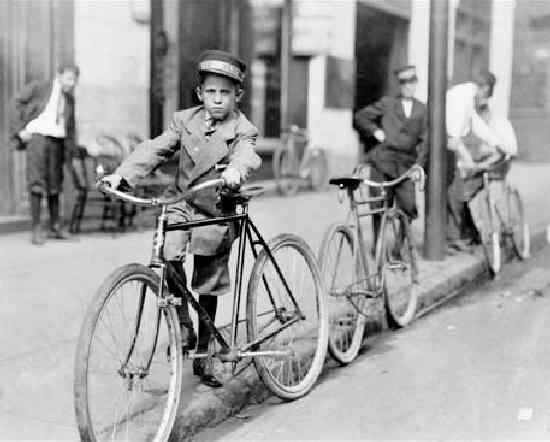
of children in the United States during 1908-21. The boy seen here is Raymond Bykes, Western Union messenger, getting on his bike in Norfolk, Virginia. The photograph was taken by Hine in June, 1911.
Lewis Wickes Hine was born in Oshkosh, Wisconsin (1874).
Lewis' father died in an accident. He had to work his way through college. Heine studied sociology at the University of Chicago, Columbia University and New York University. He became a teacher in New York City at the Ethical Culture School, where he encouraged his students to use photography as an educational tool.
Hein Hine moved to New York City and accepted a position as an assistant teacher at the Ethical Culture School (1901). It was here he began to work with photography. He began using a camera as an educational tool and started photographing school events. Hein encouraged his students to use photography as an educational tool.
Hine joined a project to photograph Ellis Island (1904). This was the high point of immigration to America. Huge numbers of Europeans from eastern and southern Europe had flowed into the United States. Ellis Island in New York City harbor became the main entry point. Anti-immigrant sentiment by the turn of the century was prevalent. He took his students to Ellis Island in New York Harbor. They photographed the immigrants arriving each day. Hine sought to portray the immigrants as they entered America. Hein's images portray the new Americans with dignity and respect. They represent an important visual record of European immigratio to America. Hein Between 1904 and 1909, Hine took over 200 glass plate photographs (1904-09). In the process he realized that documentary photography could be employed as a tool for social change and reform At the same time photo lithography had been developed to the point that photographs coild be printed in newspapers and magazines.
With the Ellis Island experience, Hine decided on an entirely new career, in fact a whole new profession--sociological photography (1906). He sought freelance assignments with the National Child Labor Committee. The NCLC gave him his first assignment (1907). The assignment was to photograph New York tenement homework. This meant the pievework families did in their tenaments. The NCLC was more than pleased with his work and hired him with a monthly salary (1908). He was assigned to document child labor practices with his photographs. At the time there were few restrictins on child labor. Hine for the next few years traveled all over the United States photographing children where ever he found them working, in mines, factories, canneries, textile mills, street trades and assorted agricultural industries. Hine's photographs brought the problem to public attention in a way that a statistical study never could. He clearly showed how child labor was depriving American children of their childhood, health, education and a chance of a future. His work on this project was the driving force behind forming public opinio on child labor issues. His photographs were critical in the fight for real child labor laws, including the all important step of Federal legislation.
Lewis Hine is one of the most notable photographers to use the medium to promote social reform. He was not the first photographer to exploit the medium for social causes. He was, however, one of the photograohers to use it most effectively. Some of his most powerful images are of immigrants taken on Ellis Island. It is interesting to note how they were dressed on entering America from Europe at the turn of the century. The sailor suit was a prominent garment. Perhaps even more importantly, Hine's documentation of child workers were instrumental in effecting the labor reforms. The photographs shocked Americans. His captions for his photographs provide a wealth of information about the working conditions, incomes, ages, sizes, and lives of the children that he photographed. Most of the images of the child workers show them wearing either kneepants or overalls. Hine worked as an investigative photographer for the National Child Labor Committee (NCLC), documenting working and living conditions of children in the United States during 1908-21.
We know very little about Hine's family. His son Corydon donated his father's portaits after Hine died (1940). The phoyographs at first were accepted by the Photo League which closed a few years later (1951). The Museum of Modern Art in New York was offered his pictures but did not accept them. Tthe George Eastman House in Rochester, New York eventually did. At the time there was not an appreciation for their historical value. Many photographs were left in the hands of the related Rich family which wound in the Walter and Dorrietta Rich estate. The parents of Walter G Rich. Walter jr. was the great nephew of Lewis. His father, Walter Rich Sr. was photographed by Hine in family type phoographs.

Navigate the Boys' Historical Clothing Web Site:
[Return to:Main photographer page]
[Return to:Main child labor page]
[About Us]
[Introduction]
[Activities]
[Biographies]
[Chronology]
[Cloth and textiles]
[Garments]
[Countries]
[Topics]
[Bibliographies]
[Contributions]
[FAQs]
[Glossaries]
[Images]
[Links]
[Registration]
[Tools]
[Search]
[Boys' Clothing Home]
Navigate the Boys' Historical Clothing Web Site:
[Sailor suits]
[Sailor hats]
[Buster Brown suits]
[Eton suits]
[Rompers]
[Tunics]
[Smocks]
[Pinafores]