|
The distinguishing feature of the cabinet card was the commercially printed mounting cards on which the actual photograph was pasted. There were various kinds of mounts. The variations in the mounts are of considerable interest because they can be used to help date the image. As large numbers of these images are today found without any provenance and are undated. At first raw paste board was used. Later cards appeared with a gloss finish. The printed cardboard mounts that the image were pasted on were printed with information about the photographer and studio. Almost all cabinet cards and an imprint giving the name and location of the studio. The colors, script style, and art work used to decorate the mounts varied over time and can also used to help date these cards. There were also change in borders and other aspects of he mounts. Some of the mounts were quite fancy including those with ornate gilt borders. The popularity of the nount colors, shapes, embossing, and gilding varied over time. This can be used to help date the portraits.
The cabinent card appeared soon after the CDV in the mid-1860s. It was similar to a CDV only larger. Just as the CDV was a standard size so was the cabinet card, about 4� by 6� inches. The size was similar in both America and Europe. The standard size probable relates to the albums that were made to hold both CDVs and cabinet cards.
Te cabinet card was introduced by Windsor & Bridge in London (1863). We first note them in Americ a few year later (1866).
Early cabinet cards were square with light-weight stock (1866-80). It very quickly eclipsed the CDV in America, but in Europe the CDV continued to be a popular format. The cabinent card was the standard American portrait firmat (1870s-90s). Thin, light weight card stock in white, off white or light cream (1866-80). We note border with red or gold rules in both single and double lines (1866-80). The photographer name and location are commonly printed just below the image. The studio name printed in small print on the back.
We note matte-finish front, with a creamy-yellow, glossy back (1882-88). There were cards with wide gold borders (1884-85). Gold beveled edges were popular (1885-92). We see different colors used for the face and back of mounts (1880s). We also see large, ornate text with the photographer's name and address, often in in cursive style wuth ornate designs. The studio name often takes up the entire back of the card along with various advertising details. European cards often depict awards won, but this is rarecon American cards.
We see rounded corners with single line rules (1889-96). Scalloped edge cards were popular (late-1880s-mid-90s). White and light colors were used in later years, but on generally heavier card stock (1890s). We see embossed studio names and locations (1890s).
After the turn-of-the 20 century, cabinet cards are seen in ne formts with different shpe and mount sizes and colors along with differnt photo shapes nd sizes. Potcard back pgotographs appered in America (1904). They rpidly replaced cabinent card s the standard format. As a result, cabinet cards are much less common after 1906, but continued to be produced into the early-1920s
.
The card stock used for cabinent cards is thicker than that used for the smaller carte de visite (CDVs). The first cabinent cards were made from Bristol Board (a single layer card stock). Gradually in the 1870s various types of press board became used. Press board was an early version of carboard. Press board as the name suggests was made by pressing layers of paper together, essentilly a paper sandwich. Most cards during the 1880s and 90s were made froim pressboard. The technology for manufacturing pressboard steadily increased during this period. Some cards that have not been well preserved can be seen to have separating layers at the edges are made with pressboard.
Cabinent cards first appeared in 1866. The mounts produced during the 19th century were basically the same size with a coinspicuous space at the botoom where the photographer can place his logo and location. Here the print varies quite a bit, but the basic format was the same. A problem working with cabinent cards, as with other formats is that most are not dated. There are a variety of indicators that can help date these cards. HBC is a fashion and history site. We decided early on that we would focus on the image rather than the entire card or mount when we post the image. Gradually we have come to the conclusion that it would be a good idea to post the entire mount, especially when the portrait is dated. This will help up date the portraits that are undated. Thus we have decided to begin doing this. About the turn of the century a new format appeared. The classic mounts continued, but the new format became increasingly common.
The edges of the cabinent cards may also have useful chronological information. Most cabinent cards had smooth edges. We think all the ealier cards had smooth eddges. Thus the smooth edges provide no useful chronological information. Serated edges, however, do provide useful chonological information. Some authors use the term scalloped edges. We think serrated is a more accurate term. We note cards in the 1880s and 1890s that had serated edges. This was not the most common alternative, but we do see a number of them. We do not yet have the precise chronology of these serated edge cabinent cards. And the variations in the serations may help us further identify the chronological range.
We note quite a number of cabinet cards which reffered to the finish on the cards. We do not fully understand just what was meant here, but these finish indications can be used to date the cabinet cards. We notice some cabinent cards were identified as "Ivoryettes". We do not yet know who develooped and introduced this process. The portrait in these cards had a whiter (ivory) finish than a standard albumen print. It gave a more natural look and some preffered it. We are not sure if this involved a change in the chemicals used or was an entirely different process than the albumen print. Studios like Dana in Pittsburgh and New York City used this process. We are not sure about the chronolohy. We have not yet noted it in the 1880s, but we see it being used in the 1890s and very early 1900s. This may have been a strictly American process, but our information is still limited. We also notice a painters palette and aan indication of 'Extra Finish'. We have no idea what this meant. But it seems to relare to miostly 1890s cards. We note one such card from Duluth, Minnesota in 1893. We are just beginning to determine the precise chronology.
We have noted blank CDV mounts. They seem to be the earliest ones. We have not yet noted blank caninet card mounts.
The color of the mounts varied widely. Ceratain colors were popular on a chronological basis and can be used to help date the poertrait. The first cards which appeared in the mid-1860s were white and rather light weight. This continued until about 1880. About 1880 you begin to see cards with face and back of different colors. This was common until about 1890. We note black mounts in the 1890s, but are not yet sure of the chronology, we think they first appeared in the 1880s. About 1882 you begin to see buff faces, matte finished, with a back of creamy yellow, glossy. This was popular until about 1888. Here we see an 1897 card done in what looks like an ivory color (figure 1).
We note some very plain mounts. We at first thought that the plain mounts were early ones, probably dating to the late 860s or early 70s. We have continued seeing them, however, into the 1890s. These were cards without colored mounts and with plain printing. They do not seem to be very common. We see more fancier mounts done with colored mounts. We believe these plain mounts were most common in rural areas. The ones we have founded have tended to comne from small rural towns. Studios in big cities tended to have fancier mounts.
Several different colors were used for the printed lettering on the cards which identifying the photographer and location. We notice many different colors being used.Usually the same color was used on the front and back. We do not yet know just what the color trends were and the chronological pattern if any. This was often the same color as borders, but we will consider borders separately. The color trends may have varied from country to country. That is another question we needed to address.
We don't have much information on the backs of cabinent cards yet. We think that most in the 1870s and 80s had printed backs with informtion bout the studio. Some even had printed dates, but this was not very common. We note cards with blank backs in the 1890s. Some had a smooth grey finish. We are not yet able to assess the chronology based oin the backs, but we have begun to collect some information.
Cabinet card borders are quite a complicated topic. Various color borders appeared over time and their were variations in with. The variations here are so complicated that it is a bit difficult to sort out. Some authors have described these trends over time. There may have been variations from country to country which furrther complicates the issue. Many of the cabinent cards we have archived are Ameican, but we notice comparable styles and trends in Europe. Actually the various styles may have originated in Europe. Red or gold rule borders (single and double lines) were popular from the beginning to about 1880. Wide gold borders were only seen about 1884-85, but gold beveled edges were popular about 1885-92. Rounded corner rule with a single line were popular 1889-96. Metallic green or gold impressed borders were briefly population during 1890-92. There were impressed outer border, without color during 1896.
Square, lightweight mounts were common from 1866-80. Square corners with heavy board and scalloped sides were common during 1880-90. The rounded corner card here was produced in 1897.
Embossing is the mechanical process of creating a three-dimensional image or design on a surface. Here we are talking about the surface of the cabinet card mount, but embossing is done on a range of materials. The emossed image is dond by mechanically applying heat and pressure on the paper. This is done by a metal die purchased by the studio. They could then apply their studio information on a blank mount. It was usually done on the lower right hand corner. The cutting die and counter die fit together and squeeze the paper fibers of the mount substrate. This cabinents mounts usually involved immpressing where the letters are lowered into the surface rather than raised. Embossing was also used to create the framing impressions which also had raisedup embossing. This was, however, usually done by the mount manufacturers rather than the studio. We begin to see embossing on the card mounts for the first time during the 1890s, mostly in the late-90s. The embossed mounts become quite common in the 1900s.
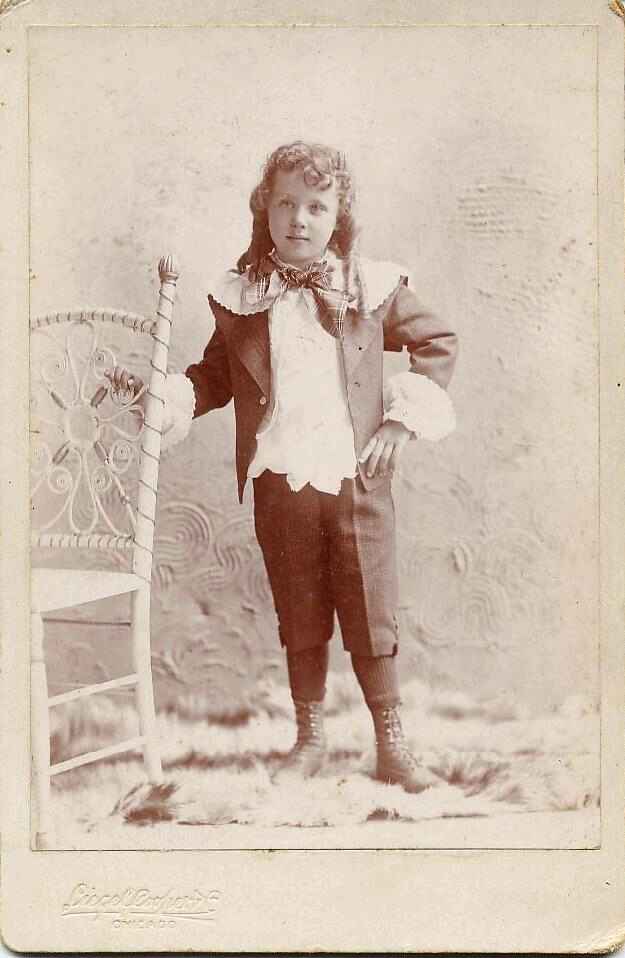
We notice standard printing on the bottom front of the card below the image which was pasted on the card. The standard approsch was to have the studio name and location. This primarily meant the name pf the studio, often in fancy lettering on the left. And on the right was the city and state, sometimnes the stree address. Not all cabinet cards were done like this, but a very large percentage of American cabirt cards conformed to this approch. The level od conformity is interesting given the huge number of photgraphic studios spead all over the country. Of course there were a smaller number of companoes that supplied the mount card stock. We notice the appearance of more variation in the 1890s. We note that sometimes a kind of enbmossing where the letters were punched down below the surface of the card. This innovation appeared in the 1890s. The 1897 Chicago portait is an example here (figure 1). One of the new approaches was to put the studio name and location in the center.
We notice some cabinent cards were identified as "Ivoryettes". We do not yet know who develooped and introduced this process. The portrait in these cards had a whiter (ivory) finish than a standard albumen print. It gave a more natural look and some preffered it. We are not sure if this involved a change in the chemicals used or was an entirely different process than the albumen print. Studios like Dana in Pittsburgh and New York City used this process. We are not sure about the chronolohy. We have not yet noted it in the 1880s, but we see it being used in the 1890s and very early 1900s. This may have been a strictly American process, but our information is still limited.
Cabinent cards for about two decades were very similar. This is in large measure because they werevmeant to fit into ablums which had slots to hild them. Thus they were all about the same size. Cabinet cards were normally about 4 1/4 X 6 1/2 inches. The image took up most of the area, buta kind of bar at the bottom was serserved for the name of the photographer and the city and state on American cards. Sometimes the address was added. These cards had mattes and letering un various styles and colors. Not only was the size standards, but the area for the image was standard so that it appered correctly in the albums. Just before the turn of the 20th century we begin to see a new style of cabinet cards they were more varied in size and done on stiffer boards. They tended tobe slightly larger, usually the card, not the image. And the relative dimensions were more varied. We see only a few colors, often white and an olive or greyish green. The photographer is no longer so prominently displayed as on the old style cards. We see the old style after the tun of the century and te new style sust before the turn of the century.
About the turn-of-the 20th century in the United States we notice cabinet cards with framed affect. Many, but not all were small portraits. Here we are primarily talking about the image size, but the card mounts also varied in size. Some were on large cards. Some were on smaller cards, often long narrow cards. They look rather like paper frames, but most were done on card stock. These small portrauts were one of the many new styled cabinet cards that appeared at the turn-of the-century. We are not sure why this change occurred at this time. But the shift is very pronounced. Oval portraits were very popular in the 1900s, but we notice square and rectangular portraits as well. Many of these portraits were quite small. But other portraits covered up much of the nount. One example is Donald W. Simpson in 1901. There may have veen some in the 1890s, but we don't think that they were very common. The dates images we have found are from the 1900s. Commonly these are bust abd not full-length portraits.
Most of the classic cabinet cards mounts had the name of the studio and the city at the bottom. We see some European mounts that instead just said 'Cabinet Portrait'. We see large numbers of these portraits. Often the studio and city was revealed on the back, but not always. Often the back was blank. Sometimes it just said 'Souvenir'. We see these cards mostly in Eastern Europe (especially Bulgaria Greece, Romania, Russia, and Serbia). Thus they are a very likely indicator of Eastern Europe, but we can not identify the country unless other clues are present. The English words and the Latin alphabet were used even in the countries using the Cyrilic alphabet, perhaps to give an impression of foreign technology. We also see some of these cards in Germany, but not very many. We are not sure why this became so common in Eastern Europe. It could be that the volume of sales did not justify individual pritings of card stocks for every studio. But it was very common. This is something we rarely see in Western Europe. We see this from the 1870s through the 1900s. Given the long period in which 'Cabinent Portrait' asused on the mounts , it doesnot help us much withdating the images.
Cabinet cards in America were much less prevalent after the turn of the 20th century. We note for some reason that many of the cabinent cards that were made had a much larger area surrounding the actual print. Other variations in the 20th century cards often had embossed frames around the image, heavy gray card stock, and studio imprints as hallmarks.
Almost all 19th century cabinet cards were done on classic stylemounts. There were stylistic diofferences, but the same basic format.With veryical mounts. the bulk of the cardboard card was a pastd on photograph. Unde that was the amae of the studio, isually a logo of some sort, and them the city and state. Some mounts did not have the studio infomation. The space at the bottom was left blank. Only
a very small number involved non-classic mounts. One such style was white-border cabinent cards. In the 20th century, we see many white border postcards and snapshots, but white border cabinet cards are very rare.
About the turn-of-the 20th century we begin to see a new type of cabinent card. They were often a little larger than the classic cabinet card. The mounts were often grey or greenish grey. Some were done as ivory mounts (figure 1), but these were less common. And the photographer did not have a bold logo at the bottom. Often thee was no logo or it was impressed and not nearly as prominant. We believe almost all of these cards date to the 1900s, but we do not yet have a complete chronology. or do we know of the company that developed these new mounts. They seem to be primarily an American mount style. They very quickly replace the old mount types. They were not as common as the old style. Not only were some portraits still made with the old style mount, but portraits with post card backs appeared in 1904.
The photographic depictions in addition to the mount characteristics also provide a lot of useful clues. Some of the characteristics to assess or the background. The portraits for the 1860s CDVs were very plain, but by the late-1860s were beginning tgo be much more elaborate. The style of the depictions and scenes depicted varies sunstantially over time. Poses also varied. Single individuals standing in a largely uncluterd stage-like scene seem common for 1860s CDVs, but we do not commonly see cabinet cards posed like this. And there were differences in the furtniture. A basic gair and small fabric-vivered table was common for Daguerrotyoes and Ambrotypes from thge 1850s and 60s, but little scene in cabinet cards. We see a lot of upolkstered furniture with tassles hanging down in the 1870s and 80s. We are nor entirely sure about the dating. One more clearly defined type of furniture was whicker furniture which we begin to see about the turn-of-the 20th century. A good example of whicker furniture is an unidentified California boy in 1897. And we see Lawrence Ray Gard in 1904 with whicker furniture. Of course the clothing styles are also helpful in dating. But for our HBC website, we are primarily interested in using tge cards to date the fashion, so this is less helpful in helping to date the portraits.
The basic chronology of cabinent cards helps to date undate images. The cabinet card was introduced in 1866 and soon surpassed the smaller CDV format in popularity. Note the date. This means that there were no Civil WAr cabinent cards. There were CDVs, but not Civil War cabinent cards. The cabinet cards were particularly popular from 1875-1895. hey began to decline in the late 1890s, but especially after 1900 with the development of the Kodak Brownie and the popularity of amateur snapshots. Also after 1895 new forms of portraits appeared. Cabinet cards declined as a result after 1895 and become increasing rare in America during the 1900s. The time line is somewhat different in Europe where cabinet cards were still being made at the inset of World War I in 1914. A few were even still being made in the early 1920s. A problem working with cabinent cards, as with other formats is that most are not dated. There are a variety of indicators that can help date these cards.
The cabinent card appeared in America (1866). I rapidly replaced the CDV as the principal photographic format. The same did not occur in Europe. The CDV continued to be very popular throughout the 19th century. We are not sure why this difference occurred. Nor do we have a great deal of information on trends in specific European countries. We do not note in trends concerning mount colors, edges, and other factors were similar in America and Europe. Hopefully asxwe archive dated examples we will be able to make some assessments which will be helpful in dating undated images in Europe as well as in America.
Our idea is to archive dated cabinent cards, both by mount characteristics and by date. An archive by decade will help us discdern trends over time. The basic chronology above helps to set the basic parameters for these cards. Here for example we see an 1897 Chicago portrait of Robert Mason Hamilton (figure 1).

Navigate the Boys' Historical Clothing Web Site:
[Return to:Main cabinent card page]
[Return to:Main photographic print type page]
[Return to:Main photography page]
[Introduction]
[Activities]
[Biographies]
[Chronology]
[Clothing styles]
[Countries]
[Bibliographies]
[Contributions]
[FAQs]
[Glossaries]
[Images]
[Links]
[Registration]
[Tools]
[Boys' Clothing Home]
Navigate the Boys' Historical Clothing Web Site:
[Sailor suits]
[Sailor hats]
[Buster Brown suits]
[Eton suits]
[Rompers]
[Tunics]
[Smocks]
[Pinafores]