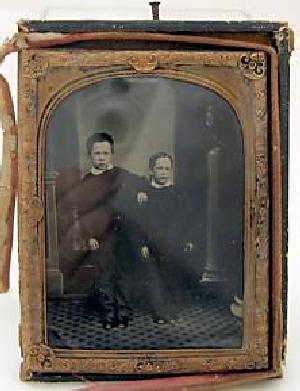
Figure 1.--This Daguerreotype portrait of two brothers was gtaken in 1865. The Daguerrotypist was identified as "W Pullen, Photographer, 6 Francis Terrace, Hamstead Rd." The boys were 7 1/2 and 9 years old. |

Most existing Daguerreotypes are undated. Unlike the prints that appeared later, there was nowhere to conveniently write an inscription. The chronology of the commercial business provides some help in dating the images. The Daguerreotype was the first successful commercial photographic process. It was invented in 1839 and quickly appeared in America. Daguerreotypes from the 1830s and early 40s are, however, rate. Larger numbers are available from the mid-40s and especially the 50s. Large numbers of Daguerreotypes were made during the 1850s, especially the early 50s. The Daguerreotype was the dominant photographic process for a relatively short period. Because it was the first process, however, it us the best known and commonly all early positive processes are called Daguerreotypes. The late 1850s is more complicated because competing positive processes appeard. The Ambrotype was introduced in 1854. This produced a positive image on glass, with a black backing which looked something like a Daguerreotype. The Tintype or Ferrotype appeared in 1856. It was an image on a thin asphaltum-coated iron plates. These processes had some advantages over the Daguerreotype process. (They involved a less complicated process and less expensive materials and the speed was faster. As a result they were less expensive and involved a shorter posing period.) Thus many positives taken in the late 1850s and early 60s are not dags. It was the appearance of the popular CDV and cabinent cards in the 1860s caused the Daguerreotype to rapidly decline in popularity after the early 1860s. Daguerreotypes were still made throughout the 1860s, although in increasingly small numbers. They were no longer made by the the 1870s. We are unsure how to assess the date of Daguerreotype image. We would be very interested if readers know of any pointers to assess undated Daguerreotypes. The fact that the Daguerreotype procedss was dominant in the 1840s and early 50s, but that relatively few dags were made in the 40s, suggests that most surviving images come from the late 40s and early 1850s. Images from the 1840s are rather rare. We do note quite a number of positives from the very early 1860s, but many of these are Ambrotypes or Tintypes.
Louis-Jacques-Mandé Daguerre throughout the 1830s worked on photography. He continued Niépce's experiments. Daguuerre accidentally discovered that exposed photographic plates were developed by Mercury vapors. This greatly reduced the exposure time from 8 hours down to 1/2 an hour. This meant that commercial photography was feasible. Daguerre announced his discovery and with out Fox/s modesty in England, named it the Daguerreotype (1839). The Daguerreotype was thus the first successful commercial photographic process. The first American to learn about Daguerre's process was Samuel F. B. Morse, a respected artist and scientist. Daguerre demonstrated his process to Morse while he visited Paris (Spring 1839). Thus the Daguerreotype process had atrong proponent in New York even before it became widely known. News of the Daugerreotype first reached the United States aboard the steamship Great Western (September 10, 1839).
It seemed fantastic at the time that images could be captured and there were initially considerable skepticism. Actual Daguerreotypes soon won over the skeptics. Within only weeks, consortiums were organized in several East Coast cities. Work began in setting up actual studios. Lenses had to be ground.
The aspiring Daguerreotypists had to experiment with chemicals. And crude box cameras had to be built. The different groups came up with different arrangements of brass tube with glass lenses, focusing mirror, and plate holder. Daguerreotypes from the 1830s are extremely rate, especially American Dags.
As the Daguerreotype process was only invented in the late 1830s, we also have relatively few examples from the early 40s. And the images tend to be low-quality often gohostly images. The baic process was fairly simple and spread rapidly. It took some time, however, for beginning Daguerreotypist to develop the refinements and skills to make a quality Daguerreotype portrait. The frames of these early Dags tend to be very simple. The two most common are box-like rectaganales and oval mat frames. We also notice octagonal, but less commonly. Larger numbers of Dags are available from the mid-40s and late-1840s. The problem in assessing Daguerotypes from the 40s is that it is hard to detinguish 1840s and 50s dags. All the portraits taken in 40s were dags. But large numbers were taken in the 50s and it is difficult to differentiate the portraits taken in the two decades. While the Daguerreotype was developed in France, there seem to have v=been more dags taken in America than anywhere else. We re not entirely sure why that was. One factor seems to have been that Daguerre was unable to enforce in copy right prorection on his invention. Amyone who wanted could pursue the trade with out paying any royalties.
Large numbers of Daguerreotypes were made during the 1850s, especially the early 50s. The Daguerreotype was the dominant photographic process for a relatively short period. Because it was the first process, however, it us the best known and commonly all early positive processes are called Daguerreotypes. The late 1850s is more complicated because competing positive processes appeard. The Ambrotype was introduced in 1854. This produced a positive image on glass, with a black backing which looked something like a Daguerreotype. The Tintype or Ferrotype appeared in 1856. It was an image on a thin asphaltum-coated iron plates. These processes had some advantages over the Daguerreotype process. (They involved a less complicated process and less expensive materials and the speed was faster. As a result they were less expensive and involved a shorter posing period.) Thus many positives taken in the late 1850s and early 60s are not dags.
|
The Daguerreotype was declining even in the 1850s because of the the appearance of other systems, namely the Ambrotype and tintype. Even so it was during the 1860s that Daguerreotypes began to disappear. It was the appearance of the popular CDV and cabinent cards in the 1860s caused the Daguerreotype to rapidly decline in popularity after the early 1860s. Daguerreotypes were still made throughout the 1860s, although in increasingly small numbers. There were still quite a number of dags made in the early 60s. The Gaguerreotype was still a very important photographic process when the Civil War began (86). By the time it finished, the CDV was well established and both the Daguerrotype and Ambrotype rapidly declining.
The dag portrait here is one of the few we have found dated after the early 60s (figure 1). It was taken in 1865.
Very rapidly after about 1862, the numbers plummet. We have found very few dags dated to the the late-60s.
As far as we know, Daguerreotypes were no longer made in the 1870s, at least we have not found any examples. It is quite possible a few were still made, but they clearly were not made in any number. We are sure about this even though most dags are not dated. The clothing styles are so different by the 1870s that that they would be easy to identify.
We are unsure how to assess the date of Daguerreotype image. We would be very interested if readers know of any pointers to assess undated Daguerreotypes. The fact that the Daguerreotype procedss was dominant in the 1840s and early 50s, but that relatively few dags were made in the 40s, suggests that most surviving images come from the late-40s and early-1850s. Images from the 1840s are rather rare. We do note quite a number of positives from the very early 1860s, but many of these are Ambrotypes or Tintypes. While few Dags have written notes inside the cases, quite a number of the mat frames have hall marks. As a good bit of information is available on Daguerreotypists, this can help not only date Dags, but locate them.

Navigate the Boys' Historical Clothing Web Site:
[Return to:Main Daguerreotype page]
[Return to:Main photographic page]
[Return to:Main 1850s ordinary biography page]
[Introduction]
[Activities]
[Biographies]
[Chronology]
[Clothing styles]
[Countries]
[Bibliographies]
[Contributions]
[FAQs]
[Glossaries]
[Satellites]
[Tools]
[Boys' Clothing Home]
Navigate the Boys' Historical Clothing Web Site:
[Sailor suits]
[Sailor hats]
[Buster Brown suits]
[Eton suits]
[Rompers]
[Tunics]
[Smocks]
[Pinafores]