|
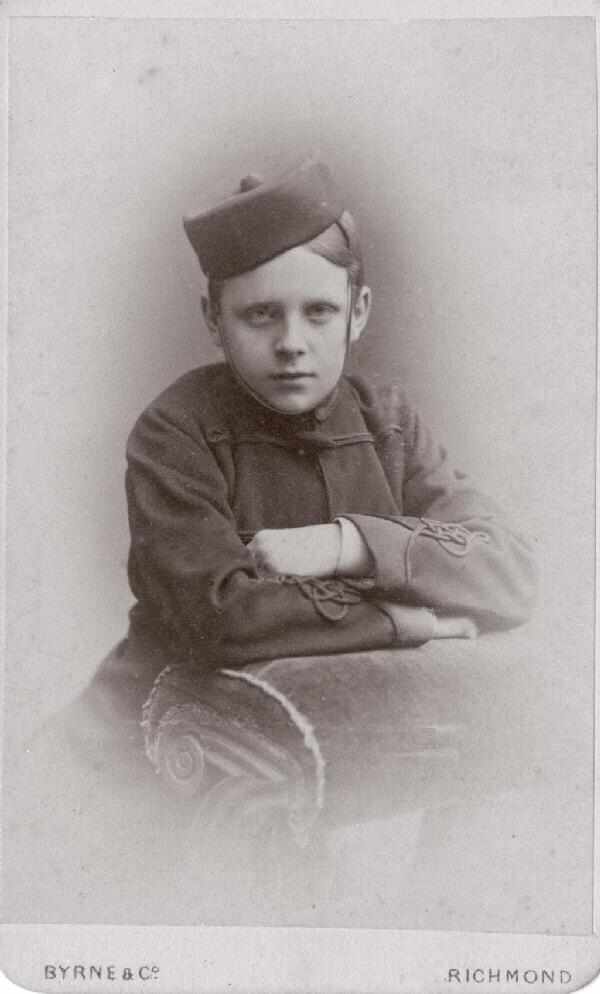
Carte de Visites (CDVs) are albumen prints, usually with dimensions were 2 1/2 by 4 inches, but there were ome variations. They were mounted on a cardboard mount. The front of the card had the photograph mounted. The back of the card had the name and usually the address of the phographer, normally in an elaborate design. As the name suggests, the origins are French. One source indicates that the CDV was first introdued in 1851. I have been unable to confirm that. Another source indicates that a French photographer, André-Adolphe-Eugène Disdéri, introduce the CDV about 1854. Within a few years the CDV appeared in England. I am precicely sure when. One English collector reports tht the earliet English CDV he has dates to 1859. We do not believe that large numbers of CDVs appeared until about 1860. This appears to be about the same time that CDVs began to appear in America. We tend to note substantial numbers of CDVs appeaing in America about 1861. The CDV was dominant from about 1860-66, but with the introduction of te cabinent car in 1866 began to decline. Many preferred the large images on the cabinent card. They were also common in the 1870s, but by that time cabinent carfds had begun to replace them. CDVs did not entirely disappear until the 1910s. The CDV was a very important advance in commercial photography. Disdéri's rotating camera back allowed the photographer to make eight individually exposed images on a single negative. The images were printed on albumen paper, then cut apart and glued onto mounts about the size of calling cards. The new camera and procedure permitted multiple images to be taken very quickly. Even more important, negatives were produced in the process, unlike daguereotypes. Negatives could be used to produce any number of prints desired. The studios usually kept the negatives on file so customers could order more photos for friends and family when ever they wanted. Some of these studio archives have been preserved and are wonderful historical records. These multiple printings also meant that photographers could sell images of celeberties to the public and collecting these images became a popular hobby. The CDVs were reasonably priced and families could collect large numbers of images over time. Soon enterprising shops were offering albums specifically designed to hold small CDV cards. Different families had various approaches. The albums wre usually kept by the mother. Some were just the immediate fmily. Others included the extended family. Still others might add celeberity CDVs such as President Lincoln, Queen Victoria, or the Emperor Napolon. Other families might be more likely to add theater actresses or opera singers.
Carte de visite is French for visiting card. In the 19th century in was popular for well-to-do people to call on friends and neigbors during the day. If the person they were visiting was not in, they would leave a card--something like a modern business card. Some individuals might leave a CDV portrait giving rise to the use of the term for this style of prints.
As the name suggests, the origins are French. The French a major role in the early history of photography. The CDV first appeared in France, although the precise date is not entirely clear. One source indicates that the carte-de-viste or CDV was first introduced in 1851. I have been unable to confirm that. Another source indicates that a French photographer, André-Adolphe-Eugène Disdéri, introduce the CDV about 1854. [Mace] I give more creedence to this report because we have an actual name. Disdéri had been a Daguerreotypist who developed one of the most prestigious studios in Paris. His CDVs were nott jus for clients who wanted multiple copies of portraits for friends and family. They were also in an era before photolithography, movies, and television for collects to obtain images of famous people. We note an early Disdéri CDV taken about 1855 of Lord Elgin and his son. It is one of the earliest in our archive. You can see why Disdéri was so respected with the excellent posing and quality furniture in the set. He did receive a patent at this time. His patent was for a camera which could expose 8 negatives on an 8 x 10 inch plate. His CDVs were not an immedite success. A portrait of Emperor Napoleon III sems to have been the turning point in popularizing the CDV. The CDV may have been first introduced in the United States in 1859. We do not yet have details as to just who did this. Existing studios had to but new equipment and train staff. The advantages of the albumen process and CDV caused this to happen rather quickly. We do not notice large numbers of American CDVs until about 1862. This of course was the Civil War Era (1861-65). Few introductions were so timely. The soldiers going off to war wanted photographs of their loved ones and the family wanted a portrait of their father, sons, and brothers. This no doubt stimulated the photographic industry. And CDVs as it was based on a negative, unlike Dags and Ambro, could be reproduced in multiple copies. they could also easily and safely be sent through the mail. The low cost of a CDV was another stimulus. The result was a vast expansion in the number of photographic images during the 1860s.
CDVs were made in the millions. They were done in an order of magnitude above Dags and Ambros. They not only had several advantages, but were much less expensive than Dags and Ambros. Many have survived to the modern day, many more than the other early fornats. Some have survived in albums or other famoly collections. Others have names and or dates on the back. Many today have no inscriptions and survive without any provinance, only the name anf lovation of the photographer. Thus e have to estimate dates. Sometimes this is fairly easy guessing the mount styles or fashions being worn. Other time it is much more difficult.
A CDV was an albumen print. This was a negative-based process also used for cabinent cards. The thin paper was sensitized with a silver nitrate solution. This involved egg whites which explains the term "albumen". The sentitized paper is then exposed to a negative through a "printed-out"process. The image is produced by the light exposure without any chemical bath to develop abd desinthesize the nitrate salts. This made it highly suspectible to fadeing. Old photograph collectors are very familiar with badly faded albumen CDVs and cabinent cards. As it was produced from a negative, multiple copies could be ordered. This was a major advantage over Daguerreotypes amd ambrotypes and as the image was printed on paper, it was not only less expensive, but much easier to store collections in albums.
The CDV usually had a standard size of 2½ x 3½-4 inches, but there were some minor variations. The standardization was very common, in part so that the portraits readilly fit into the albums made for them. The albums with fixed size slots. were a string force for stndaedization.
CDVs like cabinent cards were thin-paper prints mounted on a thick cardstock mount. The front of the card had the photograph paisted on the mounted. The actual print was on much less substantuial photogaphic paper than is the case with modern print. Thus the mount was necessary to protect it. Many CDVs, unlike cabinent cards, had no printing on the front and were completely devoted to the image. The back of the card had the name and usually the address of the phographer, normally in an elaborate design. CDVs seem, however, much more varied than cabinent cards. We note some photographers who put there name on the front, but much more plainly than was common with cabinent cards. This may have varied chronologically. We have also noted some CDVs in the 1880s with fronts much like cabinnt cards. We also notice some CDVs with elaborately styled fronts. These are almos all 20th century CDVs. Some German CDVs printed in the early 20th century before World War I, for example, had Art-deco styling. Some collectors consider these to be really attractive little objects.
Many of the CDVs we have archived are American. Very large numbers of these CDVs have a very common look. They show boys and girls standing up with very plain backgrounds, often the look of a room with little or no furniture. American CDVs are mostly from the 1860s or to a lesser extent the 70s. By the 1880s, cabinent cards had become more common. The 1860s American CDVs have a very destinctive look. It is interesting that so many CDVs have this look because in the 1850s (with Dags, Ambros, and Tintypes), the subject was commonly posed sitting down, odten with a deaped table. We note European CDVs were also often posed with atanding subject, but the empty room approach used in America is less common. We see interesting backgrounds and more furniture. The standing posture probably reflects the faster speeds of the emulsions. This may in part explain the greater use of backgrounds as well.
The chronological time-line for CDVs varies somewhat from country to country. THe precise date the first CDV was created is unceratin. I am not sure where the CDV was first developed. It appears to have been France in the 1850s. One English collector reports that the earliet English CDV he has dates to 1859. The CDV was dominant from about 1859-66 [Mace]. After 1866 it had to compete with the larger csabinent card format. We do not believe that large numbers of CDVs appeared until about 1860, at least in England. This appears to be about the same time that CDVs began to appear in America. We tend to note substantial numbers of CDVs appeaing in America about 1861. The earliest American CDVs we have archived on HBCs is matching cards of two Philadelphis brothers in 1862. With the introduction of the cabinent card in 1866 the importance of the CDV slowly began to decline. Many clients preferred the larger image on the cabinent card. CDVs were also common in America during the 1870s, but by the 1880s cabinent cards had begun to replace them. CDVs appaer to have remained popular longer in Europe. A German reader reports, "I do not really think that there was a time of more Cabinet Cards than CDVs. CDV-format is neat and handy and not so expensive, perfect for swapping
(very popular). And I have never seen an photo album just for Cabinet Cards. What I see are CDV albums or albums for with lots of places for CDVs and less places for
Cabinet Cards." CDVs did not entirely disappear until the 1910s. CDVs were still being made in Germany right up to the start of the World War I in 1914. You rarely find them in the United Kingdom. however, much after 1905.
The CDV was a very important advance in commercial photography. Disdéri's rotating camera back allowed the photographer to make eight individually exposed images on a single negative. The images were printed on albumen paper, then cut apart and glued onto mounts about the size of calling cards. The new camera and procedure permitted multiple images to be taken very quickly. Even more important, negatives were produced in the process, unlike daguerreotypes and similar processes. Negatives could be used to produce any number of prints desired. A photographer could take multiple images and the client pick the ones she or he liked best. The major advantage of a negative was, however, that the negative could be used to inexpensively print multiple copies of the same image. This permitted the client to order multiple copies to send to friends and family.
The CDV was first developed in France (1850s), but did not become a major formats until the 60s. It rapidly spread throughout Europe in the 60s, and even more rapidly in America. The CDV quickly replaced Daguerreotypes and Ambrotypes. The CDV which unlike the earlier formts was a negative based format and could be printed in multiple copies. It was the dominant portrait type througout Europe durung the the later part of the 19th century (1860-1900). It was introduced to the Unites States about 1859 and also rapidly replaced dags and ambros. The larger cabinet card appeared in America (1866). The cabinet cards rapidly replaced the CDV in America . The CDV continued, however, to be very popular in Europe. We are not sure why the CDV persisted so long in Europe, but was largely replaced so quickly in America. We have begun country pges for America as well as the major European coiuntries (England, France, Germany, Italy and other countries). CDVs are relatively rare in America by the 1880s, but were still common in Europe. There were still made in even Europe after the turn-of-the 20th century, but were rapidly being replaced by other formats. We are not yet sure about the time-line in Canada. We note a CDV of a Torinto boy in 1876.
It should be stressed that the CDV was a print produced by a negative. That negative could be used to produce prints in different formats, including both CDVs and cabinent cards. We assume that photographers generally stopped offering daguereotypes once they began producing CDVs. Newer photographers probably did bot even bother with daguereotype equipment. Many photographers, after cabinent cards appeared, seem to have offered their customers either CDVs or cabindnt cards. Presumably thre cabinent cards because they were larger were a little more expensive. We know of some photographers who offered all formats. A photographer had to have the mounts the images were pasted on printed with his name, address, and any publicity he wished to add. So photographers would continue to offer these formats only so long as they remained popular with the public and jutified having the stock mounts printed. We would assume that most people would want the larger sized cards. This was not, however, always the case. One reader speculates, "It might be a question of price, perhaps Cdvs were all that the 'working
class' people could afford." We are not sure about that. We have noted plenty of cabinent cards with images of working-class families, although not to be sure of the desperately poor. Conversely we have also noted many CDVs portraits of wealthy people.
The studios usually kept the negatives on file so customers could order more photos for friends and family when ever they wanted. Some of these studio archives have been preserved and are wonderful historical records. This was not possible with Daguerotypes. They were one shot portraits. The results went to the client and there are thus no entact collections left by early Daguereotype photographers.
Photographers played a major role in extending the popularity of celeberity. The multiple printings possible with the negatives used to make CDVs meant that photographers could sell images of celeberties to the public and collecting these images became a popular hobby. It is unclear to what extent celeberties themselves benfitted or even approved of the early sles of tgese cards. Theater and music stars eventually had cards made for sale or publicity distribution to fans. These cards were made in both the CDV and cabinet cards. Some studios even copied cards made by other studios and sold them.
We note some CDVs that have been painted over. We are not yet sure what the proper term for these portraits were. Often the background looks more like a cartoon than a photographic portrait. We first see these painted over portraits in the 1860s with CDVs, They were not very common, but we note a few. We are not entirely sure what this was done. We think there was a certain prestige associated with apainted portrait. Perhaps this is why these painted over portraits were done. I am not sure about the pricing.
One of the advantages of the CDV was tht it was inexpensive. The low cost was a real attraction. The CDVs were reasonably priced, much less expensive than a Daguerotype. We note one early American studio offering six CDV prints for a dollar. Thre were variatioins from studio to studio, but this seems a rought estimate of the cost in America. We are not sure about other countries. Another advantage of the CDV was that a photographer could print multiple images which could be inexensively printed. And many customers did want copies. Once cabinent cards with larger images were developed, many photographers continued offering CDVs. Presumably the smaller CDVs were less expensive as they requited less photographic paper and chemicals. but we have few details on the price differeence. We suspect tht the main reasin was hat the CDV portait was so popular. We note that some clients ordered both CDVs and cabinent cards of the same image. This is so they could be sent to friends and neighbors. One HBC reader writes, "Maybe people would have
cabinet cards for their own albums and distribute CDVs to relatives and
friends." Perhaps the family album sometimes purchased years eralier dictated the choice. We believe that were factors other than price that dictated the price. We know of wealthy families that had albums of CDV portraits. A good example here is the English Capper family album.
Soon enterprising shops were offering albums specifically designed to hold small CDV cards. Different families had various approaches. The albums wre usually kept by the mother. Some were just the immediate fmily. Others included the extended family. Still others might add celeberity CDVs such as President Lincoln, Queen Victoria, or the Emperor Napolon. Other families might be more likely to add theater actresses or opera singers. A good example of CDVs during the 1860s and 70s is an album kept by an English family in Cambridge--the Stanley.
The album was the most popular method of displaing a family's CDVs. They were kept in the parlor and could be brought out for visitors. The album was, however, not the only alternative. We note table top displays for particularly popular CDVs. These could be both family CDVs or celebrety CDVs. We note one American family in the 1860s displaying CDVs of Civil War generals. These displays were done in various designs, but all were limited to displaying a very small numbers of CDVs. We do note a kind of rotating table box displying, but this was more of an album on spools than a table top display. The Robinsons's rotating tabletop CDV viewer was patented in 1865. A simple album would seem more practical. This would only work with the CDV. We are not sure how popular these table top displays were. We do not see very many examples in the photographic record. We assume that they were also made for cabinet cards, but we have not yet found examples.
We are constantly looking for any indicators from specific countries which may help provide clues on dates. So far we have only found one such indicator. There is one useful American indicator, albeit for only a short period. The U.S. Federal Government to help finance the Civil War approved a 3 cents tax on all photographs sold in the United States from September 1, 1864 to August 1, 1866. This is a period at the end of the War and a little over a year after the War. Because money was involved, the presence of these stamps is definitive confirmation that the stamp was used during this 2-year period. Photographers had to charge for the revenue stamp. This was only a short period, but it does help date the portraits with these stamps. The one thing we do not know is how extensively photographrs complied. Once the stamp was on there we assume that it would stay well afixed or leave a mark where it was removed. So we have a very good indicator for about a 2-year period in the mid-1860s in the northern states and areas controlled by Federal forces. The photographer was susposed to cancel the stamp by initialing it. Some may even have dates.
This site privides a lor of useful information that can be used to help dates CDVs.
We intend to develop some guidelines for dating CDVs. Here we are somewhat limited because many of the CDVs we have archived are undated. We intend to begin assessing those CDVs that are dated. One guideline is that many of the early CDVs did not have printed lettering identifying the studio. Our general assessment is that the CDVs without printing are provably from the 1860s or 70s. An example here is an undated CDV of an American boy, Dan Brown. We would guess it was taken in the 1870s. We note many different colors of mounts, lettering, and border styles. We also note square and rounded corners. We do not yet know the chronological range for these different factos, but will begin to archive the full cards in this section in an effort to devlop some chronological indicators. This is quite a complicated undertaking, in part because the trends may have varied from country to country. While we have found many different CDV mounts, the problem is tht most are not dated and we can only use dated mounts to build a reliable list of chronological indicators.
Mace, O. Henry. Collector's Guide to Early Photographs (Krause)

Navigate the Boys' Historical Clothing Web Site:
[Return to:Main photographic print type page]
[Return to:Main photography page]
[Introduction]
[Activities]
[Biographies]
[Chronology]
[Clothing styles]
[Countries]
[Bibliographies]
[Contributions]
[FAQs]
[Glossaries]
[Images]
[Links]
[Registration]
[Tools]
[Boys' Clothing Home]
Navigate the Boys' Historical Clothing Web Site:
[Sailor suits]
[Sailor hats]
[Buster Brown suits]
[Eton suits]
[Rompers]
[Tunics]
[Smocks]
[Pinafores]