Figure 1.--Political campaigns were major events in the 19h century. Without modern mass media, there were fewer diversions at the time. Thus political campaigns became important social events with more real "upla" than today. This boy was involved in a band involved in the campaign.
President Grover Cleveland was the 22nd and 24th presidents of the United States. He is one of the most highly regarded presidents. He was honest and corageous. He vetoed more bills than all other presidents combined up to that time, even more than Andrew Jackson who was noted for his vetos. He fought for needed reforms when other presidents of the era refrained from major iniatives. He was the First Democrat elected after the Civil War, causing great concern among blacks in the South. He was only president to be married in the White House to Frances Folsom in 1886--and the first to have a child born in the White House, in 1893, just as he was leaving office. He was also the only President to leave the White House and return for a second term 4 years later. His second term was marred by one of the worst depressions in American history.
Parents
Grover was one of nine children of a Presbyterian minister, Richard Cleveland. His mother was Anne who came from an affluent southernn family. Shr had to tone
her life style down when she mairred Richard. His father was a well educated man, graduating from Harvard. Some of his partioners, however, criticised his sermons.
Childhood
Grover was born in New Jersey in 1837. He was raised in upstate New York. Stephen, the fifth
of nine children, was named after Stephen Grover, whose church Stephen's father, Richard Falley
Cleveland, had recently taken over. Stephen was very adventuresome in his early years. Once, when
he was four years old he ran into the road and fell under the wheels of a horse drawn apple cart.
Luckily a school teacher happened to be passing by and saved our future president. Grover's first name was Stephen, but a lot of the Cleveland children were called by their middle name. Grover's renowned honesty probably came from his upbrining as well as his work ethic. He worked to support the family when his father died. He did not, however, ever join the Church himself. When Stephen was five his family moved to Fayetteville, New York, ( a small farming community near the Erie Canal) where his father preached at a local church. When Stephen was growing up he
had to memorize Bible verses, read books like The Pilgrim's Progress and Shakespeare. Every
evening they had a family worship service in their home. Stephen went to school at Fayetteville's
district school house, where he was a good student but not brilliant. Stephen decided he didn't like
his first name so everybody called him Grover. Grover enjoyed swimming, fishing, and playing
pranks like taking the neighbors gate off its hinges or ringing the school bell. Grover as a boy got up to all kind of high jinks, despite being a pastor's son. Grover and his friends would climb the belfry and ring the church bell at night. They would take off fence gates. He was chubby and round-faced, with blue eyes and sandy hair. By the time he was 13, "Grove" could outswim and out-wrestle most of the other boys of his age. He learned to fish, and that remained his favorite sport all his life. Generally, his childhood was not much different from that of most American boys of his time, although as a minister's son he probably had to attend church more often than most. Like most boys, he sometimes got into mischief. There are stories about Grover's rigging up a device to ring the school bell at midnight, and helping to carry off garden gates on Halloween. Grover was the 5th of 9th children. His oldest brother was William. Two of his brothers died in a steamship on a trip to the Bahamas where they had realestate interests. Grover was aprenticed at the age of 14. When Grover was thirteen his family moved to Clinton, New York. Grover went to school at the Clinton Liberal Institute. Grover's father was district secretary for the American Home Missionary
Society and made $1,000 a year. That was a lot in the 1850's, but with nine children they still could
not pay the bills. So when Grover was 14 he quit school and got a job as a clerk at the general store
back in Fayetteville to help his family. The owner hired Grover as an apprentice for room, board,
and one dollar a week. Grover worked long hours in the store, getting up early to sweep and dust
the shelves. The room he shared with another young clerk above the store was not heated, so during
the winter they were very cold. During the day Grover would wait on customers, run errands, and
do odd jobs. His second year at the store the owner doubled his pay to $2 a week.
Here he learned something about bookkeeping, and
here, too, his true character began to show. The clerks in the Fayetteville
stores often entertained each other at ham-and-eggs suppers by filching
the refreshments from the stores. Cleveland refused to attend any party
unless everything was paid for. This made enemies of some of the clerks.
But it was the only honest thing to do, and he was brave enough to do it.
Grover realized he had no future at the store so when his apprenticeship contract expired he moved back
home to Clinton.
Education
In his early years, Grover attended school in a one-room, one-teacher schoolhouse. However, in 1850 the family moved to Clinton, New York,
where Grover attended the Liberal Institute. He was a good student, but more because he worked hard than because he as unusually bright. Grover wanted to go to College at Hamilton College in Clinton, but when he was 16, in 1853, they
had to move to Holland Patent, New York because of financial trouble. Rev. Cleveland had gotten a
job as the minister of the Presbyterian Church in Holland Patent. Unfortunately he wasn't minister for
very long, because he died suddenly on October 1,1853. In 1853, when Grover was 16, his father died suddenly. Grover had hoped to go to college to study law, but now, with four young children for Mrs. Cleveland to take care of, there was no money for college. One of
his older brothers was a teacher at a school for the blind in New York
City, and Grover got a job there as an assistant instructor. But after a year
in the school, he made up his mind to go someplace where a young man's chances were better. He decided on the city of Cleveland, Ohio. Grover decided to forget about college
and help his family. Grover's older brother William got him a job at the New York Institute for the
Blind, where William was a teacher. There were 116 students at the Institute, ages 12-25. Grover
taught writing, arithmetic, and geography. He was unhappy there because the superintendent treated
the students like prisoners, if they broke his rules they received whippings and other punishments.
After one year Grover quit his job and moved back to Holland Patent. Grover had always wanted to go west and be a lawyer, so when a wealthy church member offered to pay for Grover's college tuition if he promised to become a minister, Grover thanked him but said no. Instead Grover decided to go to Cleveland, Ohio, because it was founded by a relative.
Career
As a lawyer in Buffalo, he became notable for his single-minded concentration upon whatever task faced him. He also served as a hangman. He did not want to ask underlings to somehing that he would not due himself.
Political Career
At 44, he emerged into a political prominence that carried him to the White House in 3 years.
Running as a reformer, he was elected Mayor of Buffalo in 1881, and later, Governor of New York. He worked with New York legislator Theodore Roosevelt on reform issues.
The Republicans met in Chicago. U.S Senator and former Speaker of the House James G. Blaine of Maine emerged as the leading candidate. Blaine known as the Man from Maine, won the nomination. President Chester A. Arthur attempted to win renomination, but failed. Civil War general William Tecumseh Sherman was emensly popular in the North. He might have won the Republican nomination, but refused to run. He told reporters, "If drafted, I will not run; if nominated, I will not accept; if elected, I will not serve." The Democratic nomination was closely contested at the Chicago convention. Finally they nominated New York Govenor Grover Cleveland. The 1884 presidential election, as were many elections of the day, a quite bitter election. The campaign in fact may have been one the dirtiest election in American history. Cleveland was accused of fostering an illegitimate child. The Republican campaign slogan was. 'Ma, ma, where is pa?' The Republicans in their campaign parades would always push a prominent baby cairrage. Blaine had a staunchly conservative record and anti-immigrant record. A minor candidate was Belva Lookwood--the first woman's candidate. Mrs. Lockwood went on to become an important spokeswoman for both women's rights and the peace movement. Cleveland won the Presidency with the combined support of Democrats and reform Republicans, the "Mugwumps," who disliked the record of his opponent.
Scandal
Cleveland was accused of fostering an illegitimate child. Maria Halpin named the child Oscar Folsom Cleveland.
And Cleveland admitted to paying child support. The Republican campaign slogan was. "Ma, ma, where is pa?" In reality, Cleveland may not have been the father. Halpin was not shy about bestowing her favors. One such liason was with Cleveland's law partner Oscar Folsom. What ever the truth, Cleveland ccepted responsibility because the other possible fathers were married men. The Republicans in their campaign parades would always push a prominent baby cairrage. The Republican candidate, Senator James G. Blaine, the man from Maine, was a devout family man in stark comparison to Cleveland who was a bachelor. After Cleveland won the election, the Democrats came up with a rejoinder to 'Ma, ma, where is pa?', They added, 'Gone to the White House, ha, ha, ha.'
The American Political Scene
American elections from the Civil War to World War I were dominated by the a simple mathematical calculation. The Democrats, once blacks were precented from voting, controlled the solid South. They could thus win the
Presidency if they could carry New York and a few other states. Thus the electiins were often settled in New York. The Democratic machine there relied on New York City and particularly appealed to Imigrant grouos like the Irish, Italians, and Jews. Cleveland was thus able to finally win the presidency for the Democrats by
winnng in New York.
Character
It is Abraham Lincoln that has the reputation of being the most honest president--he was valled Honest Abe. There is probably no other President. however, that was more sincere or honest than Grover Cleveland. This made him stand out in an era of unbridled corruption. This was widely recognized. It was one reason he defeated Bane who was seen as a corrupt politician in 1888. And Cleveland pursued policies he belived in refardless of how populat they were. Now politiucs is in large part the art of compromose. Ckleecland was no compromiser. This can be the case of preople who arescrupouly hinnest. If you are cionvinced thgat you are mnoral icon, how can you comprise? None other than career presidential asoirant, William Jenninds Bryan explained this problem when asked about Cleveland's sinccerity. He said that he had no doubt about Cleveland's sincerity, but also had bot doubt about the sincetrity of the Indian mothers who threw their babies to the crcoodiles in the Ganges. [Summer]
Presidency
Cleveland was a bachelor not accustomed to domestic life. He found it hard to adjust to White House living. In a letter to a friend he wrotes, "I must go to dinner, but I wish it was to eat a pickled herring a Swiss cheese and a chop at Louis' instead of the French stuff I shall find." Only a little more thn a year into his first term, Cleveland married the very young, 21-year-old Frances Folsom. He thus becane the only president married in the White House (June 1886). With his First Lady, they turne the White House into a very busy place. During his first term, he and the first lady would shake hands with some 8,000 callers at a New Year's Day reception. There was not much in the way of security. Uninvited people entered through the doors and the East Room windows. Cleveland would also become the one and omly president to gain relection after first being defeated. Cleveland was one of the most portly presidents. He weighed 280-300 lb. Only Taft was larger.
First term (1885-89)
Blacks were very concerned about the election of the first democrat since the Civil War. Cleveland was no
Civil libritarian, no democratic candidate of the era could be. He was, however commited to basic civil rights. As New York Governor he had signed a Civil Rights bill. He made it clear in one of his first speeches at president that he was not going to undo emancipation which at any rate was enshrined in the 13th An=mendment.
Cleveland was commited to basic ethics. He pursued a policy barring special favors to any economic group no matter how powerful or how needy. He staunchly protected the public purse strings and alienated on group after another. He vetoing a bill aithotizing $10,000 for seed grain among drought-stricken Texas. He explained, "Federal aid in such cases encourages the expectation of paternal care on the part of the Government and weakens the sturdiness of our national character .... " He vetoed many private pension bills to Civil War veterans whose claims were patently fraudulent. Congress was pressured by the Grand Army of the Republic (Civil War veterans) passed a bill granting pensions for disabilities not due to military service, Cleveland vetoed it. Next he aliennated the powerful railroad lobby. President Cleveland ordering an investigation of western lands the ailroads held by Government grant. As aesult of the findings, he had them return 81 million acres. As President C;eveland put it, "The people should suppot the Government, the Government should not support the people." Cleveland signed the
Interstate Commerce Act (1887), the first Federal attempt to regulate the railroads. This would be a major step in expanding Federal powe which tiday wouls bepursued n aay that Ckeeland would not approve.
Throughout the 19th century, the tariff was a major political issue. It was the principal way of fundng the Federal Government and had been used to protect infant Anerican industry. By the 1880s, American industry was no longer in the infant phase. Ti was also one of the major issues on which the Femocrats and Republicans differed. Clevland did not advocate free trade. The United States had the highest wage rates in the world which labot, at least the trade unions, wanted to protect. Cleveland did want tariffs reformed, meaning reduced. He asked Congress to reduce high protective tariffs(December 1887). His advisers warned him that was giving Republicans an effective issue for the 1888 campaign. His response was, "What is the use of being elected or re-elected unless you stand for something?"
The Democrats renominated President Cleveland unanimously at their convention in New York. The Republicans had more difficulty deciding on a candidate at their convention, but finally settled on Benjamin Harrison of Indiana as a compromise candidate on the eighth ballot. The campaign was a muted one compared to some American elections. The principal issue became the tariffs which at the time was the principal mechanism for financing the Federal Government and important to America's developing industries. Harrison supported a high tariff to protect American industry and jobs. President Cleveland advocated reducing tariffs. This probably hurt him. High tariffs were popular in the North. Lowering tariffs was popular in the South, but the Demratic candidate was assured of taking the South. Thus the election was a close one. President Cleveland narrowly carried the popular vote in part because of lopsidded vote tallies in the staunchly Democratic South. Harrison managed to prevail in the Electoral College. The crucial state proved to be New York, Clevelan's own state. The Tammany machine helped carry the state and its 34 votes for Harrison. Mrs. Lockwood repeated her run for the presidency.
Former-President Cleveland again won the Democratic nomination. He was the first Democrat to be nominated three consecutive times. (Future Democratic candidates William Jennings Bryan and Franklin D. Roosevelt would subsequently dominate Democratic Party conventions, but Only Cleveland and Roosevelt would win elections.) President Harrison easily won renomination, but he had opposition from preenial cadidate Blaine and future nominee McKinnley. This was one of only two campaigns in which two presidents competed. (The other was the 1912 election involving Taft and Roosevelt.) Several other parties contested the ekection. The Prohibition Party nominated John Bidwell. The Populist Party nominated James Weaver. The Socialist Labor Party nominated Simon Wing. The tariff issue again dominated the campaign with the Republicans again taking a protectionist stance and the Democrats supportung a more free market approach. A new issue arose, primarily because of the Populists. They attacked the gold standard and demanded increased coinage of silver to increase inflation. This had great appeal among Southern and Western farmers who owed money. Cleveland support of "hard" money (the gold standard) gainedsupport from Eastern bankers and business. Labor politics began to influence elections. The use of Federal troops to aupress striking steel workers at Carnegie Steel damaged support for the Republicans among workers. The Populists won several Western stsates, but the South held for Cleveland and the Democrats. Cleeveland also won the industrial Northeast. Cleeveland easily won reelection and the Democrats gained control of both houses of Congress. Cleveland was the only president to be elected to non-consecutive presidential terms.
Grover was angry about many of the decisions Harrison made while he was president, so he agreed
to run for president again, predicting national disaster if things continued as they were. Benjamin
Harrison again won the Republican nomination for president, and a new party, called the Populists,
nominated James B. Weaver. In October of 1892, first lady Caroline Harrison died, and President
Harrison stopped campaigning. Respectfully, Grover also stopped his campaign. >
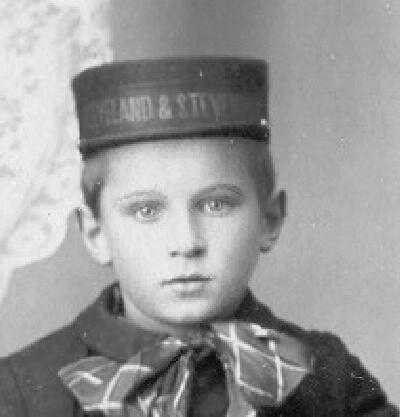
Figure 2.--President Cleveland was the only president to be reelected after having been defeated. Here is boy involved in the second campaign. The boy is unidentified, but we know the portrait was taken in 1892. The cap band clearly reads Cleveland and Stevenson, the Democratic Pary ticket in 1892. What we are not rea;l sure about is if this boy wore a pillboc cap normally or if this was some kind of special campaign cap. Click on the image for an en;asrgement of the cap. What he is resting his arm on I am not quite sure. One reader thinks it may be an accordian.
Second term (1893-97)
Clevelabd was reelected in 1892. He had disagreed with many decusions made by Presient Harrison which is why he ran again. His secind term, however, would be dominated by the Panic of 1893 and ensuing Depression. It is widely vewed as the most severe depression until the Great Depression of the 1930s. He refused to deal with business failures, farm mortgage foreclosures, and unemployment. The farm economy in particular was devestated. While Cleveland declined to intervene in the economy, he did aggrsively pursue fiscal policy. Extensive spending during the Harrison Administration ans silver purchases had depleted the American gold stock which had fllen below the psycholocicall important $100 million level. President leveland dealt directly with the Treasury to address the problem. He convinced Cingress to repeal the mildly inflationary Sherman Silver Purchase Act and with the aid of Wall Street financeers began to rebuild the Treasury's gold reserve. In the midst of the Panic of 1893, doctors found that Cleveland had cancer of the mouth. He had aecrt operation on board a ship. He had recovered and was back at work in the White House before the public knew thatvhe had been ill. A major event was a railroad strike. Striking workers in Chicago violated a Federal court injunction. Cleveland ordered Federal troops to enforce the court order. "If it takes the entire army and navy of the United States to deliver a post card in Chicago, that card will be delivered." Cleveland's foreful response to the strikers impressed many Americans. A diplomatic issue developed with Britain over the border between British Guiama (Guyana) an Venezuela. He insisted that Britain to accept arbitration Some historians see Cleveland's intervention an over reaction. The order between British Guianaabd Venezuela hardly seems reason for a major diplomatic row with Britain. Some historians beliece that his poliy was based on lingering Civil War domestic issues. The Republicans were still using the campaign slogan describing the Democrats as the "Party, of Rum Romanism and Rebellion". Some beliece that th slogan had so infuriated southern voters that it may have cost the Republicans the 1892 election. And of course the British had provided some support to the Confederacy.
Domestic isues, however, were of far more imporance than international issues in most Anerican ekections. Cleveland's failure to respmd tp the Depression were not popular with workers and farmers. Cleveland's refusal to to intervene in the economy to end the Depression aliennated many Democratic voters. As did his action agaunst chicago railroad strikers. His Party failed to endorse his policies. They nominated William Jennings Bryan in 1896. Bryan favired Federal intervention in the economy. It was at the 1896 Democratic nominating convention that he delivered his iconic cross of gold' speech. The Demorats would choose Bryan to be their standard bearer in the next three elections and he lost all three times. In fact after Clevelnd, the Republicans oukd dominate the white Hiuse ir three decades, except when T. Roosevelt split the Partyb enabling Wilson to win election. In effect the Panic of 1893 and resulting Depression turned the country into a Reoublican majority in the same way that the Wall street Crash of 1929 and ensuing Depression turnedA merica into a Democratic majority.
After the Presidency
The Clevelands moved to Princeton, New Jersey after leaving the White House. He was acquainted with future Democratic President Woodrow Wilson, but the two did not like each other. Wilson referred to him as "just another Republican". Cleveland died in 1908. While a major figure of his time, Cleveland was largely forgotten in the Republican dominance that followed him. Historians gradually began to reappraise earlt 20th century appraisals of Cleveland. Especially notable was his willingness to oppose popular issues, many of which would not have been in the country's long term best interests.
Marriage: Frances Folsom Cleveland (1864-1947)
President Grover Cleveland was a rare baclelor president, but unlike Jans Buchann, he dcided to marry. While presudent he became enchanted with a rather young Frances Folsom. She was only 22 years old, the first presidential bride to be married in the White House. Frances was born in Buffalo, New York. She was an only chikld. Her parents were Emma C. Harmon and Oscar Folsom. Folsom becme a law partner and close friend of the family . Frances when she arrived for some reason she was called 'Frank'in the family. And she grew upo she prefered it to Frances. From infancy. Clevland took an interest in Frances. He brought her first baby carriage. Folsom died unexpectely. Clevekland was the executor of his estate. As administrator of the Folsom estate after his partner's death, though never her legal guardian. He looked after her eduction. It was thought that Cleveland might marry Folsom's widow. Instead as Frances blosomed into a beautiful young woman, he began to take more than a friendly interest in her. After she entered Wells College, he asked her mother for permission to correspond with her. And he began to send flowers to her.
Frances and her mother did not attend the inauguration (1855). They visited him in the White House during the Spring. Romamce soon developed. Her mother who had hoped to b the First Lady was not pleased. Frances was sent off to Europe, but Cleveland corresponded withhr, even proposing by letter. Frances aggreed to marry despite the 27 years' difference. hey married in the WhitevHouse (June 2, 1886). The marriage was the social event of late-19th century. The beautiful young bride captivated America. The wedding has been prepared to that of Charles and Diane, but with a happier outcome. Cleveland's sister Rose Elizabeth Cleveland, a rather scholarly person had been assisting her bachelor brother as White House hostess. Her arrangements were rather stuffy affairs. Rose had no troubke turning her White House duties over to Frances. She returned to her former career as an educator. Frances delighted in the role of First Lady and had flair for entertiunment. She proived to be was a very popular First Lady, both herbneauty and persinl charm. She had an impact on fshion. She stopped wearing a bustle which prioved to send that particular fashion. She added a social dimnsion to hite house entrtaining. She held two receptions a week and insited tht one be on Saturday afternoons,
so employed women could ttend. She and the Presidented met with the venerable Mrs. Polk to the South, politiclly vital for any Democratic candidate. With Clevland's losing his reelection campaign (1888), the family moved to New York City. There baby Ruth was born. The popular candy bar years later was nmed after her. Frances was at th time more bothered by the use of her image for commercial products. Frances returned to the White House with the Presiden's unprecedent election victory (1892). Esther (1893) and Marion (1895) were born in theWhite House. Frances is best remembered as one of the best hostesses to serve as First Lady. Less well known his her charitable side. She was vnot just a flighty young woman obseessed with entertaing and fashion. Her charities included the Women's Christian Temperance Movement's "Hope and Help Project and helped establish the Washington Home for Friendless Colored Girls. Such ctivitieswere ratre for 19th century first ladies. After leaving the hite House had two more boys. They retired to Princeton, New Jersey. She was at Clevelsand's side when he passed away at their home, Westland (1908). Frances was the first First Lady to remarry. She married Thomas J. Preston, Jr., a professor of archeology (1913). She was active in the Princeton community and lived to be 84 years old.
Children
President Cleveland married lte, but eventiually had five children. The first was born after tghe Cleveland's left the white House the first time--Baby Ruth. While President Cleveland had limited time to play with the children in the White House, he enjoyed being able to spend more time with them after his presidency. He was by all accounts an sttentive nd caring father, especially after .
Oscar Folsom (1874-??)
Oscar was a young boy when he was the subject of one of the most celbrated American scandals in presidential history. After Clevland was nominated by the Democratic Convention, the news broke that he was supporting Maria Crofts Halpin and accepted responsibility for her child Oscar Folsom. The boy was named after Cleveland's law partner. Actually Cleveland may not have been the boy's father. Her other gentlemen friends were married while Cleveland at the time was single so he accepted resonsibility. The press and Reoublicans had a field day in the election campaign. Their favorute slogan was, "Ma, ma, where's mu pa. Gone to the White House, ha, ha, ha." Oscar's mother suffered from alcoholism and was institutionalized for one period. Cleveland arranged for a wealthy family in Buffalo to adopt Oscar. For a child that was at the center of aolitical storm, nothing is known about his adult life. Accounts vary from at early death from alcohol to a successful career in medicine.
Ruth (1891-1904)
Cleveland with the exception of Oscar Folsom had no children to bring to the White House because he had married while president. Ruth was known as Baby Ruth when the Clevelands moved back into the White House (1885). She was, however, no longer a bby. The American public were captivated by the little girl, but the Clevelands wanted to keep their children out of the public eye believing that the attention would harm them. The Clevelands had a large family, but curiously none of the other children attracted the same attention as Baby Ruth. Even after Cleveland left office in 1897, the public remained enamored by the little girl. Ruth tragically died suddenly from diphtheria when she was only 12 years old (1904). It devestating the Clevelands and the public which still remembered her. It was a long time before Grover began to get over his oldest daughters death. The Curtis candy complany claimed the named the 'Baby Ruth' candy bar after her (1921). That was 17 years after her death. It is widely believed tht the bar was named after baseball home run king Babe Ruth. Saying they named it after Ruth Cleveland meant that the company did not have to pay royalties to the Babe.
Ester (1893-1980)
Ester was born in the White House, but for some reason did not capture the public attentiion like her big sister Ruth. She married Captain William Sydney Bence Bosanquet. It was a high society wedding held in Westminster Abbey. They lived mostly in Yorkshiere. She tried to show her husband the room she was born in. They had two children. When her husband died in 1977, she returned to America and lived in New Hampshiere before her death a few years later.
Marion (1895-1977)
Marion was also born while her father was still president. She married William Stanley Dell and had a daughter. When he died she married John Harlan Amen. Marion was active in many charities, most prominantly the Girl Scouts. She was a community relations advisor for years and promoted enpowering programs. Her second husband was an attorney who served on the U.S. legal staff at the Nurenberg war crimes trials and latter was a special U.S. attorney who developed a reputation for racket busting.
Richard Folsom (1897-1974)
Richard was know as Dick. He was born a few months after his father left the White House. He attended Princeton and Harvard Law School. He served as a Marine officer in World War I. He worked as an attorney in a Baltimore law firm and was active in Maryland politics. He never ran for public office himself. He is best known as the attorney for Whitaker Chambers, the former Communist who helped make Richard Nixon's political career by denouncing Alger Hiss, a State Department official.
Frances (1903-95)
Frances was born after the Clevelands finally left the White House. He was 5 years old when his father died. Frances was raised by his mother and her new husband Thomas J. Preston, Jr. He attended Harvard and majored in drama. He married Alice Erdman. His acting carrer was unsuccessful and we know little more about his subsequent life.
Sources
Summers, Mark. "Grover Cleveland's 1884 election" The Presidenct Series C-Span (October 7, 2020.
Wead, Doug. All the President's Children: Triumph and Tragedy in the Lives of America's First Familirs (Atria: New York, 2003), 456p.