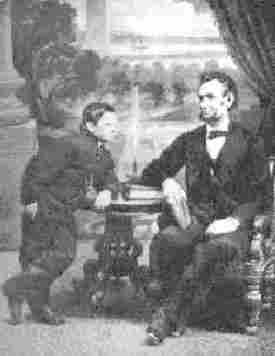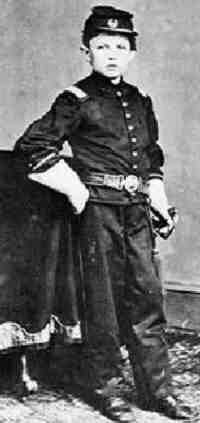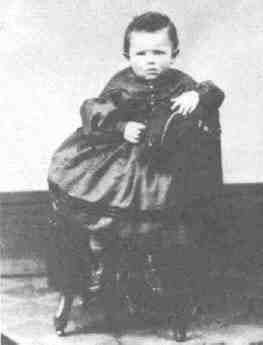
Figure 1.--The Lincoln boys, as was common at the time, wore dresses when little. I'm not sure when Tad and the other boys were breeched. |
|
Thomas was the Lincoln's youngest child. Because of his playful, mischievous nature, he is a real favorite to history. Tad
was born on April 4, 1853, in the Lincoln Springfield home . He was named after Lincoln's father, Thomas. Lincoln had a troubled
relationship with his father who passed away n 1851. Tad's head was rather large when he was born large. His father nicknamed
him "Tad," short for "Tadpole," because his father thought the large head and small body looked rather like a tadpole. Tad as he
grew up proved to be a handful. He loved to play planks and wreaked havoc in the White House. His older brother Willie was more
thoughtful and well behaved, but often went along with Tad's escapades. Tad was what would today be called developmentally
disabled, although his mother insisted that he was bright. She was to refer to him as "troublesome sunshine". Unlike Willie, he
hated having to study. After his older brother's death, he calmed down somewhat and became especially close to his father.
Tad's head was rather large when he was born large. His father nicknamed him "Tad," short for "Tadpole," because his father
thought the large head and small, squirming body looked rather like a tadpole. Normally he was called Taddie within the family.
Unlike many childhood nicknames Tad, continued to be called Taddie even as he got older. Mrs. Lincoln in her letters always
called her son Taddie.
Tad proved to be real handful for his parents. Mrs Lincoln constantly referred to him as "dear little Taddie" and called him
"troublesome sunshine". He was constantly active. Modern doctors might have prescribed drugs to tamper down his hyper-activity.
This was quite a contrast to his rather contemplative older brother, Willie. Tad was slow to learn to speak intelligibly. Here his lisp may have been part of the problem. Tad also had trouble leaning to read and write and as a result took an early dislike to studying. Again this contrasted sharply with Willie who loved to read and enjoyed his studies. Tad actually has been described differently. Some suggest that he was bright boy, but with leaning difficulties. One biographer writes, "... he had brightness, whimsical bold humor; he was a precious burden to his mother and father". [Sanburg, ML, pp. 66-67.] Tad's behavior could be quite varied and his parents were never quite sure how he would behave on a given occasion or what he would could up with next. He could be quite imaginative which showed up pranks in which Willie was often a coconspirator . Tad certainly was responsible for some of the most outrageous pranks of any White House child. He can not be called a bad boy, but he certainly was mischievous and constantly active. His mother in fact often found him exasperating and seems to have been amused at many of his pranks. Tad had another less well reported side, he was a sensitive, loving boy.
Tad was also known for his affectionate and impulsive personality. Tad quited down somewhat after Willie's death. The whole
family was affected by the tragedy and Tad no longer had a partner in crime. Tad 's relationship with his parents also changed.
The boy became became the focus of Lincoln's affections after Willie's death. He sought solace in the company of his son and the
two spent more time together.
Tad not only tended to speak very rapidly, but had trouble pronouncing his words clearly. As a result of a birth defect he had a partially cleft palate. This caused him to lisp and was a part of the problem. He was often very frustrated with his inability to make himself understood. The President, however, had no difficulty understanding Tad. He also was very sympathetic to the boy's frustrations. His mother at first took him to see a dentist. The dentist prescribed a painful steel device intended to rearrange his teeth. Not only was the devise painful, but it made virtually impossible for Tad to be understood when he spoke.
Finally unable to bear Tad's complaints, Mrs Lincoln decided to engage an elocution instructor. [R.T. Lincoln letter, January 17,
1868.] Had the President been alive, he probably would not have permitted it.
The Lincolns it is safe to say overindulged both Willie and Taddie. Monet had been tight when Robert arrived, but by the time
Willie and Taddie came, the Lincolns had the money for toys of all kinds. They not only brought their toys from Springfield, but
the President would personally take the boys to a wonderful toy shop in Washington--Stuntz's Fancy Store, 1207 New York Avenue.
Presumably this was where the infamous toy cannon was purchased.
Tad was 8 years old when the Lincoln family moved into the White House in 1861. Although Tad was more rambunctious than his
brother, Willie, both boys enjoyed playing pranks around the Executive Mansion.
The Lincoln's traveled from Springfield to Washington by train. It was a memorable trip with stops in many northern cities.
At one such stop the crowd at the station demanded to see Mrs Lincoln and the boys. Tad graciously mustered a polite bow. Tad's
behavior was unpredictable. On this occasion he his in his mother's voluminous skirts which the crowd thought amusing. [Baker,
p. 165.] The public attitude was less friendly as the train moved into Maryland.
The situation in Washington was serious when the Lincoln's arrived for the Inauguration (March 1861). Virginia's succession meant that Confederate forces were formed across the Potomac in Virginia. A Confederate flag in Alexandria could be seen from the White House. A close friend of the Lincolns was killed when he took down the flag. Only a small contingent of Federal troops was in the city. Quite a few women left the city. The commanding general of the Army, Winfield Scott, urged Mrs. Lincoln to take the boys back to Springfield. Mrs Lincoln was not about to be moved from the White House. For more than a month, Washington was largely undefended. One of the few Federal units in the city were a small detachment of New York Zouaves. Mrs. Lincoln made a doll for Tad with a Zouave uniform. Tad named the doll Jack. While in Tad's possession, Jack had a checkered history, once
being tried for treason. Finally military units arrived in force to defend the Federal Government in Washington (late April 1861). Finally a Pennsylvania and Massachusetts regiment reached Washington, parading down Pennsylvania Avenue past the White House. Mrs Lincoln waved. I'm not sure where the boys were, but certainly they were waving at the soldiers as well.
The Lincolns had brought a nurse from Springfield to help care for the boys. By all accounts she had her hands full. As a cost cutting measure Mary deciding the boys were too old to have a nurse, sent her back to Springfield. At the time, Tad was 8-years old and had not yet begun to dress himself. [Baker, p. 190.]
Mrs. Lincoln mentioned in a letter that she brought "a mame" from Springfield to look after the boys. We know that Ton Cross, a White House, messenger often had charge of Tad. They do not seem to have been very successful in preventing Tad's pranks. Tad was also sometimes entrusted to the care "Old Edward" McManus, an elderly gentleman who had worked in the White House since the Jackson years. Mrs. Lincoln had him dismissed, although the reasons are unknown. McManus was not at all pleased with his dismissal and leaked stories about the First Lady to the press. [Turner and Turner, p. 197.]
To help replace the nurse, the Lincolns decided to employ a tutor. The boys continued their education in the White House. The Lincoln's decided that attending a formal school might be disruptive. They were no doubt concerned about how Tad would do in school. As a result, they decided to have the boys tutored in the White House. It was Mrs. Lincoln who selected the tutor, Alexander Williamson. The tutor was also part of her financial machinations. His salary was largely covered by a position in the Treasury Department. [Baker, pp. 190-191.] Williamson set up a blackboard in the state dining room. The tutor soon found two very different pupils. Willie was an extremely clever boy with an inquiring mind. Willie enjoyed the daily lessons. Tad found them a constant irritation as they detracted from the great fun which could be had around the White House. John Hay who was the President's private secretary and thus intimately aware of happenings at the White House, explained that Tad "... had a very bad opinion of books and no opinion of discipline." There parents did not insist that the boys seriously pursue their studies. Williamson stayed on to tutor Tad after Willie died. The President refused to push Tad and he made little
progress academically. Williamson remained at the White House as tutor until the President was assassinated. Tad even at age 12 was not able to write. His mother wrote to his former tutor telling him that her son was now giving more attention to his studies and hoped to be able to write Henderson himself soon. [M. Lincoln letter, June 15, 1865.]
Upon their father's inaguration (march 1861), both Tad and Willie with their mother moved into the White House and it became both their new playground and home. Mrs. Lincoln asked Julia Taft to join them. She brought her younger siblings, 12-year-old Bud and 8-year-old Holly with her. They they became playmates with the Lincoln boys. 0Wead, p. 91.]
Willie and Tad with Robbert away at school had the White House to themselves and they thoroughly enjoyed romping through the halls and dreaming up adventures. Willie was more even tempered and dutiful than Tad. Unlike Tad who had difficulty focusing his attention, especially on schoolwork, Willie was quite capable of getting down to the business at hand. The boys, despite their differences were very close and shared many interests. In particular they adored animals of all kinds. The American public loved to read about the boys in their newspapers. When their interest in animals was reported, American deluged the white House with animals of all kinds. To the boys' delight there were dogs, rabbits, goats, and ponies. Because the President had no desire to discipline the boys, they did rather much what ever they wanted. The boys as in Springfield had the run of the White House. Lincoln called them,
"my splendid fellows". Others called them'hellions'. Observers wondered why the boys were not disciplined and kept under better control. Often it was Tad who was behind the more outrageous episodes such as opening fire on the President's Cabinet with a toy cannon, but both boys had their share of fun. Normally Tad gave up with the most impressive pranks such sending up a toll gate with his toy cannon to see his father or setting off the bell system in the white house. Much of this appeared in the press and editors pushed reporters for more details. Willie being the more thoughtful of the two, was somewhat irritated by constantly being watched. He complained, "I wish they wouldn't stare at us so. Hasn't there ever been a boy in the White House before." But he and Tad had a great time. And what an exciting time it must have been for both boys . The White House was full of soldiers. They allowed the boys to examine and even fire their guns. Because of the times, war-related games were popular with the boys, and they even constructed a fort on the White House roof. The war meant that there were many formal events with the President reviewing the troops. Such ceremonies were real favorites for Willie and Tad. When ever they could get permission they accompanied the President when he reviewed the troops at the many army camps ringing Washington. There mother also had an active schedule visiting the troops and wounded soldiers to distribute fruit, books, papers, and other items. The boys also went with her.
|
A year after arriving in the White House, both boys contracted typhoid fever and were bedridden (February 1862). Willie died, but Tad recovered. Both the President and the First Lady were devetated and the atmosphere in the White House changed. After Willie's death, his parents became even more lenient with Tad's behavior. [Wead, pp. 90-91.] Tad also changed, he became notably became more sedate, but the key word herre was 'more'. He was still largely undisciplined. He and his father grew closer than ever before. The 13th Pennsylvania Reserves were nicknamed the "Buck tails". Soldiers from the regiment were assigned to guard the President's family. Tad became very close to these these soldiers and the soldiers returned his fondness. [Turner and Turner, p. 250.] Tad continued to be impulsive and largely unrestrained by his parents. He was not sent to school. Rather a string of tutors were hired. John Hay, the President's secretary relates that numerous tutors were engaged, but usually quit in frustration after only a short time with Tad. Tad thus had free run of the White House and plenty of time to get up some develment. A vast litany of his exploits were noted by staff and visitors. Tad would often accompany the President when he visited the troops in the forts ringing Washington. He also went along with his mother when she brought flowers, food, and books to wounded soldiers. The white House received parcels of treats and liquors from all over the country. Mrs. Lincoln took much of this to the soldiers. Apparently Tad liked to have Col. Thomas Sweney accompany him and his mother on these trips. Like his parents, Tad loved the theater. At Grover's theater. Tad often went to rehearsals and became a familiar figure backstage. He became quite a hit with the stage workmen. He personally appeared in at least two plays when his dad was in the audience. Just before his father's assassination, Tad accompanied his father to Richmond where they toured the Confederate capital just a few days after Lee's army had been forced to abandoned it. The first Union troops to enter the city was a black calvary unit. Lincoln and Tad toured the city without incident. Only a few sailors guarded them.
|
The author has been only able to collect limited information on Tad's clothes. While a few images exist of the boys from
Springfield, numerous portraits were made of Tad after the Lincoln's arrived in Washington. Thus we know a good bit about how he
was dressed.
The Lincoln boys, as was common at the time,
wore dresses when little. The dresses for boys and girls at the time were little different. I'm not sure when Tad and the other
boys were breeched, or if there were difference about how long each boy was kept in dresses.
The Lincoln boys, both Willie and Tad, were most often photographed in unremarkable long pants suits. I do not believe the boys wore knee pants. The fashion of boys wearing knee pants was just beginning
to become popular in the United States. It was still not common for boys from Western states to wear knee pants. (Illinois at the time was a Western state.) Mrs. Lincoln was notable for shopping trips she took to northern cities like New York and Boston. On one of these trips she took Tad and purchased two suits for him, costing $26, a substantial amount for boys' suits at the time.
[M. Lincoln letter from New York, November 2, 1862.]
President Lincoln's favorite son, Tad, having been sportively commissioned a lieutenant in the United States Army by Secretary Stanton, procured several muskets and drilled the men-servants of the house in the manual of arms without attracting the attention of his father. And one night, to his consternation he put them
all on duty and relieved the regular sentries, who seeing the lad in full uniform, or perhaps appreciating the joke, gladly went to their quarters. His brother objected but Tad insisted upon his rights as an officer. The President laughed but declined to interfere, but when the lad had lost his little authority in his boyish sleep, the Commander-in-Chief of the Army and Navy of the United States went down and personally discharged the sentries his son had put on the post.
|
The author has found very little information about Mary Lincoln and children's clothes. Based on the available photographs she does not seem to have picked out any particularly fancy outfits for the boys. This is intriguing because the First Lady was a very fashionable lady. We do know that she took several shopping trips to Philadelphia and New York. During one, a letter to the President mentions that she had brought "two outfits for Taddie". She does not mention the style. Certainly the major Northeastern cities would have had more fashionable an a larger selection of clothes than would have been available in Washington at the time. Which of course is why she made the purchases on her trip.
The Lincolns, including Tad, were inveterate theater goers. John Wilkes Booth, a famous actor, shot the President while he and the First Lady were watching a performance of "Our American Cousins" at
Ford's Theater, Tad that night was also at the theater, but at a different theater. Tad was at Grover's Theater watching a performance of Aladdin or the Wonderful Lamp, more suitable for a child. During the performance rumors reached the audience. Tad was accompanied by his tutor who was discretely told. Tad was quietly ushered out of the theater and back to the White House. With Tad safely gone, the theater manager, C. D. Hess, announced to the audience that the President had been shot. Back in the White House, Tom Pendel tried to comfort the boy. I'm not sure why his tutor did not do this. Pendel put Tad in bed sometime about !2:00 midnight. His mother was still with the President at the Petersen House. Finally in the early morning Mrs. Lincoln returned to the White House. In the morning she was weeping and wailing uncontrollably. Tad was brought into try to comfort her. He embraced his distraught mother and said, "Don't cry so, Mamma! Don't cry, or you will make me cry, too! You will
break my heart!" Later he was to tell his mother, "Dear mother, three of us here, three in Heaven".
Tad was 12 years old when his father was assassinated. He had been pampered and doted on by his parents and the White House staff, especially after Willie's death. He was subjected to virtually no discipline. Mrs. Lincoln enrolled him in a public school in Chicago (September 1865), his first formal school. Although 12 years old, Tad could not yet write. Then the next year Tad was enrolled in the Brown School, a private academy within walking distance from home. Needless to say, Tad was no longer catered to by the staff or the other boys. This transition was very difficult for Tad as he began his teen years. [Turner and Turner, p. 420.] Problems adjusting to life as just an ordinary boy, was only part of Tad's problems. This outgoing, cheerful and spontaneous little boy was transformed by the tragedies that fell upon him and his family. One assessment points out, "In many
ways Tad Lincoln was the most tragic member of a family marked for tragedy. As a child he has lost a brother who was his closest companion, and then a father he worshiped. His life with his widowed mother seems to have been a hellish experience which bit by bit snuffed out much of what was carefree and spontaneous in his personality." [Turner and Turner, p. 586.] It might have been expected that his older brother Robert would have intervened to assume responsibility as a guardian, but after a brief effort he
declined to do so.
Tad's unstable and emotional over-wrought mother decided to take him to Europe. They sailed from Baltimore (October 1, 1868). The first stop was Bremen. There Mrs. Lincoln continued to be concerned about his education. Mrs. Lincoln enrolled Tad in Dr. Hohagen's Institute, a boarding school. She took a room nearby. She also arraigned for private tutoring. [Turner and Turner, p. 489.] Tad had begun to do a little better in school, but I an unsure to what extent he benefited by attending a school with classes in German. They traveled throughout Europe with an especially enjoyable visit to Scotland. They eventually moved on to London where Tad was tutored. [Sandburg, ML, p. 135.] A London tutor came daily. Later he attended a succession of private
boarding schools. I have no details, but the number of different schools suggests that he did not do well in any of them. Mrs. Lincoln's health gradually deteriorated. Her one consolation was Tad who she kept near him. She wrote, "... his dark loving eyes--watching over me, remind(ing) me so much of his dearly beloved father's."
Tad after returning with is mother from Europe, died on July 15, 1871, at the age of 18. It was about 6 years after the assassination of his father. The cause of death was probably tuberculosis. His death was a great loss to his mother, because she had depended upon him for love, companionship, and understanding after her husband's assassination.
Baker, Jean H. Mary Todd Lincoln: A Biography (Norton, New York, 1987), 429p.
Kunhard, Dorothy Meserve and Philip B. Kunhardt, Jr., Twenty Days.
Norton, Roger. Tad Lincoln.
Ostendorf, Lloyd. Lincoln's Photographs A Complete Album.
Randall, Ruth Painter. Lincoln's Sons.
Sandburg, Carl. Mary Lincoln: Wife and Widow (Harcourt, Brace, World: New York, 1960), 357p.
Turner, Justin G. and Linda Levitt Turner. Mary Todd Lincoln: Her Life and Letters (Alfred A. Knopf: New York, 1972), 744p.
Wead, Doug. All The Presidents' Children (Atria Books: Mew York, 2003).
Weaver, John D. Tad Lincoln: Mischief Maker in the White House.

Navigate the Boys' Historical Clothing Web Site:
[Return to the Main Lincoln page]
[Robert]
[Eddie]
[Willie]
[]