Dwight D. Eisenhower (1890-1969)
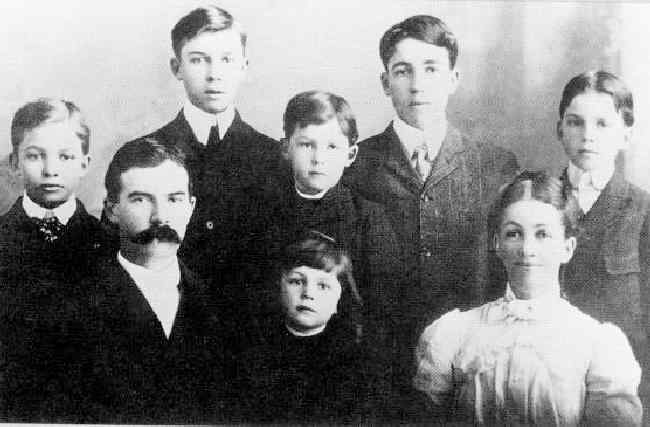
Figure 1.--David and Ida Eisenhowers had six children, all boys. Ike and his brother older brother Edgar were reported hell fraisers. The boys from left to right are: Swight (Ike), Edgar, Earl, Arthur, and Roy. The youngest Milton is in the front. This portrait was taken about 1902. Ike was 12 years old.
|
|
Dwight Eisenhower was the 34th president of the United States. He will be remenbered for his reasuring friendy smile during the dark days of World War II and his leadership of the Anglo-American military alliance. He proved to be a master of coaltion leadership, especially the impressively executed D-Day invasion which played a critical role in freeing Western Europe from NAZI tyranny and preventing Soviet expansion West. He precided over America during a period of affluence and ably led the Western alliance in its confrontation of totalitarian Soviet expansion. He cotinued the Cold War policies crafted by President Truman, enuciating the policy of Massive Retaliation. Overtures to defuse the Cold War were not returned by the Soviets. He played a generally accomplished role in economic management and launched the inter-state highway system. His major failure came in Civil Rights. He did not approve of President Truman's decission to integrate the military. As president, his tentative policies toward marshalling Federal authority after the Supreme Court ordered schools desegregated was a factor in the painful period of violence and disorder throuhgout the South. He had substantial achievements: he forced aeace in Korea, avoided war in Vietnam anf thawed the Cold war to an extent--here Stalin's death was a factor. Other accomplishments included ending McCarhysm, founded the Inter-State Highway System and thSt.Lawrence Seaway, opening the Great Lakes to ocaenic trade.
Parents
The Eisenhowers had many trying times. They lost their farm leaving Ike's mother with a life-long adversion to lawyers. His father ran a store in Hope Kansas, when the wheat market turned down he lost the store. He moved tghe family to Texas and got a job as a railroad hand at $10 a week. Ike described his mother as the most cheerful person that he ever knew. She certainly looks cheerful here (figure 1). With all those boys she would have had to have been a cheerful person. The the physical characteristic that most attracted Americans to Ike--the broad cheerful smile which he must have inherited from his mother. She was a pacifist and cried the day Ike left for West Point. Interesting that her son proved to be one of America's great military leaders.
Family Life
There wasn't much money in thre Eisenhower family. The Eisenhowers were very strict pacifists. They were Mennonites and there families had fled religious persecution in Germany. The whole family got down on their knees every morning and evening and prayed. All the praying did not seem to do Ike a lot of good. His father was very harsh on Ike and his brothers. Ike was a mischecious boy as was Edgar and the two were severely beaten by their strict father on many occassions. One biographer believes that Ike's determination came from his father and his soft streak from his mother. [D'Este]
Ike was born in Texas during 1890. He was brought up in Abilene,
Kansas. He was the third of seven sons. He grew up in an impoverished family living on the wrong side of the tracks. He was a kind of barefoot Huck Finn. He loved to roughneck and fight. He got into a lot trouble as a boy. He was also an excellent ball player. He never got over the concern of being considered a country hick. [D'Este]
Baseball
Ike played Class D basball for a couple years under the name of Wilson.
Education
Ike excelled in sports in high school, and received an appointment to the U.S. military academy at West Point. He could not have afforded to go to college had he not obtained the appoinment. WEst Point also appealed to him because he wanted to play football. An injury cut his career short. [Wukovits]
Military Career
The Army
Second Lieutenant Eisenhower was stationed in Texas where he mett
Mamie Geneva Doud, whom he married in 1916. In his early Army career, he excelled in staff assignments, serving under Generals John J. Pershing, Douglas MacArthur, and Walter Krueger. He was a fine young officer. He tried to get combat assignments, first in the Mexian campaign hunting for Pancho Villa (1916) and in World war I (1917-18), but received training assignments. [Wukovits] Ike was hard working and proved to be an efficent trainer and motivator. He developed a reputation as an organizer. He was one of the few subordinates who stood up to MacArthur. When World War II (September 1939) began, Eisenhower ws 49 years old and stll a major.
Understaning Dwight Eisenhower requires looking at his military career. Until he was sent to England by Marshall, he was largely unknown by the American people. It was General George C. Marshall that made Eisenhower's career. After Pearl Harbor (December 1941), Marshall called him to Washington for a war plans assignment. Eisenhower arrived in Europe (1942) convinced that the primary ffort should be to invade France and relieve the Red Army fighting for its life on the Eastern Front. Churchill convinced him that periferal areas should be secured first. [D'Este] Churchill was wrong about the "soft under-belly of the AXIS. He was right that American troops were not yet ready to take on the battle hardened Germans. Eisenhower He commanded the Allied Forces landing in North Africa (November 1942). It was to be Marshall that would command the Allied invasion of France, but FDR told him that he could not do without him in Washington. Marshall recommended Eienhower. FDR was hesitant to appoint such a junior officer, but aceeded to Marshall's judgement and appointed Eisenhower Supreme Commander of the European theater. Eisenhower thus oversaw the D-Day invasion (June 1944),
France. His order "Let's go" was the single most important decission of the War.
A British journalist observing Eisenhower interacting with the soldiers describes "an untimate bond with a great romantic enterprise". It is chilling to thank what might have occurred if it they had failed. It was Eisenhower's skills as a diplomat which were most valuable after D-Day, especially dealing with Montgomery. The campaign after the Normandy breakout and the liberation of Paris (August 1944) has been hotly bebated concerning the merits of a single thrust rather than the broad-front approach Eisenhower decided upon. Eisenhower had to decide on pushing the American offensive or to seek defensive positions to build up for a German counter offensive and the push in Germany. He rejected a plan proposed by Montgomery. [David Eisenhower] After the Battle of the Bulge (December 1944) and crossing the Rhine (March 1945), Allied armies rolled into Germany. Eisenhower did not cross the Elbe and push for Berlinthat he was, fooled by Stalin on the matter. [D'Este] Others claim that he had no sesire to lose men to achieve a political objective. [Wukovits] His son maintains that he made the correct decission to pursue the German field armies rather than racing the Russians to Berlin. [Davide Eisenhower] He was apauled at what he found at the the NAZI concentration camps. When the NAZI generals surrendered, Eisenhower had subordinates at the actual surrender ceremonies (May 1945). And afterwards refused to return military honors to the Germans.
Post-war Service
After the war, he became President of Columbia University, then took leave to assume supreme command over the new NATO forces being assembled in 1951. His first confrontation with right-wing Republicans came as NATO military commander.
President Truman unexpectedluy won the 1948 election, but in part because of the stalemate in Korea, his popularity had declined sharply. He realized that he could not win another election. He tried to convince war hero General Dwight Eisenhower to run for president as a Democrat. Republican emissaries to his headquarters near Paris persuaded him to run for President as a Republican. He easily won the Republican nomination, sweeping aside luminaries in the party like Senator Robert Taft of Ohio. Eisenhower's conduct during this period lends little credit to him, his behavior toward President Truman and especially Secretary of State Marshall was less than honrable--a rare such event in his career. Especially his failure to come to Marshall's defense when anti-Comminist zealots made scandalous charges. The Democrats turned to Govenor Adlai Stevenson of Illinois. Stevenson was a leading liberal figure in the party. He was nominated on the third ballot--the last convention that a nominating contest went beyond the first ballot. The campaign was dominated by the protracted Korean war and charges that the Democrats were "soft on communism". Eisenhower's strategy was the K1C2 formula-"Korea, Communism, and Corruption." He vowed to go to Korea to end the war. Eisenhower's running mate--California senator Richard Nixon--became an issue when it was discovered he used a fund created by California millionaires to pay for personal expenses. Nixon appeared on national television\, delivering his "Checkers" speech. Checkers was adog and his references to his daughters and his wife's Republican cloth coat resulted in a wave of public sympathy. Eisenhower proved enormously popular and an instant success with American voters. The slogan "I like Ike" and that irresistible smile appealed to voters. Eisenhower won a sweeping election victory in 1952.
Eisenhower and Nixon
One of the not well understood aspects of the Eisenhower oresidency is the relation between President Eisenhower and Vice-president Nixon. It was one of the most disimilar teams in presidential history. It was a two-term political marriahe between a legendary general who hd largely shunned politics and a brash young congressman who was among the most controversial and higly polarizing figures of the day. There were differences in age and temperment as well as political outlook. More is known about Nixob's aditude towrd the President than how Eisenhower viewed his vice-presudent. One historin writes, "Over the years, Eisenhower's feelings anout Nixon kept changing--from the mild disdain that he feltfor most politicians to hesitant respct. Nixon's felings about the geberal could change, too--from neediness and even awe to rare bursts of hateful rage, as when he called him a 'goddammed old fool' or by one account a 'senile old bastard'. Yet at the very end, when the general was dying and Nixon had become the nation's thirty-seventh president, Eisenhower still had aowerful hold on him." [Frank] Perhaps the least understood aspect of their relationship was the 1960 presidential campaign. Eisenhower offered very little support to Nixon in the campaign. When asked by repoters what his vice-president hd done of importantce, the President replied he coukd not think of one.
Cold War
World War II war hero President Dwight Eisenhower, played a key role in America's developing Cold War policy. De-Stalinization meant that a less-bloodthirsty, more collegial leadership emerge in the Kremlin. They were still committed to Communism and a confrimation with the capitalist West. They were not, however, willing to risk it all with a nuclear war. When Khruschchev blustered, "We will bury you," he firmly believed that the expected efficencies of Communism would defeat America and the West economically. President Truman served at a time where America posessed a nuclear monopoly or a clear predominance of nucler power. This balanced the Soviet Union' dominant ground military power arrayed against Western Europe. President Eisenhower faced a different situation. The Soviet Union was rapidly developing its nuclear arsenal and while not equalling that of the United States, certainly began closing the gap. The Communist victory in China further complicated the picture. And some in the militry felt the only way of surviving was to lunch a first strike. Ike's answer was a policy of massive retaliation, a nuclear umbrella around Western Europe. Eisenhower threatened the use of nuclear weapons if the Sviets invaded Western Europe. One perceptive historian calls this 'Ike's Bluff'. It was based on his assessment that Khruschev was unlikely to use his nuclear arsenaland that much of the nuclear power and misles existed only on paper. Although siometimes depictd in the media as a good natured simpleton, Eisenhower was a sophisticated practioner of geo-politics. And Eisenhowr was willing to tolerate this because it helped desiguse the high-stakes game to which he was committing the American people. One historian writes, "Eisenhower put trendous--some would say risky--reliance on his own intuition about his former friends and present foes in the Kremlin. He believd, as he once privately wrote a colleague, that the Russian leaders were not 'early Christian mrtyrs'. But he did not widely share this view ... nor did [he] try as hard as he should have to calm the fears of schoolchildren about the threat of Soviet nuclear attack. To do so mightbhave steadied nerves, but would also have shown cards. Public terror was a price--politically as well as psychologically--well below Armageddon." [Thomas] In essence, Eisenhower confirmed the Truman policy of blocking Soviet military expansion so the Cold War became an economic conflict between free market capitalism and Communist state planning.
Presidency: First Term (1953-57)
The Republican Party had been out of power for 20 years when Eisenhower was elected in 1952. Some historianshad speculated that restoring the Republican Party was a major achievement. He pursued the moderate policies of "Modern Republicanism," pointing out as he left office, "America is today the strongest, most influential, and most productive nation in the world." Post-War historians, often with liberal leanings and impressed with the Kennedy charm, described him as an aloof, largely ineffectual leader. With more perspective, assessmebnts of the Eisen hower presidency have increased. On biographer describes him as with the exception of Franklin Roosevelt as the most successful 20th century president. That is a bold statement, but it is clear that he was a more successful president than widely believed during his term of office.
Domestic affairs
President Eisenhower in domestic policy pursued a middle course. Unlike what many Republicans wanted, he continued most of the New Deal and Fair Deal programs. He notably extended Social Security coverage to the self-employed. He emphasizing the need for a balanced budget, understanding that the value of the dollar and interests rates were important to the economic well being of the American people. He is also responsible for launching the Inter-State highway system.
Foreign affairs
Bringing to the Presidency his prestige as commanding general of the victorious forces in Europe during World War II, President Eisenhower had enormous appeal in Europe. His first step was in Korea. He obtained a truce in Korea, largely threatening to launch a massive bombing campaign (1953). The result was not peace, but at least an armed truce along the 38° parallel which became the DMZ. Despite or perhaps because of his military background, his primary foreign affairs iniitiative was to ease the tensions of the Cold War. This was finally possible because Stalin died shortly after he becamne president. This made possible a shift in relations with the Soviet Union. Negotiating from military strength, he tried to reduce the strains of the Cold War. The new Soviet leaders consented to a peace treaty neutralizing Austria which provided for the withdrawl of Soviet and Allied troops. Both the Soviet Union and the United States developed even more destructive hydrogen (fusion) bombs. With the horific threat of atomic war, Eisenhower, with the leaders of the British, French, and Soviet governments, met at Geneva (July 1955). The President proposed that the United States and Soviet Union exchange blueprints of each other's military establishments and "provide within our countries facilities for aerial photography to the other country--Open Skies. The Russians greeted the proposal with silence, but were so cordial throughout the meetings that tensions relaxed. An historian writes, :Eisenhower's 'Open Skies' proposal caoptured the world's imagination, even though the Soviets were ininterested .... Khrushchev later denounced Eisenhower's proposal as a ploy aimed at penetrating the iron cirtail for puposes of espionage .... Elsewhere, Eisenhower was the hero of tyhe hour.... Le Monde then in a robustly anti-American phase, reported that 'Eisenhower, whose personaliyu has long been misunderstood, has emerged as thectype of leader that humanity needs today.'" [Smith]
Health
Unexpectedly, President Eisenhower suffered a heart attack in Denver, Colorado (September 1955). He was hospitalized for 7 weeks. Doctors reported his recovery (Februry 1956).
The 1956 presidential election was a rematch of 1952. The Republicans renominated President Eisenhower. The Democrats renominated Govenor Stevenson. Sentator John F. Kennedy helped build his national reputation with a book--Profiles in Courage. Actually it was his second book. The first was Wild England Slept which repudiated the isolationist views of his father, Ambassador Joseph P. Kennedy. Kennedy was more of an editor of Profiles in Courage, but it won him a Pulitzer prize and helped burnish his reputation, almost winning him the Democratic vice-presidential nomination in 1956. The 1952 and '56 elections marked the beginning of a shift in American politics. The Democrats beginning with Franklin Roosevelt's 1932 election in the middle of the Depression began an era of Democratic control. The Republican victories began a more competive period. Even so, the Democrats mostly controlled the Congress and Eisenhower was more of a war hero than a Republican Party stalwart. Major Republicans like Robert Taft wanted to roll back both the New Deal and America's expansive international involvement after World war II. Eisenhower both in the campaign and during his administration made no move to do either. The election was a landslide for Eisenhower, but not for Republicans.
Presidency: Second Term (1957-61)
Domestic affairs
Civil rights exploded as a national issue during President Eisenhower's second term. The Supreme Court ruled in Brown vs. Topeka that racial segregation in schools was unconstitutional (1954). The ruling had been achieved as a result of Chief Justice Earl Warren's leadership. Warren had been appointed by President Eisenhower in his first vterm, but he came to regret the appointment. Soon Federal Courts began to order Southern school districts which defied the Supreme Court order to desegregate. When violence occurred in Little Rock, Arkansas, the President reluctantly sent troops to protect black children and to assure compliance with Federal court orders. Although he had initially opposed the desegregation of the military, he also ordered the complete desegregation of the Armed Forces, which President Truman had begun. "There must be no second class citizens in this country," he wrote.
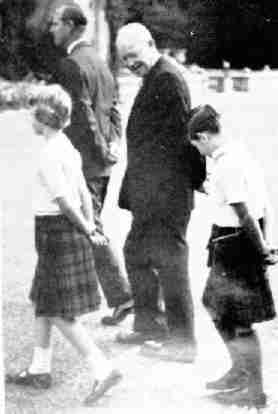
Figure 2.--President Eisenhower is pictured here during a late 1950s visit to Britain, walking with the royal family. Both Princess Anne and Prince Charles are wearing kilts.
They may prove to be the last generation of royals to commonly wear kilts.
|
|
Foreign affairs
President Eisenhower concentrated on maintaining world peace. He promoted the "atoms for peace" program--the loan of American uranium to "have not" nations for peaceful purposes.
Final address
Before he left office in January 1961, for his farm in Gettysburg, he urged the necessity of maintaining
an adequate military strength, but cautioned that vast, long-continued military expenditures could
breed potential dangers to our way of life. He concluded with a prayer for peace "in the goodness of
time." Both themes remained timely and urgent when he died, after a long illness, on March 28,
1969.
President Eisenhower could not run for reelection in 1960. The Republicas horrified by Roosevelt's third and fourth terms, oversaw the passage of the 22nd Amendmentment, resyructing a president to two elected terms. President Eisenhower for health reasond, probably would not have run for a third term. His presidency was, however, an issue. Senator Kennedy criticized the Administration for more forcibably resisting Communist aggression and for allowing a missle gap to develop. (That gap although widely discussed and believed, in fact did niot exist.) Vice President Nixon was put in th position in defending the Administration, although he had little influence in setting policies. President Eisenhower for his part gave little support to his Vice President. When asked what important contributions that the Vice President had made to the Admoinistration, he told reporters he could not think of any. It is not entirely clear why President Eisenhower did not support his Vioce President even though his Adminisdtration was being criticized by Senator Kennedy. Kennedy generally refrained from criticizing President Eusenhower personally.
Mamie Geneva Doud Eisenhower (1896-1979)
Mamie Eisenhower's bangs and sparkling blue eyes complimented President Eisenhower's famous grin. She was rarger in the mold of Bess Truman, but much more supportive of her husband. She and the President had a different view of the First
Lady than Americans had experienced with Elenor Roosevelt. Mrs. Eisenhower wanted nothing to do with politics and controversial issues. She was more outgoing than Bess Trumamn and had an out outgoing manner, art of her personality and refined during her husband's military career. She had what might be described as a feminine love of pretty clothes and jewelry, rather in keeping with the times. And she was obviously poud of her husban\d nd was content to bask in her husband's prestige. She was perhaps ideally suited for the times and was popular if not very exciting First Lady. Like her husbans, she was a Midwesterner. She was born in Boone, Iowa (1896). Mamie Geneva Doud moved with her family to Colorado when she was only 7-years old. There her father retired from business, and Mamie and her three sisters grew up in a large, comfortsble house in Denver. The family commonly visited relatives in the warmer climate of San Antonio in souther Texas. It was during one of those trios that Mame met
a young second lieutenant with aide smile--Dwight Eisenhower (1915). They met at Fort Sam Houston and it was just before Wotld War I. Ike was on his first tour of duty. Ike was immediately attracted to him. He later recalled: "a vivacious and attractive girl,smaller than average, saucy in the look about her face and in her whole attitude." Only a year later on St. Valentine's
Day he gpresented her with a miniature of his West Point class ring and they were formally engaged (1916). A few months later they were married. The ceremo\ny took place in the Doud Denver home. After 2 years of frenzied activity during World War I, the U.S. Army was sdrastically reduced. Minimal appropriations mean that promotions were very rare. It was not the most glamerous life, shuttling from one dreary Army post to another, but she became auitful Army wife. Ike had duty in
in the Panama Canal Zone; France, and the Philippines. She latter calculated that in 37 years she had unpacked her household at least 27 times. The moves often meant another step up in Ike's career ladder with gradually increasing responsibilities for her as well. The slow promotions suddenly changed with Wotld War II and the massive expansion of the U.S. Army.
Children
The first son Doud Dwight or "Icky," who was born in 1917. The boy died of scarlet fever in 1921. A second child, John, was born in 1922 in Denver. Like his father he had a career in the army; later he became an author and served as ambassador to Belgium. Two of his children are David and Susan Eisenhower who were children while their grandfather was in the White House.
Doud Dwight (1917-21)
The first son Doud Dwight or "Icky," was born in 1917. He was was the love of Ike's life. He tragically died of scarlet fever in 1921 while his father was stationed at Fort Meade, Maryland. His parents were heart broken. Ike later described it as the greatest tragedy of his life.
John Sheldon Doud (1922- )
A second child, John, was born in 1922 in Denver. Like his father he had a career in the army. He was decorated in the Korean War. His military career was somewhat limited out of concern that his capture or death in combat would have negative propaganda consequences. He served in his father's White House. President Nixon appointed him Ambassador to Belgium. He published several books on military history and other subjects. His book The Bitter Woods is generally seen as the defintive study of the Battle of the Buldge. He married Barbara Jean Thompson in 1947, but they divorced in 1986. They had four children. The best known are Dwight David II and Susan Eisenhower who were children while their grandfather was in the White House. Dwight David married Julie Nixon, President Nixon's daughter.
Childrens Clothes
Sources
Ambrose, Stephen.
Carlo D'Este, Eisenhower: A Soldier's Life (Henry Holt, 2002), 848p.
Davis, Kenneth. Soldier of Democracy.
Eisenhower, David. Esisenhower at War.
Frank, Jefrey. Ike and Dick: Portrait of a Strange Political Mrriage (2013), 448p.
Smith, Jean Edward. Eisenhower: In War and Peace (2011).
Wead, Doug. All the President's Children: Triumph and Tragedy in the Lives of America's First Families (Atria: New York, 2003), 456p.
Wukovits, John. Eisenhower: A Biogtraphy.
HPC

Navigate the Boys' Historical Clothing Web Site:
[Return to the Main President's page]
[18th Century]
[19th Century]
[20th Century]
[21st Century]
Created: June 25, 1999
Last changed: 1:13 AM 2/17/2013