
British Royalty: King James II (1633-1701)
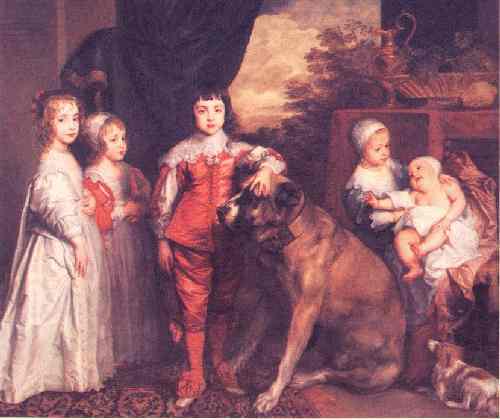
Figure 1.--Five of the children of Charles I and Henrietta Maria were painted by Van Dyck in 1637. They are Princess Mary, James Duke of York (future James II), Prince of Wales (future Charles II), Princess Elizabeth, and Princess Anne. Notice that James at age four is still wearing dresses.
|
|
James II was the second surviving son of Charles I. His father had
been executed by Cromwell, but he and his elder brother Charles fled to France for saftey. James inherited the throne from his elder brother, Charles II, in 1685. He ws known as James II in England, but James VII of Scotland. His brother had quarlled with Parliament and covertly accepted money from France, but was cautious on the religious issue. James ignored his brother's advise and his militant Catholcism cost him the throne. The unexpected birth of a Catholic male heir was the cause of his down fall. James ruled for only 3 years, when he was overthrown in what has become knon as the Glorious Revolution.
Parents
James was the third and second eldest surviving son of Charles I and the French Bouborn Princess Henrietta Maria. Having broken an engagement to the Spanish infanta, he had married a Roman Catholic, Herietta Maria of France, and this only made matters worse. Although Charles had promised Parliament in 1624 that there would be no advantages for recusants (people refusing to attend Church of England services), were he to marry a Roman Catholic bride, the French insisted on a commitment to remove all disabilities upon Roman Catholic subjects. Charles's lack of scruple was shown by the fact that this commitment was secretly added to the marriage treaty, despite his promise to Parliament.
Charles I's Family
King Charles and Queen Henrietta Maria had nine children. There were four sons and five daughters. His eldest son died at birth. His two other sons both were crowned kings of England.
Charles James (1629)
Charles James was given the title Duke of Cornwall.
Charles was born in 1630. He lived in exile in France after his father's execution and was restored to the throne in 1660. Charles was the second, but eldest surviving son of Charles I. His father, Charles I, had been executed by Cromwell, but he and his younger brother James had been spirited away to France for saftey. The throne was restored to Charles in 1660 after the death of Cromwell. Charles pursued a moderate policy offering amnesty to all but the regecides who had signed the orders for his father's execution. Charles' reign was marked a period of relative stability after the upheaval of the English Revolution.
Mary Henrietta
Mary Henrietta was born in 1631 and was the Princess Royal. Princess Mary Henrietta
married William II, Prince of Orange, at Whitehall Palace in London in 1641. They had one child, William III of Orange (1650- ). William was to marry Princess Mary, eldest daughter of King James II and in 1688 at the request of seven of the most powerful men uin the country, depose his father-in-law in the Glorious Revolution.
James (1633- )
James was born in 1631. He was the third of his father's four sons.
Other daughters
King Charles and Queen Henrietta Maria had five other other children daughters: Elizabeth (1635- ), Anne (1637- ), Catherine (1639- ), Henry of Gloucester, Duke of Gloucester (1640- ), and Henrietta Anne (1644- ).
Childhood
James II was born in 1633. We have not yet developed details on his childhood. The Van Dyke portrait here suggests that he was very close to his older brother as a child.
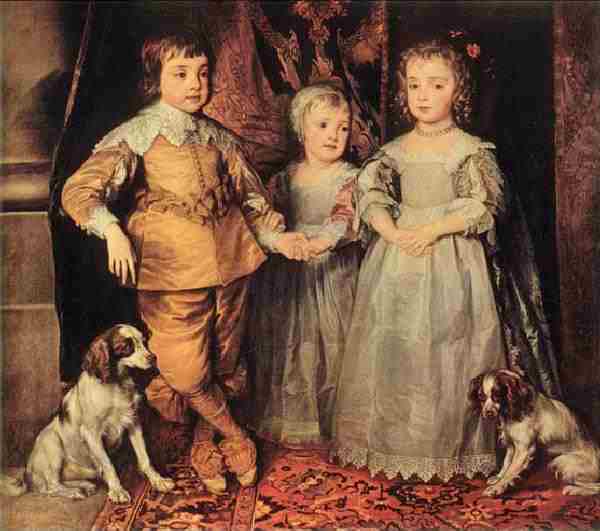
Figure 2.-- Anthony Van Dyke in 1636 painted three of the children of Charles I and Henrietta Maria. They are the Prince of Wales (future Charles II), James Duke of York (future James II), and Princess Mary. Charles would have been avout 6 years old and James about 3 years of age. Notice how similar James' and Mary's dresses are.
|
|
Childhood Clothes
James wore dresses like his sisters as a small boy. He also wore a lace cap which appears to be identical to caps that the girls wore. HBC notes that in the Van Dyck painting that James wears a jacket over his dress. Such jackets may have been worn only by boys still wearing dresses, but HBC can not yet confirm this. I'm not sure when James was breecvhed, probably about 5 years of age. After breeching, James wore adult-styled clothes like his older brother Charles wears in the Van Dyck painting.
Restoration (1660)
James returned with his brother Charles as part of the Stuart Restoration (1660). Charles appointed him Lord High Admiral of England.
Religion
James married Anne Hyde, a Catholic. James became a Roman Catholic. Both James and Anne were reconciled to the Catholic Church (probanly 1670). James did not announce this publically. Both at the time ceased to attend Anglican religious services. Anne died at St. James' Palace, London (March 31, 1671). He made little attempt to keep it secret, but did not announce it publically. After Anne's death. James married Mary of Modena, another Catholic. The Catholic marriage disturbed Parliament especially as he was now living as a Catholic. Many in the public did not know, although it was known in Parliament. Parliament passed the Test Act which required the holders of all public offices to receive communion according to the COE rites and to take an oath against the Catholic belief in ransubstantiation (1673). James was thus forced to renounced his offices including that of Lord High Admiral of England. His conversion to Catholicism thereupon became public knowledge in Englnd. James decided to live in Europe for atime. While in Europe, the House of Commons attempted to exclude him from the succession. King Charles helped to defeat the bill in the the House of Lords.
Charles' Death
There were two possible candidates to seceed Charles as he lay dieing. They were James, the king's brother who was a Catholic. The other was James Scott, Duke of Monmouth, the king's Protestant and ldest, but illegitimate son. On his death bed, Charles admitted that he was Catholic (February 1685). He also announced that his brother James should succeed him to the throne. The Duke of Monmouth challenged his father's wishes. He landed in England with a small army. He expected because he was a Protestant that he would be joined by many who would come to his flag. This did not occur. People wanted no part in another bloody civil war. James' largely Protestant army defeated
Monmouth's small band.
Reign (1685-88)
Most English people were relieved to welcome Charles back after Cromwell's stern rule. Charles had his problems with Parliament, but was cautious on the religious issue. James was crowned privately according to the rites of the Catholic Church at Whitehall Palace (April 22, 1685). He was subsequently crowned according to the rites of the Church of England at Westminster Abbey (April 23, 1685). James was an able soldier and seaman, but, unfortunately for him, an inept politician. Upon his accession to the throne he promised to protect the Church of England and maintain the political and religious status quo, but in the event he could not resist the temptation to do just the opposite. Just across the Channel he had the example and support of King Louis XIV. the kind of absolute monarch the Stuarts aspired to be and who in the same year James became king revoked the Edict of Nantes (1685). Thousands of disposed French Protestants fled to England with accounts of Catholic terror. This intensified the already vehement anti-Catholicism which existed in England.
James if he had followed his brother's cautious policies probably could have retained the crown. James did not, however, follow his brother's advise. In fact, he did just the opposite. He pursued the religious issue with a vengence and set out to reintroduce Roman Catholicism in England. There were three principal pillars on wgich the monarchy was based: 1) parliament (the nobility and gentry), 2) the army, and 3) the Church of England (COE). These three pillars had supported James against Monmouth. James immediately, however, began quareling with Parliament. He then proceeded to alienate the army. James proceeded, ill-advisedly, to enlarge the standing army and to place Catholics within it in positions of command. Parliament had earlier prohobited this with the Test Acts. James ignored this and and began appointing Catholics to senior positions in the army and the government. After doing so, he took the provocative step of stationing tghe army where it threatened Protestant London. He then alienated the final pillar ofsupport for the monarchy--the COE. He ordered all Anglican bishops to read his declaration of indulgence from their pulpits (1687). This was a declaration which, in practice, meant that Dissenters would still be persecuted while Catholicism would not only be tolerated but favored--was met with resistance by 7 of the 26 bishops, including the Archbishop of Canterbury. Those who refused to read it were arrested and thrown into the Tower of London, and immediately became national heroes. Freed after trial, they further inflamed public sentiment against him. Thus when the crisis came, James had no where to turn for support beyond the small Catholic minority.
Family
James mairred twice.
Anne Hyde
James' first wife was a protestant, Anne Hyde (1637/38- ), daughter of Edward Hyde, Earl of Claredon. They married secretly in the Netherlands during 1659 while James was living in exile. They married officially in London after the Restoration (1660). I'm not sure about their relationship. The choice of a Protestant would seem political, but the number of children suggests a harmonious relationship. They had eight children, four boys and a four girls. The boys and two of the girls had died in child birth or at young ages. Two of the girls survived, Marry and Anne. Both were raised as Protestants on the order of James' brother King Charles II. Mary wed William of Orange who replaced her father in the Glorious Revolution. Mary and William died without producing an heir and were succeeded by Anne
Mary Beatrice Eleanorna d'Este
James married agian in 1673. This time he marred a Catholic, Mary Beatrice Eleanorna d'Este. The choice of a Catholic proved to be his undoing. Her father was Alfonso IV, Duke of Modena. They were wed in Dover England. They had 12 children, but until James became king in 1666, none of the boys had survived. This meant that protestant Princess Mary from his first mairrage was in line to inherit the throne upon James' death. Then in 1688, the Queen unexpectedly gave birth to a son--the future never to be crowned James III. Prince James Frances Edward was not only born, but survived, making him the heir apparent. The king and his wife intended to raise him a Catholic, meaning that now firmly Protestant England would have a future Catholic king.
The Religious Problem
James II had learned nothing from his cautious brother and immediately upon rising to the throne began quarelling with Parliament on religious issues. These disagreements may have continued without removing the King as long as the people could anticipate a futute Protesrant queen. This changed with the birth of Prince James. Britain had changed considerably since the reign of James' father Charles I and was now a thoroughly protestant country. The British people would have accepted a protestant Stuart Queen, but were not prepared to accept a Catholic Stuart King.
James's downfall thus came about as a result of James' increasingly strident Catholcism and tghen finally the birth of an heir with a Catholic wife. James' downfall may have ocurred anyway, but the heir's birth brought the issue to a head. The prospect of a Catholic male heir, rather than a Protestant daughter, following Catholic James was too much for now thoroughly Protestant England. Various powerful figures within and without the government, faced with the prospect of a tyrannical Catholic dynasty, treasonously invited the staunchly Protestant William of Orange to assume the throne. William was the son of Princess Mary Henrietta, eldest daughter of Charles I. He was married to Mary Stewart, the eldest protestant daughter of James II and his first wife Anne Hyde. King James, as a result of his head-string policies found himself bereft of political and military support, fled. He though the Great Seal of England into the Thames. He was captured by some fishermen, however, before he could cross the Channel, and was brought back, ignominiously, to London. William, having no wish to make him a martyr or a center for Catholic resistance, contrived to let him escape again. It was announced that he had abdicated, and the throne was officially declared vacant, though it was of course immediately occupied by William and Mary. A convention Parliament in 1689 officially offered them the crown.
The Williamite or Jacobite War began when James II supported by King Louis XIV of France attempted to regain his throne (1689). It is also called the War of the Two Kings because it pitted deposed Catholic James II against the new king, Protestaht William I (William of Orange). James had been deposed by William and Parliament in the Glorious Revolution (1688). William had married to James' daughter Mary which provided a thin venner of dyastic cover. James decided to use predomunantly Catholic Ireland to launch his campaign to regain the crown. Even aftr the Glorious Revolution in England, the Jacobites held most of Ireland. Richard Talbot, the Earl of Tyrconnell, was James's viceroy in Ireland. He wabnted to ensure that all the strong points in Ireland were firmly in the hands of loyal Catholic garrisons. And by By November 1688, only the walled city of Derry (later renamed Londonderry) had a Protestant garrison loyal to William and Mary. Talbot ordered the Earl of Antrim to take the city and garison it with a loyal Catholic force. He did not immediately move on the town. James found support among the mostly Catholic Irish who forned the bulk of the Jaobites Army. James had signed a scret treaty with Louis even before he was deposed. Louis supported James with monet, arms, and men. Tghe Williamite War thus became part War became part of a wider European conflict known as the Nine Years War. A few Protestants of the established Church in Ireland also fought with the Jacobites. In England, James downfall was sealed when he lost the support of the Churchof England because of his none to secret Catholic sympathies. Williams support cane from the mostly Protestant popultion of northern Ireland. A Jacobite army attempted to take the the Williamite stronghold of Derry (1689). The Royaln Govenor declared the city indefensible, but was expelled. Appretice boys managed to stop the first Jacobite force to reach the town, by raising a drawbridge and clising the town gates. The people of Derry decided to fight even when King James appeared at the city gates and demanded surrender (April 18). The city was finally releaved by the Royal Navy (July 28). William organized a multi-national force to invade Ireland, including English, Scottish, Dutch, Danish and other troops. The Protestants who fought under William against James became known as Orangemen. In addition to the dynastic and religious struggle, The Williamite War was the last real Irish resistance to English rule until the 20th century. The Jacobites fought a series of battles. The most important was the Battle of the Boyne (1690). James left Ireland after the Battle of the Boyne. The remaining Irish Jacobites were finally defeated after the Battle of Aughrim (1691). This ended Irish Jacobitism. The Boyne was the last major Irish effort at independence until the Easter Rebellion in 1916. TheWar was formally ended on honorableterms with the Peace of Limrick (1691), althoufg the Irish Parliament subsequentlyvrefused to honor all ofthe terms of the Treaty. The Boyne confirmed English Protestant control of Ireland, but did not affect the Cattholcism of the Irish peasantry. Subsequent Jacobite Risings were confined to Scotland and England. The War had a lasting effect on Ireland, confirming British and Protestant rule over the country for over two centuries. The iconic Williamite victories of the Siege of Derry and the Battle of the Boyne are still celebrated by the Unionist community in Northern Ireland today.
Last Years
After King James was deposed (1688) and then was defeated at the Boyne in Ireland (1690), , he went to Italy with his young son James and lived under the protection of the Pope. He lived out his life in exile. For the Jacobites, King James II and VII continued to reign in the eyes of the Jacobites even after he was deposed in the Glorious Revolution. King James plotted for many years to reclaim the English and the Scottish thrones. The most serious were his efforts in 1689 right after he was deposed. James died in 1701.
Succession
James III
James II was succeeded by his son, James Edward Stuart or Janes III and VIII, who in turn was succeeded by his sons, Charles III and Henry IX and I. At this time we have little information about James III, other than his birth precipitated his father's removal as king. James III, who lived his life in exile, is principally known as "THe Old Pretender". He married a Polish princess and had two sons. His best known son was Prince Charles Edward Stewart--the Bonny Prince Charlie of legend. James lived in exile in France, supported by the French King as a challenge to the Hannovarian kings of Britain. He spent his life dreaming and ploting to seize the throne. The only seious challenge to the throne was the Jacobite Rebellion of 1745 led by his son Charles which ended disatrously in 1746 at Culloden and brought on a devestating suppression of the Highland clans.
Charles III is better known as Prince Charles Edward Stewart, Bonnie Prince Charlie. He was the son of the uncrowned Stuart King James III of Britain and the grandson of the dethroned and last Stuart king--James II James had ruled for only 3 years, from 1685-88. He quickly lost control of the country when he arogantly ignored the advise of his older, more cautious brother--the restored Charles II. Perhaps more importantly a son was born, leading to the prospect of a future Catholic king--James III. Charles Edward Louis Philip Casimir Stuart had trained in France for warfare since childhood. He had fought bravely with the French at the siege of Gaeta in Italy. The Prince, like his father, had been brought up a Roman Catholic, and dreamed of bringing England back to the Catholic faith. The Prince became for ever associated with Scotland, but was in fact not a Scot. His father conceived of seizing the British Crown from Hanovarian King George II. The Prince landed in Scotland in 1745 and launched the Jacobite Rebellion of 1745. He raised a force of Highlanders which seized Scotland and pushed deep into the English Midlands, but decided to withdraw to the Highlands and was defeated at Culloden Moor in 1746. After 5 months of evading capture Charles himself escaped by ship to France. Many of his Highland followers were no so lucky. Charles in 1750 visited London secretly. He tried for years to involve various European powers in assisting his restoration, but with no success. By the
mid-1760's his claims to the British throne were no longer recognised by the Pope and even Catholic powers. Charles died in 1788 having lived almost all his life in exile.
Henry IX and I
Henry was the younger son of James III and brother of Carles III, Bonnie Prince Charlie.
With the death of Henry in 1807 the legitimate male line of the Royal House of Stuart became extinct.
Charles Emanuel IV
The Stewart succession to the throne passed to the senior heir of King Charles I, descended from his youngest daughter Henrietta Anne. This was Charles Emanuel IV of
Savoy--an Italian kingdom.
Duke Francis of Bavaria
The Stewart succession to the throne has continued until today when it is represented by Duke Francis of Bavaria.
HBRC

Navigate the Boys' Historical Clothing Web Site royal pages:
[Return to the Main English royal page]
[Belgium]
[Bulgaria]
[France]
[Germany]
[Italy]
[Japan]
[Jordon]
[Luxemburg]
[Monaco]
[Monaco]
[Netherlands]
[Norway]
[Romania]
[Russia]
[Spain]
[United Kingdom]
[Yugoslavia]
Created: April 28, 2000
Last updated: 11:47 AM 9/26/2012