
Bavarian Royalty: Crown Prince Rupprecht
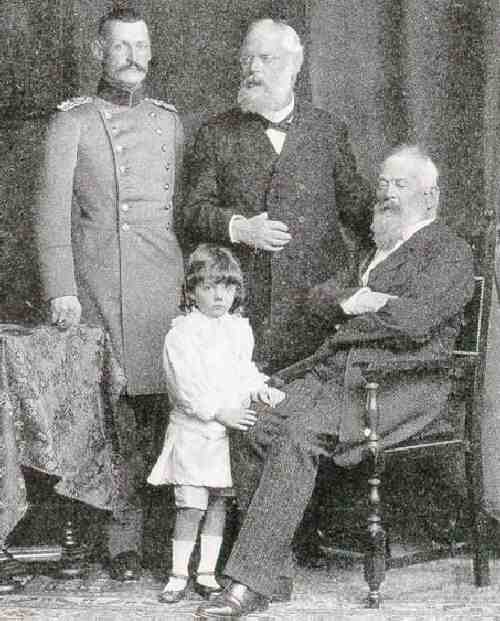
Figure 1.--Prince Ruprecht standing with with Prince Ludwig (later King Ludwig III), Prince-Regent Luitpold (sitting) and little Prince Luitpold (son of Crown Prince Rupprecht) four generations of Wittelsbachs. This photograph was taken about 1904. Note that Prince Luitpold wears a skirted garment with wht looks to be kneepants.
|
|
Crown Prince Rupprecht (Ruppert) was born in 1869. He commanded the Germnan Sixth Army and later an Army Group during World War I. He succeeded as head of the Wittelsbach dynasty in 1921 upon the death of his father, Ludwig III, the last ruling King of Bavaria. Since then, royal titles have no longer carried any legal status. Lingering monarchist sympathies still exist in Bavaria, but there have been no serious attempts to reinstate the Wittelsbacher. Putting Rupprecht, King Ludwig III's son, onto the throne was considered in the early 1930s, as a way to check Hitler's rise to power, and in the 1940s at the end of World War II, but never came about. His first wife was Marie Gabriele, née Duchess in Bavaria (1884-1912). They had four children, including Albrecht, Prince of Bavaria (1905- ). He had a second family after World War I.
Parents
Crown Prince Rupprecht (Ruppert) was born in 1869. He succeeded as head of the Wittelsbach dynasty in 1921 upon the death of his father, Ludwig III, the last ruling King of Bavaria. Rupprecht's mother was Maria Theresa of Habsburg-Lotharingen.
Crown Prince Rupprecht's father was Ludwig III (1845-1921). Ludwig was proclaimed King of Bavaria in l913. King Ludwig III, Prinzregent Luitpold's son, was already an old man and in poor health when he came to the throne. He was the last Bavarian monarch. Ludwig III was proclaimed King of Bavaria in l913. Ludig had quite a large family, 13 children. King Ludwig III, Prinzregent Luitpold's son, was already an old man and in poor health when he came to the throne. He was the last Bavarian monarch. The Wittelsbach dynasty was deposed by a Socialist revolution in Munich on November 8, 1918. Public outrage of the deprivation and tragic consequences of the War resulted in the overthrow of royal families throughout Germany. The outbreak of this German revolution helped quicken the end of World War I. The Bavarian Government was taken over by a cabinet under the left-wing socialist, Kurt Eisner, who had led the revolt against the monarchy. In 1919, however, Eisner was assassinated. Led by Count Arco-Vally of the Germany army. After a resulting communist revolution which lasted only a few weeks a democratic government within the new German republic was formed. In the upheavals that followed Germany's defeat in the First World War, Bavaria was declared a worker's republic and the royal family fled Munich on the advice of the new government, which said it could not guarantee their safety. After 783 years in power the rule of the Wittelsbach family in Bavaria was at an end.
Crown Prince Rupprecht's mother was Maria Theresa of Habsburg-Lotharingen. Her father was Archduke Ferdinand of Austria-Este (1821- ) and Archduchess Elisabeth Habsburg-Lotharingen (1831- ). Habsburg-Este or Austria-Este was a title and surname used by cadet branches of the House of Habsburg-Lorraine to indicate a connection with the extinct Italian princely and feudal family of Este. They ruled the Italian principality of Modena. As a cadet or younger branch of the House of Habsburg-Lorraine, the Habsburg-Estes were accorded the rank of Archdukes and Archduchesses of Austria, Princes and Princesses of Hungary and Bohemia. Maria Theresa married Ludwig in 1868 well before his father had become Prince Regeant and there was no reason at the time to believe that Ludwig would become king.
Childhood
Crown Prince Rupprecht ( Ruppert or Robert ) was born in 1869. This was just before the unification of Germany.
He was the eldest of 13 children. We have few details on his childhood at this time. He and his siblings spent a great deal of time at Schloß Leustetten, Starnberg, and at the family villa near Lindau, Lake Constance. Rupprecht developed an interest in sports.
Education
His education beginning at age 7 years was conducted by Freiherr Rolf Kreusser, an Anglo-Bavarian. The education was both traditional and conservative. He set, however, a new precedent. He was the first member of the Wittelsbach dynasty to attend an actual school. He attended the Maximilian-Gymnasium in Munich for 4 years. This would best be described as an academically selective secondary school. Note that this was a stsate school. The German state schools were so good that German royals often attended them instead of private schools. His education outside of school included horsemanship--important for European royals in the 19th century. He was also required to learn a trade. Prince Rupprecht chose carpentry. He later attended the Universities of Munich and Berlin (1889-91).
Military Career
As a youth, Rupprechts grandfather Luitpold, was not expected to ascend to the Bavarian crown. This came about when King Ludwig II and his successor King Otto were declared legally insane (1886). This changed the position of the teenage Prince Rupprecht who was now in the direct line to succeed to the Bavarian throne. When graduated from the Maximilian-Gymnasium. Following family tradition, he entered the Bavarian Infanterie-Leibregement as a Second Lieutenant. He briefly interrupted his military career to study at the universities of Munich and Berlin (1889-91). He advanced to the rank of a Colonel and became the commanding officer of the 2nd Infanterie Regiment Kronprinz. His responsibilities were light enough to travel. He took trips to the Middle East, India, Japan and China. He at first traveled with his Adjutant, Otto von Stetten. After marriage, he traveled with his new wife--the Duchess Maria Gabrielle. Rupprecht was appointed commander of the Bavarian I Army Corps (1906). His rank was lieutenant general of the infantry. He was promoted to full general (1912).
Rupprecht married Maria Gabriele (1878-1912) of Bavaria in 1900 who became as a result a duchess. Her father was Karl Theodor "Gackl" (1839). Karl Theodor was a son of King Maximilian I Joseph, Bavaria's first king. Her mother was Maria Josepha of Portugal--de Bragança (1857). We know little about her childhood and early life. His sister in law was thus the Princess Elizabeth. While we have little information about her, available images suggest that she was a loving mother. Unfortunately, two of her children died as infants. Maria Gabriele herself died at the young age of about 36 in Sorrento. Tragically her eldest son Luitpod died only 2 years later.
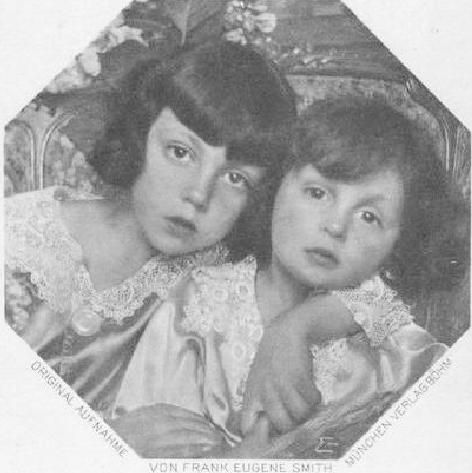
Figure 2.--This portrait of Prince Rupprecht's sons Luitpold and Albrecht was probably taken about 1908. The boys wear satin outfits with elaborate lace collars. They would have been about 3 and 7 years old.
|
|
They had four children, only one of which survived to adulthood. The children were very elegantly dressed as boys in early 20th century. Their clothing looks much like that ofthe Belgian princes at about the same time. Notably the mother of the Belgian princes was Princess Elizabeth who was to become the queen of Belgium. Luitpold was born in 1901. We have little information on Luitpold and his childhood. We do have several portraits of him and we thus know a lot about how he was dressed. His mother chose a variety of very fancy outfits. He died tragically in 1914. Irmingard was born in 1902, but died as an infant in 1903. Albrecht (Albert) was born in 1905 and became Duke of Bavaria in the geological line, although he never reigned. He married Countess Maria Draskovich at Berchetesgaden in 1930. Rudolf was born in 1909. Rudolf dies after only 3 years in 1912.
The Crown Prince's children were very elegantly dressed in the early 20th century before World War I. A photograph that appears to be taken in the 1900s shows the two boys in satin outfits with open lace collars and matching lace at the cuffs. The younger boy wears a skirt outfit. His older brother who looks to be about 10 years old wears a matching out fits but with short pants and a waist sash. Both boys wear short white socks and buckle shoes. Interestingly these outfits are very similar to out fits that Bavarian Princess who became the Queen of Belgium chose for the Belgian princes (Leopold and Charles) at about the same time. Most of the images show the boys wearing what look to us like very formal clothing. We notice a few images of the boys more informally dressed.
The boys wore relatively short hair, although longer when they were younger. Luitpold had the longest hair when young. There hair was never done in the long ringlets like some American boys wore--although this fashiomn was declining in popularity after the turn of the 20th century. The boys wore their hair over their ears until they were about 7 or 8 anf then it was cut to mid-ear level. We are not sure vabout the precise age at which their hair was cut shorter. At about 12 they received short hair cuts. The basic styles for all the boys were simulkar. Differences in the boys' hair caused some differences in the styling. Alnrecht seems to have had curlier hair than Luitpold.
We have no information about Crown Prince Rupprecht as a father. We note that most of the portriats of the boys are with their mother. The fewer portraits of the boys with their father are much more formal portraits. We note none of the more intimate portraits taken with their mother. This may reflect the general attitudes at the time, rather than the specific personality of Prince Rupprecht. Our information, howevr, is very limited and is based only on the available portraits at this time.
Dynastic Developments
Prinzregent Luitpold was succeeded by his son Ludwig just before World War I (1913). Ludwig was subsequently made king by vote of the Bavarian Senate. He became King Ludwig III. This made Rupprecht, Ludwig's elest son the crown prince of Bavaria.
The German public in 1914 entered World War I very enthusiastically--as was the case with the population in other countries. I'm not sure if public sentimate in Bavaria was any less enthusiastic. Bavaria was less militaristic than Prussia before German unification in 1871. The men and boys in the Bavarian royal family were pictured in military uniforms. This was the common practice throughout Germany as well in other Ruropean countries. France was the only European beligerent that did not have a monarchial government. Both sons Luitpold and Albrech are pictured here in military uniforms. These appear to be ceremonial dress uniforms rather than cadet uniforms. Prince Ruprech served destinguishly throught the Wat on the Western Front, commanding the Sixth Army and later an Army Group. He seemns to have reached the conclusion from an early date that Germany could not win the War because of the material superiority of the Allies. He resigned his command on the day of the Armistice. The Kaiser was forced to abdicate and flee to Holland. The other German royals also abdicated in the face of republican revolution. King Ludwig III addicated ???, 1918. The end of the monarchy meant that Prince Rupprecht and Prince Albrecht no longer had prospects of becoming king. He hoped to marry Luxembourg Princess Antoinette, but this proved impossible becsause of the German defeat and the ill will in Luxembourg toward the Germans as a result of ther occupation.
Rupprecht first wife Maria Gabriele had died in 1912 before World War I. After the War in 1921 he decided to marry again. He married
Princess Antoinette von Nassau of Luxembourg (1899- ). They had
six children including: Heinrich, Prince of Bavaria (1922- ), Irmingard, Princess of Bavaria (1923- ), Editha, Princess of Bavaria (1924- ), Hilda, Princess of Bavaria (1926- ), Gabriele, Princess of Bavaria (1927- ), and Sophie, Princess of Bavaria (1935- ). It is interesting to note how differently bthese children were dressed compared with the way his firsrt sons were dressed. One reason may be the different fashion sence of his new, young wife. The primary reason, however, is how significantly fashions changed in the 1920s after World War I.
Family Head (1921)
Prince Rupprecht succeeded as head of the Wittelsbach dynasty in 1921 upon the death of his father, Ludwig III, the last ruling King of Bavaria. Since then, royal titles have no longer carried any legal status. Lingering monarchist sympathies still exist in Bavaria, but there have been no serious attempts to reinstate the Wittelsbacher. Putting Rupprecht, King Ludwig III's son, onto the throne was considered in the early 1930s, as a way to check Hitler's rise to power, and in the 1940s at the end of the Second World War, but never came about.
Agreement with the Bavarian Government (1923)
After the creation of the new German Republic ar Weimar (1919), the question emerged as to what property belonged to the various royal families and what belonged to the state. The Wittelsbachs after some negotiation reached an agreement with the Bavarian state government (1923). The family was regonized as the owners of various properties which included both palaces and castles and substantial forest and agricultural holdings. They were also granted residency rights in palaces and properties awarded to the Bavarian government. Individual members of the family were provided apartments in various residences.
Residences
The various royal family used several different residences and moved a good deal between them, depending on the season and social enggements. As Bavarians most family members continued living in Bavaria, especially in southern Bavaria.
The primary residence was Leuchtenberg Palace. King Rupert and Queen Antonia continued to maintain Leuchtenberg Palace as their official residence. Leuchtenberg Palace is located symbocially at the center of Munich, the Bavarian capital. Like other German royals, there was still the hope that the monarchy might be restored. Republican government was new to the Germans. From the very beginning there were elements in Germany that were opposed to the Weimar Republic. Monarchial sentiment was especially strong in the military. The prominent location of Leuchtenberg Palace was a constant reminder to Bavarians thjat the royal family was still available. The spacuous palace afforded space for Rupert and Antonia as well as their six children.
The other most important family residence was the Schloss Nymphenburg which was the royal summer palace located just outside Munich. Many important family celebrations were conducted there. Another important residence was Schloss Berchtesgaden close to the Austrian border. The family loved to spend part of the summer there. Some of the children ( Princesses Irmingard, Hilda, and Gabriele) were born there. The family spent considerable time there in the 1920s and 30s. When Hitler became Chncelloe (1933), however, Prince Rupprecht stopped using the residence. He did not want to appear to be assiciated with Hitler.
Rather during the summer the family used Schloss Hohenschwangau in the Bavarian Alps. King Ludwig II had lived there as a boy and it was very close to the more famous of Ludwig's castles--Schloss Neuschwanstein. nother important family residence was Schloss Leutstetten. Actually it was more like a mannor house. There was not only the main house, but several smaller houses where family members lived. The family retained a right of residency in several other palaces and properties which were seized by the Bavarian government. Various members of the family had apartments in several residences. The family moved among these residences depending upon the season and various seasonal and public engagements.
Weimar Years (1919-33)
The establish of the Weimar Republic at the end of World War I meant that Crown Prince Rupprecht would not become king. The monarchists were an important element in Weimar Germany. Some would refer to him as King of Bavaria, but the more than seven centuries of Wittelsbacher rule ended with his father. Rupprecht escaped to Tyrol when the Communists led by Kurt Eisnerseized power in Munich (1918). his mother, Maria Theresia of Austria-Este, the last Queen of Bavaria, died (February 1919). This made Rupprecht the head of the family and heir to the crown. He returned to Bavaria (September 1919). The
Wittelsbachs retained considerable popularity in Bavaria. The changing political climate allowed him to finally marry Princess Antoinette of Luxembourg (1921). As a result of his experiences during the War, he made a public statement advocating a ban on aerial bombing, poison gas, sea blockades, and long range guns. He saw these as the cause of civilian casualties during the War. Europe at the time was locked in a debate on the War (1922). The Washington Naval Conference on arms limitations was underway at the time. Prince Rupprecht also advocated German participation in arms limitations and peace conferences. He also objected to Allied charges that Kaiser Wilhelm II was responsible for the War. Rupprecht never accepted the Weimar Republic. And he never renounced his claim to the throne. Rupprecht hoped for a Constitutional monarchy for Bavaria based on the British model. When his father died (October 1921), Rupprecht declared his claim to the throne. His father had never formally renounced his claim to the crown. He was never crowned, but became the head of the House of Wittlesbach. He negotiated the Wittelsbacher Ausgleichfond (1923). This was an agreement with the state of Bavaria leaving the most important of the royal Bavarian (Wittelsbach palaces), including the Neuschwanstein and Linderhof, to the Bavarian people. While not accepting the Republic, he never got involved in right-wing German politics. He remained a figure in Bavaria. Hitler attempted to win him over using Ernst Röhm and promises of royal restoration.
Rupert from an early poinr\t became an opponent of the NAZIs. This began with Hitler's first attempt to seize power--the Beer Hall putsch (1923). The Social Democrat (SPD) government of the Weimar Republic was both weak and increasingly unpopular. The Wittelsbachs in Bavaria in contrast retained considerable popularity. Monarchist sentiment was especially strong among those who opposed the SPD-dominated Federal Government. Some even supported an independent Bavaria.
The right-wing groups which rose up defeat the Communists often claimed to be monarchists. And there were monarchists ctive in these right-wing groups. Some saw the right-wing groups and necessary to save Germany from the Communists as the first step in the restoration of the monarchy. Hitler reportedly confided in private to a personal dislike of the Crown Prince. Prince Rupprecht confessed in a private meeting with King George V at a lunch in London that he considered Hitler to be insane (Summer 1934). During the Depression a plan was floated in Bavaria to give Rupprecht dictatorial powers with the title of Saatskommissar (1932). The plan received considerable support from a wide coalition of parties, including the SPD and the post-war Bavarian Minister-President (First Minister) Wilhelm Hoegner. But was still underconsideration with Hitler was appointed Reich Chancellor (January 1933).
Third Reich (1933-45)
For years the Bavarian royal family spent their summers at Schloss Berchtesgaden on the Bavarian side of the border with Austria close to Salzburg. It is there that Princesses Irmingard, Hilda, and Gabriele had been born. After Hitler was appointed Reichchancelor and the NAZI seized power, however, Prince Rupert discontinued his summer visits to Berchtesgaden (1933). He wanted to make sure there were no encounters with Adolf Hitler who had established a summer home at Berchtesgaden. Rupert and his family began spending their summers at Schloss Hohenschwangau in the Bavarian Alps. This castle is famous as the childhood home of King Ludwig II of Bavaria who later built Schloss Neuschwanstein only a few miles from Schloss Hohenschwangau. Prince Rupprech wih Hitler and the NAZIs in control lost all influence. He did not at first think that Hitler would last. Many chancellors in the Weimar Republic served for only short periods. He hoped that the monarchy could still be restored. He expressed this opinion in a meeting with British Ambassador Eric Phipps even after Hitler had firmly established his dictatorship (1935).
Once in power, Hitler and the NAZIs began to end any dissent.
Hitler did not take any action against such a popular figure as the Prince Rupprecht or his family, but he did act against those loyal to the Prince.
The Gestapo arrested his closest political advisor, Baron Erwein von Aretin, and interned him in Dachau, the first NAZI concentration camp. The monarchist youth organisation was disbanded and forced into the Hitkler Youth (May 1933).
The NAZIs forced the King and Country League, the major monarchist group in Bavaria, to disbnd (July 1933). .
The NAZIs excluded Prince Rupert from public life in Bavaria. Until the B\NAZIs, his birthday had been openly celebrated each year. This was ended and Huitler's borthday became a holiday. The NAZIs held three plebiscites to record the general approval of the German public (1933-36). Prince Rupert and Antonia refused to cast their ballots.
Prince Rupert decided to remain in Germany, determined to ride out the storm, hoping that the German people would come o their senses.
Rupert decided that to avoid indoctrination and the Hitler Youth to educate his younger children in England. He was especially interested in keeping Heinrich out of the Hitler Youth. And keeping the girls out of the League of German Girls (BDM) was also important. He sent Irmingard and Editha to the Convent of the Sacred Heart School in Roehampton (now Digby Stuart College at Roehampton University) (1936). Hilda and Gabrielle joined them there the next year (1937). Heinrich began his studies at the University of Oxford (1938). He was only 16 years old, but yht got him out of Germny for a time.
The Prince's known antipathy to Hitler made his continued residence in Germany dangerous. When the NAZIS seized Schloß Leustetten, he decided to leave the country a few months after the start of World War II (December 1939).
World War II (1939-45)
The War created the atmoshere under which the NAZIs could move gainst even very prestigious individuals with virtual impunity. Prince Rupprecht moved to Italy soon after Hitler lunched the War. He was a guest of King Victor Emmanuel. Italy of course was an Axis ally of Germany, but the King's protection meant that the Prince was fairly safe despite his anti-NAZI history. The family lived in Florence. Unable to arrest him, the NAZIs prohibited him and his family from returning to Germany. He continued to hope for the restoration of the monarchy after the War, toying with the idea of combining Bavari and Austria into a southern German state. He concluded that Germany would be totally defeated (May 1943). He hoped to be involved in post-War German politics and to do what he could to help the German people in whatever befell them after the War. As the War turned against the NAZIs, a very dangerous period began for the family. Prince Rupert knew that at some point the NAZIs would try to arrest him. A friend, an Colonel Grammacini, was arrested by the Gestapo. The Colonel had known Rupert since 1919 when he had come to Munich as part of the peace negotiations. The Gestapo had intercepted aetter Rupert had written in which he discussed the possible effect that Allied bombing of the Walchensee dam would have on southern Bavaria. The Gestapo used this letter to claim that Rupert had special knowledge of the Allies' plans. They tortured Col. Grammacini to get evidence against Rupert. Germany occupied Italy when the country attempted to leave the Axis Alliance and war (September 1943). Prince Rupprecht went into hiding at this time beause the King could no longer protect him. He separated from his family to make it easier to hide. He had many friends in Italy to help him
The NAZIs then occupied another Axis ally attempting to exist the Alliance and War--Hungary (October 1944). This put all of the Wittelsbach family in danger. Prince Rupprechts wife and children were living in Hungary. The NAZIs arrested them and interned them in in the Sachsenhausen concentration camp at Oranienburg, Brandenburg. As the Allies approached Sachsenhausen, the NAZIs moved the family to the Dachau concentration camp near Munich (April 1945). There they were liberated by the United States Army.
Post-War Era
Crown Princess Antoinette suffered from the terrible ordeal of internment in the NAZI conceentration camps. She never fully recovered from the months of internment. She died in Switzerland, having vowed never to return to Germany.
She was buried in Rome, but her heart was, following Wittelsbach tradition, enshrined in the Gnadenkapelle (Chapel of the Miraculous Image) at Altötting. Prince Rupprecht continued to promote the restoration of the Bavarian monarchy upon his return to Germany. The Americans who occupied Bavaria were not interested. American authorities treated him politely. General Eisenhower made available a plane to fly him back to Munich (September 1945). He returned to Schloß Leustetten.
Some authoirs suggest that he was vey popular in Bavaria. As much as 60-70 percent of the Bavarian population may have supported the restoration of the monsarchy in the early days of occupation.
Death
Prince Rupprecht died in Bavaria (1955). He was honored with a state funeral. He is buried in the crypt of the Theatinerkirche in Munich near his grandfather Prince Luitpold and great-great-grandfather King Maximilian I, between his first wife Duchess Maria Gabrielle and his oldest son Prince Luitpold.
HBRC

Navigate the Boys' Historical Clothing Web Site royal pages:
[Return to the Main King Leopold III page]
[Return to the Main Bavarian royal page]
[Austria]
[Belgium]
[Denmark]
[France]
[German Empire]
[German states]
[Italy]
[Luxenburg]
[Monaco]
[Netherlands]
[Norway]
[Romania]
[Russia]
[Spain]
[United Kingdom]
[Return to the Main royal pages]
Created: May 4, 2002
Last updated: 9:36 PM 8/29/2012