|
The Greeks founded a colony at what is modern Naples (about 1000 BC). The Romans conquered Naples (4th century BC). Under Roman rule, Naples achieved considerable economic and cultural prosperity. The Nay of Naples and Capri became a popular holidays site. Naples was popular not only for the bautiful coastline, but also for Luxurious thermal spas which became renowned throughout the Empire, Resorts around Naples the eliete of Roman society, including Cicero and Virgil. The thermal spas were of course related to underground volcanic activity and Pompei on the outskirts of Naples was the site of perhaps the most fanmous volcanic eruption in history. The city was seized by the Ostrogoths after the fall of Rome. The famed Byzantine general Belisario laid siege to Naples and used the extensive complex of aqueducts, passageways and tunnels to enter and take city (536). Naples became an independent Duchy of Byzantium (763 AD) and a key center for the Byzantine Empire and its efforts to control Italy. This autonomous status under Byzantium lasted for nearly 4 centuries. The Byzantines rule was followed by the Normans who made Naples a part of their Kingdom of Sicily. The Lombards seized control and made Naples the capital of the Kingdom of the Two Sicilies (1131). Emperor Frederick II initiated a rich cultural era during which University of Naples was founded (1224). Under the Anjou dynasty Naples again became the capital of a kingdom and considerable growth of the city occurred. King Alfonso of Aragon took Naples (1443). Alfonso used the same tactics as Belisario nearly a melinia earlier. Alfonso success follow a protracted attack against the fortified city. He succeeded in breaching the city's with the help of two master stone masons, "Aniello and Roberto" who showed Alfonso's soldiers a tunnel which ran under the city. under Aragon rule many churches and monuments were built and the city became a cultural mecca. Aragon rule evolved into Spanish rule with the marriage of Ferdinand and Isabella. There was an failed popular uprising led by Masaniello (1647). There was a short period of Austrian rule (1707-1734) after which Naples again became an autonomous Kingdom under Charles de Bourbon. Naples during the Napoleonic Wars was ruled ny the Bonapartes. The Emperor Napoleon gave the throne of the Kingdom of Naples to his brother Joseph (Giuseppe) Bonaparte and later his brother-in-law Murat. After the defeat of Napoleon, crown of two Sicilies was returned to the Bourbon dynasty. Garibaldi entered the city (1860). A plebiscite was held and the population decided to join the Kingdom of Piedmont which then became the Kingdom of Italy (1870).
The Greeks founded a colony at what is modern Naples (about 1000 BC). Rhodes colonized Cumae (1000 BC) and soon afterwards a site near Naples on the western side of Mount Vesuvius. The Greeks referred to it as Parthenope, Palaepolis, and Neapolis. Phoenician traders and Athenians were subsequently attracted by the beauty of the coastline. They founded another city nearby and named it Neapolis (New City).
The Romans conquered Naples (4th century BC). Under Roman rule, Naples achieved considerable economic and cultural prosperity. The Romans admired Naples because of its Greek culture, scenic beauty, and thermal baths. The Bay of Naples and Capri became a popular holidays site. Naples was popular not only for the bautiful coastline, but also for Luxurious thermal spas which became renowned throughout the Empire, Resorts around Naples the eliete of Roman society, including Cicero and Virgil as well as Pompey and Caesar. Tiberius virtually deserted Rome for Naples. The thermal spas were of course related to underground volcanic activity and Pompei on the outskirts of Naples was the site of perhaps the most fanmous volcanic eruption in history.
Naples was seized by the Ostrogoths after the fall of Rome. The Ostergoths were conquered by the Huns and thus fought with them as allies. The Ostrogoths, after the death of the Hun leader Attila and after plundering the Balkans managed to conquer Italy, and Gothic king Theodoric (Diederik) and then replace the last Roman emperor. Rhe Eastern Roman Empire becme Byzantium. Byzantine Emperor Justinian would first conquer the Vandals in North Africa and then wage a more protracted campaigns against the Goths in Italy (6th century).
The famed Byzantine general Belisario laid siege to Naples and used the extensive complex of aqueducts, passageways and tunnels to enter and take city (536).
Naples became an independent Duchy of Byzantium (763 AD) and a key center for the Byzantine Empire and its efforts to control Italy. This autonomous status under Byzantium lasted for
nearly 4 centuries.
The Normans led by Robert Guiscard and his successors seized southern Italy from the Byzantines. The Normans seized Sicily and Naples along with the rest of southern. Roger II (c1095-1154) was the son of Roger I. Roger II added the duchy of Naples to the kingdom he founded on Sicily. He took Apulia and Salerno on Sicily (1127) and sided with the antipope Anacletus II against Pope Innocent II. The Papacy has special concerns with Naples as it bordered on the Papal states, but even more wanted to determine who ruled southern Italy. Anacletus crowned Roger king (1130). Innocent obtained the support of Holy Roman Emperor Lothair II and others against Roger but Roger defeated their forces (1139). Roger made Naples a part of their Kingdom of Sicily (1139). Naples and Capua then recognized Roger as their king. Innocent had no choice but invest Roger with the lands that, for the next 7 centuries, were to be known as the kingdoms of Naples and Sicily (or alternatively the kingdom of the Two Siclies). Roger also conquered the coast of Africa from Tunis to Tripoli. He wasa capable administrator and tried to fuse his far flung dominions and different peoples into a united kingdom. Sicily and Naples were prosperous under Roger. He located his court at Palermo and it became a center of the learning. His son William I succeeded him.
The last Norman king of Sicily chose Constance, wife of Holy Roman Emperor Henry VI, as his heir. Thus Emper Frederick II inherited Sicily and Naples. Italy held a great attraction to early Holy Roman emperors, in part because of Rome and the imperial tradition. Emperor Frederick II initiated a rich cultural era during which University of Naples was founded (1224). The German Hohenstaufens (who ruled until 1266). The last Hohenstaufen was Conradin. The execution of Conradin (1268) is one of the often told stories of medieval German history. Conradin's death left Charles of Anjou (Charles I) the undisputed ruler of Naples.
Charles I of Anjou took control of the Kingdom of Sicily. The Papacy had fought a bitter dispute with the German Hohenstaufens emperors over the issue of investitures, but in essence to decided if church or state was dominant. As a result the Papacy did not want the Emperor's to be temporal rulers any where in Italy from where they coulkd threaten the Vatican. Pope Clement IV invested Charles of Anjou with the crown of the Kingdom of Sicily seeking to drive Hohenstaufens from Italy. Under the Anjou dynasty Naples again became the capital of a kingdom and considerable growth of the city occurred. Charles transferred the capital from Palermo on Sicily to Naples. After the Sicilian Vespers insurrection (1282), Sicily passed to the house of Aragón. Although Charles lost Sicily after the Sicilian Vespers insurrection (1282), he retained control of what became known as the kingdom of Naples. Charles and his successors fought the house of Aragón, which had seized Sicily. Queen Joanna I of Naples finally renounced her claim to Sicily (1373). During Joanna I's reginm a dynastic began between Charles of Durazzo (Charles III of Naples) and Louis of Anjou (Louis I of Naples). The struggle was perpetuated by their heirs. Charles's descendants (Lancelot and Joanna II) succeeded in defending their crowns despite the papacy's preference for their French rivals.
Joanna II adopted Alfonso V of Aragón as her heir which looked like it might finally reslove the issue. But then she adopted Louis III and René of Anjou setting up a major confrontation. Alfonso defeated Ren� and the pope then invested him with Naples (1442).
Alfonso of Aragon took Naples (1443). Alfonso used the same tactics as Belisario nearly a melinia earlier. Alfonso success follow a protracted attack against the fortified city. He succeeded in breaching the city's with the help of two master stone masons, "Aniello and Roberto" who showed Alfonso's soldiers a tunnel which ran under the city. under Aragon rule many churches and monuments were built and the city became a cultural mecca. Alfonso through his patronage to Alfons de Borja gave rise to the subsequent Borgia dynasty in Florence. Alfonso's successor, Ferdinand I (Ferrante) defeated a plot by feudal lords who objected to foreign rule and the dimunition of their privliges. The dynastic struggle was not yet over, The Angevin claim to Naples had with the death of René's nephew, Charles of Maine, passed to the French crown (1486). King Charles VIII of France decided to persue that claim and French forces briefly seized Naples (1495). This launched the Italian Wars between France and Spain. King Louis XII, Charles's successor, joined forces with Spain and dethroned Frederick (1501), the last Aragonese king of Naples. He then withdrew from the alliance.
Aragon rule evolved into Spanish rule with the marriage of Ferdinand and Isabella. Naples and the Kingdom of Sicily were absorbed by Spain. The Italian Wars were ended with the Treaties of Blois (1504-05). The War ended in a Spanish victory. Naples and Sicily under the termsf the treaty were awarded to Spain. The Spanish sent viceroys who reigned as virtual dictators (1503). One viceroy was situated at Naples and the other at Palermo. Gonzalo Fernández de Córdoba was Spain's first viceroy in Naples. Spanish rule was decidedly heavy-handed and unenlightened. Under the Spanish southern Italy became one of the most backward and exploited areas in Western Europe. This condition persisted into the 19th and 20th century and was a factor in Italian immigration to America. The Spanish introduced heavy taxes which the nobility and clergy were exempted from paying. The Spanish treasurybenefitted, but agriculture suffered. The nobility acquired huge estates and the peasantry became largely landless, surviving at near subsistence levels. Famines and malnutrition were chronic. At a time when Western Europe was entering an eary of expanding learning and education, southern Italy experienced superstition and ignorance flourished. There was an failed popular uprising led by Masaniello (1647-48).
There was a short period of Austrian rule (1707-34) as a result of the War of the Spanish Succession. The Austrians occupied Naples (1707) and in the Peace of Utrecht were awarded the kingdom (1713). Carlos of Bourbon (later Charles III of Spain) reconquered
Naples and Sicily during the War of the Polish Succession. The subsequent Treaty of Vienna (1738) confirmed the Spanish conquest. Napels and Sicily became possessions of the Spanish crown. They were ruled in personal union by a junior branch of the Spanish Bourbon line.
After the brief Austrian interlude, Naples again became an autonomous Kingdom under Charles de Bourbon. The Spanish Bourbons reestablished Naples as capital of the Kingdom of the Two Sicilies (1734). With the exception of the brief period of Bonaparte rule (1806-15), the Bourbons remained until 1860. The Emperor Napoleon gave the throne of the Kingdom of Naples to his brother Joseph (Giuseppe) Bonaparte and later his brother-in-law Murat. After the defeat of Napoleon, crown of two Sicilies was returned to the Bourbon dynastu. Garibaldi entered the city (1860). A plebiscite was held and the population decided to join the Kingdom of Piedmont which then became the Kingdom of Italy (1870).
Carlos de Borbon, brother of Ferdinand VI of Spain, conquered Naples and Sicily, and became Charles IV, King of the Two Sicilies.
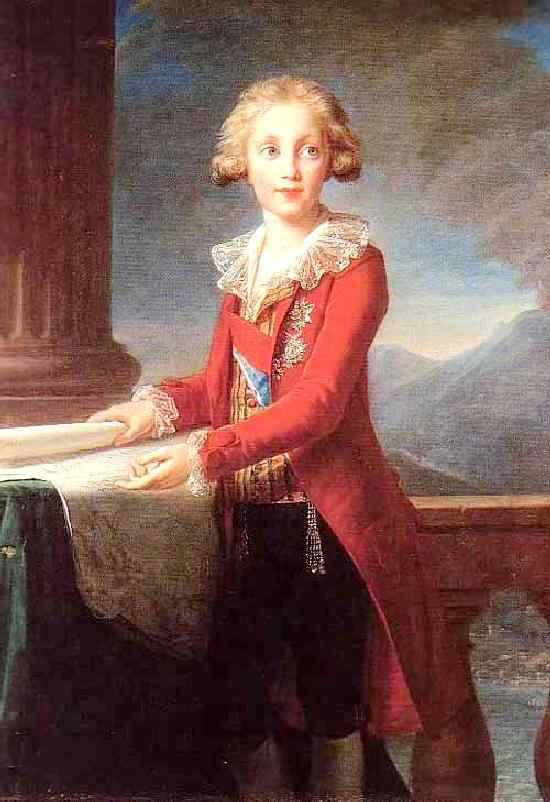
When Charles IV of the Two Sicilies acceded to the Spanish throne as Charles III, he made his younger son King Ferdinand IV of Naples. Ferdinand married Queen Maria Caroline of Austria, sister of Marie Antoinette. Their eldest son Francesco (Frances) di Borbone (1777-1830) became King of Naples as Francis I in 1825 Figure 1). His oldest daughter was the firey Duchesse de Berry (1798-1870). Queen Caroline in 1790 requested Madame Vig�e le Brun to delay her departure from Naples in order to paint Prince Francesco and his three sisters Maria Theresa (soon to be Empress of Austria), Maria Louisa (later Grand Duchess of Tuscany) and Maria Christina (Later Queen of Sardinia). The beautiful and talented Madame Vig�e le Brun was the arist of choice of Queen Marie Anyoinette, but had to flee France in 1789 with the onset of the French Revolution. The French Revolutionary Army entered Italy. Ferdinand IV and Queen fled (1798). They wre replaced by the Parthenopean Republic (1799). British forces under Lord Nelson helped reinstate Ferdinand (1799) and severe reprisals wre carried out aginst the revolutionaries. Sir John Acton became the queen's favorite. Ferdinand and Marie Caroline fled to Sicily (1806). The Emperor Napoleon I at first deposed Ferdinand, then restored him as King Ferdinand I of the Two Sicilies. Napoleon deposed Ferdinand again (1806).
The Emperor finally gave the Kingdom to his brother Joseph (March 30, 1806).
Joachim Murat wasperhaps Napoleon's most dashing cavalry commanders. He was born (1767). Murat joined the French royal army just beforfe the Revolution as a mere cavalry trooper when he was only 20 years old.
He first saw the rising General Napoleon Bonaparte when he was involved in the suppression of the Vendemaire coup. It was in Italy that Napoleon became a phenomenon. Winning promotion, Murat joined Bonaparte in Italy and was involved in the figting at Tagliamento (1796). Napoleon next conducted his Egyptian campaign. During the fighting, Napoleon awarded Murat a battlefield promotion to general of brigade. Murat commanded the French cavalry at Marengo to great affect in the defeat of the Austrians (1800). Marengo and successive events gave Napoleon control of Italy. Murat's skill and dash won him the admiration of the Emperor who by this time looked on him as one of his most trusted generals. The Emperor consented to the marriage with his suster, to Caroline Bonaparte. Bapoleon promoted him to marshal (1804). The Emperor made his brother Joseph King of Naples (1806).
Murat became renounded for harassing retreating enemies, His intervention at Eylau against the Russians (1807), probably prevented the Emperor's defeat. Many military historians consuder this to be the high point of Murat's military career. Napoleon decided to give Joseph the Spanish crown. Murat who went to Spain to help establish Joseph, participated in the repression of the Madrid insurrection. His harsh action may have added fuel to the Spanish national uprising against the French. Murat gave up his military command in Spain because of poor health. The Emperor gave the kingdom of Naples to Murat who was through marriage a member of the family (1808). By all accounts he ruled Naples well. Murat was not able to spend much time in his new kingdom as he was at the Emperor's side as a key field commander during many of the Emperor's major battles, including invasion of Russia (1812-13). He fought at Ostronovo, Smolensk, Borodino and Vinkovo. He took command of the latter stage of disatrous retreat from Moscow. In his absence from Naples his wife ruled capably. They introduced many needed progressive reforms. After the retreat from Moscow, he returning to Naples. He then rejoined Bonaparte for the 1813 Campaign in Germany. He fought at Dresden, Wachau and Leipzig. By this time it was clear that Napoleon could not defeat the Allies. Murat betrayed the Empreor by negotiating with the Allies to save his own throne.
But then he attempted to spport the Emperor during the 100 Days' Campaign by organizing a revolt in northern Italy. The attempt dailed and Npoleon lost at Waterloo. Murat attempted to restablish himself in Naples, but he was arrested and shot (1815).
After Murat's execution (1815), Ferdinand restored to power ruled again. Marie Caroline had died (1814). Ferdinand revoked the social and legal reforms introduced by Murat. Ferdinand merged Sicily and Naples and restyled himself Ferdinand I, King of the Two Sicilies (1816).
Francesco (Frances) di Borbone (1777-1830) became King of Naples as Francis I in 1825 (figure 1). His oldest daughter was the firey Duchesse de Berry (1798-1870).
Francis II abdicated (1861) at which time the Kingdom of Naples became part of the Kingdom of Italy under King Victor Emanuel.
Garibaldi entered the city (1860). Francis II abdicated (1861). A plebiscite was held and the population decided to join the Kingdom of Piedmont which then became the Kingdom of Italy (1870).

Navigate the HBC Royalty Section:
[Main Italian states page]
[Main royal pages]
[Austria]
[Belgium]
[Denmark]
[France]
[Germany]
[Luxemburg]
[Monaco]
[Netherlands]
[Norway]
[Romania]
[Russia]
[Spain]
[United Kingdom]