|
Nicholas II, the last Russian Emperor, was the eldest son of Alexander III and was born on May 6, 1868. Nicholas was born on the Alexander Palace, as the eldest son of Tsar Alexander III and Tsarina Maria Feodorovna, of the House of Romanov-Holstein-Gottorp, in the small town of Tsarskoe Selo ("The Tsar's Village" in Russian), near St. Petersburg. Nicholas and his siblings were brought up very simply. They were brought up in the Imperial Palace of Gatchina, their father's favorite residence. Despite the palace having 900 rooms, their quarters were located on the mezzanine level, firstly destinated for servants. They slept in army camp beds without pillows or mats and they took cold showers every morning. Their father didn't want them spoiled. Being Tsarevitch and as a rule in the family of a Tsar, Nicholas was brought up by tutors and private teachers, the best of their time. Nicholas and his siblings attended classes in separate rooms but the same curriculum was given. Nicholas ascended the throne after the untimely death of his father on October 20, 1894, and was crowned on May 14, 1896. Nicholas was only 28 years old and probably not yet read for the emense responsinbilties he faced. According to contemporaries, Nicholas was gentle and approachable. Those who met him easily forgot that they were face to face with the Emperor. In private life, he was undemanding but had contradictions in his character, tending to weakness and inconsistency. A stubborn supporter of the right of the sovereign, despite
growing pressure for revolution, he did not give way on a single issue, even when common sense and circumstances demanded it. Nicholas married the daughter of Grand Duke Ludwig of Hessen, Alice Victoria Eleanor Louisa Beatrice (Alexandra Feodorovna). The story of Nicholas and Alexander is one of the great love stories of the 20th Century. The two were devoted to each other throughout their lives. They had five children. The youngest child, Alexis Nicolaievich, was born August 12, 1904. The Czarevich Alexei suffered from hemophilia and was a permanent invalid. There were four daughters. Olga, Tatiana, Maria and Anastasia. The First World War sealed the fate of Nicholas and his family. Without the War, Russia may have been able to have evolved into a democratic government. It would have been difficult, but not impossible. The War made such a transition virtually impossible. Horendous losses were suffered in World War I, which Russia entered on the Allied side on August 1, 1914. Russian participation forced the Germans to divide their forces, probably saving France on the western front. Russia's loss of territory, massive casualties and confusion at home were the main reasons for the Second Russian Revolution in February 1917. Nicholas II abdicated on March 2, 1917, in favor of his brother Michael. Lenin ordered them to be shot on July 17, 1918. The bodies were hidden and have only recently been found and identified. They were given a Christian burial in 199?. A good-hearted man, he was not capable of guiding his huge empire into the modern world and the disaster of World War I.
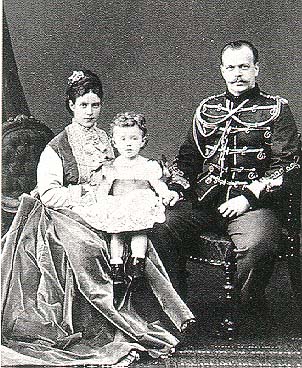
Nicholas' father was the Tsarevich Alexander, son of the Tsar Liberator, Alecxander II. Alexander was the second son of Alexander II. He was born in St. Petersburg on February 26, 1845. Alexander III became official heir to the throne after the death of his elder brother, Nicholas (1865). He came to the throne on March 1, 1881, at the age 36 after the assassination of his father and was crowned in the Dormition Cathedral of the Moscow Kremlin (May 15, 1883). He was a bear of a man and dominating all around him, although he was also a devoted family man. Nicholas's mother was a study in contrast to her husbands. Prince Dagmar was the daughter of Christian IX. The princess grew up in frugal circumstances. She was very close to her sister Alexandra who married the future Edward VII. Both girls were beautiful, perhaps why princes from such a small country married into two of the leading European families. Dagmar "Marie" was born in 1847. She was not as beautiful as her older sister Alexandra, the future Princess of Wales, to whom she was very close.
Tsar Alexander III and Tsaeina Dagmar had six children, five of whom survived into adulthood. After the birth of Nicholas, the Imperial family grew rapidly in size. The next baby, Alexander, born in 1869, unfortunaltely died before he was 12 months old. Then George was born, in 1871, followed by Xenia, in 1875, Michael, in 1878, and finally Olga, in 1882. George and Xenia became Nicholas's playmates in childhood games. The family would be ravished by the Bolshevicks after the overthrow of the monarchy. The eldest son succeded his father as Tsar Nicholas II. Both he and his father felt that he was unprepared to be Tsar. History proved them to be correct. Alexander could not have imagined what would happen to Russia nor could he understand how responsible he was. Neither understood the modern world and how to move Russi into it. Their youngest boy Michael was Tsar for a day but renounced the crown seeing that the monarchy was untenable. He was also shot by the Bolshevicks. Only Xenia and Olga escaped Russia after the Revolution.
|
Nicholas was born (1868). He was the first child of Crown Prince Alexander Alexandrovich and Crown Princess Maria Fyodorovna. When he was born, his grandfather, Alexander II, was still in power. His brother Grand Duke Georgy Alexandrovich (1871). His sister, Grand Duchess Xenia Alexandrovna. was born (1875). Nicholas enrolled as lieutenant in the Life Guards of the Erevan Regiment (1875). He began his education (1877). Grand Duke Mikhail Alexandrovich was born (1878). . His grendfather's assassination would prove to be a traumatic experience for the young Nicholas (1881). At the age of 13 Nicholas became the 'tsarevich', the heir to the throne. His last sister, Grand Duchess Olga Alexandrovna was born (1882). His parents provided Nicholas and his siblings gave him an intimate, warm and uncomplicated childhood. This was something that many royal children did not experiebce in the 19th century. We can say his childhood ended as a teenager when he met Princess Alisa/Alix of Hesse at the wedding of Grand Duke Sergei Alexandrovich to her sister Ella (Elizaveta Fyodorovna). Alix was clearly taken with Nicholas. The 12-year-old Alix scratched their names on the window of the Peterhof Palace.
The Imperial family was in many ways a protypical Victorain family, but towered over by the pesence of Czar Alexander--a larger than life presence. After the birth of Nicholas, the Imperial family grew rapidly in size. The next baby, Alexander, born in 1869, unfortunaltely died before he was 12 months old. Then George was born, in 1871, followed by Xenia, in 1875, Michael, in 1878, and finally Olga, in 1882. George and Xenia became Nicholas's playmates in childhood games. Despite Alexander being both a good husband and father, he dominated his family like the very incarnation of the proverbial Russian bear--as he dominated his Empire. Because of his preoccupation in ruling the country, it was Maria who looked after the children and served as a buffer between them and their father. Alexander was so fearsome and strong that he sometimes freightened his own children as he sometimes did his subjects. Nicholas stood in awe of his father, Tsar Alexander III. Nicholas and his siblings were brought up very simply. They were raised in the Imperial Palace of Gatchina, their father's favorite residence. Despite the palace having 900 rooms, their quarters were located on the mezzanine level, firstly destinated for servants. They slept in army camp beds without pillows or mats and they took cold showers every morning. Their father didn't want them spoiled. They were also trained in outdoor games as a indispensable component of their everyday life, for their future benefit.
|
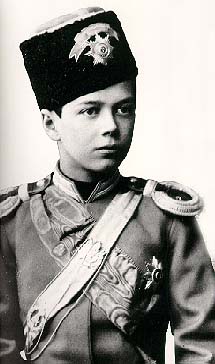
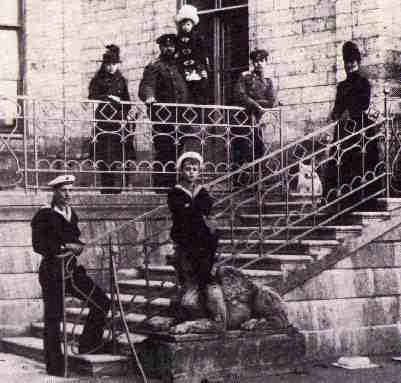
We have some limited information on Nicholas' childhood clothing. He and his btother George wore fancy dressed when they were very young. The tywo were very close in age. One portrait shows George weearing a velvet dress with extensive lace decoration (1872). The dress has a low neckline and a very high hem. It was worn with both skirted petticoats and lacy pantalettes. Given the age of the boys, it is likely that Nicholas wore similar dresses, although because of the age difference, not at the same time.. Nicholas in the 1872 portrait wears a velvet sailor suit with what looks like lacy wrist cuffs and back flap. The knee pants have a decorativev stripe, a common decoration at the time. Because of their age, the boys were not wearing long stockings, a type of hosiery that was very common in the 1870s for both boysv and girls. These clothes were selected by Alexandr;s wife Dagmar. When the boys goy older the court probably took over clothes selection. We are unsure to what extent Alexander got inviolved in such matters. The boys commonly wore military uniforms, both army amd navy uniforms. Here we see Nicolas wearing a husar uniform. (figure 2). The choice of uniforms does not seem to be age related. European royals commonly began wearing sailor suits when they weere young. Tsar Alexander's boys wore both army and navy uniforms even as they got older (figure 3). They seem to have changed from childish knee pants sailor suits to actual sailor suits at about 6 years of age. We do not know just when they began wearing civilian suits as our archive Alexander's family is still limited.
Being Tsarevitch and as a rule in the family of a Tsar, Nicholas was brought up by tutors and private teachers, the best of their time. Nicholas and his siblings attended classes in separate rooms but the same curriculum was given, over a 13 year span. During the first years, they learned Russian, English, French, German, Religion and Natural History. They had also Calligraphy, Drawing, Dancing and Music. Later, it was included Chemistry, Phisics, Geography, Biology, History and fundaments of Mineralogy. They were also trained in riding and fencing. Foreign languages were given special attention. Nicholas was a good, if unimagnitive student. Nicholas's English was so good that he could have fouled an Oxford teacher. His German was understandable and he could even speak Danish relatively well, very possibly due to his mother's influence. His memory was excellent and, as a way to induce a well organized and practical life, he was taught to keep a diary. He recorded every event like the weather, the number of birds he had shot and the people he had walked or dined. His diary was very similar to his English cousin's, George, Prince of Wales, later King George V of England, with almost the same events, written in a monotonous and unpretencious way, like a catalogue. Ironically, Nicholas's diary was used by many people to show a negative image of him, while his cousin's diary was praised for the revelation of his honest character. But the heavy study schedule also offered fun and relaxation and sometimes the Imperial family would leave the city of St. Petersburg and go to the Imperial Estate of Gatchina. They played and worked in the gardens and, in winter, they went skiing and sledging down the hills full of snow. Meanwhile, Nicholas always had a good sense of humour. He and his siblings played many pranks to the tutors but overall relations were friendly. His English tutor was mentioned many times in his diaries and he sent him his best regards whenever any opportunity arouse. Due to this very extensive educational background, Nicholas was very well read and cultured and was, perhaps, one of the best educated monarchs of his time. He read Russian, English and French authors, all in the original. After he became Tsar, Nicholas built a huge and library which was kept on the Winter Palace. Nicholas' education, while extensive was not broad. His education excluded a critical assessment of the liberal ideas that were sweeping Western Europe. His education was limited to subjects deemed appropriate by his autocratic father and his advisers. He was thus not exposed to ideas and influences outside of the narrow range of the Imperial court. He never attended schools with other boys and was not exposed to the ideas and problems of middle class Russians--let alone those of workers and serfs. Thus despite his education, he was illprepared to guide Russia
into the 20th Century. A critical failure that doomed Nicholas, his family and millions of Russians
One possibly liberating influence from the Imperial court was Nicholas' family background. He was the grandson of the King of Denmark and the nephew of King Edward VII of England and Kaiser Willhelm II of Germany. Alexander was a granddaughter of
Queen Victoria. Liberal ideas had penetrated many of the Western European
monarchies. The family ties, however, seem to have had little
impact on Nicholas after he became Tsar.
Nicholas fell in love with the daughter of Grand Duke Ludwig of Hessen, Alice Victoria Eleanor Louisa Beatrice (Alexandra Feodorovna). Her mother was Queen Victoria's second daughter, Princess Allice. The story of Nicholas and Alexander is one of the great love stories of the 20th Century. A potential mattiage offered strong ties to both the German and English royal families, but more than anything else, it was a true love match between the two.
The Tsarevitch Nicholas had been in love with Princess Alix for some time. She hesitated, in part because a conversion to Orthodoxy would be required, but finally consented. [Battiscombe, pp. 204-205.] Nicholas became Tsar in 1894 after the untimely death of his father, Alexander III, who died from Bright's disease at only 49. Tsar Alexander's death and Tsar Nicholas' marriage took place at almost the same time, casting a palor of gloom over the ceremonies. The story of Nicholas and Alexander is one of the great love stories of the 20th Century. The two were devoted to each other throughout their lives. They had five children. The youngest child, Alexis Nicolaievich, was born August 12, 1904. The Czarevich Alexei suffered from hemophilia and was a permanent invalid. There were four daughters:
Olga, Tatiana, Maria and Anastasia. The two were devoted to each other throughout their lives. They had five children. The youngest child, Alexis Nicolaievich, was born August 12, 1904. The Czarevich Alexei suffered from hemophilia and was a permanent invalid. There were four daughters. Olga, Tatiana, Maria and Anastasia.
Nicholas ascended the throne after the untimely death of his father on October 20, 1894, and was crowned on May 14, 1896. Nicholas was only 28 years old and probably not yet ready for the emense responsinbilties he faced. The coronation ceremony in Moscow was overshadowed by a catastrophe on Khodynskoe Field, where more than a thousand spectators were crushed to death.
According to contemporaries, Nicholas was gentle and approachable. Those who met him easily forgot that they were face to face with the Emperor. In private life, he was undemanding but had contradictions in his character, tending to weakness and inconsistency. A stubborn supporter of the right of the sovereign, despite growing pressure for revolution, he did not give way on a single issue, even when common sense and circumstances demanded it. He struggled desperately to hold on to power during both the 1905 and 1917 revolutions. Freedoms accorded to people in his manifesto of October 17, 1905, were soon annulled. He was not the most competent of political leaders, and his ministers were almost uniformly reactionaries. Nicholas II in foreign policy issues took steps to stabilize the international situation, initiating two
peace congresses at The Hague. During his reign, Russia was
involved in two wars. In 1904-5, the country suffered a
disastrous defeat by Japan--400,000 men were killed, wounded
or captured, and material losses were valued at 2.5-billion
gold rubles.
Perhaps the most important personal relationship at the turn of the 20th century was that between Tsar Nicholas and Kaiser Wilhelm. There were no real terrotorial or philosphical disputes that divided their two countries. There was no reason to believe that the two countries would wage a war that would destrouy both empires. In fact the two shared a common interest in maintaining the European system largely conducted by monarchy. I am not sure when the two first met. They even had family ties. In fact they were cousins. Wilhelm was a second cousin to Nicholas' father. (Wilhelm's mother was the aunt of Tsarina Alexandra.) A more distant common ancestor was King Friedrich Wilhelm III of Prussia (1770-1840). I am not sure when Nicholas and Wilhelm frst mey. Wilhelm had even closer ties with the British royal family, being the grand son of Queen Victoria. Wilhelm had caused trouble as a little boy and increasinly alienated his English relatives as he got older--even his rather pro-German grandmother. I'm less sure about his behavior with his Russian relatives. We do know that it was Kaiser Wilhelm who after dismissing Bismarck allowed the treaty with Russia to lapse, prfoundly altering the European ballance of power. The two men met several times as adults. One of the most notable was at Björkö, Sweden (1905) Kaiser Wihelm had convinced himself that his uncle (King Edward VII of England) had engineered a system of treaties surrounding Germany. He also considered himself a skilled diplomat and that his personal diplomacy could undo this, In particular he believed his personal relationship with his cousin Tsar Nicholas could prevent war between the two empires. The two met at Björkö (1905). It was in fact a personal meeting, but the two concluded a treaty of alliance without any consultation with their governments. Both governments rejected it. The two also met at Świnoujście, a German Baltic-coast spa town. Kaiser Wilhelm visited the town regularly from 1882 soon after becoming kaiser. It was here he Tsar Nicholas in a well publicized meeting (August 4, 1907). There was much talk in the press of the meeting. Some journalists felt that the meeting would resolve political issues and ensure European peace for decades. Wilhelm arrived aboard the the white imperial yacht Hohenzollern. Nicholas asrrived aboard the black Kronstadt. As was the custom of European royalty, the two emperors wore each other's uniforms. Wilhelm wore the uniform of a Cossack colonel. Nicholas wore the uniform of a Prussian dragoon colonel. They both swore eternal friendship and at night two letters were lit bright in the night sky--N and W. It is probably true that Wilhelm and Nicholas got on better personally than Wilhelm got on wuth his Uncle Edward VII. This is probably because the family ties between Wilhelm and Edward were closer and as result the two had more opportunities to irritate each other than did Wilhelm and Nicholas. In the days leading up to World War I, the two exchanged telegrams in a vain attempt to avoid war--the famous Dear Nikki and Willi telegrams. Nicholas wanted to only mobilise against Austria-Hungary, but is generals explained that this was impossible. He thus ordered a general mobilisation (meanig against Germany as well as Austria-Hungary). The two attempted to renew the 'personal diplomacy' of Björkö. They tried to avoid war with Russia by an exchange of telegrams with Nicholas II in the lNicholas assured Wilhelm in a telegram that the mobilisation was NOT against Germany. This was unacceptable to Wilhelm and his ministers. Thus the the telegrams proved futile and Wilhelm ordered the activization of the Schlieffen Plan launching World War I.
|
Nicholas and Alexandra were deeply in love. Whatever the political failings of the Tsar and the Tsarina's aristocratic outlook, in purely personal terms the two were extremely close. They had five children, four girls and a finally a boy. The girls were: Olga (1895), Tatiana (1897), Maria (1899), and Anastasia (1901). We do not know much about the four girls. Olga was the oldest and Russian society was obcessed with her future marriage prospects. Olga was interested in photography and as a result, we have many wonderful, intimate images of the royal family. These are not the formal portraits commonly produced by professional photographers outside the family. Tatiana was the second oldest. She was very close to Olga. She worked as a nurse during World War I. Maria was a fun-filled little girl. She was deemed to young to nurse during the War, but did visit soldiers with her younger sister, Anastasia. It is Anastasia that is the best known Of the four princesses. This is because after the family was killed by the Bolshevicks (1918), an imposter appeared claiming to be the Grand Duchess. Four girls in a row, however, healthy were a major political concern. Nicholas was by all accounts a loving and devoted father and adored the girlds. A boy was needed, however, to perpetuate the family line. Thus there was considerable relief when Alexis finally arrived (1904).
|
Following the jubilation over Alexi's arrival (August 12, 1904) was the discovery that Alexi was afflicted with hemophilia. This disease is transmitted genetically and prevents blood from clotting properly. This meant that a person could easily die from a minor bruise, something that all children experience. Doctors at the time had no medicl treatment for it. As a result, most people with hemophilia at the time died in infancy or early childhood. Nicholas and Alexandra after learning of the disease decided to keep it a family secret. Here the decession was based on the increasing unpopularity of the monarchy as well as concern that Alexi's place in the line of secession might be questioned if the severity of his condition was known. Alexi almost died as an infant. Alexi was very cloesly looked after by his nurses and the sailor Clement Nagorny looked after the Tsarevich bginning in early childhood. As Alexi got older he became very frustrated with this. Frustrated by the inability of her doctors to help Alexi, Alexandra turned to a Siberia peasant monk. Uneducated and crude beyond belief, Grigori Rasputin was also a mystic that seemed to have somehow saved Alexi, or at least appeared to have done so in Alexandra's eyes. Some bekieve that Rasputin's secret with Alexi was hynosis. This may have had a calming influence which helped to to stem the bleeding. This is the most reasonable explanation, but in fact no one really knows.
Alexandra at any rate became increasingly dependent on Rasputin. She was not well liked in the public eye, in part because of her German origins. This relationship with the uncouth Rasputin further undermined her poularity leading to all kinds of wild rumors.
Alexandra at any rate also accepted Rasputin's advice on non-medical subjects as if it was the word of God. Rasputin was murdered by Grand Duke Dmitri and his associates (December 1916). It took poison, bullets, and freesing water to finally kill him.
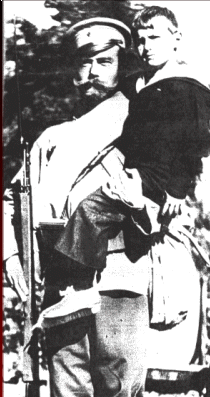
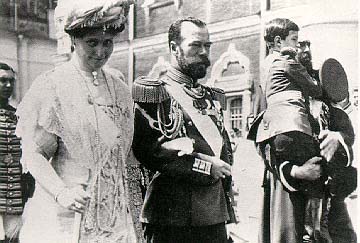
Most historians are relentlessky critical of Nicholas as Tsar, viewing him a weak and indesisive. Generally a very different picture emerges of Nicholas as family man. He was absolutely devolted to his family. He loved Alexanda and unlike many in his position had no extramrital affairs. He was devoted to his children, especoially his last chld--the Tsarevitch Alexis. Nothing appealed to Nicholas more than times away from the weighty affairs of state with his family. He was a doting father and adored by all the children. There are numerous formal portraits of the family. There are also numerous informal snapshots which show Nicholas with the children and obvously enjoying carefree time with them.
|
The First World War sealed the fate of Nicholas and his family. Without the War, Russia may have been able to have evolved into a democratic government. It would have been difficult, but not impossible. The War made such a transition virtually impossible. Horendous losses were suffered in World War I, which Russia entered on the Allied side on August 1, 1914. Russian participation forced the Germans to divide their
forces, probably saving France on the western front. Russia's loss of territory, massive casualties and confusion at home were the main reasons for the Second Russian Revolution in February 1917.
Russia was unprepared for War. It had huge army once mobilized, but did not have the industrial base to properly equip them with modern weapons. The Russian soldiers fought bravely, but suffered devestating losses, bith from the Germans and from inadequate supplies. Tsar Nicholas assumed command of the Army at the front. This was probably a mistake necause it made him personally responsible for the military disasters. And in addition to the disasters at the front, with so many men conscripted from rural areas, the harbests were inadequate to feed Russia. And the Allies had no way of supplying Russia because the Germans doiminated the Baltic and the Turks maintained control of the straits leading to the Black Sea ports. The result was Revolution.
Russia was unprepared for War. It had huge army once mobilized, but did not have the industrial base to properly equip them with modern weapons. The Russian soldiers fought bravely, but suffered devestating losses, bith from the Germans and from inadequate supplies. Tsar Nicholas assumed command of the Army at the front. This was probably a mistake necause it made him personally responsible for the military disasters. And in addition to the disasters at the front, with so many men conscripted from rural areas, the harbests were inadequate to feed Russia. And the Allies had no way of supplying Russia because the Germans doiminated the Baltic and the Turks masinaimned control of the straits leading to the Black Sea ports. The result was Revolution. Nicholas II abdicated on March 2, 1917, in favor of his brother Michael. No fool, Michael renounced his claim the next day. After the abdication, the royal family first remained in Czarskoe Selo then, by decision of the interim government, were transported to Siberia. The Bolshevik government in April 1918 decided to move the Imperial family to Ekaterinburg in the Urals.
The Bolsevicks seized power overthrowing the Provisional Government (November 15, 1917).
The Bolsheviks made changes in the treatment of the royal family. They announced that the family would be put on put on soldiers' rations (600 rubles per person per month) (March 1, 1918> They no longer received "luxuries" such as butter and coffee. Their meals were soup, fish or meat. The Bolshevicks moved the royal family to Yekaterinburg (April 1918). Alexi was so ill that he could not be moved. So they moved his parents and older sister Maria to Yekaterinburg (April 1918). The three other sisters remained with Alexei until he was strong enough to make the trip. As a result of his injuries he was confined to a wheelchair. The Bolsheviks gave secret police officer Vassili Vassilievich Yakolev the task of moving the royal family (April 22, 1918). The initial plan was to bring them back to Moscow. The Bolshevicks were concerned, however, that one of the monarchist groups would free the family. Yakolev and the Romanovs arrived at Ekaterinburg in Siberia (April 30, 1918). They were lodged in the Ipatiev House. The family was only allowed the use of the main floor, The six servants they were allowed shared their accommodations. There was a first no running water or ventilation. The windows were whitewashed and barred to prevent any communication with the outside woirld. The bathrooms were filthy and even has pornographic drawings of the Tsarina and Rasputin. The family was only permitted an hour outside each day for a walk in the garden. The family becane increasingly worried, but they were closely guarded and there was no hope of escape unless the White Armies orgabized to fight the Bolsheviks could reach them. Lenin ordered them to be shot (July 17, 1918). The bodies were hidden and have only recently been found and identified. They were given a Christian burial in 199?.
Battiscombe, Georgina. Queen Alexandra (Houghton Mifflin, Boston, 1969).

Navigate the Boys' Historical Clothing Web Site royal pages:
[Return to the Main Russian royalty page]
[Austria]
[Belgium]
[Bulgaria]
[Denmark]
[France]
[Germany]
[German states]
[Hesse]
[Italy]
[Japan]
[Jordon]
[Luxemburg]
[Monaco]
[Netherlands]
[Norway]
[Romania]
[Spain]
[Sweden]
[United Kingdom]
[Yugoslavia]
[Return to the Main royal pages]