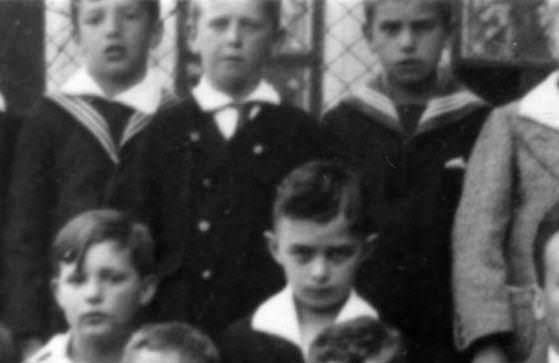
Figure 1.--Belgian boys commonly wore sailor suits to school at the turn of the century. Even after World War I in the 1920s, sailor suits were still popular for boys. |
|
Belgian schoolwear has developed along the same lines as France. Belgian boys have not commonly worn formal school uniforms like their across the Channel English cousins. The smock became a type of uniform in several European countries, especially Belgium, France, Italy, and Spain. I believe the use of the smock in Belgium was influenced by its adoption in neighboring France. Beginning with the French Third Republic in the 1870s through much of the first half of the 20th century, elementary school boys in Belgium and France wore black, dark, blue, or grey school smocks over their clothes. As this was a very common practice, it gave the appearance of a school uniform. Not all French schoolboys wore smocks--serving to obsure social differences. One account from 1900 describes a French boy who began the lycee wearing a sailor suit with long curls his mother dearly loved. I believe that such styles and experiences would have been quite similar in Belgium. Most boys did not wear school uniforms, but some Catholic schools did require them. Blue sweaters, shortpants, and white kneesocks were a common style. The schools that still require uniforms have now mostly mostly changed to long pants. While Belgian and French school uniforms trends have been similar, the Belgians appear to have held on to traditional styles some what longer than the French.
The decision to require French boys and girls to wear smocks was a decision implemented by French authorities during the 1870s. It was in keeping with the styles of the day as both boys and girls commonly wore smocks. I have no specific information on Belgium. I do not know if the Belgian Government officially followed the French example and
required school children to wear smocks. It may have been left to individual schools or parents. There may also have been differences between Flemish and Waloon areas of Belgium. The style was, however, so common that I assume that Begium, which like France, had a centralized educational system may have required it.
HBC at this time has little detailed information on Belgian school uniforms and attire. Hopefully Belgian contributors to HBC will provide some detailed infprmation. HBC believes that Belgian boys began wearing smocks at about the same time as French boys in the 1870s. This is just specualtion, however, at this time. I'm not sure when Belgian boys began wearing kneepants, probably in the 1860s. They were widespread and normally worn with three-quarter length socks by the 1870s. Short pants appeared with the Scout movement in the 1900s and began replacing kneepants by the 1910s. School uniforms were not common in Belgium. but were required by some private catholic schools. Shorts were very commonly worn by the 1920s. Older boys might wear knickers. Smocks were commonly worn by school children through the 1940s, but declined in popularity in the 1950s. Shorts dominated boys' wear throughout the 1950s, but began to be replacec by long pants in the late 1960s. Some conservative schools still required shorts pants in the 1980s, but this had largely disappeared by the 1990s.
|
One complication in Belgium is that there is both a French (Waloon) and Dutch-speaking (Flemish) population. There are, as a result, schools for both groups. I'm unsure how clothing standards may have differed. It is likely that smocks were most common in the French schools. HBC does not, however, have any information on differences in school attire in the two different areas of Belgium.
Belgian schoolboys over the yeras have worn a wide variety of styles and garments. Boys in the late 19th century generally wore kneepants. Sailor suits were very common. Many boys wore smocks. Fauntleroy suits were popular with mothers, but probably not commonly worn to school. Short pants began to be worn in the 1900s with the adventbof the Scout movement. School uniforms were not common in Belgium and as a result svhoolwear is generally a reflection of ordinary boys' clothes. Some private Catholic schools did require uniforms. Boys have worn many differentbtypes of clothes to school. Most boys into the 1960s wore short pants, but knickers were also worn until the 1950s. Sailor suits were still popular, although not as much as at the turn of the century. Many types of hosiery were worn. Boys wore both ankle and kneesocks. White socks were popular. Some boys wore long over the knee stockings. Shorts were very commonly worn by the 1920s. Older boys might wear knickers. Smocks were commonly worn by school children through the 1940s.
Most Belgian schools are state schools. The state schools are well funded and are of excellent quality. There are schools conducted in both French and Flemish depending on the language make up of the local communities. Language is a major issue in Belgium, but this in the state schools was resolved in the late-19th abd early-20th century. As is the case in much of Europe, the private sector is relatively small, in part because of the quality of the state system. The one exception is the Catholic schools. We are not sure just how large the Catholic sector is, but the Catholic schools receive state funding. Unlike the state schools, there were uniforms at some Catholic schools.
Belgium has a full range of state schools covering children ll the way from toddlers to teenagers. Nurseries which are more daycare facilities are available for todlers beginning about 2 1/2 years of age. Toilet training largely detrmines when the children are rady to begin. Nursery school (kleuteronderwijs/enseignement maternel) are based on French maternelles. Priority is given to mothers in full-time work. More formal schooling begins with Kindergartens which children begin at about 5 years of age. Kindergartens are usually attched to local primary schools.
Both nursey schools and Kindergrtens are optional, although many children attend them, especially Kindergarten. Formal coupulsory school begins with primary school at about age 6 years. Some children begin earlier if they are more advanced. There are 6 years of primary school (lager onderwijs/enseignement primaire). Primary encompasses a wide range of subjects. Belgium is a multi-lengual country and as aesult, the schools give considerable attention to languages beginning at the primary level. The primary program is basically the same for all chilkdren with few options abnd individual choice. Homework is set from the first year and parents are expected to play a role in the child's education. Secondary education (secundair onderwijs/enseignement secondaire) is a further 6 year program. The students begin secondary school at about 12 years of age after they complete the primary program. The secondary system includes three cycles (graden/degrés). The students choose a course that they want to pursue based on the student's skill level, goals, and interests.
We have only limited information on activities at Belgan schools. We have some Belgian school portraits, but not many showing activities at the schools. As far as we can tell they are essentially the same as other neigboring European countries. We do not yet know enough about the school curriculum to assess school activities. We know of no destinctive Belgan school activities. Classroom scenes appear similar to those in other neigboring countries. We note Belgian school gym classess. European schools generally did not give as much attention to gym classees as American schools ommonly have. We do not yet have much information on Belgian schools. We note a primary school gym class from an Antwerp school in 1954. We notice some special activities at Belgian schools. A good example is the end of the school year ceremonies. We notice the end of year ceremonies at an unidentified Primary school we would guess in the 1950s or early-60s.
We do not yet have much information on individual Belgian schools. This is an important element in our national school sections. School portraits over time provide a huge amount of information about education and school uniform trends. We hope to expand this section as our site grows. We do note the
Institut Saint-Boniface-Parnasse is a school in Ixelles. We do not know a great deal about the school, but know that it was founded in the 19th century. A reader has provided us some information about his antwerp Catholic school in the early-1960s. Our reader tells us, "Uniforms were not mandatory at our school, but it was rather an elite school, jeans were strongly discouraged. Many of us wore suits. Boys wearing short trouserswearers were not the majority, but were not uncommon." Hopefully other Belgian readers will provide us some information about their school and school experiences. While we focus on school wear and uniforms, we are also colledctging other information aboput schools around the world.
|
HBC has little information on actual regulations concerning clothing at Belgian scgools. We believe that smocks were required schoolwear in the late 19th century, but in fact have little information to confirm this. Belgian school children for the most part did not wear actual school uniforms. We note some schools portraits, however, in the 1920s and 30s which suggest that there were some requirements, perhaps more commonly at private than state schools. After World War II some private schools had uniforms, especially Cathloic schools. We are not sure just when these uniforms were instituted, but believe that it was after World War II. The earlist images we are note are from the 1950s, but it could be earlier. These uniforms varied. Some may have required smocks. There were various other uniforms. One of the most commom was blue shirts, blue sweaters, blue short pants, and white kneesocks.
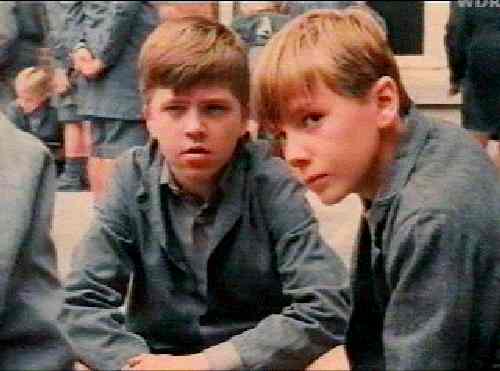
Belgian films look remarably similar to French ones. I do not know of particularly classic Belgian films, but HBC correspondents have provided some sample images. Belgians boys are often shown wearing short pants and until the 1950s schoolboys are commonly seen in smocks. Berets are also worn, presumably in the French speaking areas. Modern movies
show boys wearing the same pan-European styles.
We have some limited information about individual Belgian school boys. In some cases we only bhave individualportraits or snapshots. In other instances we have some ctual details about their school experidences. Hopefully our Belgian readers will send along details about their own school experiences. Belgian schools for the most part did not require uniforms. Many parents had, however, very conservative ideas about schoolwear.
Related Links: Careful this will exit you from the Boys' Historical Clothing web site, but both sites are highly recommended .
Boys' Preparatory Schools: A lovely photographic essay on British Preparatory Schools during the 1980s with over 200 color and black and white photographs.
New Zealand Schools eBook: Apertures Press Digital eBook books on New Zealand schools (Volume I-III) available
British Preparatory Schools: Apertures Press Digital eBooks on British Preparatory Schools (Volume I-VI) available.

Related Chronolgy Pages in the Boys' Historical Web Site
[Main Chronology Page]
[The 1880s]
[The 1930s]
[The 1940s]
[The 1950s]
[The 1960s]
[The 1970s]
[The 1980s]
Related Style Pages in the Boys' Historical Web Site
[Smocks]
[Berets]
[Long pants suits]
[Shortpants suits]
[Socks]
[Eton suits]
[Jacket and trousers]
[Blazer]
[School sandals]
Navigate the Boys' Historical Clothing School Uniform Pages
[Main narional school uniform page]
[Australia]
[]
[England]
[France]
[Germany]
[Ireland]
[Italy]
[Japan]
[New Zealand]
[Scotland]
[United States]
Navigate the Boys' Historical Clothing Web Page
[Introduction]
[Activities]
[Biographies]
[Chronology]
[Clothing styles]
[Countries]
[Bibliographies]
[Contributions]
[FAQs]
[Glossaries]
[Images]
[Links]
[Registration]
[Tools]
[Boys' Clothing Home]