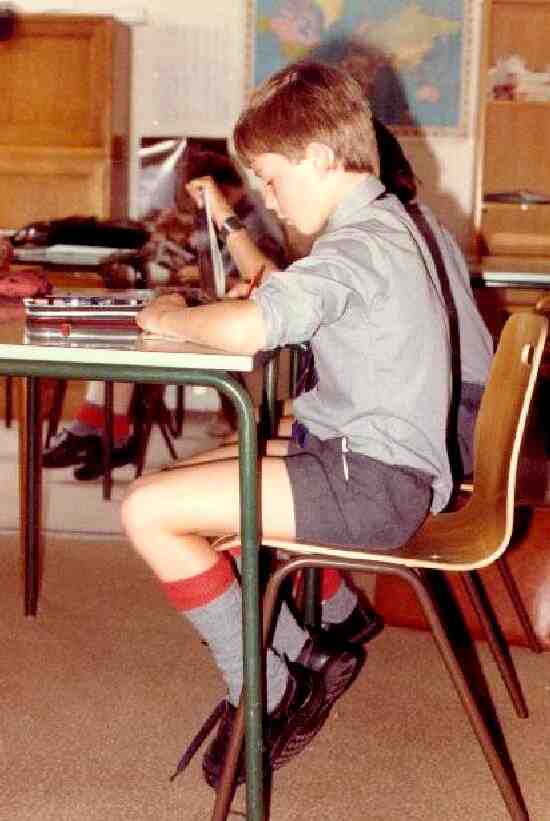
There are a wide range of activities conducted at school, both inside and outside the classroom. Many of these activities required a specaialized uniform or sports gear. English schools, especially the private schools probably had more elaborate uniforms and specialized schoolwear than any other country. The school regulations varies over time and among the many different types of schools. Many schools had a dress uniform worn on Sunday or special school events. During regular school days a less elaborate uniform was worn. At some schools boys would come to schools in their blazers, but just wear their jumpers while in class. Some class room activities like art or science might require some sort of protective gear. Quite a number of schools sponsored youth group units such as Scouts. Some secondary schools had Cadet units. Many schools had a gym uniform. There was a variety of specialized uniform for various team sports.
Many schools had a dress uniform worn on Sunday or special school events. Here the dress uniforms varied from school to school. During regular school days a less elaborate uniform was worn. Here the regulations varied over time. caps were rsometimes required with the dress uniforms. At some prep schools the only difference was a white rather than a grey shirt, although a few schools had colored shirts. Ties were always worn with the dress uniform. Boys atmost schools wore blazers, but at some schools the boy wore grey suits for special occassions. most schools had either suits or blazers, but a few schools had both. At a few schools the older boys could wear long trousers for special occassions. Hosiery was always required with the dres uniform. At most schools lace-up shoes rather than sandals were required for the dress uniform.
Regulations on the traveling uniform varied from school to school. Most schools wanted to pit their best face forward and had definite rules on how the boys should be dressed in public when coming to school. State primary schools, even those with uniforms, often did not have blazers. Many other schools did have blazers. At some schools boys would come to schools in their blazers, but just wear their jumpers while in class or shirts in the warm weaher. This included the boarding schools with day boys. The baorders often did not wear their blazers much, only on Sunday and other special days. Most schools required the boys to dress up in their blazers when taking school trips or when traveling at the beginning and end of term. Caps were also required although by the 1980s theybhad been dropped at many schools.
State primary schools, even those with uniforms, often did not have blazers. Many other schools did have blazers. Boys at many schools wore just their jumpers and not their blazers during the school day. Here regulations varied from school to school. Many prep schools had the boys put away their blazers. Secondary schools were more likely to leave it up to the individual boy. During the warm summer term boys just would wear their shirts with or without ties. At many schools wearing the jumper or not was up to the individual boy. There were more commonly rules about the blazer. Many schools required ties, but some did not require them during the warm summer term. Again regulations varied from school to school. Most boarding schools had the boys wear the regular school uniform after classes in the evening. At some boarding schools the children could change out of their uniforms after classes, but this was not the most common convention. Most schools had boys wear a jumper, tie, shirt, grey shorts, grey kneesocks, and shoes or sandals, but there were many variations. One popular variation was a corduroy uniform with a lumber-jacket and cord shorts.
Some class room activities like art or science might require some sort of protective gear.
Some schools had pecial playwear so boys would not get their uniforms dirty when playing outdoors in their free time. Here boiler suits and wellies were commonly used.
Schools sometimes specified dress for certain events held during the school year. Her boarding schools were commonly the most likely to specify the dress at various occassions. These events included both events requiring the formal dress uniform. Other evenys might entail the ordinary class room uniform. Some of these events included: fetes, games (sports events) with other schools, prizegiving, religious services, theatrical and other presentations, and a variety of other events. Specific requirements ranged from school to school, but the basic convntions were quite common.
Some secondary schools had Cadet units. Let us not assume that military training for boys is peculiar to the old Soviet Bloc countries. The idea of preparing school children for war may in fact be the British cadet program, although HBC does not have avery complete understanding of the program yet. The English program does appear to have been functioning in England during World War I (1914-18), just when the prigram began I do not yet know. Presumably it was the genesis for cadet program in colonial countries like Australia, New Zealand, and South Africa. One British contributor reports, "I was trained at school from the age of 13 in military skills, including combat training, firing automatic weapons etc. although not compulsory, pressure was applied by the school to conform and few demurred. This was in Britain in the mid 1970s and is still going on."
Drill was a kind of static PE lesson with the pupil doing various exercises. Often these ther arm exercises designed to build arm strength, good posture, and promote breathing. Both boys and girls did them. We notice numerous images of British children in the early 20th century doing drill. (We assume this was also done in the 19th century, but few images are available.) Drill was also considered to be good discipline for the children. A similar activity was used to teach the children to swim--without going into water. This was a partner activity one child was supported by the other as the swimming stroke was practiced. Then the children would change places. Honest!
Many schools had a general gym uniform used for a wide variety of sports and athletics. Most schools had a gym uniform for a variety of acttivities. In addition to the the gym uniform, there were also sports uniforms for rugby, football, and cricket. The private schools had elaborate sports uniforms. This was true of both the public and prparatoy schools. Part of the ehos of the public school was an emphasis on sport and even boys of limited ability were encouraged to participate. Sports were not as emphasized in state school, but we note that even state primary schools had some sports teams. We are not sure how common this was.
The British call the end of school going home home time. In between breaks are known as morning and afternoon break, what American children call recess. This involves the children in the play ground, playing and supervised with a teacher who would have kept a watchful eye on the children but not interfered in the games unless it was endangering the children or some one was misbehaving. An enthusiastic teacher might play the games the children played. An English reader writes, "Very rarely the weather was so bad we would not be allowed out at breaks.
Today I think the weather decision was more to do with whether the staff
wanted to go out and supervise as we would always be outside in the rain and
snow etc at other times. 'Wet Play' meant we had to stay in our classrooms
or one of the school halls. The halls would always get very noisy and
rowdy. Some Scottish schools refer to breaks as "Peace". I know of an English
senior school which discusses it's three terms as "Quarters". There are
many such individualities within UK schools with varying names for each year
group, particular rooms and so forth."
We notice English boys in school unigform appearing in a variety of events. This includes both school and civic events. Occassionaly the event or group may have a special uniform. An example here are the Wilbondon ball boys who have a special uniform provided by the Wilbodon Trennis Club. In many other occassions the boys wear their school uniforms. We have noted several such images. We are often not aware of the particular event involved. The boys are oftren used to carry placcards or banners. Sometimes they help with escoring visitors, manning booths, parking, or a variety of other assignments.
Schools sponsir a wide range of other activities, including basketry, carpentry, chess, choir, computers, cooking, debate, dramatics, electronics, fishing, model building, music, railroading, rilfelry, and much more. The activities offer depend in part on the type of school. Some of these activities are associated with the academic program. Other activies are extra-curricular activities which are given varying degrees of emphasis at different schools. Some of these events required some specialized gear. The boys for others more associated with classroom activities commonly just wore their everyday school uniform. Some classess such as sciuence or art may require some sirt of smock or protective clothing.
Many schools sponsored youth group units. The most common were Boy Scout Cub Packs or Scout Troops. Some schools, especially Church schools, may have also sponsored other groups such ads the Boys' Brigade or the Church Lads. These groups, however were more commonly sponsored by Churches than schools. We notice some of these units were particularly well uniformed. A HBC reader writes us, "I remembered a photograph of my secondary modern school Scout Troop that appeared in the local evening paper in July, 1999. The photograph was was taken around 1951. The gentleman in civilian clothes
looks to be the headmaster, and the person to his right wearing glasses was one of my teachers at the school, he also became District Commisioner for Scouts. His father was my family doctor. It would be another 7 years before I would attend the school, and although I knew of the Scout Troop, I wasn't interested in joining it, as I was never one for mixing with my peers. I much prefered adult company at that time of my life."
Related Chronolgy Pages in the Boys' Historical Web Site
[Main Chronology Page]
[The 1880s]
[The 1930s]
[The 1940s]
[The 1950s]
[The 1960s]
[The 1970s]
[The 1980s]
Related Style Pages in the Boys' Historical Web Site
[Main school uniform page]
[Main country page]
[Long pants suits]
[Short pants suits]
[Socks]
[Eton suits]
[Jacket and trousers]
[Blazer
[School sandals]
Navigate the Boys' Historical Clothing School Uniform Pages
[Main School Uniform Page]
[Australia]
[England]
[France]
[Germany]
[Italy]
[Japan]
[New Zealand]
[Scotland]
[United States]
Navigate the Boys' Historical Clothing Web Page
[Introduction]
[Activities]
[Biographies]
[Chronology]
[Clothing styles]
[Countries]
[Bibliographies]
[Contributions]
[FAQs]
[Glossary]
[Satellite sites]
[Tools]
[Boys' Clothing Home]