English Girls School Uniform: Garments
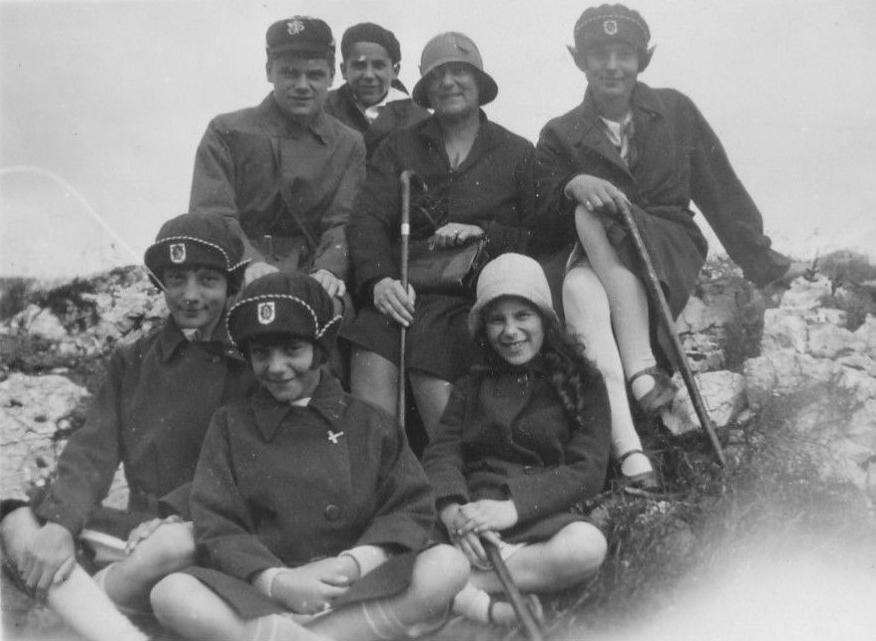
Figure 1.--This English snapshot shows an unidentfied group at the beach. Three of the girls are wearing their school caps with a badge. I have not seen this cap style before and am not sure what to call it. The snapshot is undated, but the cloche hats suggest the 1920s.
|
|
Girls headwear is much more diverse than that worn by the boys. There is no one style worn by the girls that was as common as the peaked caps worn by the boys. One very common garment worn by the girls was the gym slip. A good example is the City Grammar School in 1938. That was a standard uniform item for many years. With very few exceptions, English girls do not wear trousers to school. There are a few exceptions. We have noted a few coed prep schools where girls during the Winter were allowed to wear cord long trouswrs like the boys. During the Summer, however, they were not allowed to wear short trousers. A HBC reader writes us that "In The Daily Telegraph newspaper (June 22, 2005) today there is an article about Broadstone Middle School which has now banned girls from wearing skirts to "protect their modesty" during activity lessons such as drama and music; all girls must now wear full length trousers to all lessons, even during very hot weather!" There were also differences in hosiery. Some girls wore grey kneesocks, but white ankle and knee socks were very common. We have also noted long black stockings at many schools, although this became less common after World War II. Also footwear varied. Although both boys and girls wore school sandals, girls commonly wore strap shoes. There were also sturdy school oxfords, but they were styled somewhat differently than the boys' shoes. Hopefully some of our English readers will provide us some more information about girls' school uniform trends.
Headwear was the most diverse schoolwear itemfor both boys and girls. And this only increased when more girls began attending boarding schools. The first schools in England were for boys. This included the boarding schools. When private schools for girls were established (mid-19th century), the schools had to develop a program suited for their needs, or more accurately what was thought appropriate at the time. The girls' schools adopted the philosophy and much of the program of the boys' schools with some modifications. This included both sports and the uniform. Girls headwear is much more diverse than that worn by the boys. There is no one style worn by the girls that was as common as the peaked caps worn by the boys. We have noted berets, boaters, bretons, and rounded crown hats (felt anbd straw), but there were several other less common styles. Some of these we do know the proper name. We have no ideawhat to call the caps the gurls here are wearing (figure 1). The rounded crow hays were done in many different styles affecting the crown, brim, and hat nand. Each school wanted their own destinctive style.
Blazers
Sweaters
Boys and girls at British schools commonly wear the same sweaters. This is not true at all schools. A reader tells us, "At our Anglican primary school the girls wore navy blue cardigans and the boys grey pullovers." We believe that this was more common after World war II but since the 1970s most schools have the same sweaters for boys and girls.
Ties
Blouses
Girls wore different styles of white blouses, sometimes with ties. Asfar as I know, they were not any grey blouses like boys' grey shirts. The blouses were worn with boy gym slips and skirts.
Dresses
Gingham frocks were popular as girls school uniforms during the summer. It came in all colours depending on the school colours. A British reader tells us, "At our school we wore green and white checks. A friend at a Catholic school wore blue and white and so on." A reader sent us a school portrait showing the summer gingham frocks the girls wore along with the uniform the boys wore. He writes, "I associated that pattern with girls which is probably why I didn't like check. My Mum bought us all shirt and short sets one Summer and the shirts were in this pattern."
Gymslip
One very common garment worn by the English girls was the gym slip. While it originated in England it became worn in many coyntries around ghe world, both for school and rdinary wear. A gymslip is basically a sleeveless tunic, commonly done with a pleated skirt. It first appeared as part of a school uniform. The term 'gymslip' is a school uniform term. When not wirn as a school uniform item, we notice pinafore dress (Britishh) or jumper (American). The gymslip began as the name implies as gym/PE wear for girls. It was an ooption gor the more restictive middy blouse and romper that had become standard. It was apparently invented by Mary Tait who was a student of Martina Bergman-Österberg, an early fifute in women's physical education in Britain. Sports and PE was initually seen as a boys' activity, but gradually as more girls' schools were founded, programs for girls appeared. Gymslips were worn by gymnasts and athletes (1880s - 1920s). They were less restrictive than earlier styles allowing for the freedom of movemnt mportant in PE. While less restrictive, they were suffucently modest to keep the underwear hidden. They were not at first seen as appropriate for public wear, but over time many schools adopted them as the standard school unifiorm. When worn as the standard school uniform they were worn with a white blouse and often a tie. Older girls might wear a blazer as well. You negin to see this (1900) abnd was fairly cimmon (1920s). We see them at private schoolsoften with a badge as wll as convent schools and secndary schools. They were often worn with long stockings thriough the 1930s. A good example is the City Grammar School in 1938. That was a standard uniform item for many years.
Skirts
Trousers
With very few exceptions, English girls do not wear trousers to school. There are a few exceptions. We have noted a few coed prep schools where girls during the Winter were allowed to wear cord long trouswrs like the boys. During the Summer, however, they were not allowed to wear short trousers. A HBC reader writes us that "In The Daily Telegraph newspaper (June 22, 2005) today there is an article about Broadstone Middle School which has now banned girls from wearing skirts to "protect their modesty" during activity lessons such as drama and music; all girls must now wear full length trousers to all lessons, even during very hot weather!"
Hosiery
There were also differences in hosiery. Some girls wore grey kneesocks, but white ankle and kneesocks were very common. A British reader writes, "An obvious s difference between boys and girls school uniforms is white socks for girls and grey for boys." We have also noted long black stockings at many schools, although this became less common after World War II.
Footwear
Also footwear varied. Although both boys and girls wore school sandals, girls commonly wore strap shoes. There were also sturdy school oxfords, but they were styled somewhat differently than the boys' shoes.
Other Items
For some reason girls macs buttoned from left to right and boys right to left - I don't know why! Girls macs also tended to have hoods - but,as far as I recall, girls rarely wore wellies.
PE Uniforms
A reader writes, "When we were smaller we did P.E. in our underwear and boys always wore white briefs and singlets whereas girls wore navy-blue knickers and white vests."
HBC-SU

Related Chronolgy Pages in the Boys' Historical Web Site
[Main Chronology Page]
[The 1880s]
[The 1930s]
[The 1940s]
[The 1950s]
[The 1960s]
[The 1970s]
[The 1980s]
Related Style Pages in the Boys' Historical Web Site
[Main school uniform page]
[Main country page]
[Long pants suits]
[Short pants suits]
[Socks]
[Eton suits]
[Jacket and trousers]
[Blazer
[School sandals]
Navigate the Boys' Historical Clothing School Uniform Pages
[Main School Uniform Page]
[Australia]
[England]
[France]
[Germany]
[Italy]
[Japan]
[New Zealand]
[Scotland]
[United States]
Navigate the Boys' Historical Clothing Web Page
[Return to the Main English school uniform gender page]
[About Us]
[Activities]
[Chronology]
[Clothing styles]
[Countries]
[Debate]
[Economics]
[Garment]
[Gender]
[Hair]
[History]
[Home trends]
[Literary characters]
[School types]
[Significance]
[Transport and travel
[Uniform regulations]
[Year level]
[Other topics]
[Images]
[Links]
[Registration]
[Tools]
[Return to the Historic Boys' School Home]
Created: 4:33 AM 2/6/2006
Last updated: 2:30 AM 5/12/2018