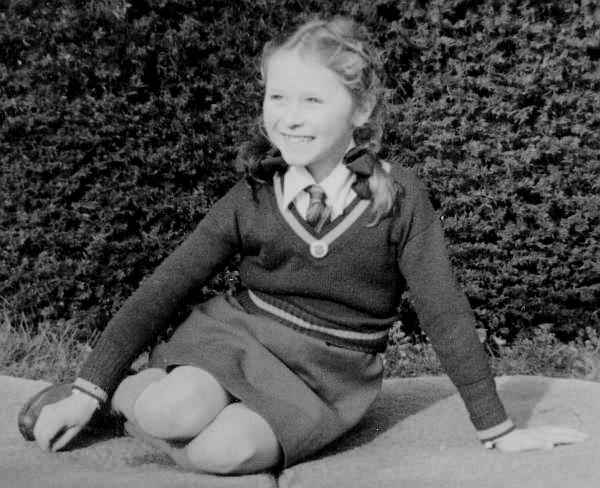
Figure 1.--Girls in England wear many of the same school garments as boys. Here the sweater and tie are common garments also worn by boys. |
|
There are substantial similarities between boys and girls school uniforms in England. Girls have adopted many items worn by boys such as ties and blazers. We are not sure precisely why this was, but suspect it may be because there was a long tradition of boys' boarding schools in England before the first girls' school was opened. The girls' schools apparently followed the examples of the already prestigious boys' schools. Besides the blazers and ties, girls wore the same sweaters that boys wore. Girls wore different styles of headwear, including berets and brimmed hats. There were of course differences. Girls always wore different headwear than the boys. Also they wore skirts rather than trousers. Here many schools for some reason had blouses and skirts for cool weather wear and light-wight dresses for warm weather. With very few exceptions, English girls do not wear trousers to school. There are a few exceptions. We have noted a few coed prep schools where girls during the Winter were allowed to wear cord long trouswrs like the boys. During the Summer, however, they were not allowed to wear short trousers. A HBC reader writes us that "In The Daily Telegraph newspaper (June 22, 2005) today there is an article about Broadstone Middle School which has now banned girls from wearing skirts to "protect their modesty" during activity lessons such as drama and music; all girls must now wear full length trousers to all lessons, even during very hot weather!" There were also differences in hosiery. Some girls wore grey kneesocks, but white ankle and knee socks were very common. Also footwear varied. Although both boys and girls wore school sandals, girls commonly wore strap shoes. There were also sturdy school oxfords, but they were styled somewhat differently than the boys' shoes. Hopefully some of our English readers will provide us some more information about girls' school uniform trends.
Parents in the 18th century did not consider it necessary to educate girls. This idea began to be challenged in the 19th century, although it took some time for attitudes to change. Miss Buss and Miss Beale were leaders in girls' education. They set up a primitive system of girls' education. The idea was to emulate the best boys' schools, and this went so far as to involve wearing of collared blouses somewhat similar to men's shirts, including separate stiff collars. Girls also began wearing ties and blazers, only with shirts and dresses. Remarkably this idea was retained and is to be seen today worn by teenage girls at many many schools in England (although nowadays with semi-stiff attached collars.) The girls school uniforms worn today began to take shape in the 19th century, although girls uniforms were still quite varied. The gym slip was a major girls uniform item in the early 20th century and was popular through the 1950s. Long stockings were very common. It is still worn at quite a number of schools. Gradually after the World War II, girls uniforms became increasingly stanadedized. Girls during the winter term wear blouses and pleated skirts with the same jumpers that the boys wear. The skirts are often grey. Plaid skirts are also worn, but are not as common as in America. Hosiery is highly varied including both tights and sockx. The socks but not the tights are often white. During the summer term, brightly colored, often checked, citton dresses are worn. .
There have traditionally been curriculum differences between the prograam offered boys and girls. A British reader writes us, "We did woodwork at secondary school (it was all boys as you know - at primary school some classes were split, but in that case the girls did needlework whereas we did a form of technical drawing - and of course we played football or cricket while the girls played netball. We did P.E. and Art together though)."
There are substantial similarities between boys and girls school uniform garments in England. Girls at most schools wear many garments interchangeably with the boys including ties and blazers. We are not sure precisely why this was, but suspect it may be because there was a long tradition of boys' boarding schools in England before the first girls' school was opened. The girls' schools apparently followed the examples of the already prestigious boys' schools. Besides the blazers and ties, girls wore the same sweaters that boys wore. Other items such as kneesocks and sandals are also ofren the same.
Girls wore different styles of headwear, including berets and brimmed hats. There were of course differences. Girls always wore different headwear than the boys. Also they wore skirts rather than trousers.
Here many schools for some reason had blouses and skirts for cool weather wear and light-wight dresses for warm weather.
Girls headwear is much more diverse than that worn by the boys. There is no one style worn by the girls that was as common as the peaked caps worn by the boys. One very common garment worn by the girls was the gym slip. A good example is the City Grammar School in 1938. That was a standard uniform item fir many years. With very few exceptions, English girls do not wear trousers to school. There are a few exceptions. We have noted a few coed prep schools where girls during the Winter were allowed to wear cord long trouswrs like the boys. During the Summer, however, they were not allowed to wear short trousers. A HBC reader writes us that "In The Daily Telegraph newspaper (June 22, 2005) today there is an article about Broadstone Middle School which has now banned girls from wearing skirts to "protect their modesty" during activity lessons such as drama and music; all girls must now wear full length trousers to all lessons, even during very hot weather!" There were also differences in hosiery. Some girls wore grey kneesocks, but white ankle and kneesocks were very common. We have also noted long black stockings at nmany schools, although this became less sommon after World War II. Also footwear varied. Although both boys and girls wore school sandals, girls commonly wore strap shoes. There were also sturdy school oxfords, but they were styled somewhat differently than the boys' shoes.
Hopefully some of our English readers will provide us some more information about girls' school uniform trends.
We notice that thar there seem to be differences not only inn the obvious garments bits and girls wore, but in the regulations and engorment of the rtules. This was most obvious in the 19th and early-20th century when girls commonly wire pinafores to school, but boys wore no such orotective garments. Especially in the 19th century when girls first began attending schools in large numbers and Britiam somewhat behind several other countries was just beginning to create a free state education system. This of course was counter inutuitive. Given the basicallky gentic-based behavior of boys, if anyone needed to wear protective garments it was the boys. This refleted stanbdard dress at the time and as far as we know, the pinafore was largely worn as a resilt of parehtal choice rather than school rules. Although it is quite possible there were some schools which had rules on this. Unuforms were only worn at private schools in the 19th cenhtuyrty. Until the late-19th cenhtury this mean mostly boys. We begin to see some public (elite private boarding) schools vfounded for girls whuch like the boys' schools had unifiorms. State schiools did nit begin to require unifirnms until the mid-20th century. LKargely state financed Abglican schools may have begun this earlier. We are less sure about the Catholic schools. We see some coed schools which had required uniformns fir girls, but not boys. And girls sschools more likely to have unifirms than biys schi=ools, We are not sure just why this was. Perhaps girls were kmore amenable to followuing rules. Here we are not talking about private schools, but state schools and the state-financed schools with a religious affiliation.
We have archived several girls or coed English schools in the Individual School section of HBC. One such school is the City School.
We have a few accounts about girls' uniforms at English schools. A HBC reader, Laura, tells us about her school uniforms in the 1980s-90s. She went to several different schools because her father was in the Royal Air Force. Another HBC reader, Stephen, tells us aboutv girls uniform at the comprehensive in a mining area that he and his sister attended during the 1970s.

Related Chronolgy Pages in the Boys' Historical Web Site
[Main Chronology Page]
[The 1880s]
[The 1930s]
[The 1940s]
[The 1950s]
[The 1960s]
[The 1970s]
[The 1980s]
Related Style Pages in the Boys' Historical Web Site
[Main school uniform page]
[Main country page]
[Long pants suits]
[Short pants suits]
[Socks]
[Eton suits]
[Jacket and trousers]
[Blazer
[School sandals]
Navigate the Boys' Historical Clothing Web Page
[Return to the Main English school page]
[About Us]
[Activities]
[Chronology]
[Clothing styles]
[Countries]
[Debate]
[Economics]
[Garment]
[Gender]
[Hair]
[History]
[Home trends]
[Literary characters]
[School types]
[Significance]
[Transport and travel
[Uniform regulations]
[Year level]
[Other topics]
[Images]
[Links]
[Registration]
[Tools]
[Return to the Historic Boys' School Home]