The father of French education is generally considered to be Charlemagne, the father of the French nation. Charlemegne, who was largely uneducated, respected learning and incouraged the resumption of formal education. He reversed the descent toward barbarianism in western Europe that had followed the fall of the Roman Empire. I only have limited information, however on how boys were educated at the time and what they wore. Nor do we have much informatioin on the overall medieval era. Education in 17th century France was for the privildged. The Government did not provide schools. Fee paying schools, dominated by the church were available for middle-class boys. Artistocratic boys were educated at home by tutors.HBC has very little information on the clothes worn by French boys to schhool in the early and mid-19th century. It is unclear to HBC if French boys commonly wore smocks before the late 19th-century. A fe available images suggest that many boys wore military style uniforms at seconadry schools. I'm less sure what the younger boys wore. The major event affecting schoolwear was the Franco-Prussian War (1870-71). The Emperor Napoleon III's disastrous loss in the war cost him the crown and paved the way for the Second Republic. The decision to require French boys and girls to wear smocks was a decision implemented by French authorities during the 1870s. The smock was in keeping with rhe Republican sensibilities of the day. The smock was viewed as a very democratic garment, hiding the inexpensive clothes that might embarras pooer children. It was in keeping with the styles of the day as both boys and girls commonly wore smocks, altough I am not sure if they were commonly worn to school. France has such a centralized, highly respected educational system, that the decision was relatively easy to implement. I'm not sure just what age boys wore smocks. Presumably it was just elementary schools, but I have seen photographs showing what appear to be younger teenagers wearing smocks as well as younger boys. French boys continued to wear school smocks and berets in the early 20th century. Some boys appear to have worn military styled uniforms. Smocks became somewhat less common after World War I (1914-18), but were still quite common until after World War II (1939-45) in the the 1950s. Berets also largely disappeared after World war II. Most French boys wore kneepants with three-quarter socks in the early 20yh century. After World War I, short pants becamee more common. Shorts were commonly worn through thr 1960s, but mostly by younger boys by the 1960s. Kneesocks were also common, although by thr 1950s they had become more common in the winter than the summer. French boys by the 1980s were dressing in the American-influemced pan-European style in jeans, sweatshirts, and other casual styles. The French in the 21st century have begun to debate the efficacy of school uniforms, but they are still not very common.
The Celts were not a literate peoole. We have not been able to find informationsuggesting the existence of Celtic-era schools.
The Romans to the south of course were a literate people. An Julius Ceasar conquered Gaul (Celtic France) in a series of wars--the Gallic Wars (58-50 BC). Rome quickly romanized Gaul and the Celtic people there. And this meant literacy which required schools. Rome did not have a public educarion system, but there were schools. Parents paid to send their children to school. There is not hard data on the literacy rates in the Greco-Roman, but most scholars agree were seldom more than 20 percent. Which is high by other ancient civilizations such as Pharaonic Egypt. [Hopkins, p. 135.] The average was probably was about 10 percent in the Roman Empire with substantial regional variations. It is believved that it probably never rose above 5 percent in the western provinces--including Gaul. [Wright]
The father of French education is generally considered to be Charlemagne, the father of the French nation. Charlemegne, who was largely uneducated, respected learning and incouraged the resumption of formal education. He reversed the descent toward barbarianism in western Europe that had followed the fall of the Roman Empire.
He founded the �cole du Palais with the aim of instructing the men of his inner circle (781). Nobels at the time werre no all that interested in going to school. But he also fonded a school for aristocratic boys.
We only have limited information, however on how boys were educated at the time and what they wore.
No information available at this time.
Education in 17th century France was for the privildged. The Government did not provide schools. Fee paying schools, dominated by the church were available for middle-class boys. Artistocratic boys were educated at home by tutors.
The availability of education expanded in the 18th century. Poor boys, however, received little or no schooling. The schools continued to be the province of the church. The French Revolution (1789) brought about a fundamental transformation of French society and education was no exception. The Revolution and the Napoleonic Empire which followed established the principal of free public education for all. Education was also secularized by taking it out of church hands. We have noted great diiferents in school clothing. Some boys wire closed virtually no existent collars. Ither boys wore open ruffled collars. Knee breaches were the standard, although by the 1790s, some boys were wearing long pants skeleton suits.
|
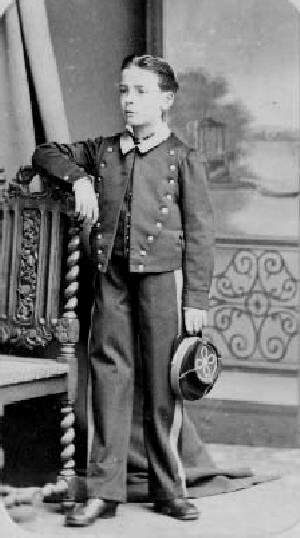
HBC has very little information on the clothes worn by French boys to schhool in the early and mid-19th century. It is unclear to HBC if French boys commonly wore smocks before the late 19th-century. A fe available images suggest that many boys wore military style uniforms at seconadry schools. I'm less sure what the younger boys wore. The major event affecting schoolwear was the Franco-Prussian War (1870-71). The Emperor Napoleon III's disastrous loss in the war cost him the crown and paved the way for the Second Republic. The decision to require French boys and girls to wear smocks was a decision implemented by French authorities during the 1870s. The smock was in keeping with rhe Republican sensibilities of the day. The smock was viewed as a very democratic garment, hiding the inexpensive clothes that might embarras pooer children. It was in keeping with the styles of the day as both boys and girls commonly wore smocks, altough I am not sure if they were commonly worn to school. France has such a centralized, highly respected educational system, that the decision was relatively easy to implement. I'm not sure just what age boys wore smocks. Presumably it was just elementary schools, but I have seen photographs showing what appear to be younger teenagers wearing smocks as well as younger boys.
|
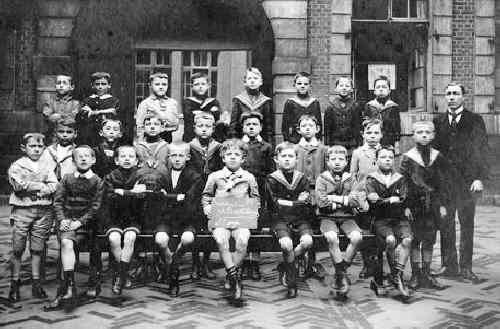
French boys continued to wear school smocks and berets in the early 20th century. Some boys appear to have worn military styled uniforms. I'm not sure if this was a popular style or if it was required by a school. I'm not sure wih this style began, but it generally passed out of fashion during the 1920s. Smocks became somewhat less common after World War I (1914-18). Before the War most boys wore smocks. After the war they were still common, but no longer universal. They were still quite common until after World War II (1939-45) in the the 1950s. Berets also largely disappeared after World war II. Most French boys wore kneepants with three-quarter socks in the early 20yh century. After World War I, short pants became more common. Shorts were commonly worn through the 1960s, but mostly by younger boys by the 1960s. Kneesocks were also common, although by thr 1950s they had become more common in the winter than the summer. French boys by the 1980s were dressing in the American-influemced pan-European style in jeans, sweatshirts, and other casual styles.
A French reader in 2005 tells us, "It is in topical question here in France now to begin requiring pupils to wear school uniforms. Some people say that uniforms are worn in England and it is a perfect way to avoid descrimination abnd the obsession with brand-name clothes. Children are under constant pressure to get the latest trendy clothes and many cannot afford to do so. Interestingly most teachers for some reason are against school uniforms. I'm not sure why. I noted recentlt that in an important Catholic forum site forum ( Bayard ) that there were quite a few people that advocated a return to traditional uniforms. I don't think modern French children would be very accepting of this." A reader writes, "Girls in France go to school in dresses, never with jeans. There is no
standard uniform, but parents don't hve to dress the children in expensive clothing. France is the
country where fashion still is originating and children learn that when very young."
Hopkins K. "Conquest by book", in J.H. Humphrey (ed.) "Literacy in the Roman World" Journal of Roman Archeology Supplementary Series No. 3 (University of Michigan: Ann Arborpp, 1991), 133-58.
Wright, Brian J. "Ancien Rome's daily news publication with some likely implications for early Christian studies, Tyndale Bulletin Vol. 67, No. 1 (2016), pp. 145-60.

Related Chronolgy Pages in the Boys' Historical Web Site
[Main Chronology Page]
[The 1880s]
[The 1930s]
[The 1940s]
[The 1950s]
[The 1960s]
[The 1970s]
[The 1980s]
Related Style Pages in the Boys' Historical Web Site
[Main school uniform page]
[Main country page]
[Long pants suits]
[Short pants suits]
[Socks]
[Eton suits]
[Jacket and trousers]
[Blazer
[School sandals]
[French catalogs]
Navigate the Boys' Historical Clothing School Pages
[Return to the Main French school chronology page]
[Return to the Main French school page]
[Australia]
[England]
[Germany]
[Italy]
[Japan]
[New Zealand]
[Scotland]
[United States]
Navigate the HBC School Section:
[About Us]
[Activities]
[Chronology]
[Clothing styles]
[Countries]
[Debate]
[Economics]
[Garment]
[Gender]
[Hair]
[History]
[Home trends]
[Literary characters]
[School types]
[Significance]
[Transport and travel
[Uniform regulations]
[Year level]
[Other topics]
[Images]
[Links]
[Registration]
[Tools]
[Return to the Historic Boys' School Home]