Italian School Uniform: Individual Schools


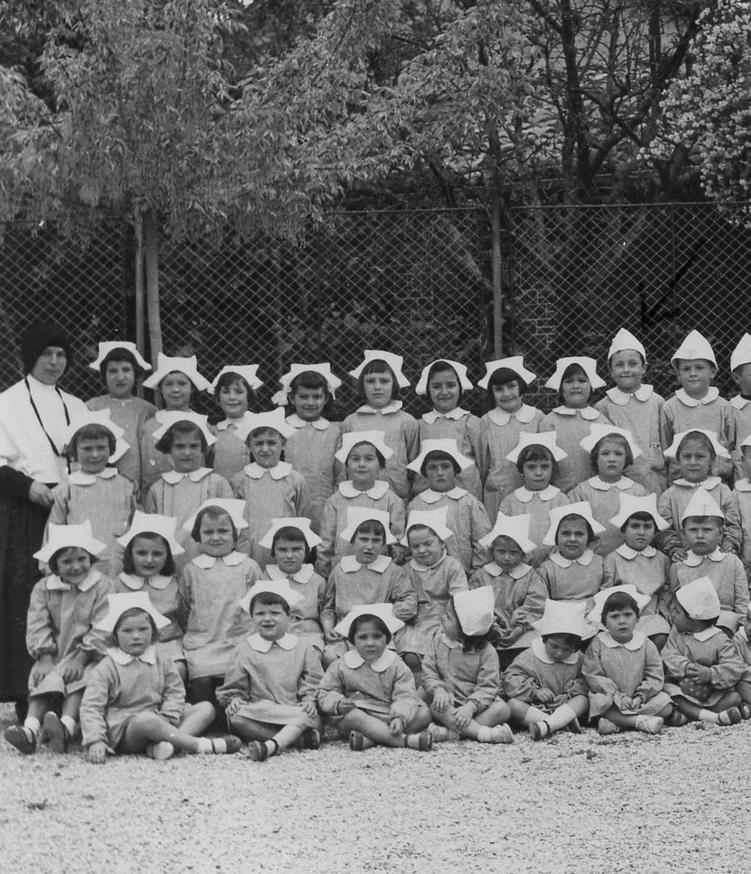
Figure 1.--We do not fully understand the regulations at Italian schools. This school Liceo Bianca Villa clearly had a school smock as shown in the 1957 school portrait. Notice how over half the class wears the same dark blue smocks with white collars. Most wear bows with their smocks. There would not be this kind of uniformity unless the school set guidelines. Yet they were either not required or the regulation was not strictly enforced. Notice how the teacher has only allowed the boys wearing the school smock to sit in the front row.

HBC is collecting information on individual Italian schools. We have some at this time information on several scgools, both public and state schools in different parts of the country. Information from these schools show how schoolwear has varied over time at several different schools.

B

(Liceo) Bianca Villa

We do not know where the Liceo Bianca Villa was located. Of course it could be the Liceo located in Bianca Villa where ever this was. We do not know when the school was founded, but believe it operated most of the 20th century. The image here shows a class at the school in 1957 (figure 1). All that we know about it was that the school was a liceo, although that term was variously used in Italy. Here it looks to be a primary school. The school at the time seems to have incouraged the boys to wear smocks, but did not require it.

C

Capoterra Village School

Capoterra is a village on the southern coast of Sardinia, near Cagliari. Its territory includes the coast and the inland hills. The traditional activities of the inhabitants were farming and sheep breeding. This photo shows a group of village primary schoolboys. It was taken in 1915. At the time Capoterra had about 2,000 inhabitants. All but one boy seem farmers or shepherds children. Almost all children wear long trousers or knickers-length pants with jacket and go barefoot. There is only a boy sitting down near the teacher that is better clothed. He wears bloomer knickers, a jacket with a big stripped collar, stripped knee socks and shoes. He could be the son of a wealthy farmer or of the village doctor or chemist (if there was someone at the time), or also the son of the teacher.

F

(Liceo) Foscarini

The Liceo Foscarini was located in Venice. We have no information about it at this time. It looks to be a secondary school with boys entering at about age 12. It was a single gender school in the 1940s and 50s. There was no uniform. Some boys wore suits, but most did not. Most of the junior boys in 1949 and 51 were wearing short pants and ankle socks, but we ee a few boys wearing knickers and long pants.

P

(Ginasio) Parini

The Ginasio Parini is located in Milan. We have information at this time about the school other than it is a gynasio. This would mean a secondary school with high academic standards. We have information on oly one years at this time. Our information on the school is from the 1930s. There was no school uniform. Many moys wore suits, but others did not. We see a few boys wearing sailor suits, but not very many. In the first 3 years almost all boys wore short pants. We are not sre about the younger boys.

S

San Giorgio village school

A HBC reader has sent us some images frim the village school at "San Giorgio della Richinvelda", a village in North Italy. San Giorgio della Richinvelda is a small village in the north-eastern part of Italy. San Giorgio lies 110 km from Venice. It is a flat area (86 meters above sea level), with a surface of 48 sq/km. It has now a total population of about 4,500 inhabitants. The photograph shows the school beginning at the turn of the century.

San Nicola primary school

Here we have a picture showing pupils of a state primary state in Calabria (southern Italy) in the early 1960s. The photo was taken in San Nicola, a village about 100 km from Reggio Calabria (the most southern town in the peninsula). At the time school attendance was mandatory only in primary school (scuola elementare) for 5 years (children started when they were 6 and ended when 11). The Italian Government beginning October 1, 1963 also made "scuola media" (intermediate school) another 3 years mandatory. This mean children were required to attend school until age 14 years. Small villages like this had time until October 1, 1966 in open intermediate schools. The photograph here was published in 1963 with a journalistic inquiry about Italian schools in the Italian Touring Club magazine. This image shows a poor school attended by largely indigent village children. Note the rough desks. Kids clothing indicate their social rank. We can assume also the bare feet as a poverty indicator. Although many Italian children went barefoot there are very few school photos showing pupils without footwear. Bare feet for play in everyday life may be the child's choice. But if you see a child barefoot to school you can think that his parent can't provide him footwear. Moreover the photo here was taken in winter.

Scuola Italiano Tangiers

HBC has little information on the Tangiers Scuola Italiano, but we have noted several images illustrating schoolwear trends during the 1950s. The pupils wear the classic dark Italian back-buttoning school smock with emaculate wide white colars. The school appears to have been very strict about the style and color of the smocks woren to school. Not only are the smocks identical, but so are the white colars. While almost all of the children wear school smocks, in most of the class photographs there usualy


HBC-SU


Related Chronolgy Pages in the Boys' Historical Web Site
[Main Chronology Page]
[The 1900s] [The 1910s] [The 1920s] [The 1930s] [The 1940s] [The 1950s] [The 1960s] [The 1970s]


Navigate the Relate Boys Historical Clothing Style Pages
[Main country page]
[Long pants suits] [Short pants suits] [Lederhosen] [Kneesocks] [Eton suits]
[Jacket and trousers] [Blazer [School sandals]


Navigate the Boys' Historical Clothing School Uniform Pages
[Main Italian School Uniform Page]
[Main School Uniform Page]
[Main School Uniform national page]
[Australia] [England] [France] [Germany]
[Ireland] [Japan] [New Zealand] [Scotland]
[United States]


Navigate the Boys' Historical Clothing Web Site:
[Introduction] [Activities] [Biographies] [Chronology] [Clothing styles] [Countries]
[Bibliographies] [Contributions] [FAQs] [Glossaries] [Images] [Links] [Registration] [Tools]
[Boys' Clothing Home]


Created: June 5, 1999
Last updated: 10:44 PM 12/20/2007