Italian Fascist School System (1925-43/44)
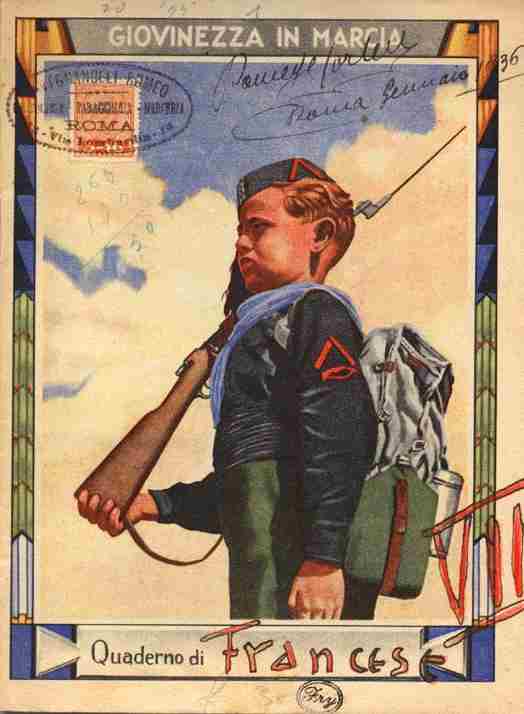
Figure 1.--This "Giovinezza in Marcia" (youth in march) school notebook, was one of the notebook Italian children used during the Fascist era. This was the notebook for French class . It was issued in 1935 ans apparently used in 1936. Note that a stamp had to be bought for it. The notebooks had patriotic Fascist illustrations and quotations from Mussolini on the front and back. The boy pictured wears his Bailial hiking uniform conplete with rifel and bayonet.
|
|
Mussolini Fascists upon seizing control of Italy immediately focused on education. This is the nature of totalitarian society. The Fascists required that Fascist Culture be taught in the schools. Unlike a democratic society, the Fascist ideology was taught as the proper way of ordering society. Alternative visions of government and social organization were excluded. The idea of freedom, including both democratic elections and capitalism were vilified. What the Fascists did was not to change the basic structure of Italian education, but rather introduce Fascist ideology into the curriculum. This was the same approach the NAZIs in Germany pursued. Administrators and teachers unwilling to cooperate were fired. As best we can tell, these efforts were less draconian than in NAZI Germany, but here our information is still limited. Political reliability became a major factor in new hires. Other factors may well have been more important. Some private schools were closed. The Fascists in Italy seem less successful in its program of indocrination than the German NAZIs. Although the Fascists were in power nearly twice as long as the NAZIs, they do not seem to have generated the same level of support as the NAZIs. To what extent the school system was responsible for this we do not know. We are still collecting information about how school classes were organized in Fascist Italy. We are unsure, for example, just what ginasio and liceo meant.
Italian Fascism was unique among the radical forces produced by the early 20th century. It developing out of economic problems which followed Italy's costly involvement in World War I. Strangely it had no clear predecessor in the 19th century. The Italain Fascist movement emerged in 1919, catapulting its leader, the journalist Benito Mussolini, into the premiership 3 years later in 1922 and then to the creation of a new political dictatorship beginning in 1925. We believe that the Italian Fascists exercised control over all schools in Italy, although they did not close down Catholic and private schools. We have, however, little information at this time on Fascist school policies. The Fascists were very critical of earlier educational systems. The Fascists prescribed both content and general methods of teaching, as part of Mussolini's pedagogical "reforms." This pedagogical "charter" drawn up by Mussolini's minister of education, Giuseppe Bottai, is a radical reforming document that proposes to substitute for the existing bourgeois system one more responsive to the needs of students not heading for the university. The system would include nursery schools, trade and artisan schools, special training for girls, and the introduction of practical crafts, among other considerations.
Grade/Form Year System
We do not know at this time what the grade system was during the Fascist era. AS far as we can tell, the Fascists retained the basic structure of Italian education. It was the content thsat changed, not the structure. We noticed divisions at one school of gimnasio inferiore or primary school and gimnasio superiore or secondary school. These may have been 6 year programs, but we are positive about this. There were also liceos, but I think this was an alternative secondary program. The term ginnasio and liceo seems to some extent to be interchangable. We notice for example one ginnasio estatale with a web address of a liceo. A reader writes, "I am as confused as you are about the Italian school system. I thought at first that the ginnasio/liceo split might be a convenient school-leaving point for those who aren't going any further, while those who are going on will do liceo before possibly going on to university. I notice photographs of students in the third year of liceo look to be older than American high school seniors, so maybe the liceo might be thought of as something like an American community college. I hope someone who actually knows something about Italian schools will chime in."
Types of Schools
The Fascist focus as might be expected was on the public school system. It was the system educating most Italian children. And as the Government administered the public schools it was the system which could most most easily be controlled. The curiculum was set by the government and could be changed as the Ministry of Education saw fit. Administrators or teachers who did not follow the new curriculum could simply be dismissed. The private schools were different. Here the Government had less control. Totalitarian systems varied in their approach to private schools. The Communists simply shut them down, often arresting the people running them. This was in part of Communist atheist campaigns as many private schools were connected with religious groups. Fascist countries like NAZI Germany and Fascist Italy tolerated religions to some extent, Italy more than in Germany. Regulations were issued demanding curiculum changes and governing various aspects of runnuing the schools, such as teaching Jewish children. In Italy, the Ministry of Education ordered that a course be taught in Fascist Culture. Schools that refused to teach the course weee closed. One example was the Nave Scuola Marinaretti Caracciolo founded by Giulia Civita Franceschi for poor street boys (1923). She had refused to cooperarte with the Fascists. TheChurch schools followed the law and cooperarted. Just to what extent they supported the spirit of the law we are not sure. It surely varied from school to school with the various administrators and teachers.
Effectiveness
As best we can tell, these efforts were less draconian than in NAZI Germany, but here our information is still limited. Political reliability became a major factor in new hires. Other factors may well have been more important. Some private schools were closed. The Fascists in Italy seem less successful in its program of indocrination than the German NAZIs. Although the Fascists were in power nearly twice as long as the NAZIs, they do not seem to have generated the same level of support as the NAZIs. To what extent the school system was responsible for this we do not know.
Sources
HBC

Related Chronolgy Pages in the Boys' Historical Web Site
[Main Chronology Page]
[The 1900s]
[The 1910s]
[The 1920s]
[The 1930s]
[The 1940s]
[The 1950s]
[The 1960s]
[The 1970s]
Navigate the Relate Boys Historical Clothing Style Pages
[Main country page]
[Long pants suits]
[Short pants suits]
[Lederhosen]
[Kneesocks]
[Eton suits]
[Jacket and trousers]
[Blazer
[School sandals]
Navigate the Boys' Historical Clothing School Uniform Pages
[Main Italian School System Page]
[Main School Uniform national page]
[Australia]
[England]
[France]
[Germany]
[Ireland]
[Italy]
[Japan]
[New Zealand]
[Scotland]
[United States]
Navigate the HBC School Section:
[About Us]
[Activities]
[Chronology]
[Clothing styles]
[Countries]
[Debate]
[Economics]
[Garment]
[Gender]
[Hair]
[History]
[Home trends]
[Literary characters]
[School types]
[Significance]
[Transport and travel
[Uniform regulations]
[Year level]
[Other topics]
[Images]
[Links]
[Registration]
[Tools]
[Return to the Historic Boys' School Home]
Created: September 1, 2001
Last updated: 7:12 AM 4/16/2018