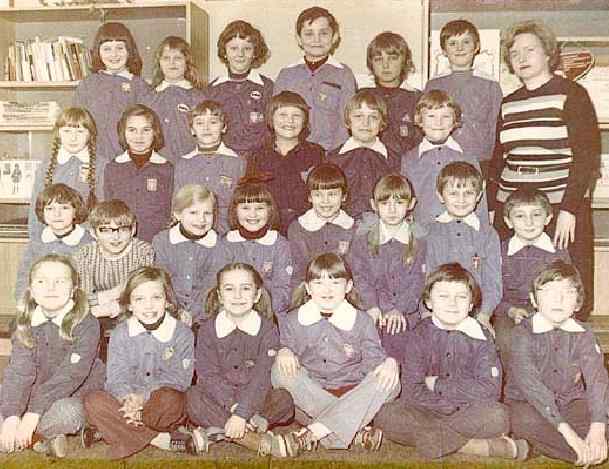
Figure 1.--This photograph of Polish school children was probably taken in the 1970s. One boy dies not appear to be wearing his fartuszek, but he is just waring a jackt over it. Notice he school badge on one boy's sleeve. |
|
Russian "liberation" resulted in the reserection of an independent Poland. The
border was pushed far to the west. Territory adquired by the Soviets in the east
was replaced by former German Silessia and other territories in the East. Millions of people were forcibly moved, the Poles by the Soviets in the east and the Germans by the
Poles in the west. By 1948 the Russians had coreagraphed the creation of the Polish
People's Republic. The Russians did all they could to recast Poland in the Soviet mold. The Church and the strength of Polish nationalism made this difficult from the start. It was eventually Poland, spearheaded by the Solidarity movement, that led to the unraveling of Russia's Eastern European Empire in the 1980s and eventually the Soviet Union itself.
Russian "liberation" resulted in the reserection of an independent Poland. The
border was pushed far to the west. Territory adquired by the Soviets in the east
was replaced by former German Silessia and other territories in the East. Millions of people were forceibly moved, the Poles by the Soviets in the east and the Germans by the
Poles in the west. By 1948 the Russians had coreagraphed the creation of the Polish
People's Republic. The Russians did all they could to recast Poland in the Soviet mold. The Church and the strength of Polish nationalism made this difficult from the start. It was eventually Poland, spearheaded by the Solidarity movement, that led to the unraveling of Russia's Eastern European Empire in the 1980s and eventually the Soviet Union itself. I have no detailed information yet on the school uniforms worn by Polish children
during the Communist era. I believe smocks were commonly worn by the younger boys and girls. Polish boys commonly wore short pants in the 1940s-70s, and presumably this included school wear.
We are not sure when the Polish Governmebnt instituted smocvks for school children. Wehave only a few Polish school images so we can not yet follow school wear trends in detail. We note school portraits from the 1940s and-early 1950s in whih the children are not wearing smocks. The Communists of couse tool over at the end of World War II (1945). We do not begin noticing the school smocks in the mid-50s.
The first portrait we have at this time is an unidentifed school in 1957. Most of the younger children wear smocks, Almostt all the girls and about half of the boys. We are not sure why there is a gender disparity here. Given the level of compliance, the school must have insisted on the smocks. We are not sure why the boys seem to require a little more encouragement. The white collars also seem to have been introduced at this time. They seem to be white shirts/blouses, but in other images they look to be collars pinned on to the smocks. We also do not know just how they delt with children not coming to school in the smocks. most chiolprimarily with short pants. We notice some older boys from the samne school not wearing smocks. Either they did not have to or they took their smocks off for some reason. A reader though that perhaps the smocks were introduced for the younger children first. We are not yet sure about that. We also notice the Katowice No, 34 School in the 1963-64 school year. We think that smocks were introduced before this, but we sre not sure yet precisely when. We also do not know when the children stiopped wearing smocks. We think it was some time in the 1980s.
Our information before World War II is very limited. Poland before World War II had no national school uniform, but I believe many Polish school had their own individual uniforms. Soon after after the People's Republic of Poland, a kind of national school uniform was adopted for all students. Polish pupils were ruired to wear a protective smock or fartuszki (singular form: fartuszek) to protect the clothes the children wore to school. There was no required unifom clothing, only the fartuzki. All Children had to wear fartuszki in all Polish schools, both primary and secondary (lyceum) schools. This means Polish children wore fartusski from about 7-18 years of age. While fatuski were required, there wasn't any strict regulation about the pattern and stylistic details. As a result, the fartuski that the children wore in actuality differed significantly.
The Englisg words pinafore/apron/smock often do not have precise translations in other languages. The Polish term 'fartuszek' [pronounce it like fartooshec] is often translated as 'pinafore'. The garment that the Polish children wore are clearly smocks as they had sleeves and backs. And unlike Soviet girls, Polish girls did not wear pinafores over their dresses/smocks.
There were two basic styles for Polish fartuszki, one for boys and another for girls. Girl's fartuszek were longer than the one worn by boys so that it covered their dresses. Over time the length of the girls fartuski changed. The earliest ones were quite long, but they became shorter over time, perhaps because girls began wearing shorter dresses. Girls' fartuszki used to be longer - ended a bit above the knee like a short dress, Boy's wore much shorter fartuszki that were not designed to protect their pants. A factor may be that boys jostly wore short pants when the fartuszki was introduced, we think in the 1950s. Even when boys began wearing long psnts, the boys' fartuszki continued to be quite short. Another trend we notice was that there are often several boys not wearing the fartuszki, but usually all of the girls or at least almost allof the girl's are wearing them. We also note that some times the boys tucked them into their pants.
|
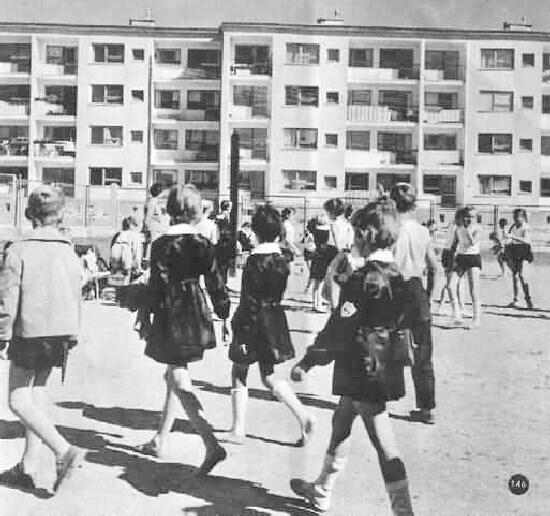
The first fartuszki were black, but dark blue was later aopted as the standard color. I don't know when exactly the color was changed. Some photograpohs suggest a lighter blue was also worn (figure 2).
We see Polish children wearing all kinds of white collars with their smocks. Some are wide whilte collars done as Peter Pan and Eton collars or a variety of other shapes. Some were smaller collars. These were special collars added to the smock. We see other children wearing whitere shirts with normal size collars. There seems to have been considerable vaiety here. Some schols seem to have been stricter with this than other schools. Ghere doesnot seem to have been any gender conventions concerning the collars in the early years, but the Peter Pan collsars seem nore common with girls in the later years..
Communist authorities intoduced school smocks not just to protect the children's clothes, but for ideological reasons. They sought to hide social differences between children. {This was also the reason smocks were adopted by French educational officials of the Third Republic in the 1870s.)
Education authorities never isued strict directive as to precisely what the fartuski should look like, other than the color. As a result, fartuszki appeared in wide variety of styles. Fartuszki has simple white detailing such as thin white stripes at the chest. They also had wide white detachable collars. They buttoned on to the fartuski so that thy could be easily taken off and washed. Fartuszki came with a belt made of tge same material as the fartuszki itself. All fartuszki used to have two breast pockets.
Pupils wore a school badge on their left breast pocket or the left arm of his/her fartuszek. The badge was a symbol of school which the student attended. The badge was a small navy-blue shild with white frame and the number of the school. Polish schools normally had numbers as well as names. The best pupil in each classroom were given special red badges ( wzorowy uczen ) meaning "model pupil" which was also worn on their fartuski.
The fartuszki weren't matched with any special clothes. Children could wear lothes of their or their parents choosing. Nor did they have to wear blue clothes to match the fartuski. They could wear differet pants. Girls normally wore skirts and dresses. Boys wore various shirts and short and long pnts. Primary boys through the 1970s commonly wore short pants, but long pants became more common in the 1980s. Girls by the 1980s wer also commonly wearing pants.
Virtually all Polish children joined the Young Pioneers. There would be periofic Pioneer meetings at school and activities organized at school. Periodically the children would wear tgheir Pioneer unifoms to school. I am not sure if theyalso wore fartuski on those days.
Polish children never liked fartuszki, especially the older children. Some students found wearring them were humbling. Younger children didn't like playing dressed in them on the school playground. Here HBC is not sure why. We do not note French children making similar complaints. As the fartuski were not popular, many children as soon as they left school took off their fartuszki and put hem into their book bag.
Fartuszki ended with the fall of Communism in 1989. Within a year pupils gradually threw them away. Some pupils were, however, continued to wear garments similar to fartuszki, both blouses or shirts for a short time to reduce contrast.

Related Chronolgy Pages in the Boys' Historical Web Site
[Main Chronology Page]
[The 1900s]
[The 1910s]
[The 1920s]
[The 1930s]
[The 1940s]
[The 1950s]
[The 1960s]
[The 1970s]
[The 1980s]
[The 1990s]
[The 2000s]
Navigate the Relate Boys Historical Clothing Style Pages
[Main country page]
[Long pants suits]
[Short pants suits]
[Lederhosen]
[Kneesocks]
[Eton suits]
[Jacket and trousers]
[Blazer
[School sandals]
Navigate the Boys' Historical Clothing Web Page
[Introduction]
[Activities]
[Biographies]
[Chronology]
[Clothing styles]
[Countries]
[Topics]
[Bibliographies]
[Contributions]
[FAQs]
[Glossaries]
[Images]
[Links]
[Registration]
[Tools]
[Boys' Clothing Home]