|
Public eduction is a very modern development. Interesting, something of the beginnng of Thai education is known to most Americns, because of the Broadway musical -- 'The King and I'. TheTYHai Goverment did not create a substantial public school system until after World War II. All Thai students today wear school uniforms. The uniform is very basic and very similar across the country. There are some differences in colors from school to school. Most schools have uniforms consisting of white shirts and colored, usually khaki, short pants. Kindergarden boys oftem wear destinctive red shorts. Scouting is a required part of the school curriculum.
The first know form of educatiin in what id now Thailand occurref during the Sukhothai period (1238-1438). Tere hd to be some form of education after King Ram Khamhaeng the Great invented the Thai alphabet (1283). The new alphabet was based on Mon, Khmer, and southern Indian scripts. Thai boys and young men were expected to be ordained and live as Buddhist monks for a time. They wore the saffron robes associted with Buddhism and lived in the temples. Here they were lern to read and writing as well as a variety of crafts. This was just for the men. Women remined at home where they learned cooking and household skills as well as crafts. It was only as Thailand came into contact with the West that the idea of formal education began to create the impetus for modern secular education. This began with American and Britiish missionaries introduced formal European education for he first time (late-18th century). And change also occurred in the palce. The Broadway musical 'King and I' is based on a true story. Until this, what might be called scholarly pursuits primarily occured in Buddhist temples, but it was hrdly rigoroius learning. It was mostly memorizing religious scriptures. The process of creting an eduction began with King Mongkut Rama IV (1851-68). He hired an English goiverness, Anna Leonowens, to educste his children. She rrived with her young son and recorded her experiebces in a memoir. He is the king played by Yul Brenner in the 'King and I'. King Chulalongkorn Rama V (1868-1910) thought the answer for Thailand was to integrate traditional monastic instruction with Western educational ideas. This proved unworkble, so he appointed his half brother, Prince Damrong Rajanubhab, to design a modern nationl education systems. Thai authorities hired Western eduction experts to assist in the effort. Major steps, however, did not occur until the 20th century. The first major steps were taken during the reign of King Vajiravudh, Rama VI (1910-25). He expanded public eduction and founded Thailand's first university -- Chulalongkorn University (1917). The Compulsory Primary Education Act was proclaimed (1921). King Vajiravudh was suceeded by a brother, Prajadhipok Rama VII (1926-35). He would be Thailnd's last absolute monsrchy. After the Revolution of 1932, he andicasted. through all of this he continued his broher's eductionl reforms. Emphasis on education grew after the 1932 coup as a result of the new constitutional requirement for a literate populace able to vote in the elections that were now planned. The 1921 Compulsory Eduction Act was not followed by the the appropriations neeed to actually build a school system. Some primary schools were opened. Private schools, mostly in Bangkok and a few other cities appered and privided mich of he secondary schooling avialble. Even for some ime after World War II, formal eduction as liomited to the well-to-do elite in Bangkok.
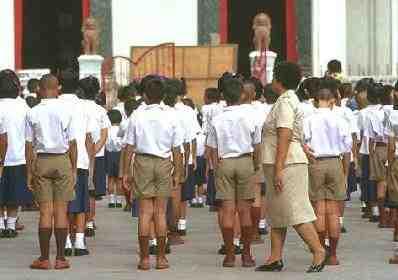
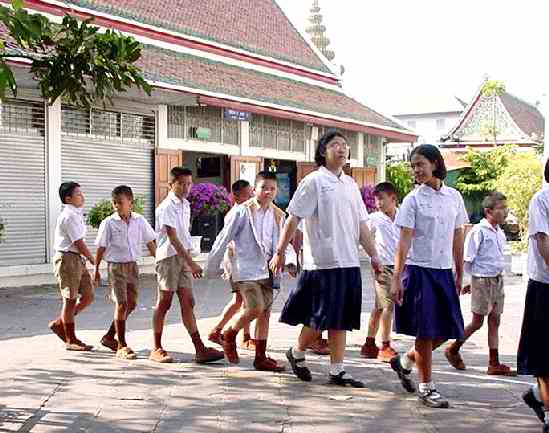
Khaki shorts for boys and blue dresses for girls are common at Thai schools. Some schools have grey uniforms. Other colors such as blue, black, and olive are also used. Red is used, but usually for pre-school children.
School uniforms are commonly worn in Thailand and there is little difference as to grade level. Thai school uniforms
usually are very basic. The same unifiorm is worn year round as there is no cold winter weather to contend with. The uniforms at a typical school is a white shirt and black or khaki short pants for boys. Boys usually wear matching or coordinated socks with
leather shoes. The socks are often not knee socks, but may be longer than normal ankle socks. Both elementary and secondary boys wear shorts. The girls wear white middy blouse, dark blue skirt, and dark blue bows. However each schools has there own distinctive
uniforms. Girls uniforms are similar except that girls wear blouses and skirts
instead of shirts and shorts.
Many kindegartens require red shorts.
Thai schoolboys, however, wear a simple but nonetheless distinctive uniform. Virtually all primary schools require uniforms. The uniform conists of a white shortsleeved shirt (often with the name or school symbol sewn on the front pocket) and uniformed trousers. The color of the trousers varies from school to school. Short trousers are required of all primary schoolboys schoolboys. Shorts worn by primary schoolboys are typically worn a few inches above the knee. Many schools also require that the color of the socks (typically ankle or mid-calf) match the color of the shorts (particularly when the
shorts are khaki-colored). The most popular color among primary schools appears to be khaki, worn with rust-colored socks (see photo).
The uniform at secondary schools is essentially the same as at primary schools. The only major difference is that some secondary schools permu long trousers. Usually this means uniformed long trousers in the upper grades. Secondary schools opt for blue, black, olive, or khaki shorts. The length of the shorts varies from school to school among secondary schools. Most common appears to be knee length but some schools seem to require somewhat shorter shorts -- even mid-thigh. Thai school shorts are generally a little longer than those worn in Indonesia.
|
Thai boys dress outside school today in the ubiquitous global style. Poorer boys may only be able to afford cheap flip-flops, cutoffs and t-shirts, but middle class and wealthier boys want the baggy, below-the-knee carpenter shorts and name-brand uppers worn by their counterparts around the world.
One Thai reports, "When I was young I wished that I did not have to wear a school
uniform because the students in other country don't wear them and they are not very attractive. Many of my friend thought the same way. But now that I am older I see that a school uniform is useful. It saves money and
bother for the parents. I think the students in America don't wear a school uniform because the weather is cold so they must wear everything that help them to can stand the cold. I think America should have school uniforms, but they must be warm. Pornpimon Krutgamjorn, 1998
Another Thai attending a New Zealand boys' high school compared his school the New Zealand school he was attending. My school is in Bangkok, Thailand, and it is very good. Here is a profile of it, not including the teaching style. There are 7 main buildings in the school with 5 floors in each building. In Bangkok we have lots of businesses. We can not use much land for schools; the reason for that is that land space is very expensive so they are better to build the schools upward. In Shirley Boys' High School I saw a big difference. Here people are very involved in activity and sport. Therefore Shirley Boys'has a big playing field. As everyone knows it's a common thing that everyone works and is busy in a capital city. Everyone tends to follow this role and so it is very busy in my Thai school. At Shirley Boys' everything is very different from my old Thai school. In my home school there is a good environment, good for study because everything invites me to study, and also it's very quiet. It's very easy to concentrate on study in that school. In Thailand we use only one uniform. It consists of just a short sleeved shirt and trousers because it's very hot, especially in Summer season. We wear just short sleeved shirt and short pants, that's all Thai students wear. Necktie, shirt, jersey, jacket, dark grey trousers and a pair of black leather shoes. All of this is my uniform in Shirley Boys'. As everyone knows the cold-wet weather is a common thing in New Zealand. I have seen another uniform about the school which might be for rain but many boys still wear it even if there is no rain. It's not right to say that my school in Thailand teaches differently from here, because it's basically the same. However there are a few differences. For example in Thailand almost all students respect the teacher. So when the teacher tells the students or wants something, all students are going to do what their teacher wants. But Shirley Boys' is notlike that. There are not many sports that we play in school in Thailand. Our favourite sports are soccer and basketball. So when we get free times in school, we always play those games, and right through the year.
A report from Bangkok indicates schoolboys there all wear
uniforms, and at most of the schools in the city these include short trousers, normally worn wih white ankle socks. This appears to apply even to boys of 16 years or more. At Assumption College (Roman Catholic) the shorts are royal blue. Long trousers there didn't appear to be an option, even for senior prefects who looked indistinguishable from grown men. At another school just by the Grand Palace, they are dark grey, definitely tailored "short trousers" as we used to call them in the UK, not just any old shorts. In both cases worn with white open-neck shirt and formal black shoes. As in Singapore, the climate is too hot for blazers and ties so the school badge that would be on
the blazer is on the shirt instead. Another school has khaki shorts with, rather oddly to my eye, russet-brown mid-length socks.
The bad news is I didn't have a camera, and also that most of the
shorts were rather on the long side, especially at the
school with the khaki shorts. I don't know whether this excessive
length is intrinsic to the culture or merely reflects the current
fashion.
Thai students have to join the Boy or Girl Scouts. They come to school once a week (or month) dressed in their Scout uniform for a day of Scouting based instruction and games. Almost all Thai boys join the Boyscouts. The Boyscout uniform is more elaborate than the simple school uniform and consistes of knee socks with garters (must be hot in that climate!) khaki shorts and shirt, kerchief and beret.
A look at individual schools can provide a great deal of information, both about fashion trends asc well as societal and educational trends. A this time we have very little information about individual Thai schools. The only school we have archived is the Finnish School of Bangkok. An interesting element in Thai education is the Buddhist monastary schools. We do not fully understand the system, but they seem to serve two porposes. One is to trrain future monks and are long term schools Two is to train boys for just ashort period as part of their relgious training, but not to prepare them to be monks. Quite a substantial number of Thai boys have attended these monastic schools for brief periods, often during regular school breaks like summer vacations. We do not yet have information on other Thai schools. Hopefully Thai readers will send us some information about their schools.

Related Chronolgy Pages in the Boys' Historical Web Site
[Main Chronology Page]
[The 1900s]
[The 1910s]
[The 1920s]
[The 1930s]
[The 1940s]
[The 1950s]
[The 1960s]
[The 1970s]
[The 1980s]
[The 1990s]
[The 2000s]
Navigate the Relate Boys Historical Clothing Style Pages
[Main country page]
[Long pants suits]
[Short pants suits]
[Lederhosen]
[Kneesocks]
[Eton suits]
[Jacket and trousers]
[Blazer]
[School sandals]
Navigate the HBC School Section s
[Main School Uniform Page]
[Main National School Uniform Page]
[Australia]
[Belgium]
[England]
[France]
[Germany]
[Ireland]
[Italy]
[Japan]
[New Zealand]
[Poland]
[Scotland]
[Singapore]
[]
[United States]
Navigate the HBC School Section
[About Us]
[Activities]
[Chronology]
[Clothing styles]
[Countries]
[Debate]
[Economics]
[Garment]
[Gender]
[Hair]
[History]
[Home trends]
[Literary characters]
[School types]
[Significance]
[Transport and travel
[Uniform regulations]
[Year level]
[Other topics]
[Images]
[Links]
[Registration]
[Tools]
[Return to the Historic Boys' School Home]