|
A good idea of fashion trends in America, as children at public schools did not wear uniforms, can be assessed by looking at what the children were wearing to school. Unfortunately many of the available images are not identified or are not dated, despite this, the images are very valuable views of children's fashion trends.
Here is a list of schools alphabetized by school name. Unfortunately for many images we have collected, we do not know the name of the school. We will add images of schools which are identified by name as well as schools about which we have obtained information. Readers are invited to contribute here information and images about their schools and school experiences. We certainly hope if readers find their school listed here that they will provide us some information on it.
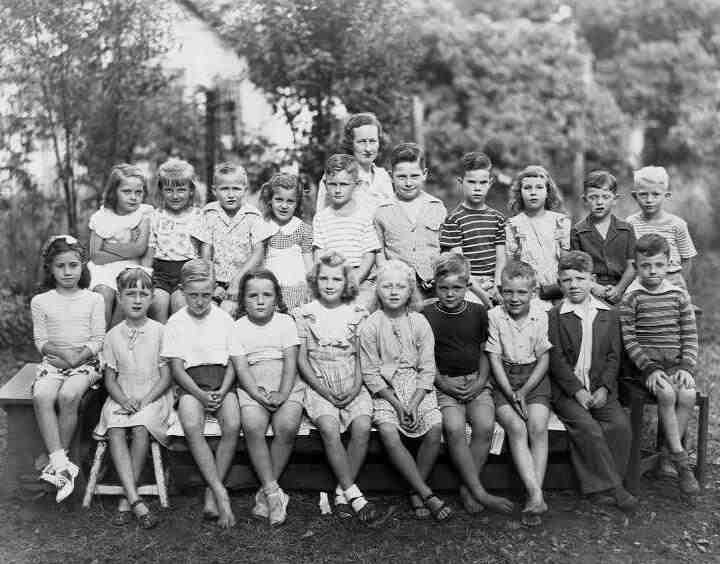
We have found portraits from an elementary (primary) school in Abbeville, South Carolina. We don't have the name of the school yet. Abbeville is not a large city, but there were probably more than one school. The portraits we have found so far are from the 1940s. Many of the younger boys wear short pants and are barefoot. Notice only the boys are barefoot. There are a range of shirts, including t-shirts. One boys wears a suit. I don't know why he is so dressed up. Almost all of the girls wear dresses, but one of the third grade girls is a bit ahead of her times wears pants. Going to school in the 1940s and 50s, I don't recall girls wearing pants. In the photo of 3rd grade class there are some older pupils mixed in wuth the younger children. I am not sure why.
Accident, Maryland is is small town in extreme western Maryland well up into the Appalachin Mountains. While small, they had a substantial white plank school. We have a postcard-back portrait of the school. The children are posing outside with thir teachr in 1913. The teacher holds the new 48-star American Flag. One of the boys holds a chalkboard with the words "Accident School 1913" on it. Unfortuntely the children are streached out meaning that we do not have close ups of their faces and schoolwear. Someone put an x over onehead of a girl in the back row and an "x" on the face of another meaning that they died at an early age. Given the smll size of Accident (about 200 people at the time) the town, many of the children would have come from the rural area around the town. In 1913, most boys wore knickers to school, but in rural areas more boys wore long pants. One tounger boy wears a light-colored button on suiy with a larrge collar. This might be called an Oliver Twist suit. There are 30 childre of all primary ages, probably meaning 8th grade or about 13 years of age. The school looks large enough to have more than one room.
Here we see what looks like a graduating class at the Adams School. Unfortunately we can not read the banner. We are not sure just who Adams was. The second president, John Adams, is the most likely candidate, but we do not know for sure. Unlike the first and second president, Adams who only served one-term did not comannd the sme historical acclain. The school was located in Port Huron, along as might be expected, Michigan's eastern Lake Hurin coast. Michign. We do not know much about the town, but the 19th century economy was based on timber and ship building. The railroad arrived connecting Detroit (1859). a 12-year old Thomad Edison began his career by selling newsppers. We suspect agriculture was more important by the turn of the 20th century. The children were apparently 8th graders (13-14 year olds). Many elementary (primary) schools at the time were 8-year schools. Many children nfed there schooling with finishing these schools. Eventually as junior higgs were established, elementart (primary) schools became 6 year schools. Here we see the girls most promently as they are placed in the first row. A few of the girls wear pinafores. Everyone seems to e weing black long-stockings. All of the boys wear suit jackets except one boy who wears a shirt with suspenders. The photograph was taken in 1899.
This is a portrait of a 1st Grade Class at the Jane Addams School in Dayton, Ohio. The children began 1st grade at age 6 years. The school was named after Jane Addams, an American settlement activist. She co-founded Chicago's Hull House, one of America's most famous settlement houses (1920). She was a notable figure in the history of social work and women's suffrage in the United States and an advocate for world peace. She co-founded the ACLU. In 1931, she became the first American woman to be awarded the Nobel Peace Prize. The teacher was Miss Daniels, The school portait is not dated, but would have been taken in the 1930s, probably the mid-30s. Like schools in the north, the school was integrated. Until the 1910s most, most African Americans lived in the South. Beginning in the 1910s, large numbers began the Great Migration to the indutrial cities of the Mid-West and Northeast. The girls all wear prim dresses. The boys wear a mix of short pants, knickers, and long pants. One boy wears a sailor suit. Two boys wear what looks like overalls.
We note the Agassiz School in Boston, we believe in Cambridge. Our information about the school is somewhat confused. There is no doubt about the man the school is named after--Jean Louis Rodolphe Agassiz (1807-73). Agassiz was a notable Swiss paleontologist, glaciologist, geologist and a major academic theorizing modern concepts of the Earth's natural history. He was the first naturalist to conceive of ice ages and use the term. He was a professor of natural history at the University of Neuch�tel. He emigrated to the Unitrd States to accepted a professorship at Harvard University. Agassiz was a strong critic of Darwin's evolutionary theories. Agassiz was a creationists and in America became a major fifure in what became known as scientific racism. He advocated polygenism. This is the theory that human races had separate origins and were endowed with varrying attributes and capabilities. It is interesting that he was so right about natural history and so wrong about evolution. Because of his respected scientific stature, schools were named after him, although we do not have much details on them. We note references to the Agassiz Grammar School in the late-19th and early-20th century. We believe that it was grammar in the English sence of an academically strong school. We notice reference to the school as being bi-racial having a primary and seconday section anh having a black femal principal, Mary Baldwin, for the primary section. A portrait of the Agassiz School in 1914. We think this may be the Grammar School, but the portrait refers to only the Agassiz School. It shows all white students and only boys. The boys wear knicker suits. In more recent years we notice the Agassiz School Elementary School also in Boston which may have originated as the Grammar School. It wasdescribed as an undeperforming school with a largely black student body. It has since been closed.
The Allan School I believe was a public elementary (primary) school in Pittsburgh, Pennsylvania. A photograph in the library during 1928 shows the older children, probably about 11 or 12 years old. Thet are reading in a clearly staged portrait. The boys all wear white shirts with ties. While this is a staged portrait, we believe this was how the children commonly dressed for school. One boy wears a suit. The boy seem to be wearing knickers, although this is a little difficult to tell. The boys also seem to be wearing dark long stockings. Notice the one boy wearing shoes that come up above his ankles. They look to be sneakers. Many boys at the time had sneakers, but generally wore leather shoes to school.
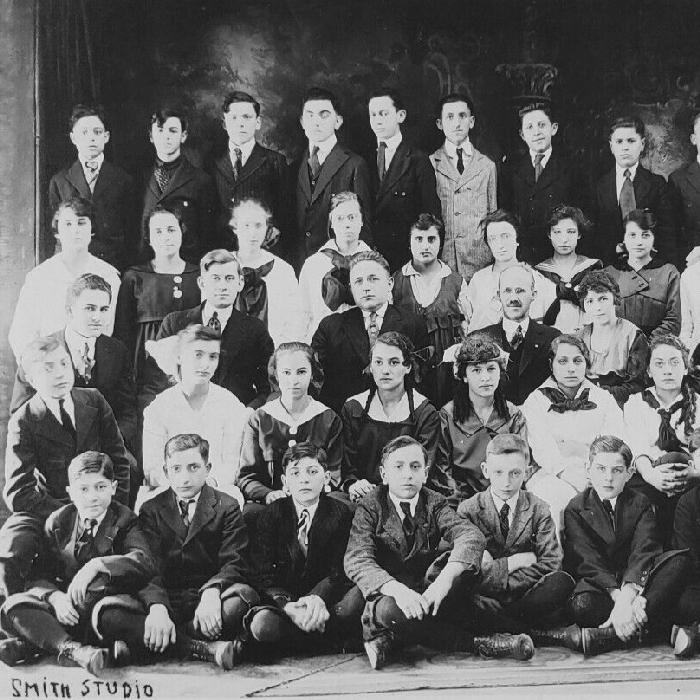
This wondeful portrait looks to us like a school group, but we are not entirely sure. There seem to be a lot of teenagers and very few younger children. We are windering if it could be a small secondary school. It is possible that it could be a sunday school groip, but a school group seems more likely. The portrait is undated, but the clothes and format suggests it was taken About 1900-05. We see one lady or teen student wearing the ballon-sleeve dress style popular un the 1890s, but because she is the only one and the format is the new style cabinet cards, we would date the image to the very early 1900s, but the very late-1890s is certainly possible. The boys all wear long pants which is unusual for the period, perhaps because this was a rural school and the only boys we can see look to be teenagers, albeit younger teens. The few younger boys are in the middle of the portrait and we can not see theer trousers. Several of the girls wear sailor caps, one girl a tam. Notice the young boy with the prickly stick. An almost everyone has Rhododendron twigs or leaves. Not sure what that is all about. The dealer believes the portrait was taken in Alton, West Virginia -- Upshur County. Alton is located on the Buckhannon River with lots ofs Rhododendron in the area.
The Anona Elementary School is located in Largo, Florida, a city near Tampa on the Gulf of Mexico coast. Anona is one of the older public schools in Florida, founded in 1874. The southern states, unlike the northern states did not begin to build a public school system before the Civil War. This only began after the War in the Reconstruction period. Lost Cause historians accused Reconstruction legislatures of being fiscally irresponsible. One of the reasons for higher state spending was the cost of building and maintaining public schools. Here we have a group of Anona 1st graders (6 year old) with a Native American chief in 1964. We are not sure what the ocassion was.
A HBC reader has mentioned the Armenian Sisters Academy. The school is a pre-school amd kindergarden in Randor, Pennsylvania. The school was the inspiration of Msgr. Stephen Stepanian, pastor of St. Mark's Armenian Catholic Church in Philadelphia. Stepanian asked Rome for nuns to staff the school. Sister Valentine, Sister Hripsime and Sister Arousiag arrived in 1963 to start an Armenian day school which the Armenian community had wanted for decaded. The first Armenian say school on the East coast was finally opened with 12 children (1967). The school was important because it provided the vehicle to pass on the Armenian language, history and culture. The Armenian Sisters Academy seeks to preserve the Armenian heritage. The school with the support of the Armenian cimmunity gradually increased to 185 children. The school moved to larger quarters several times before moving into the current facilities at Randor, Pennsylvania (1975). A 2005 photograph shows the children wearing smocks.
Here we see the Bancroft School in Bancroft, Iowa. This is a small town in Kossuth County. It looks like an elementary (primary) school. At the time it was probably a 1st-8th grade school. Those childten who wanted to go on to high school would probably have to go to a larger town. We see the children in front of the school. They seem to be the older children. We do not see many of the younger children you would expect. We count 40 children. hat would mean only 5 children per class grade. The substanbtial school in the back is clearly mde for more than 40 children. The portrait is undated and very difficult to date because we can't tell if the boys are wearing knee pants or knickers, the easiest way to differebtiate the 1900s and 10s.
We would guess the portrait dates to the 1900s because we think the boys are wearing knee pants, but it is not at all clear because they are all sitting down. One child who looks like a boy seems to be wearing a smock, but we think that the child must be a girl with short hair. We think that they would be more common in the 1910s. The boys are all wearing suits. The portrait is a large size cabinet card. The photo is approximately 6.5 x 5 in while the card matt is 7 x 9 inches. This would suggest the 1900s, but the mount color was not the common ones in the 1900s.
This is an cabinet card portrait of a wonderfully well lit primary school classroom. The banner by the door reads 'Bandon School - Step by step'. We believe this is from Bandon, Oregon but we cannot be sure. There are a number of Brandon schools and there is no studio information. The portrait is undated, but the card mount and children's clothes suggest the 1900s, probably the early- or mid-1900s. That may be a portait of President Roosevelt above the chalk board. The boys look to be wearing knee pants suits and the the girls dresses. This would have been a public school, but it seems a prosperous community. All the children have dark long stockings. The children seem to be about 11-12 yeras old. That would be the oldest chiidren in a 6-year elementary school, but in the 1900s there were many 8 year elementary schools. We get a good look at the desks and seat arrangements. This was almost universal at the time, all the desks facing forward toward the teacher's desk. These desks could nit be easily moved as they were connected to the desk behind. We can see the teacher at the back. Lady teachers were more common in America than in most other countries at the time.
This is an albumen cabinet card of the Bank Grammar School. Grammar school is the Americam term for a primary school. Unfortunately we don't know here it was located except for some place in the North. We see 40 school children, photographed outside on the steps of their brick school house. Their lady female school teacher is photographed with them, evrn know her name--Annie D. Price. The class is made up of both boys and girls. Unusually the older boys are placed in front. The boy where suits with both knee pants and long pants. There is a single African American boy in the front row. About half of the children are identified on the back of the photograph in feint pencil, and the other half are unidentified. The photograph is marked "___der Bank Grammer School" (the first few letters of this word are unidentified, because they are broken off along with the corner of the cardboard of the matte) - Furthermore, the photograph is marked 'Annie D. Price, Teacher' and 'about 1890'. This dare to us seems reasonable. The photographer is unidntified. The photograph: 8 1/4" Wide x 5 3/8" high. Cardboard matte: 10" wide x 7 7/8" high.
The Banker School was a small rural school located in Henderson Township located in Wexford County, Michigan. This was the western part of lower Michigan. We see a view of the school in 1897. It is notable for its rough construction. One might have thought by this time that Michigan would have had a little more substantial schools even in rural areas. We 17 children of various ages. Many of the boys wear fancy blouses. The younger boys wear knee pants, but we are not sure about the older boys. All the younger children are barefoot. An interesting aspect of these rural 19th century school portraits is that the boys did not wear overalls. Wexford County was named after a county in Ireland largely because so many Irish immigrants settled there. A narrow gage railroad helped open the area. Lumber was the major resource. Notice the rough board construction of the school.
This photo shows the Barger School in Allardt, Fentress County, Tennessee. The photograph is undated, but the source suggests was taken uin the 19th century. If so it would have been the 1890s. This is cetainly possible, but we are not sure it was not the very early 1900s. Note the contrast between the clothing of younger and older boys. Some of the older boys are dressed up in suits and ties. They seem rther old to be attending a primary school. The younger boys wear knee pants, although some are quite long, and are barefoot. One younger boy wears a blouse with a large collar. The girls wear various styles of print dresses.
Here we have a wonderful image from Bartley, Nebrska. We think the school was probably known as the Bartley School, but we are not positive about this. Schools at this early period were often known by the name of the school. We are a little unsure as to just what kind of schools this was. The older students are virtually all girls and seem to old for primary school. Older boys were often discouraged from attending school because they were needed on the farm. This portrait is especially interesting because some of the children are acting up. In so many portraits like this the children are much less animated. The photograph is not dated, but we would guess was taken about 1909-10. Note that a few boys wear overalls. This was not commion eaelier in the 1900s. Some of the younger girls wore pinafores. Note that quite a few boys wore long pants. This tended to be more common in rural areas than in the cities.
This school portrait show the teacher and her 4th grade class at the Bellevue school in Illinois. This would be children 9-10 years old. The portrait is not dated, but we would guess ws taken in the late-1930s, although the early-40s is possible. Bellevue is a small town in Peoria County, Illinois. It is located in central Illinois, a farming area which is why you see all the overalls. Today Bellevue is a part of the larger Peoria metropolitan area. There is a saying in American politics and culture, "Will it play in Peoria?" This meant that Peoria located in middle America was a good test of American tastes and values. The phrase originated during the vaudeville era of the earl-20th century as big city enteriners could easily travel around the country. It was popularized in movies by none other than Groucho Marx. America has changed a lot since then, but the election of Donal Trump shows that it has not entirely lost its currency. The boys wear a few T-shirts, but mostly collared shirts which the boys all ticked in. As far as we can tell, the boys all wer long pants, quite a few overalls. Ntice how one biy has cuffed his overalls. We suspect that this was a size issue and not fashion. The 1930s was the last decade we commonly see oiveralls. They rapidly disappeared in the early-1940s. The girls all wear prim dresses. The names of the teacher and children are written on the back.
Here we have an elementaryy (primary) school lovated in Middleton, New York--the Benton Avenue School. The photo is dated 1910. This looks like a public, not a private school. We say this in part because some of the boys have holes in their black long stockings. Interestingly, the school is racially integrated. Notice the African American girls sitting second and third from the right and the two older boys at the left in the second row. The school building was built about 1882. Most of the boys wear kneepants or above-the-knee knickers. The variety of dress is interesting. One boy wears a sailor suit, another wears a floppy bow, and still another wears a belted double breasted blouse with large lapels. One boy has a polka-dot blouse. This looks like some of the younger children at the school, perhaps the 2nd graders.
Berwick Academy was founded in 1791, the first school in what was to be the state of Maine. We have a Civil war-era portrait that seems to be one of the pupils, probably in the ealy 1860s. Unfortunately the boy who seems to uniformed and carries a gun is unidentified.
Here we have a view of a West Virginia School. We are not sure that the name of the school is the Berwind School, but it was appararmtly located in Berwind, West Virginia. We have one image taken during 1930-31. It appears to be a town school, but many of the boys wear overalls--more common in rural areas. Perhaps Berwind was a small town. It also may have been a coal mining town. The children of miners like farm families were more likely to wear overalls, especially during the Depression.. Other boys wear both knickers and long pants. We don't note any short pants. The girls wear dresses. Several children are barefoot.
This is a wonderful old cabinet card portrait of the children at the primary school in Blackburn, Missouri. It was probably known as the Blackburn School. There are 49 children of all ages and a man who we assume is the head techer at the far right. It is possible that he was the only teacher, if so he must have had his hands full. The children in the back row are the older students and in the center are two girls who may be twins and who are wearing identical dresses. While the cabinet card is not dated, we believe it was taken in the 1870s because of the clothing and style of the mount. Notice that most of the boys in the front have rounded-crown hats. We think we see a few caps, although it is not real clear. We suspect that the older boys in the back had basically the same headwear. The girls for some reason are not holding their hats. The photographer was G. L. Collier of Blackburn, Missouri.
This is a wonderful example of a rural one-foom school. It even has the classic shape with a bell at the top that the teacher can ring from down below. All we know for sure is that it was School No. 8. But as the photographer was in Waterloo, Iowa, we assume that it was School No.8 in Blackhawk County. There are 11 children who mostly look to be younger children and their teacher is posing with them. The photograph is not dated. Nor do we know when the school was built. Over the door, however, it tells us that it was painted in 1898. It looks like it could use a repainting. The postcard-back AZO stamp box (four triangles up) and children's clothes suggest that the photograph was taken about 1908. (Note here we are using our knowledge of clothing styles and postcards to asess the date, so this page should not be used as a defimitive statement of 1908 styles.) Two of the boys are dressed up for the portrait. Notice the boys' knee pants and theone boy wearing overalls. we see knickers and overalls appearing about the same time--about 1908. The girls wear pinafores. And everyone is wearing long stockings. And over to the right you can see the flat, treeless landscape for which Iowa and the Great Plains are so well known.
Here we see a rural school in Blanton Town, Florida. The school was painted white. We are not sure why in America they always describe the little red schoolhouse. There were about 30 students, evenly divided among boys and girls. The one teacher we see was a man. The boys all wear shirts or blouses with knee pants or knickers. Most are barefoot. The one boy that is mot wears black long stockings with his knickers. The girls all wear dresses and are also barefoot. The photograph is not dated, but we have a fairly good idea when it was taken, we think anout 1915. This is suggested by the boys wearing knickers, but the fact that the younger boys are waring knee pants suggrsts it was not the late-1910s. Kinickers were standard for boys in 1915. Vut we still see younger boys wearung knee pants. We see that in a Sears 1915 younger boys suits . The boys here are in Florida in the pre air conditioning page so they are not wearing suits.
We are not enirely sure where this school was located. We know where Boyd Mountain was located--eastern Tennessee near the Kentucky border. So it is likly that this is where the school was located. There is no town nanmed Boyd Mountain, it was a country school. Interestingly, we have a good dea about whay life was like in this area. This is the general area where Dolly Parton grew up. So we get in her songs abiyr growing up in eastern Tennesse what klife was like for these children. The school building has been described as a one and two room school. Apparently there was more than one school building over time. And a school was located at the site for a considerable time, We note a school portatsit from 1939-40, but it may be just the younger children, although two teachers are with them. Theccholdren look to be about 6-10 years old. Most of these schools had a program going up to 8th grade whch woild mean younger teen agers. Although in rural areas older children might attend. Some of the children had to walk quite a fistance. We notice one accouunt where a pupil had to walk 2.5 miles. So presumably some children had to walk even further. We kmow at some time that the school was separated between younger and older children which is what the two rooms accomodated. The school was heated by a pot-bellied stove and there only outdoor facilities. Water came from a cistern. Note how common overalls still were at the time.
This photo postcard shows the brass marching band from the Boy's Industrial School. Unforttunately we dob't know where the school was located, but we would say the Mid-West. Posed in front of the brick schoolhouse are; the band leader, a young child and 3 rows of teen band members holding their instruments.
The AZO card is undated, but the stamp box indicated it was taken sonetime from 1904-17. We would guess some time in the 1900s. rather than the 10s. It is postally unused but does have writing on the backside. It states: "Another 'smut' exhibition. Wouldn't know me, would you!" I'm not too sure what the boy meant. Nor I am entirely sure what an industrial school was. This may have meant a school that focused on manual arts rather than academics. It may have meant a reform school, I'm not yet sure.
This photograph sows the Brick School in Amherst, New Hampshire during 1913. Brick Schol was the actual name of the school and not a description of the school building. New Hampshire tthe time was largely rural and populated with small towns. There was some limited industry, especially in Manchester, the largest city. Amherst was a small town wuth less than 1,000 inhabitants. Brick School must have been a one-room school, although it is not pictured, because there are only 15 pupils. They look to be about 6-13 years of age, meaning 1st to 8th grade. Normally such a small school would be in the ountry, but in this case was in town because the ywn was so small. The younger children for ome reason are mostly boys and the old children girls. The boys wear caps and hats, several wear peaked caps. Several boys wear blouses, one a fancy Faunleroy blouse. As far as we can tell, all the boys wear knee pants. None of the boys wear overalls which were common in the time in rural areas. The girls wear dresses, pinafores, blouses and skirts. The children who are not barefoot wear black long stockings.
We do no know a lot about the Broadview School. We have a 1896 portrait taken in front of the school. It appears to have been a typical small rural school. It was located in Maury County, Tennessee. The boys wear blouses and knee pants. And in warmer weather they come to school barefoot. Notice none of the boys wear overalls. The girls wear dresses.
We have photograph of the Bryant Station School the 1900s decade. Notice the fabncy Fauntleroy blouses, but inly the younges boys wearing them. Unfortunately the oportrait is not dated. It was surely taken around the turn-of-the 20th century, probably around 1900-05, but we do not think it was taken in the 1890s. One inducator is that two boys wear overalls. That was not very common in the 1900s, except at the end of the decade, but became virtually standard un the 1910s. The school was located at Bryant Station in Maury County, Tennessee near the line with Marshall County. It was a typical one room school. These schools were very common in Tennessee and other rural areas at the turn-of-the 20th century. The teacher was Miss Haynes of Lewisburg. Many of the teachers in these one-room schools were young, unmairred women. The younger boys wear fancy blouses and knee pants. Only one boy wears a large floppy bow. It looks to us as if the portrait was scheduled and the children dressed up for the occassion. A rather defiant younger boy wears a plain white dress. We are not sure why such a young boy was at school. Perhaps he was a brother of one of the older children who tagged along for the day. Anoter possibility us that he is tghe teacher's son. But this iseems less likely because in the 19th century, teachers were expected to resign when they married. Perhaps this was changing.
Here is a photograph of the Buckland School in 1893. Bucklnd was founded in late-colonial times (1742). It was apparently named for the prevalence of game. the population of the town was about 1,500 people. Thus onjlyb asmall school was needed. Our photograsph shows anout 20 children who loook gto be about 6-10 years old. Presumably there was a class for older children of about the same size. We have only a gilmse of the school, a white plank building, prrobably with two classrooms. The children are pictured with their teacher. The girls wear dresses, many with pinafores. There are no hair bows. The boys wear blouses and knee pants. The younger boys we can see are barefoot, suggesting it was late in the school year, probably June. Note that even though some of the children must have come from farms, none of the boys wear overalls. Also interesting is that even though was the height of the Fauntleroy Craze, the bioys do not have elaborate Fauntleroy items. The best dressed biy has a small now. It is the girls that have large lace collars.
The Buena Vista School looks to be a public primary (elementry) school in Colorado Springs, Colorado. We note a class portait from the 1920s which looks to be the 1st or 2nd grade. We see some older styles that were still popular, such as large collars and floppy bows. Some boys wear sailor suit. The girls all wear dresses. Only a few of the girls have hair bows.
This is a rare photograph of 1860s school class. School photography was onlky beginning at the time. It is a 1/2 plate (5.5" x 4.5" cased tin type. Most tintypes were not cased, but in the early-1860s some were because the convention of casing Dags and Ambros was so strong. A tin type meant that only one copy was avaialble. This is why almost all school portraits were albumen prints so copies could be made for the parents who wanted them to send to family and friends. Probably it was made for the teacher. Unlike most cased portrits, there is some information about this portrait. The teachrr is identified in the case as Victoria Cheek. The school was located at Burkesville Kentucky. This portrit had to be taken during or just after the Civil War, as Miss Cheek was married in 1866. Her new name was Rand. The boys wear a variety of suit jackets with long oants. Stangrlu, two children at vthe center look likev boys wearing smocks over askorted hrment. We don't know what to make of that. One of the boys looks very young, the other who may be his brother is several years older.
We are sure about the name of this school, but we believe that it is the Cain School. We know nothing about the school itself at this time, except where it is located. We do do know that it was located in Harrison County Missouri. We have an image from 1902. We can not make out a lot of detail in the photograph. We do not that two of the younger boys are wearing large ruffled collars. We suspect that the children may have dressed up for the portrait.
The Calvert School in Baltimore is probabnly the most famous elementary (primary) school in America. The school was a kindergarten through 8th grade coeducational school located in Baltimore, Maryland. Elementary schools for grades 1-8 were fairly standard t the turn of the 20th century in rural areas. Schools wih grades 1-6 were more standard in cities. The addotionl Kindergarten was a innovation. The school was founded in 1897. The school developed a homeschooling division which has made the curricvulum available to home schoolers around the country. Virgil Hillyer, a Harvard-trained scholar, became the Head Master of the School. He decided to sell the curriculum developed at the school through a Baltimore bookstore. The idea of home school was not as developed as it is now. People at the time had more confidence in the public schools. Many mothers, however, were interested in preparing their children for 1st grade. Kindergartens were just beginning to appear. Thus the Schools Kindergarden curriculum proved very popular. The popularity of the curriulum developed after advertising in the National Geographic magazine. The original cost of the curriulum was $5.00.
|
The James Campbell High School was an impressive building in Philadelphia built (1899). All we know about it was that it was a public school. We have found several images from the 1910s. The building was huge, it seems very large for a school. It looks more like a corporate headqarters. And the images we have suggest a small school, at least some of them. The school may have closed in 1924 or that was the last of the images. We are not sure who James Cambell was. We note a James Campbell High School in Hawaii. He was an Irish immigrant who was a sugar cane industrialist who became the lsgest land owner in Hawaii. We are not sure just who the Philadelia James Campbell was, perhaps the same as the school was built at the same time the United States annexed the islands. The images show the boys wearing knickers suits, at least the youngerr boys at the front. The younger boys would be 9th graders, meaning boys about 14 years old. The girls wear middy blouses and scarves. It all looks rather like uniforms. This was not very common at American High Schools. The images show a range of ages, so we are not sure that they are class groups. Unfortunstely there is no informastion accomopanying the images. One images is dated to 1916 and because all show similar clothing, they all seem to date to the 1910s.
We do not know much about Canton High School. We do have a photograph showing the cast of a production of Shakespeare's "Merchant of Venice" produced by the drama department of the Canton High School in Canton, New York, probably during the mid- or late-1910s.
We have found a cabinet card portrait of the Carbondale School, a small rural school in the early 1900s decade. The board adds Distruct 12, but no further information. The problem we have is that there are several towns named Carbondale in the United States, including Colorado, Illinois, and Pennsylvania as well as other states. The name is usually used for towns in or near coal fields. It is likely there were children from coal mining families in the group. This Carbondale appears to be a very small community because it was a small rural school. This is a problem working with American schools because the United States is such a large country. We see a wide age range, looking like all the age grades from 1st to 8th, the normal 8 grade programs of these schools. The portrait is not dated, but the cabinet card looks date from the early-1900s decasde as do the pupils' clothes. The younger children look like many come from low-income families, although we see some Fauntleroy items, especially the collars. This waswithin the last years of the Fauntleroy Craze. The boys do not wear actual Fauntleroy suits, but was as was common there are Fauntleroy related decortive items. The boys wear knee pants and long stockings.
The Carlisle Indian Industrial School, initially called the Carlisle Indian Training School was a boarding school located at Carlisle, Pennsylvania. It was the best known of the Native American boarding schools established by the Federal Government. It was opened in an abandone Army post--Carlisle Barracks , Peensylvania (1879). The school was founded by Captain Richard Henry Pratt. The Carlisle School was the first off-reservation boarding school in the United States. It was designed to bring Native American children from the hunter-gathering stage into the modern world by forcibly assimilating them. Native American advocates refer to this today as cultural genocide. The School became a model for other schools working with Native American children. Many of the children were forced to attend the schools. Once at the school, their hair was cut and they were issued uniforms. The school has been criticized for taking the children from their parents and strict regime verging on brutality, based on modern standards. Using modern standards, however, is unfair. Any assessment should compare them to contemporary schools. Perhaps the most valid way of assessing the school program is to compare the life success of the graduates to comparable children who stayed on the reservations. We are not sure if such a study has ever been conducted. The children came from 140 tribes. The school had the all the attributes of boarding schools for wealthy children. It was known for its football team. Perhaps its most famous graduate was Olympic athelete Jim Thorpe. The school was closed (1918). The U.S. Army resumed control and converted Carlisle Barracks to use as a hospital to treat wounded soldiers returning from World war I service in France. The Army War College was subsequently opened there. The Carlisle complex was designated a National Historic Landmark (1961).
The Carter School was an public elementary (primary) school. The school was located in the Buena Vista Community of Indian Creek Township, in South Central Indiana (1930). Here we see the 3rd grade class at the Carter School. Most of the boys were knickers with patterned knee socks, but one boy in the center wears beige long stockings with his knickers. Some mothers preferred long stockings to knee socks for their son's knickers because the knee socks tended to fall down whereas the long stockings would stay up neatly if worn with hose supporters. Another boy wears bib overalls.
This class photo was taken in 1954 at Caton's Chapel Elementary School in Sevierville, Tennessee. In mid-1950s most of boys and girls still attend in bare feet. Often it was more common for the boys to go barefoot. This was becoming less common in Americas, but we still see boys mostly in the southern sastes attending barefoot. Also notice that the boys all wear long pants despite the fact that it was a warm day. One boy wears overalls. These look like the younger children in the school, presumably 1st and 2nd graders.
Cenrtville School was a rural primary school. This postcard-back portrait shows the children and parents in front of the school in 1913. It is some kind of special event, apparently a school reunion. And the children are all dressed up to celebrate which is why so many are wearing hats. The poertrait is notavle for a display of the destinctive 1910s hats. It is the last decade in which large numbers of children, especially the boys will be seen wearing hats. Caps were becoming dominant in the 1920s and by the 30s hats for boys were clearly on the decline. Gats were seen as more formal than caos nd by the 1920s no longer commonly seen at school. The school was torn bown in 1921.
Here we see a school yard scene in Central City, Colorado. It looks like quite an old school. We are guessing it is a Catholic school because of the church in the background. We are not, however, sure about that. The children arevnot wearing uniforms and many Catholic schools by the 60s had uniforms. The photograph is a good example of playground activities. The boys seem to be wearing various casual shirts with jeans and slacks. The girls wear dresses. The photograph looks to have been taken in the 1960s, but is not dated.
The boards held by the children in a 1902 portrait clearly identify the 7th grade class of Charles City High School. Unfortunately there are several towns in America named Charles City. We believe this was probably the Iowa Charles City, in part because there continues to be a Charles City High School in the Iowa town. It is sited on the location of a Winnebago Indian village for the identical reasions, the Cedar River as well as nearby timber lands--a rarity in Iowa. For a small town, Charles Town has an impresive history--the birth place of the tractor. This was a new term, a combinatiion of the word traction and power Iowa. Production began about the same time that the portrait was taken. The company continued producing tractors until 1993, a Rust Belt victim as the U.S. Government failed to protect its manufacturers. The school is an impressive stione and brick builsing. The photograph highights the girls in the class, placing them in the front. They wear both dresses and bloyses and sjirts. Three girls wear sailor dresses. Two girl hold impressive hats. For som reason, many of he boys are holding their caps. All of the boys wear different styles of suits with lapel jackets--mostly high set lapels. Many of the boys wear ties. No sailor suits. Only bone boy has large collar. All of he boys we can see wear knee pnts. Both the boys and girls wear long stockings. The 7th grde would mean most of the children were 12 years old. Generally high schools were 9-12th grade. As Charles City was a small town, the school incluyded 7th and 8th graders.
The dealer tells us that this was a photoograph of the school at Charles Mill, presumably it was called the Charles Mill School. It is in Richand Countu, Ohio. It is identified only as the 'Old Central Bldg.' on the back. It was a substantial brick building. The children look like 7th or 8th graders meaning 12-14 years old. Primary schools at the time were commonly schools with programs for 1st to 8th graders. At the time many children did not got on to high school. It is dated 1898. The boy in fromt of the door is Chas. B. Van Wye. The boys nostly wear suits, double breasted jackets with knee pants and black long stockings. Neckwear varied. The girls wear dresses or blouses and skirts. Notice the volunious sleeves. One girl wears a dark pinafore. We do not see any of the white pinafores that were common at some schools. The cgildren looked rather dresses up. Perhaps they did so for the phoyographer.
This is a cabinet card portrait of an orphan, Mr William J Wetheral. He is at the Chester Springs Orphan School, located near West Chester Pennsylvania. Apparently the school was a military school. William is proudly dressed in a sargent's cadet uniform, and looks to be 13, perhaps 14 years old. The uniform is a Civil War-style uniform. It is not dated, but we would guess was taken about 1880. It could have been taken ay time in the 1870s or 80s. Uniform styles did not change like fashion. Notice the white gloves.
This cabinet card portrait shows the graduating class at the Child's School in Philadelphia, Pennsylvania during 1924. The cabinet card looks like an early-20th century portrait, but it is dated so we know it was taken at the end of the school year (June 1924). We have not been able to find any information about the school other than what can be noted in the class portrait. It seems a strange name for a school, after all schools are virtully all for children by definition. We do note some other schools with this name, but not in Phildelphia. We think it is a public school, probably an 8 year elementary (primary) school. So the children would be mostly 13-14 years old. The girls are mostly wearing dreses. We see a few girls wearing what look like middy blouses. We don't see any hair bows, but we do see hair bands. The boys mostly wear suit and ties. Norfolk suits seem popular. Some boys wear cardigan sweaters rather than suit jackets. Most of the boys seem to be wearing knickers and long stockings based on the front row, but some were wearing long pants.
We are not positive, but we believe that the children here are from the Cliff Side School. It appears to be a small school in Elliott County. Te photograph is undated. We would guess that it was taken sometime in the 1930s. The image is notable because it shows how common it was for boys to wear overalls in rural areas. Most but not all of the boys here wear overalls. The photograph also shows that it by the 1930s despite the Depression, coming to school barefoot was becoming much less common. Only one girl here is barefoot.
|
We notice a portrait of the first grade class at the Clovis School in This would mean 6-year olds.Many of the boys wear long pants. That was not very common in the 1920s. I think this was a social-class matter. Clovis is located in the Llano Estacado and eastern New Mexico area bordering on Texas. It is a largely agricultural area. And this is relected in the children clothes Interestingly mazny of the boys wear overalls with the large collars commonly wirn by younger boys at the time. Most of the boys have shoes, Some of the boys wear short pants and long stockings. Stranbgekly, Clovis while a small town is notable for two very different matters. Clovis is near the site where the clovis point projectiles were found. And in sharp contrast the town played a role in the early history of rock music.
Coalinga Union High School was located in Coalinga, a town in California's Central Valley. It was and continues to be the most important agricultural area in California. We have very limited information on the school at this time.
We note an unidentified boys' school in Collegeville, Pennsylvania. We are not sure just what the name of the school was. It looks to be an elementary school. The class wa all boys which may mean that it was a private school. The boys look to be about 10-years of age which means that they were probably a 5th grade class. Presumably the building in the background is their school. It ws a substanyial brick building. We count about 25 boys which was a little small for a state school. The portrait is undated, but we would gues was taken about 1895-1905. The vboys all wear suits, almost entirely bknee pnts suits. As was standard at the time, the boys wore long stockings with knee pants. Most have caps which are quite varied.
This AZO photo postcard portrait shows what looks like 1st graders all decked out in theor best outfits. They attend Columbia School in Cleveland Ohio. The portrait is not dates, but looks like the 1910s to us. The AZO four triangles ip stamp box give us a range of 1904-18. The mix of lace-up and button shoes suggest the late-1900s or early-10s and the knickers suggest the 1910s. So we would guess the portait was taken in the early-10s. The girls wear light-colored dresses with low wausts, looking rather like tunic suits. Many have great hairbows. Most of the boys wear suits. One boy wears a sweater. Other just wear white shirts abd ties. The boys in front wear knickers.
This photo was taken in Columbus, the county seat of Colorado County, Texas. The county was formed in 1837 from a Mexican Municipality. We are not entirely sure about the school's nme. It was located in Columbus, but it may have had a different name. The photo shows a class of elementary school, about 1911. It is a class of younger children, perhaps 2nd graders. The boys wear blouses, a few with bows or ties. One boy has a particularly large collar. All the boys wear knickers. Note that none wear short or long pants. The girls wear dresses, mostly white dresses. Almost all the children wear black long stockings. A few of the boys are barefoot.
Here we see a 3rd grade class at the Copley School. That would mean most of the children ar 8-year olds. It was an American elementary school, meaning a public primary school. We do not know where it was located. We think it may be Ohio, but we are not sure. The photigraph we have was taken in April 1934. It was quite a large class, 49 children. The lady teacher was photographed with them. The boys based on the first row are mostly wearing knickers and knee socks. Several boys wear sweaters. Only two boys wear suits, but several wear neck ties. Only one boy wears a bow tie. As far as we can tell, all the girl wear dresses. We do not see any girls wearing blouses and skirts. The girls mostly have shortish hair. Only one has a hair bow. Some of the girls, but not the boys have bangs.
This photograph was taken at the Cordova School, I think in Cordova, North Carolina. The photograph was probably taken in 1925. The school looks to be a substantial brick building, but therecare only about 30 children in the portrait. I am not positive this is all the childen. Nearly all the boys wear overalls.
This looks like a class grouip as the children at an elementary (primary) school. They look to be about the same age, perhaps 10-11 years. We know the school was located in Cowpens, South Carolina. We are less sure about the actual name of the school. Naming the school after the town was common, but there were oter names, especially if there were more than ond school in the town. Cowpens was a small town and a key Revolutinary battle was fought there. The photograph we have was taken in May 1912. The boys wear knickers without shoes and socks. Going barefoot was quite common in the southern states at the time.
Here we hve a class portrait at the Craley Secondary School in 1908. It was located in Wison, York Pennsylvania. We believe this means York Country in southeasten Pennslyvania, in between the Civil War Antitem and Gettysburg battlefields. We are not sure what Wilson means, presumably a small town, but we cannot find Wilson in York County. We are not sure why it is called a scondary school and not a high school. The postcard back postcard shows a class of younger students, we would guess 14-year olds which would nean 9th graders. There is a board placed in front of the boys, but it does not tell us anything but what is written on the back, the name of the principal, L.D. Hains, and the name of the school. The back tells us that the portrait was taken in November 1908. There are 22 students and their teacher who may be the principal. The boys wear suit jackets, some with overalls which were just beginning to appear in schools. The boys wear knee pants and long stockings. Notice that we do not yet see knickers. The only long pants we see are overalls. This suggests a rural area of the county. The girls wear dresses or blouses and skirts, but not pinafores, Several have hair bows. The footwear is lace-up high tops, an indicator of the 1900s.
We note a first grade class at Crowley School in 1937. We believe this is a school in Crowley, Lousisiana (Acadia Parish). The boys' clothes are quite varied. One boy in the front row is wearing long pants (probably dungarees) and tennis shoes (sneakers), another is wearing bib overalls, and a third (the dressiest of the three) is wearing a white shirt and tie, short trousers, and tan long stockings neatly held in place with hose supporters (he is undoubtedly wearing a garter waist). The girls seem to be bare legged with ankle socks. This photo is a good illustration of the continuing custom of sending younger boys to school in short trousers with long stockings. Notice that the stockings are knitted extra long (as advertised at the time in Sears catalogs) so that the necessary hose supporter fastenings won't show. This can be seen in 1930s catalogs.
The Cypress Creek School was a small primary school in rural Louisiana. It was located in Winn Parish. We note the children gathering around a bookmobile during 1938.
We have not been able to find out much infomatiiomn about Annie Davis or the school. We believe it my be a school named after Annie Davis rather than founded by her. We think Annie Davis may be the Marylamnd slave thar wrote to President Lincoln asking if she as really free. We note a photograph of a class at the Annie Davis School near Tuskegee, Alabama taken about 1902. It appears to be a school asociated assiciated with George Washington Carver's Tuskegee Normal and Industrial Institute. Normal means teacher training. The African-American children are studying studying corn and cotton. Carver is best known for developing techniques to improve soils depleted by repeated plantings of cotton which was the cash crop of the South. He advocated farmers to grow alternative crops, such as peanuts and sweet potatoes which might help restore the soil. The photograph was taken by the important turn-of-the century photograper Frances Benjamin Johnston (1864-1952).
Here we have a cabinet portrait of the Davis Street School in Atlanta, Georgia. Thanks to the bosrd the boy is holding, we know the portrait was a 3rd grade class taken in November 1896. Third graders are chilfren about 8nyears old. And what a class it is. There seem to be about 55 pupils. Of course it could be two classes photographed together, but as there is only one teacher with the children, it must be one big class. This is one example of how poorly schools in the South tended to be poorly funded. Of coure this was particularly true for segregated Black schools, but it was also true for White schools. It is done on one of the large size cards, in this case 9 1/2x 8 inches. We see a lot of the boys wearing Faunleroy styles, both ruffled collars and plainer, but large collars. We notice two boys waring sailor suits. And we notice some of the girls and teachers wearing the baloon-sleeved dresses popular in the 1890s. Several of the girls wear mostly white pinafores.
Deckard Primary School was located in Brown County, Indiana. This is located in the southern part of the state, an essentially rural area. We have a photograph from 1934-35. The teacher standing in the rear is Clotha
Hillenburg. This looks like a typical small one-room rural school. As a result of the Land Ordinance of 1785 every block of public land had one section (number 16) reserved for public schools. This was used to both locate the school and sold to finance the schools. Thus there were large numbers of small rural schools in America until after World War II when they were consolidated. Most of the boys here, who are about look to be about 6-12 years old, wear overalls to school. This was quite common in rural America until after World War II. One boy in the second row on the extreme right wears short trousers with long cotton beige stockings (obviously with supporters), a short-sleeved white shirt, and a somewhat oversized sweater-vest. Long stockings were still woirn in the 1930s, esoecially in th early 30s, but becoming less common. I doubt if the long stockings are being worn for warmth. They are a very lightweight version. Long stockings were just one of the several appropriate options for young schoolboys in the 1930s. The children are standing in front of their smallish rural school building. Overalls were very common school wear in the midst of the Great Depression. Notice that boys greatly outnumber the girls. I am not sure why that was, perhaps just a statistical accident gicen the small number of children.
DeWitt Clinton High School waas was the one of the largest high schools in depression-era America. It had a student body numbering over 10,000 and wasten thousand boys and was located in the Bronx (New York). Rge school produced more than its share of writers and artists, many of whom were published in THE MAGPIE, the school's literary magazine. James Baldwin's earliest published work can be found between its covers, as well
as the works of photographer Richard Avedon, master printmaker Robert Blackburn, screenwriter Sidney (Paddy) Chayefsky, and many others. Articulate and observant, these artists and writers cover life in New York City and social and economic conditions in the United States and abroad, bringing a youthful point of view to a history usually documented by adults. The school has a wonderful website. It includes 175 poems, articles and short stories and 270 graphics and photographs from THE MAGPIE, encompassing the years 1929 to 1941. These resources are organized by date, author and subject. The site also includes a lesson plan and bibliographical and online resources. HBC does not yet have information on schoolwaer but believes in the 1920s that the younger boys commony wore knickers.
The Dexter School was located in Kentucky's Calloway County. The image we have found was taken in Fall 1897 meaning the beginning of the school year. It looks to be a rural school, but not a real small one. The children were photographed in fron of their school building. We assume it was a primary school. The image is notable for the age of some of the boys still attending primary school.
Here we have a a school in Downers Grove. Illinois. Downers Grove is a Chicago suburb. It was a red brick school, but we are unsure just how lsrge it was. You can see the building in the background of a 1892 photograph. It may have been called the Downers Grove School. We are not sure about this. It surely must be a state elmentary (primary school). It was an integrated school. There are two black children. It clearly is not a single class. The children look different ages, but there are few younger children so this must not have been all the children at the school. The children pictured here look moistly abouut 10-13 years old. There was a man and lady teacher. The girls wear dresses and pinafores. The boys mostly wear suits with knee pants. We only see one boy wearing long pants, although we are not sure about the boys in the back. One younger boy wears a blouse with a large collar and floppy bow.
This is the High School in Dunbar Nebraska, we assume thast the chool was called Dunbar High School.
The inscription on the back reads, "Harry's picture when he was in 9th grade at Dunbar, Nebraska. The 9th grade students would be mostly 14-15 years old. This is all High School. November 1924-1925 term." Most of the boys are wearing suits and ties. And most of the boys in the front row are wearing knicker suits with long stockings. The girls are all wearing dresses. At the time, nost students did not go to high school. So the students here would be from the mkore affluent families in town.
Here we see the East Shannon School. The children are standing in front of their school, It looks to be a smll one or two room school. Many of these schools we have noted are painted white, yet Americans generally refer to the little red school house. The photograph is undated, but we would guess the late 1920s. Almost all of the boys wear overals. Most of the children are barefoot.
The East View School was located in Grayson Country Kentucky. It looks a typical rural school at the time. An school portrait taken in 1911 shows the boys mostly wearing overalls or kneepants. Several boys wearblouses with wide collars. The girls all wear dresses. Several have pigtails and hairbows. All of the children appear to be barefott, although the older children in the back row presumably are wearing shoes.
We have one school portrait taken at the East Waterford school in Waterford, Illinois. The school portrait was taken in 1897. There are 24 children and one male teacher who seems to wearing a long frock coat. They are standing in front of the school which looks to be a white plank building. The girls wear dresses, some with pinafors which are difficult to make out. Most of the pinafores are dark, but we are unsure just what color. The younger boys wear blouses and knee pants. Notice some of the large collars. Several boys wear overalls, which is rather unusual in the 1890s. We are unsure why we see so many boys wearing overalls here, but not in many other school portrais from the 1890s. Some of the older boys also wear overalls. They seem to be wearing shorts, but we can not tell if they are wearing knee pants or long pants. Most of the younger children, boys and girls, are barefoot without shoes and stockings. This was common at the time, but seems particularly pronounced here.
Teachers in the 19th century were mostly men, except for dame schools. As public education expanded, school districts sought to save money by hiring young, umarried women who were willing to work for less money than men. One they go married, hiwever, they had to resign. It was expected that married women should devote their attention to theor husbanfs, home keeping, and children. Here we have a snapshot of a teacher's class at the El Monte which she took after resigining in 1903. We see the boys wearing blouse, sailor suits, suits, and overalls. Many re barefoot. The girls weair dresses and hair bows. White dresses seem ppilar. Unlike the boys they wear long stockings and shoes.
Here is the Emmerich Manual Technical High School Football Team, Indianapolis, Indiana, in 1905. The uniforms are quite different from modern football uniforms. Notice that there is no padding at all. The boys wear light-colored shorts (maybe white), and black sleeveless jerseys with the highschool initials on the chest, almost like basketball uniforms. Their coach stands in the back row wearing a white shirt, tie, and suit. Their captain is at the right wearing a long-sleeved black and white striped jersey. Black and white seem to be the school colors. Interestingly, for 1905, the team is racially integrated. There is one black boy on the team (back row, left). Manual Training schools were high schools that taught boys various trade skills (metal work, carpentry, machine shop work, industrial skills), preparing them, usually, for jobs in industry. These boys were not academically inclined and were not being prepared for college. They tended to be for boys only.
There is also an English High School in Lynn, Mass. It was founded later than its Boston namesake. It was founded in 1887, and moved to its present site (1931). This is an amusing story that the foundations of the building were poured on to glass patent medicine bottles from Lydia Pinkham's factory (Lily the Pink). A reader writes, "The Pinkhams were a local dynasty in Lynn. I went to 6th Grade with her grand-daughter Patricia. She lived just across the road from my family. I walked to school. She was taken by chauffeur driven, white-walled tyred Cadillac. I never got a lift!"
Boston's English High School is the oldest public high school in the United States. We are not sure why it was named the English High School, probably because it set up with English standards. Many Americans would have been attracted by high standards, even ghough Boston had been a hot-bed of sedetion in the Revolutionary War. The School was founded in Jamaica Plain (1821). Cadet training was introduced in public schools began during the Civil War (1863). Apparently there was a concern that Southern boys would somehow come north and make trouble. There was a desire to have a group of northern boys trained and ready to deal with them. It now a truly unique, urban school serving a diverse population of over 1,200 students, including children from several foreign countries. The School admitted its first female students (1972).
Here we see a great one-room rural school, the Eureka School, near Canton, Illinois. At lkeast we think it is a one-room school because of the small number of childern. The children are, however, quite young. Perhaps there was an older group as well. The photograph that we have features Mrs. Cluts, an experienced looking teacher, and her brood of young learners taken from a Canton, Illinois photo album. The cildren are ll very serious, not a smile in the group. You can tell it is a a rural school as the boys all wear overlls. Every time I look at the photo I see something new. The one boy in overalls biting his lower lip. The girl in front a little shy to be the only one barefoot. One girl wears what we might have called a tunic suit with matching short pants, rather unusual for a girl.
Schools in the United States are the responsibility of state and local government. There are a few exceoptions such as on Native American reservations and military posts, especially posts overseas for dependants. The Farm Security Administration was a New Deal Agency and during the Depression seems to have set up schools at some of its community projects. We have some information on the FSA, but not much on its schools yet. Here we have a photograph from the FSA school in Weslaco, Texas.
Here we see a group from Farmington, New Hampshire visiting Washington, D.C. We have the town, but are unsure about the name of the school, perhapsthe Farmingtom school. The portrait is a cabinet card. We re not sure just what the group here is. Farmington was a small town with a few thousand residents. We doubt if they had a highschool. There may have been more than one elementary school, meaning schools with classes from 1st through the 8th grade. This was normal for small towns without high school or rural schools. The children here may be a graduating class of th 8th graders. There are, however, many adults wuth them which seems unusual for a class trip. The children only slightly out number the adults. They certainly were a well chaperoned group. Also the children seem very well dressed. The boys wear mostly flat caps, but we see a few dress peaked caps (what the British call school caps) with more rounded crowns. They all wearsuits, nostly with dounle-breasted jackets. All that we can see wear knickers with black long stockings and high-top shoes. The girls wear elaborate wide-brimed hats with hairbows. Normally girls had to choose between the two, but here hey have move the hairbows down to the noe of their necks. They all wear dresses, bur cibere by jackets and overcoats. Like the boys they wear black long stockings and hifgh top shoes. The portrait is undated. The dealer suggests 1919. It cerainly was taken in the 1910s, we might have guessed a little earlier earlier in the decade.
We know that this cabinet card portrait was taken of a group at the Farmington School in 1926.. We think iy my be the Farmington School in Connecyicut, but we are not sure. It is preumably a class group, but a rather small class, only 20 children. It is a mounted gelatin silver nitarte print 8.75� x 7.25�. The class is mostly boys. Two girls in the front hold part of a card tht says "Fifth c � 1926". Some of the children have very comical expressions and amusing features as often they will do in school photos without someone there to help keep things in order. Note the protruding ears on the boy in the front row far left white shirt, and the wild hairdo on the boy in the second row third from the right in the dark button up plaid shirt. On the Verso is written: "Farmington, Harold Bensteelis Picture". The boys all wear knickers and long stockings. The boys are vriously dressed. One boy is very neatly dressed ina suit. Many boys just ear shirts.
The Foreign Mission School at Cornwall, Connecticut is one of the most remarkable schools in American educational history. It was a product of the China Trade. America was a still small largely agrarian country. Even so, New England became a center for maritime commerce and after the British, the largest participant in both the China Trade and the whaling industry. The Yankee Clippers would compete with the British like no other country's shipping. As part of the emensely profitable China Trade, American ships took on sailors from all over the Pacific. It was thus inevitable that some of the sailors would not only show up in New England when the ships returned, but decide that they needed an education. This explains why Henry Obookiah attemted to enter an astonished Yale College (1809). The astonished Yale administrators turnd him down, but the American Board of Commissioners for Foreign Missions a decade later decided that Obookiah had the right idea and opened the Foreign Mission School (1817). The skeptical locals christened it the Heathen School. The School soon was teaching studens from China, Hawaii, India, Malaya, and Timor as well as a German Jew. While at first the School taught Pacific Islanders, soon Cherokees from the southeast showed up (early-1820s). Two, John Ridge and Elias Boudinot became leaders of the Treaty Faction. Their time in Cornwall led to the demise of the School. They wed local women and married them. The locals were concerned about the School from the start, but mixed-race marriges was more than they could tolerate. And the experience of the students when they returned to their own societies was often even worse. [Demos]
The Frankewing School was located in Giles County, Tennessee. It was a small rural primary school. We see boys in 1951 wearing both stripped and collared shirts. We see jeans, overalls, and slacks. Afew younger boys wear short pants. We note boys wearing Keds and going barefoot. Going barefoot was no longer very common at American schools, but we see it at a few rural southern schools. Tennessee schools were still segregated in 1951 so the children are all white.
This is the school located in Fulton, Ohio. The photograph was taken in 1917. The girls all wear dresses, but without pinafores. White or light-colored dresses were popular. Most of the dresses seem very plain. There are several hair bows. The boys wear mostly blouses without bows along with knee pants and knickers, although most of the boys are in the back rows where it is difficult to see what they are wearing. One boy wears a heavy roll-collar sweater. None of the boys are wearing overalls. All the children seem to be wearing long-black stockings.
This photo shows 5th and 6th grades at Gallatin Elementary School, in Downey, California. It looks klike a substabtil school. We are not sure why they are being photographed together. There are two teachers suggesting two separarte classes. There are over 30 children which would seem about the size of a single class. The photo was taken in 1948. The clothing the children are wearing look like populat 1950s styles. Notice the cowboy shirt, T-shirts, and jeans. The girls all wear dresses well-below the knees. Many of the children are still barefoot. This was something thatwas becoming less common in Amercan schools after World War II. Downey is located southeast of Los Angeles and was a largely rural area until after World War II as Los Angeles continued to grow. Farmers raised grain, corn, castor beans and fruit, and by 1930s orange groves were increasingly important. When this photograph was taken Downey was in the process of changing from a rural to suburban community. Sueburban home trcts and factiries were replaing farms and orange grives. The town was incorporated (1956). The largest employer as aesult of the War and subsequebt Cold War. The largest employer was what became known as Vultee Aircraft (which became North American Aviation/North American Rockwell/Rockwell International). The company was eventually bought by Boeing. The Downey facilities were the birthplace of the systems for the Apollo space program as well as the Space Shuttle.
The Garrison School is a rural school located in Williamson County, Tennessee. This is a rural county located in the central part of the state. The population were mostly farmers raising corn, wheat, cotton, and livestock. Tennessee was a slave state which joined the Confederacy. Three Civil war battles were fouhht in the county. The only important manufacturer was the Dortch Stove works in Franklin, the county seat. It became better known as the Magic Chef factory, producing electric and gas ranges. The county has changed in recent years, especuially had nearby Nashville has grown into a major urban center. The senic Natchez Trace Parkway passess through the county. The Garrison School was a fairly standard rural frame school. It looks to be more than a one room. We see about 30-40 children attending the school. We see photographs from different years
All we know about the class here is that the name of the school was the Gardenia Public School and that it was located in Colorado. Perhaps it was a town called Gardenia. Unfortunately we know nothing about the school or community. The portrait we have is undated, but base con the children's clothing was probably taken about 1920. The class portrait is notable because it looks to include both Native American and Japanese children. I'm not sure at this time what Colorado policies were concerning children of other races, but the school here looks well integrated.
May Day festivals often occur in parks or schools. May Day celebrations were not all My polls. We note a California school that had a Chinese or perhaps international theme. This photo shows children from Garvanza School located in Highland Park. This was a neighborhood elementary (primary) school. It still exists today. Highland Park was a neighborhood of Los Angeles, California. The children are celebrating May Day in Elysian Park. They are dressed in Chinese costume. Four boys are carrying a girl. I think there were other national groups. We seem to see Native Americans at the right. And the children in white are presumably the Maypole dancers. The photo is undated, but looking at the boy in the background we could assume that it was taken in 1920s.
This photograph was undated, but we believe was taken in 1889. It was taken at Geneva College, a Phrespetryian school north of Pittsburgh. The boys were mostly children of the teaching staff. The younger boys wear knee pants, single breasted suits, and long black stockings.
Gilman was an exclusive New York private school. Economies were required in the 1930s because of the Depression. The ethos of educating gentlemen had to be adjusted. Waiters and whine linnen table cloths at lunch disappeared. The uniform also changed. A former student writes, "Parents chipped in with their own economies. The custom-tailored suit from DePinna gave way to ready-made slacks and a jacket from Hutzler's. Vests disappeared completely. So did knickers. Boys now went straight from short pants to long trousers, no stop in between." The school played an important role in developing the Hyde Bay Camp.
The Girard Academy was located in Erie Pennsylvania. We know very little about the school. As its name is "academy" it would have been a private school. It appears to have been associated with the Girard Alliance Church. Here we have a photo taken about 1891. The photo was taken at the back of the school. It seems a substantial building. Notice the wooden door and shutters. While public schools were coeducational, private schools were often single gender. The Girard Academy, however, was coeducational. The children seem quite well dressed. Notice the barefoot boy in the front row.
Glenn School seems to be a small one room country school. We notice a photo taken at Glenn School during the school year 1928-29, probanly in May or June 1929. The boys would not have gone barefoot in cold weather. This was just before the Great Depression. The boys wear either knickers or overalls which were common in rural schools. Boys commonly wore long stockings with knickers, but in warm weaher went bsarefooty. The youngest boy wears a button-on sailor suit. The girls wear dresses and seem less likely to come to school basrefoot. They wear knee siks asnd long stockings. Glenn School was located in Butler County, Pennsylvania. There were 16 students and they are pictured wth their young teacher.
This is another Glenn School, an American elemntary school. We can see a substantial brick school in the background. Perhaps some one will recognize it. So it is not the Pennsylvania Glen School we have already loaded. The photograph we have is undated, but the 1st grade and the name of the school is on a placard. First graders would be 6-year olds. The class has bnoth boys and girls, but almost all of the boys are at the back. Quite a few are wearing neckties are now ties. This suggests the 1920s or early-30s. One boy is in front and wears longish short pants with tan long stockings. We have much more in the way of girls' clothing. We see all kinds of different dresses little girls wear. Interesting we do not see any with ballopn sleeves, although many have short sleeves. They are mostly A-line dresses without defined waists. Several have large collars. The hemlines are about the same, above the knee. Notice how most of the girls are wearing striped or pattererned knee socks rather than long stockings, This and the low-cut skoes suggest the 1930s. Thus we would guess the portrait was taken around 1930. Notice how one mother was concerned about the hem lengths and the girl has bloomers rather like above-the-knee knickers. Also interesting is how many of the girls have the same bangs hair cut.
A portrait from the 1920s show a class from Globe, Arizona. Globe was a mining town. We are not sure about the name of the school. It was pfobably the Globe School, but we know it was located in Globe. It was an elementary (primary) school. The boys wear overalls and knickers with knee socks and long stockings. One boy wears short pants and knee socks. The boys are not wearing their caps, except for one boy who wears a bennie. The girls all wear dresses.
We see the the children at the Good Shepherd Lutheran School, a private school in Columbia, Missouri. The Catholics operate the largest non-public school system in the United States, bu many other religious groups , like the Lutherans, also operate schools. The school has a "pioneer school day". To make their experience of the life of pioneer-age school children as authentic as possible, the girls wear long dressed and sunbonnets. The boys wear less accurate shirts and jeans. All the children attend classes barefoot. They also use slates and chalk.
The photo was taken at Gordon Elementary School, in Wilkinson County, Georgia, a rural county. It was taken during the school year 1957-58. It shows a 5th grade class. The boys wear colored long-sleeve collared shirts. Jeans seem very popular for the boys. Notice the well-worn knees. The girls wear dresses and skirts. Notice how full the skirts were. The girls called them 'poddle skirts'. At least three boys are barefoot. It is not clear if they went to school barefoot or took off shoes at school. It looks like they have shoes under their desks. I have not seen that before. Apparently it was still normal to go barefoot for boys aged 11-12 years. If they had shoes with them, they didn't put them on for the class photo. The girls are all wearing their shoes. We are not sure why the boys are barefoot, but it would not have been poverty. We suspect the boys were more comfortable going barefoot.
Gorton is perhaps the most famous school in America. Endicott Peabody founded the school in 1884 and was its legebndary headmaster. The school was pased on the English public (Exclusive private) school. Although called a prep school in America, it is comparable to an English public school. Peabody relentlessly preached high moral standards and the duty of the wealthy for public service. The school was unde Peabody academically rigorous. Like many English public schools in stressed sports. It was like English public schools a severe schools in many ways. Boys endured "boot boxing" (cramed into his boot locker and turned over and over and "pumping" literaly being nearly drowned under a spicket. Boys who were used to warm baths and being coddled by nannies and govenesses arrived to find themselves living in Spartan dormitories and beginning the day with communal cold showers. Future presidents Theodore Roosevelt, Franklin Roosevelt, and Jack Kennedy attended Gorton as well as an extrodinary numbe of individuals who rose to important positions in virtually every important aspect of American life, except perhaps the arts.
The Grafton school is a public elementary school in Grafton Massaschusetts, a northeastern state. As with other public schools, there are no school uniforms. We have no information about the school, but we do have photographs taken over many years which provide a wonderful record of changing American boys' fashions over time. One notice about cahnge over time is how American boys used to dress up to go to school, but gradually began wearing casual clothes.
This photo shows the pupils and the teacher in front of a rural schoolhouse in Greene County, Ohio. There would have been several schools like this one in the county. We do not know if the school had aame or mumber. Often schools like this were named after aocal community or landmark. It was probably built on land designated for schools when the Federal governmrnt sold public lands. The photograph is undated. We think it was taken in the 1900s because the boys look to be wearing knee pants rather than knickers. The overalls some of the boys wear suggest the later part of the decade. Baseball seems popular. Country boys often had trouble getting enough friends together to play baseball. School recess provided a rare opportunity. This and the fact that the trees are just coming out suggests the Spring. Notice that some of the boys are already barefoot.
This potrtrait of the Green River school. The school was located near Guilfird, Veremont. The portrait comes from a photograph albumn. The older children have therir names written on tyhe portrait, but asre not eay to resd. We are not sure what kind of portrait it was, perhaps a postcard. It is clearly a small, one-room school, given the wide age range of the 14 children. We would guess that children are about 5-14 years old. The little girl may be a 5-year old. School began for most cildren at age 6, but some of the rural schools may have allowed younger children to attend. The portrait is undated, but is easy to date. Given it is not a cabinet card means that it was taken after the turn-of-the 20th century. We do not see any Fauntleroy items or larege floppy bows. Note that none of the children are wearing knickers, meaning that the photograph was taken before 1910. This means that that the portrait was probably taken about 1905. The barefoot children are interesting. Going barefoot was common in the 19h century, but for some reason we see more of in both school and family portraits which we do not fully understasnd. The youinger boys arecweating blouses and knee pants. The varied headwear is also interesting. By the 1910s, flat caps were vurtuallyb universal.
This is the Grant School in Fort Morgan. The first Ft. Morgan that came to mind was the venerable Ft. Morgan on Mobile Bay that played a role in the Civil War battle. This of course would have been a strange name for a school deep in the heart of Dixie. So it turns out that there is a Fort Morgan in Colorado and this is where the Grant School was located. The Hine phorograph shows 34 children present at the Grant School, 5 weeks after the school was opened. We do not have the complete story. In the back we see a brick building. As this was a school for migrant children, we doubt such a school was built for them as it would not be needed year round. Perhaps an unused building was repurposed. This was apparently at the beginning of the beet season. The school was expecting 300 children. Notice only the younger children are prsnt. Older children are probably working in the fields. The HiHine caption reads, "They will overflow, this year, into a special school being prepared for them." We are not sure what that meant, suggesting the school in the background is a temporary facility. Hine continues, "Mrs. Bell, the Principal here has taught these beet children for years and has watched the effect of the work. She vigorously denounces it." Mrs. Bell seems to be referring to migrant labor. The photograph was dated Otober 26, 1915. The beets were probably sugar beets. This was during World War I, America had not yet entered the War, but orders for both industrial and agricultural products flowed in from Europe. And America had launched a relief effort to feed the Belgians and other countries adversly affected by the War.
We know that this is the Grantville School, a public elementary school in 1929 because it is written on the back. Grantville is a small town northeast of Topeka. Given all the overalls, the children are mostly farm children. Given the substantial building in the background, it suprises us that so many of the boys wear overalls. We usually inly see that at small rural schools. Grantville is a very small town, so mist of the children must have lived on farms. Notice that this was a fully integrated school. We see both black and native American children.
This is interedting because the court case that led to the Suprecour Desegregation Decision, id usually cited as Brown vs Topeka. attually three Southern sStates (Virginia, South Carolina, and Delaware) and the District of Columbia were involved, all of which had fully segregated school systems. Kansas was different. Kansas did not mandate segregation by law, butb permitted segregation school districts to segregate. The Kansas City high schools were segregated as were elementary schools. This largely depebdended in the size of the community. Elemnentary schools in larger towns and cities, such as Topeka, weresegregated. In smaller towns like Grantville, they were integrated. This is a photo in a paper frame which is how studios commonly handeled portarits after the decline of the cabinet card.
The Greenbriar School was located in Grayson Country Kentucky. The children look a little more prosperous than the East View School which was also located in Grayson County. The Greenbriar School also looks to be a rural school. Here we have the children photographed outside their school. Many of the boys wear overalls and are barefoot like the East View Schoo, but we see several smartly dressed younger boys, some wearing tunic suits with long stockings and shoes. All the younger children at the East View School were barefoot. The older boys are variously dressed. One boy wears overalls, but the boy next to him looks to be wearing a suit.
Here we have a photograph of the Grindstone School in Calloway County Kentucky. The photograph was undated, but looks like the early 1920s. The boys almost all wear overalls, except one boy wearing kneepants with suspenders. Overalls in the 1920s were almost universal in these rural primary schools. The photograph is a little unusual as the school has a large front porch looking more like a house than a school.
Grizzly Bluff School was an historic school in the farm fields outside Ferndale, California. We note an unidentified boy walking to school with what looks like a George Washington lunchbox. The photo is undated, but was taken about 1915. The boy wears overalls which were very common in rural schools at the time.
Denos, John. The Heathen School: A Stoty of Hope and Betrayal in the Age of the Early Republic (2014), 352p.

Related Chronolgy Pages in the Boys' Historical Web Site
[Main Chronology Page]
[The 1900s]
[The 1910s]
[The 1920s]
[The 1930s]
[The 1940s]
[The 1950s]
[The 1960s]
[The 1970s]
[The 1980s]
[The 1990s]
[The 2000s]
Navigate the Relate Boys Historical Clothing Style Pages
[Main country page]
[Long pants suits]
[Short pants suits]
[Lederhosen]
[Knee socks]
[Eton suits]
[Jacket and trousers]
[Blazer
[School sandals]
Navigate the Boys' Historical Clothing School Uniform Pages
[Main U.S. individual alphabetical school page]
[Main national school uniform page]
[Australia]
[England]
[France]
[Germany]
[Ireland]
[Italy]
[Japan]
[New Zealand]
[Poland]
[Singapore]
[Scotland]
[Singapore]
Navigate the HBC School Section:
[Activities]
[Chronology]
[Clothing styles]
[Countries]
[Debate]
[Economics]
[Garment]
[Gender]
[Hair]
[History]
[Home trends]
[Literary characters]
[School types]
[Significance]
[Transport and travel
[Uniform regulations]
[Year level]
[Other topics]
[Images]
[Links]
[Registration]
[Tools]
[Return to the Historic Boys' School Home]