***
school uniform schoolwear : United States -- individual schools H-L
U.S. School Clothes: Individual Schools (H-L)
A good idea of fashion trends in America, as children at public schools did not wear uniforms, can be assessed by looking at what the children were wearing to school. Unfortunately many of the available images are not identified or are not dated, despite this, the images are very valuable views of children's fashion trends.
Here is a list of schools alphabetized by school name. Unfortunately for many images we have collected, we do not know the name of the school. We will add images of schools which are identified by name as well as schools about which we have obtained information. Readers are invited to contribute here information and images about their schools and school experiences. We certaonly hope if readers find their school listed here that they will provide us some information on it.
H
Hackensack High School (New York)
Most American secondary schools, and even some primary schools, beginning in the 1950s have have prohbited the boys from wearing short trousers. While shorts were not common in secondary schools, knickers were through the 1930s--at least for the younger boys. By the 1980s many boys during the summer wanted to wear shorts. This was becoming common in California, but not on the East coast. The students at Hackensack High School during June 1986 protested the dress code enacted by the Hackensack Board of Education which prohibited the wearing of shorts. The protest was very well organined. The news media was alerted to the protest. Over 400 boys wore skirts to school and all major NYC television stations sent their trucks and reporters. The Board of Education in response saw the light very promptly; met with the students, and revised the dress code.
Here is an elementary (primary) school in Haddam, Kansas. We assume that the name of the school is the Haddam Elementary School, although we are not possitive. We have a photograph of the school band during the 1940s. The school had a rather elaborate band for an elementary school. Most high schools had school bands, but it was less common for elementary schools.
This school portrait shows the graduating class at Hancock School in June 1932. The school was located in Philadelphia Pennsylvania. We have no detailed information about the school, but it looks like an elementary (primary) school that had an 8 year program. The children look to be 12-13 years of age. Many American schools were strutured this way instead of having separate junior high schools. About half of the lass is African Americans. This is the result of the great migration which began wih World War and rising violence against African Americans in the South. This was part of a major shidt among African americans from a rural southern population to an urban northrn population. The people involved were seeking security and job opportunity, but a major change was increased access to education. They came as family units and the breakdown in African American family units would come later after World War II. About half of the boys ear knickers and the other half long pants.
This is an interesting photo from the Harriet School, Minneapolis, Minnesota, taken in 1920. It shows school children (about 4th or 5th grade) depositing money in their school bank accounts. The idea was to promote the virtue of thrift among school children and to teach them greater maturity in the handling of their money. These were probably savings accounts into which the children were depositing some of their weekly allowances. I'm not sure whether
a commercial bank was involved here and extending their services through a school program, but I suspect this was the case. It is hard to imagine a public school getting into the banking business on its own. These kinds of activities were generally discontinued in the 1960s. The boys wear knicker suits. Corduroy seems popular. One of the girls wears a sailor dress. All of the children wear long stockings.
The Harris Middle School was located in San Antonio, Texas. Middle schools meant different age groups from state to state. They were similat, but not identical to junior highs. We are not sure aboutthe age group here, but would guess about age 12. The portrait may have been taken in the 1931-32 school year, although wecan not be positive. Texas at the time had segregated schools with blacks and whites in different schools. I think in some school districts Hispanic childen wee segregated, but I am not sure about this. The expense of operating separate school systems probably limited this. Noyce boys wearing overalls, long pants, amd knickers. The boy in the front wear kickers with ankle socks. This began to be more common as knicker declined in poplsrity during the late 1930s. Fewer boys had knee socks. A factor here is that San Antonia is located in the south and it can be quite warm.
<<
The Haverford School is a private, non-sectarian, all-boys college preparatory day school. The school was founded as The Haverford College Grammar School (1844). It is located in Haverford, Pennsylvania northwest of Philadelphia. It moved to current location (1903). The school changed its name to Haverford College Preparatory School for Boys. It is now known as the Haverford School because it has expanded and offers an educational program for boys of all ages. The upper school is what Americans call a preparatory school, meaning a private school for secondary-age boys, preparing them for college. The school is run like a British school with houses and an emphasis on athletics. In Britain the upper school would be called a public school and the lower school a preparatopry school. We have a portrait from the Phillips Studio in Philadelphia showing the senior class in 1955. The boys all wear grey suits and are pictured in front of the ivy covered school building. The school is still in operation today. The Haverford School today is a non-sectarian college preparatory day school, Junior Kindergarten through grade 12, which educates qualified boys of differing backgrounds. The school tells us, "We provide a superior liberal arts education in a challenging and supportive environment that emphasizes scholarship, leadership, citizenship, and high standards of character and conduct. At The Haverford School, we strive to prepare each student for life by developing his full intellectual, moral, social, artistic, athletic and creative potential."
Hampton Institute is today Hampton University, a private historically black research university in Hampton, Virginia. It was founded by black and white leaders of the American Missionary Association after the American Civil War (1868). The goal was to provide education to the new freedmen. It now maintains the Hampton University Museum, which is the oldest museum of the African diaspora in the United States and the oldest museum in Virginia. It was founded as a normal school, to train black teachers for the new public schools being established in Virginia. As it bhad beennillegal to educated blacks before the Civil War, there was a great need to tarin black teachers. Former Union brevet Brigadier General Samuel C. Armstrong (1839–1893) was the first principal. The new school was built on a former plantation named 'Little Scotland' with a panormaic view of Hampton Roads which played an imprtant role in early American history. The body of water known as Hampton Roads is one of the world's largest natural harbors. During the American Civil War (1861–65), the historic Battle of Hampton Roads between the first American ironclad warships, the USS Monitor and the CSS Virginia (Merimack) took place off Sewell's Point in (1862). Federal forces later took control of Hampton Roads, Norfolk, and the lower James River. Some escaped slaves had been camped near Fort Monroe. Their owners demand them back. The Federal commander vrefused, declaring them to be contraband of war. The original school buildings fronted the Hampton River. The school was egally chartered as a land grant school (1870). It first known as Hampton Normal and Agricultural Institute. By the tirn of the century it had become a college, but maintained a schools for youunger children as part of the teacher training program. We have aphotograph taken about 1900 with children doing their exercizes.
Here we have an elementary (primary school). We know the name was the Havelock School, but we do not yet know where it was located. This is a unique enough name yhat hopefully we will be able to locate the school. The way the children are dressed, we suspect it was a small town in a rural area because several of the children are wearing bib-overalls. We believe this swould be the most common in the South. The school is a very substantial brick building which suggests to us that it was in a town. It looks to be a fairly modern school, perhaps built in the 1940s.
This school was the Hearst Grammar school. We are not sure where it was located, but New York seems a possibility. The portrait is the 7th grade B class. Grammar school in America meant primary school. (They were also called elementary or grade schools. Most wre six grades, but a few had 7th and 8th grade as well. Many of these children would finish their education with the 8th grade. A minority went on to high school for the 9th-12th grades. There were no tests involved, it was entirely a matter of whether the child needed to bring in an income to help support the family. The boys mostly wear knee pants or knickers suits with black long stockings. Notice the one boy wearing long pants does not wear a suit. The girls mostly wear white or light-colored dresses. One girl wears a sailor dress.
Here we see a dance demonstration as part of an arts festival at a Colorado primary school. A press caption read, "Bertha Heid School Flies Mobiles: These mobiles under which the children are dancing are only a few of artifacts on display in Bertha Heid Elementary School, E. 91st Ave. and Poze Blvd., Thorton [near Denver]. The occasion for the 1,300 mobiles, pictures on all availabke wll spce in the hallway, butterflys on corridor ceilings , and sculpture and ceramics perched everywhere, is schools annual art show. The public art exhibit is by students of Mrs. Alice Pavlisin and Mrs. Kathryn Hoggard. Art is work of first-fourth grade." Notice the Cub Scout and Brownie. The photograph is dated April 30, 1969.
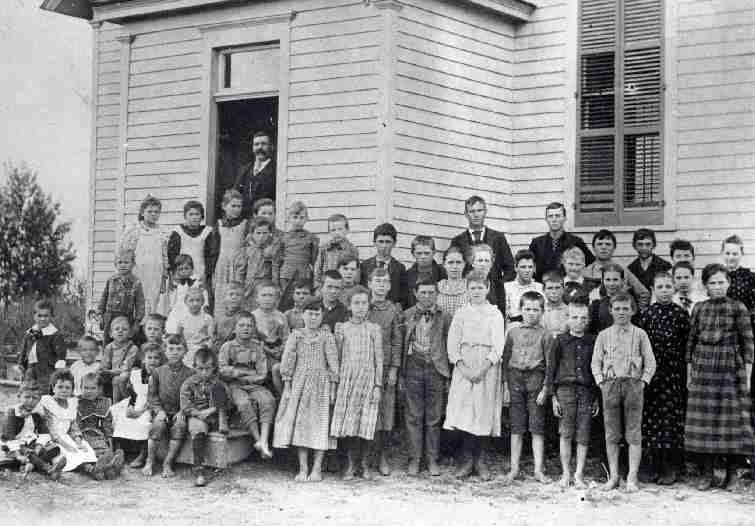
Figure 1.--Here we see the Hesston School in Kansas. The town was established as a village in Emma Township, Hesston began to grow as the Missouri Pacific railroad expanded westward through the state. We note a substantial school by 1893. Like many of the schools sat the time, it was painted white and not red. It looks like it was two rooms and very finely finished. Hesston by 1912 had grown into an important shipping and receiving point for farmers throughout the region. Many of the early settlers in the area were Mennonite farmers.
Here we see the Hesston School in Kansas. The town was established as a village in Emma Township, Hesston began to grow as the Missouri Pacific railroad expanded westward through the state. We note a substantial school by 1893. Like many of the schools sat the time, it was painted white and not red. It looks like it was two rooms and very finely finished Figure 1). Hesston by 1912 had grown into an important shipping and receiving point for farmers throughout the region. Many of the early settlers in the area were Mennonite farmers.
The Hibbard School is a Chicago, Illinois School. William G. Hibbard was named in honor of William Gold Hibbard, a pioneer Chicago retailer, He made a fortune in the hardware business. An then became an important city philanthropist. The school which honored him as built (1916). You can tell by the multiple stories. It originally consisted of the main brick building and thirty portable classrooms. It was inintially a combined elementary (primary) and high school. This was somewhat unusul, especilly for a big city school. The high school was moved into new Roosevelt High School building, this presumably meant the 10th-12th grades (1927). The junior high school pupils were moved into the new Von Steuben Junior High School building, meaning the 7th-9th grade (1930). Hibbard became a six-grade ekementary school. The changes coninued. Two of the junior high school grdes (7th-8th grades) were returned to Hibbard during the Depression (1933). For many years American educators debated what to do with the 5th-9th. Evenbtually the 8th grade went to high schools, ther wr bariou answers for the other children in this age range, mning middke and juniir gigh schools. Then the 7th and 8th grades were finally transferred to the Von Steuben Upper Grade Center, a middle school (1959). From that point on, Hibbard has remained a standard six grade elementary school. An off-site State Pre-kindergarten was established (1992). A Pre-K is now located within the newer addition to the school.
Highland Park is a neighborhood in northeastern Los Angeles. It is one of the oldest and most established areas of what is now a huge city. We note a scene from a primary school in Highland Park. We are not sure, however, what the name of the school was. We have a photograph that looks to have been taken in the 1890s, perhaps the early-90s. We think the wooden frame school is in the background. For some reason, only the boys are in the photograph. We assume there were girls at the school, but apparently they were photographed separartely. That was not very common. Several boys have various styles of hats. The youngest boy has a broad-brimmed hat. Note that they are wearing hats rather than caps. That helps date the image. Most of the boys wear suits. Some wear just blouses, including the younger boy who wears a Fauntleroy blouse. . One boy has a floppy bow. Almost all of the boys wear knee pants. The boys with shoes wear black long stockings, except for the youngest boy. It is interesting that boys who wore shoes wore long stockings, but bare legs were acceptable when going barefoot.
This CDV shows a class at the Hill Street School located in New London. Connecticut. We do not know much about the school, except tht it was in operation during the Civil War. The portrait is undated, but was probanly taken in 1862. The small class size suggests to us tht it was a private school. There would have been public schools in New London at the time. These boys look to come from affluent families. The teacher is Newton Fuller. The portrait was taken at a photographic studio. A map has been added to give a school room look. The boys are holding books. The boys are identified: Lathan Fitch, Geo Brown Jr., standing; left to right, Fred Latimer; Fred Richards; Fred Bodet; ? Newcomb; Leslie Pratt. This photo was acquired with Newcomb and other family photos from New London, Connecticut. Some of the other images show the boys in military uniform posed with rifles. The photographer was Morgan and Bolles, New London.
This photo shows the pupils at Hiwassee School in Smith County, Tennessee, during 1902. It looks like a small one-room school, as many others at the time. Notice the rough-hewn construction. The boys all wear knee pants or overalls. Boys mostly wore suspenders. We cannot see the three older girls in the back row, but all the others pupils are barefoot. Also the boy in the front row, wearing his best clothing with a large white ruffled collar, is in bare feet.
We believe the school here was called the Hogden School. It was located in Hodgen, a small town in LeFlore County, Oklahoma. The photograph we have was taken in 1910. It was a white, wood slat mlti-story building. There look to be about 80 children in the photograph. This may be a 8-year elenentary school. Notice the wide age range of the children. all Most boys wear knee pants and went barefoot. Only a few boys wear overalls. We note some Native American children at the school. Only two teachers are with the children, a man and a woman. It is difficult to tell if some of the the individuals in the back row may be teachers or older girls.
The Holderness School is a respected private school in New Hampshire. It is an Episcopal (Anglican) boarding school for boys located south of the White Mountains in the town of Holderness, now adjacent to Plymouth. It was founded in 1879 along the lines of an English public (private secondary) school. This was the standard for private schools at the time. The school was originally only for boys but is now, like most New England prep schools, co-educational. Sports, particularly ice hockey and skiing, have long been an important tradition at Holderness. The first headmaster was the Reverend Frederick Moreland Gray, an Episcopal priest. Father Gray presided over the school from 1879 to 1886, starting with a small group of only 15 boys but quickly enlarging the student body to at least twice that number. The boys ranged in age from about 14 to 19 and were being prepared for entrance to colleges and universities. The boys tended to come from rather affluent families, which is still the case at Holderness, although, despite their privileged backgrounds, the boys are required to engage in a certain amount of physical work and public service such as helping rake leaves, working in the kitchen, or visiting the elderly in hospitals and nursing homes.
Holy Cross was a parochial (Catholic) school in the Bronx. We know very little about the school, except that it was operating in the 1940s. We have a photograph of a 2nd grade class in 1949. The children who attended parochial schools in New York were largely the children of Irish and Italian immigrants. By the 1940s they had been largely assimialated into the American mainstream. Some of the family names here are. Monahan, E. Sicilian, G. Finnegan, O'Flaherty, Pignoni, Valentino, D. Como, McCarthy, Barbarino, D. Mulcaty, McGuiness, J. Palumbo, Viola, Hennessy, Reando, P. McShane, Sullivan, Murphy, McVay, Murphy, Pareti, Dougherty, Boyle, Vinacchio, and Hurley. We alsdo notice some Polish and German names. The children do not wear school uniforms, which became very common in Catholic schools during the 1950s.
Here we see Mrs. Walker's 1939 2nd grade class at the R.L. Hope school in Atlanta, Georgia. This would mean that thaey are 7-8 years old. The class has about 20 children. They are identified by name on the back of the photo. Mrs. Walker has provided a play house weith plants a girlm is watering. The children have play vehicles. There also seem to be piled of what look like books, although we are not sure. That seems like a strange place to pile up books. The children's art work features prominently on the wall. This is a very well lit, airy classroom. The shades have been drawm so as not to was out the photograph. The girls mostly wear prim dresses. Puff sleeves are popular. The boys wear a variety of shirts, both T-shirts anbd collared shirts, with short and long pants.
This postcard back school room portrait is entitled 'My First School' meaning a 1st grade classroom or 6-yer old children. We believe it was the Hoquiam elementarry school or one of the Hoquiam schools because the photographer was located there. Aeader tells us it could be in nearby Aberdeen. The chilren are all obediently seated at their desks, except for those out of the range of their amera who were position standing at the rear. Some of their work is posted on the walls. The portrait is undated, but given the AZO stamp box and the way the children are dressed we would say that the mid-1910s is the most likely date. The suits and knickers are a strong indicator that it was in the 1910s and confirmed by the AZO stamp box. But we do not know just when in the 1910s other than it was not real early as there are no knee pants and not later than 1918. So the mid-10s is the best estimate. Most of the boys wear suits. ne boy wears a blouse an bow-tie. They would also be wearing knickers and black long stockings. The girls wear dresses and hair bows. The studio was J.C. Dean Photo in Hoquiam.
We have an image of the Hueytown School in 1912. Hueytown was a small town in Alabama. The school is small, but looks like it might have two class rooms. The children wear a range of clothing. We do not note overalls. Several of the children wear suits. We note both kneepants and knickers. About half of the children wear long black stockings and half of barefoot. This may be a little misleading because more of the younger children in front may be barefoot than the older children in the rear. The image shows how common it was for children to attend school barefoot, especially in the South and rural areas. There are both boys and girls that have come to school barefoot. Some of the children with suit jacket are barefoot too.
The Hygienic School was a historic Afro-American school in Pennsylvania. The photograph was taken in 1886-87. The school was located in Steelton, Pennsylvania near Harrisburg. Steelton was a the name suggests built around the rising iron and steel industry of the area. The steel mills at the center of the city rose to be a major industrial complex after the Civil War. The mills attracted workers in large numbers, among which were blacks primarily from the South. Low wages over time resulted in industrial strife. One of the company's strategies for dealing with labor unrest was to hire blacks and went into the South to recruit black workers. They were thought to less likely to strike and white workers often did not want to bring them into the trade unions they were attempting to form. The primary company was the Pennsylvania Steel Company which in 191 became the Bethlehem Steel Corporation. The recruiters they sent into the South were successful in finding willing black workers who had few prospects in the Jim Crow South. Once a black community was established they attracted family and friends. This began before the Great Migration beginning during World War I, but increased during this period. The first blacks were housed in barracks built and operated by the company. The first recruits were mostly young men. As families formed, a black shantytown developed the old Pennsylvania Canal and along Adams Street. Other ethnic groups (Croats, Slavs, Germans, Italians, and others) attracted by the jobs gradually assimilated into multi-ethnic society, a pattern repeated elsewhere in the industrial Midwest. The prevailing racism of the day, however, kept Steelton's blacks in their own separate community. And this included a separate school.
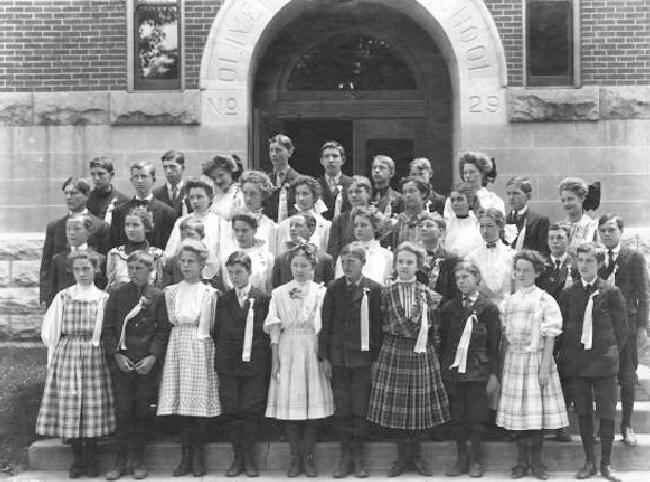
Figure 2.--Many public primary-level schools were known by their numbers. For many years they were not named. Here we see a graduating class (8th-graders). This is Public School 29 in Indianapolis (1908). Notice the ribbons that the students wear in their lapels, the sign that they are graduating. The boys wear dark suits with white shirts and ties, knee pants, and long black stockings. For some reason these 8th-graders look slightly older than the children in the 1907 class at a different school. We suspect that this schools was located in a little better neighborhood.
Indiana was a leader in the free public school movement. The Indiana General Assembly became the first state to appropriate public monies for free public kindergartens (1901). It was not enough to fully fund a state-wide kindergarten program. Local tax funds were needed as well as public subscriptions. In Indianapolis, the Indianapolis Benevolent Society decided to focus its efforts on the care of poor children (1882). Many of the poor children were immigrant children. They changed their name to the Children's Aid Society (CAS) decided that the best way to confront poverty was through education at an early age. They opened the first trial Kindergarten (1882). They formed the Indianapolis Free Kindergarten Society and began establishing free kindergarten schools throughout Indianapolis. The CAS assisted with 33 free Kindergartens throughout Indianapolis. Kindergartens were established for immigrant children (including Italian, Slavonic, and Austro-Hungarian students) as well as programs for orphans and sick children. The CAS kindergartens were located in a variety of places including leased houses, community churches, and institutions such as the Children's Guardian Home. This is one of these Kindergartens. Notice that the building in the background does not look like a city public school.
Many public primary-level schools were known by their numbers. For many years they were not named. Here we see a graduating class (8th-craders). This is Public School 29 in Indianapolis (1908). Notice the ribbons that the students wear in their lapels, the sign that they are graduating. The boys wear dark suits with white shirts and ties, knee pants, and long black stockings. For some reason these 8th-graders look slightly older than the children in the 1907 class at a different school. We suspect that this schools was located in a little better neighborhood.
We note some scenes from the Irwinville School, presumably in Irwinville, Georgia. We know very little about the school, but it looks to have been a primary school with a rural setting. It seems to have had a substantial building. One photograph from 1937 shows what looks like the children going back into class after a recess. The girls wear dtesses. Several of the boys wear overalls meaning that it was a rural school. We also notice what looks like a girls' gym class at the school for which the girls changed into rompers. We wonder if it may have been some kind of institutional facility.
The Irwin Ave. Junior High School was located in Pittsburgh, Pennsylvania. The Irwin Ave. Junior High Science Club photograph (1919) shows the boys quite dressed up. Most of them wear knicker suits with formal shirts and ties. A few of the boys wear only shirts without jackets. The variety of trousers here is interesting. Notice the front row which shows long trousers, knee pants, and above-the-knee knickers. These children would be about 13 or 14. The most conservative parents would insist on knee pants and long black stockings whereas the more liberal parents would allow long pants. The middle-ground compromise would appear to be above-the-knee knickers.
This photograph shows learning the trade of shoe-mending or cobbling in a trade school in New York City called the Italian School. The school specialized in training imigrant children in various useful trades and manual occupations. The boys seem to be about 12 or 13 years old. I'm not sure who set up the school. It might hve been part of the settlement house movement, The Brooklyn Italian Settlement was particularly well known. The term Italian School may have been because it was in an Italian community, not because only Italian boys were accepted. The boys are neatly dressed in white shirts with ties, above-the-knee knickers and long black stockings. The photographer is the famous Lewis Hine, who took many photographs of boys in New York and oyher cities, mostly in the 1900s and 1910s to dicument child labor and living conditions. This photo is dated 1928.
Here we see the Jackson School in April 1949. There was quite a number of Jackson schools named after President Andrew Jackson because he was one of the major presidents of the 19th century. Today he is not as popular because of his policies toward Native Americans. The school looks to be a standard elementary (primary) school. Pictured here is room 15. We believe the school was in Fresno, California. This seems quite possible by the children's light dress. The grade is not indicated, but we would guess they are 4th graders and about 9 years old. The boys are wearing a variety of shirts, including "T" shirts. Some of the boys wear white rather than striped "T" shirts. I don't remember boys doing that at my school about the same time. We always wore striped "T"-shirts. We can't see the pants the boys are wearing, but one boy is wearing jeans. Scouting was very popular at the time. The portrait was taken on Scout day. You can see several boys wearing their Cub Scout uniforms. One boy wears his Cub uniform with jeans, which was often done. At least the color matched. None of the girls, however, for some reason are wearing their Brownie uniforms. The girls all wear dresses. Several boys are wearing sneakers, but none of the girls. They wear strap shoes amd lace-ups including saddle shoes. Notice the old-style school desks and the pioneer mock-up for American history in the middle of the room.
American including school children watched terrible scenes of the War in Europe and China in movie newsreels. After Pearl Harbor, no olne really knew what to expect. Neither the Japanese or Germans had planes thst could reach America, but the Germans did launch U-boat attacks all along the Eastern seaboard. Some school principals took civil defense preparations very seriously. Foreogn armies entering America wwere unthinkable, but also was the stunning Japanese attack on Pearl Harbor. Here we see a 1942 scene at Jackson School in Allentown, Pennsylvamia a few months after Pearl Harbor. The children are praticing an air raid drill. Three childern (of course justv the boys) have metal army helmets. One boy is wearing his a Boy Scout uniform. Another boy is a safty patrol. One girl wears a Red Cross nurses outfit. Two boys also are wearing Red Cross arm bands.
Here we see the Jackson Center School in 1911. It was a one or two room school. Notice how the wood plank building stands out on the flat, treeless Kansas prarie. The school was located east of Webber, Kansas, a town in north-central Kanasa near the Nebraska line with a rail station--the Atchison, Topeka and Santa Fe. A rail ine at the time was the making of a small town. We do mot know much about about the town, but it seems to be a town in a largely farming community. The school itself looks very new. Tere are about 30 children. The girls wear dresses. The older boys wear suits. The younger boys wear blouses. The boys excet for the ones wearing overalls wear knickers and long stockings. One boy wears a sailor suit. All in all, an excellent view of 1910s fashions. The school marrm poses with the children.
This CYKO postcard-back school portrait shows what we think is the graduating 8th grade class at an American elementary (primary) school--Janus Lick. We do not know where it was located. The portrait was taken in 1909. The children would be 13-14 years old. At the time many elementary schools were grades 1-8. Most children at the time did not go on to high school (secondary school). These children all seemed smartly dressed. We suspect that many did continue their education. We are not positive it is a graduation class as their are no graduation scrolls. This is probably the class portrait of a graduating class, not their graduation portrait. The reason we think it is a graduating class is that the boys with headwear all have hats. Caps were more common at the time for school. The boys obviously dressed up and the children look the right age. There are about 50 children, a rather large class unless they were two classes. The girls wear a variety of dresses, a few with pinafores. Most of the girls have hair bows. The boys all wear suits. We note boys wearing knee pants, knickets, and long pants. We see many boys beginning to shift from knee pants to knickers in 1909. And we begin to see boys switching from knee pants/knickers to long pants about 14-15 years of age. All the boys wearing knee pants ahnd knickes wear long stockings. Anoter possibility is that itis a high school freshman class with would men the children are 14-15 years old. (9th grade). he reason we mention this is that we see 8th grade classes at the time where none of the boys are wearing long pants yet.
Thomas Jefferson was one of the great figues of the American Revolution. He was not a military figure, but the author of the Declaration of Independence and governor of Virginia. He was one of the great spokesmen for American democracy anf the third president of the United States. As a result like George Washington and John Adams, many schools are named after him. This is the Thomas Jefferson Junior High School in Clevelabnd, Ohio. The photograph is dated January 1929. It is of particular interest because we see the students in a open class room, in this case room 310. The teacher and students are present, wonderful examples of what children were wearung in the late-1920’s. One boy wears knickers and brightly patterned knee socks. but the others boys seen to be wearing long pants, although it is a liitle difficult to tell. The girls wear dresses and both long stockings and ankle socks.
Here we have an image of the Jefferson Scool, an elementary (Primary) school. There are many Jefferson Schoolsin the United States. This one was located in West Allis, Wisconsin. It is a third grade class photographed near the end of the chool year in May 1953. The children would have been mostly 9-years old. The girls all wear dresses, ather long ones. The boys wear both collared shirts and "T"-shirts. One boy wears a tie and others have buttoned their collar button. The "T"-shirts are mostly stripped. One boy wears a Hopalong Cassidy "T"-shirt. Pne boy has suspenders. All of the boys wear long pants.
The sign in the background although we can not see it all suggests that this was the Jefferson School. The phiotograph was taken in 1928. The stidio was apparently the Fancy Thompson Studio in San Francisco. We are not sure what kind of school it was, but it seems to be a high school. We note the students that are older teenagers. The children here are younger. High schools begin with the 9th Grade, meaning students about 14 years old. The school might have included even younger students. These students nay be the 9th graders. The boys mostly erar ties, bit only a few sear suits. We see wear knickers and knee socks, at least the boys in the front row. The girls wear a variety of dresses. There is tofay a Jefferson High School in Dale City, just outside San Francisco.
The Johnston School was located in Detroit, Michign. We do not know much about the school, but it was a public elementary (primary) school. It seems to be a fairly typical public elementary school at the time. The one photograph we have shows the children playing. It is not clear if this was their classroom because there are no desks. Perhaps they have moved them out of the way for a play session. We suspect that it was aspecial room because desks at the time were fairly heavy, too heavy for younger children to easily move. The children are having a play session. Perhaps it was a rainy day. The girls all wear dresses and the boys knickers.
This school was located in Kern City, California. We do not know if it had a specific name or was just called the Kern City School. We have a single portrait from 1891. The portrait seems to show more than a single class, but not the older children that would have attended a primary school at the time. The children wear quite a large range of garments, providing a good view popular fashion in the 1890s. The many different garments and even hair styles here is particularly interesting.
This cabinet card portrait of girls doing rythemtic exercises was maked 'Fifth Year -- LHS'. The HS suggests a high school, but the girls look more like the fifth year of elementary (primary) school. I supose it is possible that the school was counting backward and they were 8th graders in a seconary school. While we do not know the full name of the school, we know where it was located--District No. 10 in Hampstead, New York. This is a city in Nassau County (western Long Island) close to New York City. We can see a teacher playing the piano while the girls exercize. It could be a kind of music/dance class more than a physical education class. It looks like they are in a classroom that has been coverted into an activity room. Notice that the girls have not changed into a gym costume (usualy middy blouse and bloomers) which also suggests that it is an elementary school. Only girls are involved. The portrait is not dated, but the mount suggests the 1900s.
Here we see a group of older teenagers in Laconia, New York. The only group we can think they may have belonged to is Laconia High School which was opened in 1875. The classes wwre quite small so you would guess that this was the graduating seniors. Presumably there were at least some girls, so the boys seem to have had their portrait taken separately. Note the boy in the middle wears knee pants and black long stockings while the other boys all wear long pants.The portrait is indated, but was probably taken in the 1890s. Prints of cabinents cards like this cost $0.25.
This photo shows a schoolboy in his classroom. It is an interesting photiograph because most images of rural schools were taken outside the school. The unidentified boy is reading aloud in front of the class. The children probably took turns reading. He looks to be about 10-years old. He is standing near the teacher's table, where we can see the the classic school bell, some books, and a cheerful bunch of flowers which suggests the late spring, probably June. The photo was taken at Lafayette School, in Tompkins County, New York. It looks to be a small rural school, but it is difficult to tell. The photograph was taken inside the school room during 1907. On the wall hangs a picture of President Theodore Roosevelt which was fairly common. It helps to date the photograoh even if we didn't have a date. The boy is quite well clothed. He is wearing a dark knee pants suit, but without a tie. Hnd his bare feet don't give any appearance of poverty. Going barefoot was very common seasonally at the time. It is near the end of the year and the temperature has warming up, explaining the flowers.
This is a class portrait from the Laguna Honda School which as elementary shhool located in the heart of San Francisco only a few years after the devastating earthquake. Laguna Honda is next to the more exclusive Forest Hill neighborhood, one of eight master-planned residential areas, in this case with a decidedly up-scale, white-only population. Forest Hill is located near the middle of the City, bounded by Laguna Honda Boulevard to the north and east. Laguna Honda was settled before Forest Hill was developed (1913). The most notable aspect of the Laguna Honda was a hospital for the general public. Laguna Honda itself is also known as the Forest Hill Extension. Laguna Honda means 'deep lagoon' in Spanish and probably reflects a lagoon that existed there in Spanish colonial times. Today it survives as the Laguna Honda Reservoir. Apparently Laguna Honda was not as exclusive as Forrest Hills. We see a class group, perhaps 3rd graders. The children are well dressed, but some not as well as others. The photographer has placed the girls in front and the boys in the back. All of the girls but one wear black long stockings and all wear high-top shoes. . We can not tell for the boys, but we suspect that they are all wearing black long stockings and high-top shoes. The girls wear dresses and hair bows. Two wear dresses styled rather like tunic suits and one wears a pinafore. It is more difficult to tell about the boys as they are in the back. We see a range of outfits including blouses, sweaters, and sailor suits, but not too many suits. Three boys have longish hair. . The photograph we have is a postcard back portrait taken in front of the school dated in pencil on the back to 1910. The photograph we have is a postcard back portrait taken in front of the school dated in pencil on back to 1910.
This 2nd grade elementary (primary) school class portait was taken in Lake Wales, Florida, during 1932. Second grade mwans children 7-8 years of age. Presumably Lake Wales was also the name of the chool. The clothing worn by the children is very varied. One boy is wearing a suit with a vest and tie. Other boys wear overalls. One barefoot boy wears a play suit. It was still quite common for younger boys in the South to come to school barefoot. Thuis was a school in town. More children wouuld have been barefoot in more rural schools. The age of the boys and warm climate is why so many boys are wearing short pants. None of the boys are wearing knickers, in part because of the climate. Florida was just beginning to become a vacation and retirement center. This began more intensely after World War II with the arrival of air conditioning. Lake Wales is located in central Florida, east of Tampa. At the time it was still a largely farming area which explains why so many boys are wearing overalls.
Landon School (Washington, D.C./Maryland)
The Landon Boys' School opened September 12, 1929, not a very propitious time for a private school. The school began using a comverted mansion on Embassy Row in Washington, D.C. They moved soon after in 1934 to Bethesda, Maryland, a suburb of Washington. The school still operates in Bethesda as a non-sectarian school and has an excellent academic reputation. We note a portrait of Hans Penndorf wearing his new school uniform about to begin at the newly opened Landon School in 1929.
Here we see boys at the Laramie Training School in Laramie, Wyoming, The photograph was taken
in October 2, 1916. The group is referred to in a notation on the photograph as the "Potato Club" under
the supervision of a supervisor, Miss Adsit. The Laramie Training School was an experimental school attached to the University of Wyoming at which prospective teachers in the Department of Education got
practical training as public school teachers. The boys have obviously collected sacks of potatoes for some reason--perhaps as part of an agricultural project, or perhaps as a charitable enterprise of some
sort. Note the scale for weighing the potatoes in the background. The boys are nicely dressed for their photograph, wearing suits and ties, or, in some case, coat sweaters with shawl collars. One boy wears a
Norfolk-style suit. The boys wear white shirts. Interestingly, for 1916, Laramie was already integrated, there being one black boy in the group. The boys all seem to be wearing above the knee knickers with long black stockings. For some reason, the boys sitting cross-legged in the front seem to have shed their jackets and are wearing only shirts and ties with their knickers and stockings.
Lawrenceville School (New Jersey)
The Lawrenceville School is a famous eastern prep school in Lawrenceville, New Jersey, with quite a long tradition behind it. The school was founded in 1810 as the Maidenhead Academy and after various vicissitudes refounded in 1883 with its present name. HBC does mot yet have a page on the school, but we do have a pahe on a TV seies based on the school. "The Lawrenceville Stories" (1986). Earlier a film, "The Happy Years" (1950) was made with Dean Stockwell.
We are not sure about the name of the school here. We know the school was located in Lebanon, a small village in southeastern Red Willow County, Nebraska. We suspect that the school was called the Lebanon School. Here we have a school photo taken in Lebanon in 1907 or 1908. It is interesting because of the great hats the children are wearing. Another interesting observation is that only one boy is wearing overalls, and he has covered them with a jacket. . By the 1910s we see many American children wearing overalls to school. It seems that this was about the time that overalls began to be worn to school.
The Liberty School was located in Rusk County, Texas. It was a small one-room school. Quite a few of the boys wear bib-front overalls. Many of the children came to school barefoot in this 1940 photograph. This photograph was taken right before America entered World War II. America was just recovering from the Great Depression. After the War children coming to school barefoot was became much less common as did wearing overalls to school. After the War differences between rural and urban schools also began to disappear.
There seem to be more schools name after Presidnt Lincoln than any other other American, president or otherwise. And this is a name that the PC crowd is unlikely to want to change, although we notice a arnge of wholly invalid criticisms. Unfortunately, we do no know where this particular Lincoln School was located, other than it was somewhere in the North. For a century, Lincoln was a hated name in the South. We do know that the cabinet card portrait was taken in 1896. This Lincoln School seems go be a small country school. We do not see the school, only the the students and teacher. They seem to be the older students. As was fairly common in the country, many of the boys wear long pants ar a time tht knee pants were fairly standard for boys in cities. Also intersting is the number of boys who had bikes. This as an indication of the affluence that Ameruca ws achieving. You would not have seen that at a comparable European school.
Here we know the name of the school and the date, but we do not know where the school was located, except that the school was located somewhere in the North. Southern schools understanably were not named after President Lincoln, the Union leader during the Civiln War. The name of the school does not help much because there were so many Lincoln schools all over America, except the South. This is an interesting images because it shows how common knickers still were in the 1930s, but it shows that American boys were beginning to reject them. Notuice we do not see boys wearing short pants. Many American boys resusted wearing shiorts. This varied from family to family. But boys were beginning to wear knickers with ankel rather than knee socks. Beginning with the 1910s when knickers were the dominant tyoe of pants worn by boys, through the early-30s. They were always worn with first long stockings and then knee socks. But by the mid-30s boys had begun wearing them with ankle socks which we can see. We do not know what year class this was, but they look like 3rd graders, children about 8 years old.
There are of course many Lincoln Schools in the United States. This one was located on Central Avenue in Middletown Ohio. The full name of the school was presumably Lincoln Elementary School, meaning a primary school. This looks to be some of the older children at the school, perhaps the 5th-6th graders which would mean children about 10-12 years old. Notice one girl wearing saddle shoes. The boys all wear long pants, except one boy who wears knickers with ankle socks. The image is undated, but we would guess about 1940, primarily because only one boy wears knickers.
This is the Lincoln School if we are reading the board correctly. It is clearly not a class group given the wide age spread. We can only assume it was a small one-room school. There are about 33 children. The teacher and at least the boys seem proud of their baseball equipment. There are just about enough boys for game of baseball, but some of the boys are too young to have mastred the needed skills. The older boys wear suits. Many of the younger boys wear sweaters and knickers with long stockings. Two boys wear sailor suits. The girls wear dresses, several have hair bows. A little girl at the center has a huge hair bow. Two boys have Dutch boy bangs. We can makeout the date, October 1922. The studio was something like Welles in Lebanon, Pennstlvania.
This Lincoln School was founded (1866) after the Civil War. West Virginia was part of Virgina, but separated during the War and supported the Federal Government. Even so, after the War as they established a ublic school system, they segregated black and white children. The Lincoln Lincoln School was the African-American segregated school of Ohio County. Here we have a school portrait taken in the 1880s, probably the early 80s as we don't see any Fauntleroy paraphenalia. Most of the boys wear suits and thge girls long dresses, several have pinafores. The children look to be about 10 years old which would mean 5th grade. The school remained segregated until the Supreme Court ruled segregated schools unconstituional.
The Live Oak Elementary School was located in Sutter County, California. It is located northeast of San Francisco in Northern California. It was nammed after John Sutter, of course on whise land golswas discovered, stting off the Califotnia Gold Rush in 1848. We have found a photograph of a class at the school during the 1920s. At the time the county was a largely rural county. The photograoh shows two different styles of schoolwear. Two boys in the front row wear white shirt, knickers, black long stockings, and shoes. The were presumably town boys. Most of the boys wear overalls and go barefoot. These were presumably farm boys.
This class photo of the Logan School, Denver, Colorado. It looks to be a elementary (primary schoo for grades 1-8. It could be a junior high school (grades 7-9). The only information we have was taken in June 1919. The portrait shows the children very dressed up for their school picture. The children seem to be about 7th graders (about 12 years old), but this could be an 8th grade graduation class (which would mean that the children would be about 13). The boys mostly wear formal suits with shirts and ties. Some of the boys wear knickers (both above-the-knee and below-the knee), and one or two boys seem to be in knee pants. They all wear black long stockings. The girls tend to wear white stockings. Two boys in the back row seem to be wearing only shirts without jackets. One girl in the front wear appears to wearing spats--a bit unusual for girls, one might suppose. The photo seems to have been taken on the front steps of the school in warm weather (it was June--graduation time).
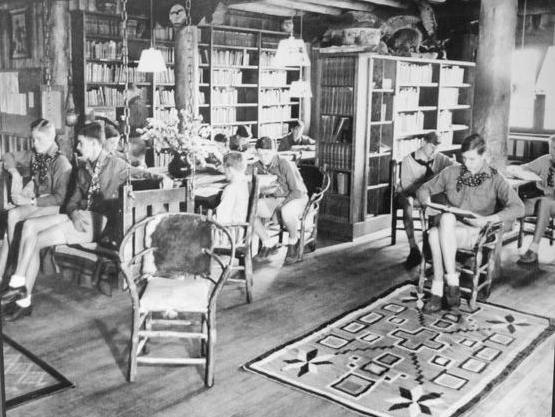
Figure 3.--This is the library at the Los Alamos Ranch School in he Big House. Most readers will instandly recognize Los Alamos as the isolated place in New Mexico where the American atomic bombs were designed and built. The site for the project was to be this isolated little known boys' school. The site was chosen because scientific project manager, pysicist Robert Oppenheimer as a boy became enchanted with the natural beauties of New Mexico. .
Most readers will instandly recognize Los Alamos as the isolated place in New Mexico where the American atomic bombs were designed and built. The site for the project was to be this isolated little known boys' school. The site was chosen because scientific project manager, pysicist Robert Oppenheimer as a boy became enchanted with the natural beauties of New Mexico. He knew that the Manhattan Project leader, Gen. Leslie Groves was concerned about security. And Los Alamos was perfect from a security pont of view--put everyone behind barbed wire in one of the most remote locations in the country. The history of the school dates back to the late-19th century. The Homestead Act (1862), opened Werstern lands for small-sacle land ownership. Homesteaders in the area utilized the land for ranching. The homesteaders built basic log cabins that were onlyused during warm weather to help feed and maage the livestock. Most eventually moved down to the warmer Rio Grande Valley. Homesteader Harold H. Brook sold part of his land and buildings to Ashley Pond II, (1917). Pond was a Detroit businessman who used the land to founded the Los Alamos Ranch School. Pond believed the rugged New Mexico landscape could be used to teach tenage boys ranching and outdoor skills as part of gtheir education--skills which could have a very positive impact in building character. Here we see echos of Kurt Hann and Gordonstoun in Scotland. The Ranch School hyad to be closed at the height of its success, giving way to World war II and the Manhattan Project. The school was reopened at the Sagebrush Inn.
The mame of this school is not identified, but we know it was located in Lovington, Illimois. This is a town ib centrl Illinois, meaning that it was a farming community. Lovinmgton was a small town of only about a 1,000 residebnts so the school was surely called the Lovington School. It was a substantial brick school. The photograph we have is a postcard-back class portrait taken in 1908. It looks like an 8th or 7th-grade class posed on the front steps of the school with the lady teacher (Bertha Lechner) is placed in the center of the class. The names of the children and teacher were written on the back of the card.. The boys mostly wear knee pants and black long stockings, but unusually we see two of the boys with some kind of leggings. We are not sure what that was all about. It does not seem a particularly cold day. One or two boys wear knickers. This is precisely the time that knickers for some reason began to replace knee pants in the Unitd States. One boy wears long pants. The girls wear a mix of dresses or blouses and skirts, also with black long stockings. Notice that hair bows are not nearly as common as they would become in the 1910s. Also interesting is that a high school (secondary school) was opened in Lovoimgton the yeraftr this potrait ws taken (1909). Such small high schools were not uncommon in America at the time. This is interesting because a town of 1,000 people would not have had a secondary school in Europe. America at the time was expanding its secondary school system far beyond the level of that in Europen countries. Only a fraction of American children went on to high school after elementary (primary) school, but far more than in Europe. And they did so on a non-selective basis meaning gender and academic ability. Unlike Europe, American girls did so in large numbers, often more so than the boys who in a community like Lovington were needed on the farm.
Lowell School appears to be a public elementary (primary) school with pre-schoolprograns. Itbis located in the Capitol Hill neigbpthood and also attracts children from downtown. It stresses diversity with large numbers of immigrant students speaking different languages. It gives consideable attention to children with disabilities. The school opened as a standard lmentaty school with am 8 grade program (1890). The original school was named the Pontius School. It was renamed Columbia School (1891). It was renamed Lowell School honoring James Russell Lowell, 19th century poet, scholar and diplomat from Massachusetts (1910). New playground facilities were installed making Lowell the first school in the nation with a play area designed to allow equal access for students with disabilities (1973). The Accelerated Progress Program (APP) and programs for students with significant disabilities operated in the building 1997-2011). The school became a neighborhood and downtown area school, serving a diverse student population (2011-12). The primary classes run through grade 5. There are currently about 380 K through 5th grade students.
(La) Lumiere School (Indiana)
La Lumiere was a private Catholic boys boarding school at Long Beach near La Porte, Indiana. This was close to Norte Dame University where many of the boys went on to university. The school had a cobservative dress code requiring the boys to wear suits. One of their aluni, John G. Roberts, Jr.was appointed by President Bust to the Sipreme Court (2005).