|
A good idea of fashion trends in America, as children at public schools did not wear uniforms, can be assessed by looking at what the children were wearing to school. Unfortunately many of the available images are not identified or are not dated, despite this, the images are very valuable views of children's fashion trends.
Here is a list of schools alphabetized by school name. Unfortunately for many images we have collected, we do not know the name of the school. We will add images of schools which are identified by name as well as schools about which we have obtained information. Readers are invited to contribute here information and images about their schools and school experiences. We certainly hope if readers find their school listed here that they will provide us some information on it.
The McCaskill School was located in Susperior Wisconsin. It appears to be a standard American grammar (primary) school, problably with grades 1-6. We note a photograph of a 2nd grade class in 1926, The children would be 7-8 years old. Some of the boys are wearing sailor suits. The boy in front looks to be wearing a light-blue sailor suit. We do not see this so much in Europe. Other boys wear white shirts (one with a tie and one with a white shirt buttoned at the neck but without a tie). Nearly all the children wear long stockings. Most of the boys seem to have short pants rather than knickers. Some of the stockings are black, others seem to be of the popular new tan or light
brown shade.
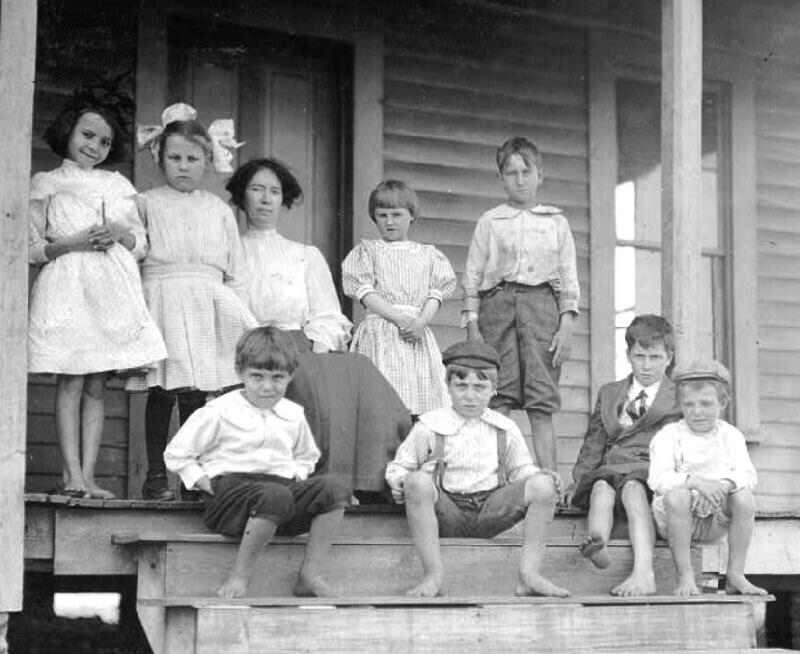
Here we see the McIntosh School. It was the only school near Cotton Mills, Winona, Mississippi. A photograph in May 1911 shows the teacher and the pupils. It was a private school taught by Miss McIntosh. It might be called an old fashioned dame school. Miss. McIntosh operated a school for several years. She charged each pupil only $1.00 a month. With about 10 pupils the job was not very lucrative. She said it was discouraging, but that many of the children seemed to appreciate her efforts. "What we need is compulsory education and a free school out here, which we may get before long." The children she taught ranged from 6 to 10 years. The Southern states did not have public schoo; systems before the Civil War and lagged behinfd the other states in establishing public schools after the War. In fact, one of the charges leved against Reconstruction government was reckless spending, especially for education. Mississppi well into the 20th century was commonly at the bottom of the lost of states for spending on education.
We are not sure where the Madison School is located. We would guess it might be in Virginia as President Madison was from Virginia, but there are many Washihgton, Adams, and Jeffeson schools located all over the United States. It looks to be an public elementary school. We have a photograph of the school safety patrol in 1935. Notice their badges abd white shoulder belts. The older boys were chosen to help the younger children across the street at corners around the school. Note only boys were chosen. The boys wear mostly long pants, but two wore knickers with patterened knee socks. The photograph is a good indication of how knickers were declineing in popularity by the mid-1930s. More and more boys were wearing long pants.
This looks like the students from a small high schhool. We see a substantial brick school. There is no indication where the school might be located, but the one Asian face suggests in might be California. It looks to us that it may be the freshman class which woud mean 14-15 year olds. We do know the photograph was taken in January on 1933 which also, given the way they are dressed, suggests California. This was during the Depression which had an impoact on high schools. With so few joibs available more boys in partcular were extending their educations. Madison was of course the fourth president and like Washihgton, Adams, and Jeffersi had many schools named after him. So there is no way of knowing where the school was located. The girls are wearing a variety of dresses. The boys are mostly wearing suits and ties. We are never sure with these portraits if this is how the students always dessed. the taking of a school portrait would have been dressed in advance. The Based on the students in front, the boys are weaing mostly knicker suits, but some have long pants. Knee socks rather than long stockings had become standard. Sone elenentary (orinary) children were still wearing long standards, but this was no longer common in secondary schools.
Here we have a phoitograph at the Horace Mann School, we think in Missouri. lt is an outdoor photograph, interesting because it was taken at recess. It looks like the teachers had organized xircle games. It is hard to tell justwhat the games are, butthere look to be two circle games. At my advanced age, it is hard to recall recess in my primay schools. But I do not recall thec teachers organising recess. I recall kickball and dodgeball which we orgaized our selves and was mostly for the boys. The girls were much less interested in these active games. The more placid circle games were more to their taste. We know the name of the school which was located in Kansas City, we think Kansas City, Missouri. The photograph is undated, but the cars suggest the mid-1920s to us.
The Masonville school appears to be a small one-room school in upsate New York. Here we have two photographs, although the images look quite different even though they only are identified as being taken at about the same time. Note that many of the boys are wearing knickers. American school portraits taken in the 1900s show boys mostly wearing kneepants.
Here we see the Meredith village school house in 1901. The boys sitting in the front row would seem to be about 8th or 9th-graders, i.e., about 12 or 13 years old. The older boys standing at the back look like high school children, i.e., 16-17 years old. The boys are quite formally dressed for the photograph, probably more formally than they actually would have been for daily classes. They wear jackets and ties, and most seem to be wearing suits. The younger boys all wear knee pants with long black stockings and
hightop shoes. At least one of the boys in the front row (the third from the right) seems to be wearing long underwear under his stockings (note the somewhat lumpy appearance). This was probably quite common at the time, especially in chilly New Hampshire. The children are grouped on the front steps of the local Meredith schoolhouse. Meredith is a still a fairly small town so the school house could have been only a one-room affair.
This is the 3rd grade class at the John Milledge School in Georgia during 1928. Thevchikdren woukld have been about 8 years old. Children 3rd Grade 1928 Georgia. This looks to be a primary school in a toen. The size of the class and the substantial red brick buildimg shows that it was not a rural school. All the boys we cn see are barefoot. This would havebeen quite common in a small town. We are not sure about the girls. We suspect tht somevwould alsomhave been barefooy, but probablynsome ear shoes. The boys mostly wear whitevshirys, several with tiesvshowing mothers had dfferent ideas as to how to dress the kids for school. One boy wears a butonon shorts set. The other voys wears short panrs or knickers. The girls are in the back with their teacher. They look to be wearing mostly dress althogh sone may be wearing blouses and skirts.
Here we see a great photograph of children playing a ring game at a one-room school on the Great Plains. It was taken in Milton, North Dakota during 1913. We are guessing the name of the school was the Milton School. American schools were often called "little red school houses". We're not sure what color the school here was painted. It does not look red. Nor do we know just what game the childre are playing. Perhaps one of our readers will recognize it. Notice that the teacher has joined the game.
We believe this is the Monticello School. We know it is an elementary school in Monticello, the county seat of Jasper County, Georgia. The community was named after Thomas Jefferson's home in Virginia. The county was named for Revolutionary War officer, Sgt. William Jasper. An image from the school in 1908-09 shows almost all of the boys coming to school barefoot. Here going barefoot does not seem to be a matter of poverty because the boys are otherwise quite well clothed (some even wear ties).
We do not know of a town named Mount Thorp, but there is a mountain located in a wooded rural area east of seattle in northwest Washington. The school was presumably located near the mountain which was we think a logging area. Today popular hiking trails run through the area. We have a good picture of the school which appears to have been constructed of mud bricks. Perhaps readers will have a better idea of that. The photograph was taken in 1902. We count about 30 children and two teachers. The school looks like it could accomodate more than one classroom. There are two doors. We are not sure about the purpose. The children look well dressed, not formally but with sturdy clothing. Some of the children wear heavy jackets. Several girls wear sailor dresses. Almost all of the boys wear long pants. This was at a time that knee pants even for older boys were nearly universal in cities and towns. We see one boy wearing overalls. We think overalls became common in factories, mining. and logging areas before being worn by farmers. We don't see farm children extensively wearing them until the late-1900s decade.
The Mount Zion School was a small one-room school in the Florida panhandle. It was attended mostly by Dominicker children. The Dominickers were one of several small multi-racial isolates in the Southeastern United states. We have a photograph from about 1905-10. Florida schools were segegrated at the time. So we assume that the school would have been part of the black system.
We know very little about this school, but we believe it was located in upstate New York. Given the size of the class it was presumably a one-room country school house seen in the background. The photograph we have is undated, but we believe it was taken about 1900. It is especially interesting because the children are wearing headwear. Usually the children in these class photographs have taken off their caps and hats.
Most American public schools have names. New York and some other big cities just numbered their schools. New York did this by the different buroughs. We have very little information about the school. We know the number. P.S. 62, but we do not know which burough. The boys seem to belong to a boys' club organized at the school. It is fairly easy to estimate the date. It would have been some time in the 1900s, probably about 1905. We are not sure about the type of school. The children look to be about 13 years old. This could mean an 8-year elementary (primary) school. Or it could be a junior high school. The boys all wear knee pants suits. There was no required uniform nor do we think there this was a special dress up event. This is just how the boys dressed. we also seen some of the girls. All of the children wear long stockings.
Many Amrican schools did not have names, but rather numbers like PS 64 in the Bronx here. PS means "Public School". The Bronx of course is a borough of New York City. I am not sure why New York did not name its schools. The same conventions were followed in the other boroughs as well. We do not know much about PS 64, except that it was operating in the 1950s. The school was locate on Jerome Avene just off Fordham. We have a photograph from 1950. Here we see the children playing with blocks, I think in their classroom. Or perhaps there was a playroom. The girls wear dresses. Many of the boys wear sweaters, suggestng that the photograph was taken in the Winter.
Many Amrican schools did not have names, but rather numbers like PS 64 in the Bronx here. PS means "Public School". The Bronx of course is a borough of New York City. I am not sure why New York did not name its schools. The same conventions were followed in the other boroughs as well. We do not know much about PS 64, except that it was operating in the 1930s. A photograph from 1937 shows the graduating 8th grade class. The boys wear suits and the girls skirts and blouses. There were no middle schools/junior high schools at the time. The children continuing their education would have entered the 9th grade in a high school.
Many Amrican schools did not have names, but rather numbers like PS 70 in the Bronx here. PS means "Public School". The Bronx of course is a borough of New York City. I am not sure why New York did not name its schools. The same conventions were followed in the other boroughs as well. There are many available images from New York schools provide a wonderful insight into popular styles. We even begin to get color images during the 1960s. We note the boys wearing ties into the 1960s. We wonder if they wore them every day or just dressed up for the class portrait. Quite a few boys wear white shirts and ties. One boy wears a suit and another a British looking blazer. The girls mostly wear dresses. The boys have short hair into the mid-60s.
New York Bronx P.S. 90 was another city elementary (primary) school. We know very little about the school, but a press phtograph provides a view. It was taken at the end of the 1941-42 school year with the children rushing out the school doors. We see both boys and girls, usually these 'Yipee!' photographs are mostly boys. The girls wear dresses. The boys wear dress shirts and ties. Many of the boys wear knickers, but without knee socks. This was the first year of American participation in World War II. No sign of it in New York. In fact New York and other cities kept the lights on creating siloutte targets for German U-boats opertating along the American East coast (January-June1942). We still see knickers in the early-1940s, but by the end of the War, they were becoming rare. Footwear included leather shoes, saddle shoes, and sneakers.
We note a portrait of the 'Guards' at Brooklyn (New York) P.S. PUblic School) 216 during 1938. The Guards were presumably the Safety Patrol Boys. The school was coeducational, but at the time only boys were chosen for the Safety Patrol. We are not entiely sure whaich t grades were involvd. Standard elmentary (primary} schools were grades 1-6, which would mean ags 6-12 years of age. The portrait was taken in the spring so many of the 6th graders had begun to turn 12 years of age. Some of the boys look a ittle older. They were photographed on the front steps of their red brick school. Only a few boys wear suits to school, although mny boys wear ties. Based on the front row about half the boys wear knickers and the other half wear long pants. Notice that the knee socks are mostly patterned. They may have been the younger boys. Often at elmentry scools both 5th and 6th graders qualified for the Safety Patrol. P.S. 216 is now the Arturo Toscanini School with a pre-kindergarden through 5th grade program .
This school portrait shows a very well dressed class 8B3 at P.S. 87 in Manhattan. This would be an 8th grade home room class. The B3 suggests that there were several 8th grade classes. As it was in New York City you would expect to find largeschools with several classes. The portrait was taken in June 1941 at the end of the year. The children would have been 12 years old when they began 8th grade in September 1940, but when this photograph was taken some would have turned 13 years of age. This would probably have been a junior highschool. The boys all wear schools and ties. The knicker suits common ijn the 1930s were going out of style in the early-40s, but one boys here wears knickers and knee socks. The girls seem less formally dressed. Some wears dresses, others wear blouses and skirts. We think the children dressed up for the portrait. We do not think the voys wore suits every day, but of course Manhattan was a ritzy neigborhood, so the children probably dressed better than most most American school children. There were 35 children.
Here is a 9th grade portrait at New York City School P.S. (Public School) 165 in Manhattan during January 1934. It appears to be an all boys schoolor class. We are not sure how common tyhis was. We are not sure if it was a junior high or high school. Most of the boys wear suits, several are still wearing knicker suits, although long pants suits are more prevalent. The boys in 9th grade would be mostly 14 years old, but beginning to turn 15 years.
PS 84 was a New York City elementary (primary) school in the burough of Queens. Wev have a portrait of a 5th grade class in 1959. We at first thought it was a parochial school because so many of the boys wear white shirts and ties. We do not know if that was normal or if the children were told to dress up for the photograph. The girls all wear dresses.
The town of Newhall was established in the summer of 1876 as a little flag stop along the brand-new Los Angeles-to-San Francisco line of the Southern Pacific Railroad. It was a time of drought, so in January, 1878, the whole town picked up and moved 2 miles south. In 1878, 53school-age children lived in or near Newhall. Teacher Kate A. Kaystile tutored six of them in the corner of Addi Lyon's bunkhouse on the Sanford Lyon Ranch. In the following year, they decided to construct a self-standing schoolhouse at the northeast corner of Ninth and Walnut Streets, two blocks back from Newhall's Main Street. This was the first 'official' school.
We are not entirely sure about the name of the school, but we think it is the North School. We are sure that it was school near Seattle. It looks to be in the country, but Seattle was not a large city in the late-19th century. The photograph is not dated, but it looks to us like the esrly-1880s, even the 70s. Outdoor school photographs at the time were not common so we are not sure about the date. The clothes look like the early-80s to us, but we welcome reader assessments. Notice the rounded crown hats and lumberjack caps. We do not see any of the pore modern styles like peaked and flat caps. And note the long pants most of the boys wear. Many of the girls wear pinafores. This a little unusual. Normally the childten are lined up neatly in front of the school. The school marm looks to be standing to the right of the door. There is a lot of children for one teacher, but we don't see any other.
Here are two images from a North Plainfield, New Jersey schholl. One shows a class, we think of the older children. We would guess this is a public elementry (primary school) with classes up to the 8th grade (13-14 year olds). The boys mostly wear knee pants suits with blacl lobg stockings. Afew boys wear long trouser suits. The girls all wear dresses. There is also a portrait of the teachers of the school. All but two are women and one of the men is probably the principal. This suggests to us that it was an elementary school. We know the school was located in North Plainfield and taken in 1898-99. We don't know what the name of the school was.
The North Side School was located in Fort Worth, Texas. We have one class portrait of a 4th grade class in the 1949-50 school year. The girls mostly wear simple dresses. The boy wear "T"-shirts, colored collar shirts, and apropo of Texas--Western-styled shirts. Most wear jeans. One boy is barefoot, another boy wears sneakers, but most wear leather shoes. One girl wears cowboy boots. I recall at about the same time getting in trouble for wearing cowboy boots to school, but I wan't from Texas.
We have found a portrait of an Oakland High School in 1923. Unfortunately there is no additional information. There are quite a number of diffrent Oalkand High Schools in several states. And we have no idea which one this is. Of course when he see Oakland, we think of California which is the largest city named Oakland in the United States. Oakland is opposties San Francco on San Franccico Bay and is today a huge city. But this is such a small school that we rather suspect that it is not the California Oakland. Note the wood frame building, one you might expect in a small town. Even in 1923, you would think that Oakland would have a large, substantial high school. We think this school had a 4-year, 9th-12th grade program. The feeder elementary (primary) schools were probably 8-year schools. The boys in front would be 9h grders, meaning that they were about 14 years old. he reference to 12 yrs would mean seniors in grde 12. Many of the boys wear suits and ties, but we also see sweaters and short sleeves without ties. All the boys in front wear knickers and long stockings. The girls mosly wear dresses, some wih coats. We see three sailor dresses. We also see blouses and skirts. Mote than none of the f=girls wear hair bows.
We have some images from this Norfolk, Virginia primary school in 1937. Most of the boys appar to be wearing knickers and go barefoot. We assume this is probably near the end of the school year as temperatures are beginning to get warm. One boy came to school in a long pants suit and tie, but still went barefoot.
The Okeechobee School was a primary school in central Florida. We have some class photographs from 1948-1949. The images are a good reflection of how American children were dressing in the late 1940s. All of the girls wear dresses. Florida is the most southerly America state. The weather in central Florida can be stifeling hot. Yet all of the boiys wear long pants. We were not surprised to see this at the high school, but a little surprised to see it at a primary school. Most of the boys or barefoot which was becoming increasingly less common in America after World War II. Some of the boys have parched pants suggesting a level of poverty, but we suspect that many of the boys just preferred to go barefoot.
The Okeechobee High School was a secondary school in central Florida. We have some class photographs from the 1940s. An American high school has classes for grades 9 through 12. Sometimes the 9th graders are in the junior high. I think the junior and senior high may have been combined at this school. The images are a good reflection of how American children were dressing in the late 1940s. All of the girls wear dresses. Florida is the most southerly America state. The weather in central Florida can be stifeling hot. Yet all of the boys wear long pants. Most of the boys or barefoot which was becoming increasingly less common in America after World War II. It was less common for the high school students to go barefoot than the primary (elementary) children, but a few did so,
This school photograph was identified as "1st Intermediate" from Onarga, Illinois. We are not sure what the name of the school was, but as the photograph was taken in Onarga, we are guessing that the name of the school was the Onarga School. The photograph was taken about 1882. The photograph is of interest for several reasons. Note the black girl in the front row. This was clearly an integrated school. The boys mostly war suits. We are not sure if this was common or if the children dressed up for the photograph. Also notice the girl in the first row, third from the right, who appears to be wearing single bar strap shoes. This was not all that common in the 1880s. Most children wore hogh-top shoes. One reader thinks they may be t-strap shoes. This is difficult to tell, however, from the available image. If so, this would push the traditional English sandal type well back into the 1880s.
Here we see a classroom scene taken in Osceola County, Florida (March 1945). The school was set up in the local Farm Labor Supply Center operated by the Office of Labor, War Food Administration. The War Food Administration (WFA) was establish from a range of previous programs New Deal programs to address the needs of migrant farm families. The War created new needs that had to be addressed. Previously the New Deal farm policies dealt with a problem of over supply of farm products and the resulting low prices. The Government also set up migrant labor camps to proivide safe, sanitary living conditions for migrant farm workers. World War II created the opposite problem, the need to increase farm harvests. And to do this farmers needed access to labor. During the War, however, unempoloyment disappeared and labor shortages developed. The Bracero Program brought in farm workers from Mexico, but there were also America farm workers needed. THe WFA coordinated these and other programs to maximize American farm output. Increased production was needed to feed the 16 million American service men and women as well as to meet the food needs of America's allies and liberated countries. In addition, full emplpoyment meant that many Americans now had the income to purchase more food than they were able to do during the Deoression of the !930s. The school here was a school for the children of migrant farm workers. At the time, school in Florida were segregated. This was a class for white chikdren. Presumablybthere was a separate class for black children. This is the second grade, taught by Mrs. Emma Greenwood. Many of the children are barefoot, but this was also common in the regular Florida public schools at the time.
Our Lady of Angels was a Catholic School in the Bronx borough of New York City. We know little about the school except that it was a Catholic school. American Catholic schools in the 1950s began introducing basic uniforms. The boys wore white shirts, ties, and dark trousers. The girls often wore gym-slip type unifoems, often done in plaid. Here we see a 2nd grade class in 1967.
Agricultured dominated the Kansas economy until after World War II. It wa ine of the most imprtant farm states. We have found some class portraits from the Overland Park Elementary School. Overland Park was a town just south of Kansasa City, the largest city in Kanasa located on the Missouri border. As a result we see farm kids at the school until after World War II. We are mot sure how the name developed, but suspect it had to do with the Oregon Trail which began in Independence Missour and moved est from theor through what is noe Kansas City. Kansas City became the kargest city in the Planes. As the song about farmners and cowboys goes--'Everything is up to date in Kansas City'. Now the city is more of a Kansas City suburb. The class portaits before World Wat II show the farm imprint with quite a fe boys eraring overalls. After the War, the differences between farm and city dress disappeared very rapidly.
This was P.S. 41 which we can clearly see on the bord, only we do not know what the city was. We can see the school building in the background and it looks like a big city school, we just do not know what city. Confusingly we can also see 'No. 15' written on the board. We have no idea what that means, perhapd the room number. The names of the children are written on the back along with 'Class of 1910-1911". We take that to mean the school year when the photograph was taken. The children look to be about 9 years old. Many of the girls have large hair bows. Several boys wear suits. It is a little difficult to tell what the other boys are earing, but we see blouses and sweaters. All the boys wear knickers and long stockings. It is intresting how fast knickers replaced knee pants. Knee panys had been worn for several decades, but were lrhely replaced in only a couple years. Only one boy has a floppy bow. This would have been much more common a decade earlier. As far as we can tell almost all of the boys wear high-top lace-up shoes.
The Peabody School was a public elementary school in Little Rock, Arkansas. Little Rock is the capital and largest city in the state. We see a 1st grade class at the Peabody School in 1887. This was a public elementary (primary) school. Unlike the northern states, the Southern states did not have important public school systems before the Civil War. This was one of the complaints of white Southeners about Reconstruction--higher taxes to finabnce public schools. We do not have any history of the Peabody School. Being located in Little Rock, it might have been founded before the Civil War. Arkansas only entered the Union in 1836.
This is a tough one. Looking at it, our first inclination was that the card is English. The boys look British to us. American schools would have a more varied look. And it seems to me the boys are dressed more like British boys. The suits look English to me, but we are not entirely sure about that. We do not often have such nice clear early school images. There are a lot of Eton collars, but American boys look wore Eton collars as well. It is an all boys class, Most American schools were coed, but single gender classes were common in Britain. There is nothing destinctive about the class room, except the tiling, but we are not sure if that yhas any country connotations. The portrait looks to us like it was taken in the 1900s or early-1910s. We know it was not the 1890s because it was a divided back postcard. Britain pioneered this (1902) and the United States followed (1907). British postcards commonly feature the term 'Inland Mail' and this one does not have this term. This is why we think that the card may be American. Perhaps some postcard experts can help us here. Note that with the name board, there is the term 'CS5'. We suspect this may be the grade level, but we are not sure what the CS means. We will archive it hear under America, but move ino England if we learn it is English.
We do not yet know where the Penn School was located. It seems to have been a rural area. We have a school portrait from 1936. The boys wear overalls and knickers. One boy wears jeans with te cuffs tuned up. The girls all wear dresses. The photograph is interesting because the mid-30s were a time of change in boys' fashions. We still see farm boys wearing veralls. And many boys still wore knickes, although they were no longer universal. Note the boy wearing jeans, an up and coming style. This would pobably not have been common in city schools. The cuffed jeans are probably a movie cowboy influence.
Perkins is a very old and famous instituion, located now at 175 North Beacon Street, Watertown, Mass., on the Charles River, now a part of metropolitan Boston. The school is 175 years old and was the first school for the blind in the United States. Helen Keller is the most famous graduate. The school was incorporated in 1829 by John Fisher, the original founder, and opened to receive students in 1832. At first Fisher used the house of his father in Boston. But, having outgrown this residence quite quickly, the school moved in 1833 to the larger home of Thomas H. Perkins, the philanthropist for whom the school has ever since been named. Next the school occupied a converted hotel in South Boston, Perkins having sold his home and donated the proceeds to the school.
Phillips Academy is the oldest incorporated academy in America. Here we notice a reference to both Andover and Exeter and am not sure about the difference
The school had quite a history. It was founded by Samuel Phillips Jr. (1778). The school's seal was designed by Paul Revere, while John Hancock signed the Academy's incorporation papers. George Washington spoke at the school.
Phillips Exeter Academy is located in Exeter, New Hampshire. The small, quiet town is dominated by the school. The Academy was the setting for the novel, A Separate Peace, and the filming location for the 1972 film of the same title. A reader writes, "I count myself among those who enjoyed the novel as well as the apparent few who like the film.
The school consists of those idyllic red brick buildings, some suitably ivy covered. Of course, a pilgrimage to the river and the infamous tree was in order. The tree from which Finney (John Heyl) and Gene (Parker Stevenson) jumped in the film is in Gilman Park, adjacent to the Academy's athletic fields. That particular tree may no longer be standing, but quite a few other trees tower over the river bank."
The Phoenix Indian School was one of the Federal Government schools founded to serve Native American children. It was operated by the Department of the Interior Bureau of Indian Affairs. It was situated in Encanto Village located in the heart of Phoenix, Arizona. There was an 160 acres campus. It was established as aan elementary (primary) school (1891). We think that meant hrades 1-8. In subsequwntly was changed to a hifgh chool for secondary-age children (1935). The high school program was intended to focus on vocational education. As jobs dried up during the Depression, more attention was given to agiculture as the children tened to return to the resrvations. The Federal Government closed the school (1990). it was the only non-reservation BIA school in Arizona, but the BIA operated everal other non-reservaion schools in several other cities. The purpose was to incourage assimilation by removing the children from the reservations and their parents. Eventually this and Native American education in general became a controversial issue.
Pierce Elementary School was located in West Pasco County, Florida. It ssems a typical souther elementary (primary) school in the rural South. An image from 1963 shows a first grade class. The boys all wears jeans which was very common at American elementary schools. The girls dresses. One boy is barefoot. That was unusual by the 1960s at American schools. The school was located in a rural area, but even in rural areas coming barefoot to school had declined sharply.
We don't know much about the Misses Porter's School. It was located in Middletown, New York, a town in Orange County in the southern part of the state not too far from New York City and close to the eastern border of Pennsylvania. It seems to be unrelated to the famous private girl's school, Miss Porter's School, of Farmington, Connecticut, although it is possible there was some family connection. The name suggests a private rather than a public school. It was not common to name a school attended by boys after an unmarried woman. Many private schools were single gender schools The children all seem to come from relatively affluent families because they are so well dressed.
The school in this cabinet card here is unidentified, but we believe was located in Prague, Nebraska. The children here are a group of about 20 children who look about the same age, perhaps 10-11 years old. This means there were probably a class group and a hundred or more children at the school. That and the building at the background means that it was not a rural one or two room school, but a school in the town. And as the photographer, F.H. Svoboda, was located in Prague, Nebraska, we assume that was where the school was located. It thus was probably callecd the Prague School. The photographer's name and the name of the school suggests that there were a number of Czech immigrants in the town. It is a very small town in eastern, Nebraska. The towns claim to fame is, kolache, a popular Czech/Slovak pastry. The portrait was probably taken about 1895 based on the style of the children's clothes and the cabinet mount style. Some boys wear suits while others just shorts and blouses. Many of the boys wear long pants. We see both suspenders and button-on outfits. In the city knee pants wre more common, but long pants persisted longer in rural areas. The fact that many of the children may have been Czech immigrants children. The girls wear colorful dresses, one with a touch of sailor styling.
Punahou School, once known as Oahu College, is a private, co-educational, college preparatory school located in Honolulu. It has a very strong academic emphasis. The school is well known today as the school a young Basrack Obama attended, beginning in grade five after returing friom Indonesia and graduated from in the 12th grade. It is today a very large school. It has 3,750 students from kindergarten through grade 12. The school reflects Hawaii's ethnic, cultural and socioeconomic diversity. It is the largest independent school in the United States.
The George Putnam School in Boston had photographs taken of their students hard at work in their classes. Most school photography of the day consisted of a photogtraph of the children in front of their school. We also begin to see separate classes, alsomuusally posed outside. We do see a few photograph of the children in their classrooms. The George Putnm provides some particularly good classroom images taken in 1892. The children are shown ebgaged in classroom activities. We see the children studying butterflies. The children are well dressed. We vsee the girls wearing long dresses, some with pinafores. The boys wear blouses often with bows and knee pants. The phitos we have were taken in June. The boys during cooler months wore their suit jackets.

Related Chronolgy Pages in the Boys' Historical Web Site
[Main Chronology Page]
[The 1900s]
[The 1910s]
[The 1920s]
[The 1930s]
[The 1940s]
[The 1950s]
[The 1960s]
[The 1970s]
[The 1980s]
[The 1990s]
[The 2000s]
Navigate the Relate Boys Historical Clothing Style Pages
[Main country page]
[Long pants suits]
[Short pants suits]
[Lederhosen]
[Kneesocks]
[Eton suits]
[Jacket and trousers]
[Blazer
[School sandals]
Navigate the Boys' Historical Clothing School Uniform Pages
[Return to the Main U.S. individual alphabetical school page]
[Return to the Main national school uniform page]
[Australia]
[England]
[France]
[Germany]
[Ireland]
[Italy]
[Japan]
[New Zealand]
[Poland]
[Singapore]
[Scotland]
[Singapore]
Navigate the Boys' Historical Clothing Web Page:
[About Us]
[Activities]
[Chronology]
[Clothing styles]
[Countries]
[Debate]
[Economics]
[Garment]
[Gender]
[Hair]
[History]
[Home trends]
[Literary characters]
[School types]
[Significance]
[Transport and travel
[Uniform regulations]
[Year level]
[Other topics]
[Images]
[Links]
[Registration]
[Tools]
[Return to the Historic Boys' School Home]