|
A good idea of fashion trends in America, as children at public schools did not wear uniforms, can be assessed by looking at what the children were wearing to school. Unfortunately many of the available images are not identified or are not dated, despite this, the images are very valuable views of children's fashion trends. HBC has acquired many images of American schools showing the clothing the children worn. This is a major challebge for the 19th century, we have much more information in the 20th century. We have, however, foundcsome 19th century images. While we do not know the names of these schools or the location, we can estimate the date and classify them as urban or rural schools. Sometimes other information can be discerned from the photograph. Here we havec archived images that are dated, but not identified. We will also included the unidentified images if they can be dated. There are very fewarly photigraohuic types (Dags and Ambros), only with invention of the Albumen process do we begin to see many school images (1860s). Almost all are cabinet cards. And t first they aremostly privte schools, even though private schools are a minor pat of the overll achool scene.
There are no photographic images of school vhildren or schools before the 1840s. There may be some painted images of schools. We know Winslow Homer did some paintings like "crack the Whip", but these were images from the mid- and late-19th century. we are not yet sure if their are paintings depicting early-19th century school images. Perhaps readers know of early-19th century artists who painted school scenes.
We have been able to find few school portraits from the 1840s. Photographs were Dagurreotypes and these were mostly taken in studios. This meant that not many school portraits were made. There may be a few, but we suspect they were very rare. We would be very interested in any such images readers may know about. We note boys wearing jackets and long pants. We see girls weating dresses with pinafores and pantalettes. This is an especially interesting period, because it is the decade in with Mark Twain's classic Tom Sawyer is set. Unfortunatelythere are not many photographic images.
We do not know of any school photographs from the 1850s. Of course portraits could be made. There was, however, a technological constraint. This was the case in large measure because the Daguerrotype was a one of a kind image. As there was no negative, copies could not be made to sell to the parents. To photograoph aclass you would hve to take multiple exoposures, one fir each familky that wiushed to purchase one. As a result even though photograohy was invented in 19=839, we still do not see school portraits in the 1850s. There might be individual portraits of chool boys or small groups, but no class portraits.
School portraits were not really feasible until the 1860s. Once photographic processes creating negatives were developed, a whole new economic activity fr phothraphers opened up--school portraits. One portrait could be taken for sale to all interested parents. We do not, however, notice many school portraits from the 1860s. We have found many individual portraits of children, but school group portraits are realativeky rare. Younger boys had begun wearing knee pants suits in the 1860s, but this seems to have been mostly boys from fashionable big-city families. The few 1860s images we have found mostly show the boys wearing long pants.
We see some school portraits from the 1870s, but not very many. It does not yet seem common to have class porteaits made. The system of public schools had begun to take shape in the United Sttes by the 1870s. Here the Homstead Act (1863) plyed an important role as it provided for a school allotment in the sakle of homsteads. Even the the Southern states begn to found public schools. The images we have found show the boys wearing suits with long pabts except for the very youngest boys who wore knee pants. Several of the 1870s images are private schools, presumably because the families of boys at private schools could more easily afford to ay for the portraits.
We begin to see many more school portraits in the 1880s but the number sees still relatiely limited. We are not entirely sure why this did not occur earlier. We suspet that the tehhnology of operating outside studios was still fairly compliated This made the portraits still fairly expensive. Portraits seem more common at private schools than public schools. This presumably reflects the fact that the school portrait was still a fairly new feature and boys at private schools were more avle to pay for it. We see boys wearing a range of outfits, but mostly suits. Knee pants were becoming more common, but not yet commonly worn by older boys. Girls all wore dresses, often wih a pinafrore..
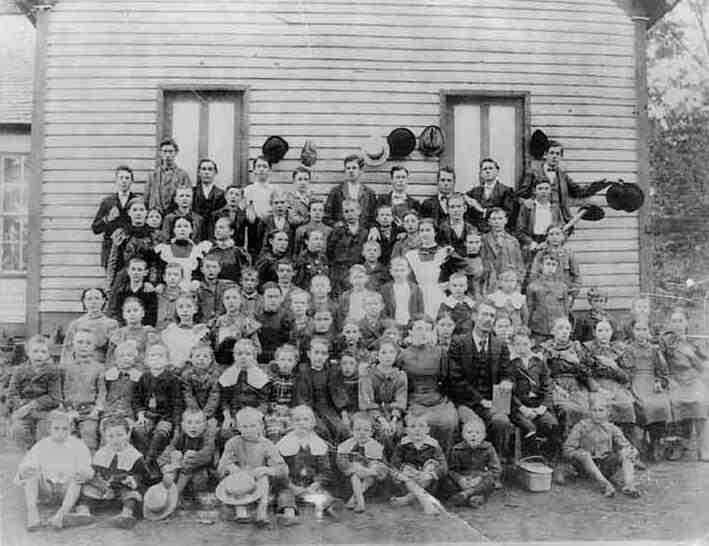
School portraits in the 1890s became very common photogrphy improved and became incerasingly affordable. We see class portraits from all over the country, includuing one-room schools on the rapidly shrinking western frontier. We see boys commonly wearing suits to school, even in country schools, although there boys in warm weather commonly just wore blouses and knee pants. Many boys wore straight-leg knee pants. Knickers were not very common, but we see them at some private schools. The type of pants did vary. We see boys at some schools wearing long pants. We are not entirely sure why there were such variations. Age of course was a factor. Boyys and girls commonly wore long stockings. Black long stokings were especially common.
Many younger boys wore blouses with large collars, sometimes ruffled Fauntleroy collars. We also see sailor suits, especially in urban schools. Girls wore dresses, often with pinafores. Many children came to school barefoot, especially in rural areas.

Related Chronolgy Pages in the Boys' Historical Web Site
[Main Chronology Page]
[The 1900s]
[The 1910s]
[The 1920s]
[The 1930s]
[The 1940s]
[The 1950s]
[The 1960s]
[The 1970s]
[The 1980s]
[The 1990s]
[The 2000s]
Navigate the Relate Boys Historical Clothing Style Pages
[Main country page]
[Long pants suits]
[Short pants suits]
[Lederhosen]
[Kneesocks]
[Eton suits]
[Jacket and trousers]
[Blazer
[School sandals]
Navigate the HBC Country Schools Pages
[Main U.S. individual school chronology page]
[Main National School Uniform Page]
[Australia]
[England]
[France]
[Germany]
[Ireland]
[Italy]
[Japan]
[New Zealand]
[Poland]
[Singapore]
[Scotland]
[Singapore]
[United States]
Navigate the HBC School Section:
[About Us]
[Activities]
[Chronology]
[Clothing styles]
[Countries]
[Debate]
[Economics]
[Garment]
[Gender]
[Hair]
[History]
[Home trends]
[Literary characters]
[School types]
[Significance]
[Transport and travel
[Uniform regulations]
[Year level]
[Other topics]
[Images]
[Links]
[Registration]
[Tools]
[Return to the Historic Boys' School Home]