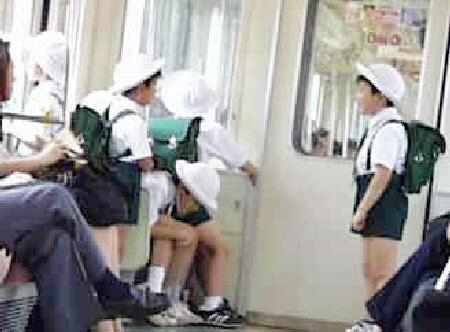
Figure 1.--These boys are on the subway on the way to school. They wear the standard white shirts and blue short pants adopted by many schools with white brimmed hats. This was the summer uniform. They may have had blue felt hats for winter. < /i> |
|
Many Japanese schools require a school uniform and most include caps or hats. Even schools which do not require uniformns have the children wear caps. There are several different styles of hats and caps worn by Japanese school children. One of the most common is a sailor cap with brim turned down. Some schools had a wide brimmed hat, but this is now not very common. Another style worn in Japan is the baseball cap. The Keio Yochisha hat is more elaborate than is typical (again, private schools often have elaborate hats--such as Tsukuba with its cotton balls.) Many schools even without a uniform will have children wear a bright yellow or blue simple hat (the yellow I think is common because it is so visible, thus ensuring children stand out in traffic). The Keio hat is black felt, worn by both boys and girls. The Keio uniform was adopted, I believe, well before the war and the round felt hat and Etonesque collar reflects European children's fashions of the 1920s. e have noted berets being worn, but except for special occassions, mostly by girls.
Japanese children tend to wear headwear to school, especially primary children. While headwear has declined in Western countries, including school headwear, it is stiil very common at Japanese schools. Outside of school, the children do not commonly wear headwear, but for school most do, especually primary children. Many secondary boys wear cadet caps, but secondaty girls do not usually wear headwear. Japan has both uniform and non uniform primary schools. Most do not require uniforms., but there are many schools that do require a basic school uniform. Most of these uniforms include caps or hats. But even the non-uniformn schools tendedv to require headwear. The headwear like the uniform itself varied widely. The headwear is often coordinated with the uniform style. Many schools had strict rules about wearing the uniform headwear, including the non-uniform schools. The headwear for the younger children is commonly done in bright colors to ensure they can be seen by motorists. We note a lot baseball-style caps in the post-war era, presumably the American influence. In more recent years we note more and more children wearing hats.
There are several different styles of headwear, both hats and caps, worn by Japanese school children. The specific style seklected is up to the individual school to select. Severl are familiar with modern Western school children. Others seem based on more historic, although Western styles. Interestingly the origins are different Europen countries and America. We do not yet know the Jpanese terns for these different styles of caps. Hopefully one of our Japanese readers will provide some information here. Some are also difficult to describe in English as they are not all now worn by American or European children.
Many schools even without a uniform will have children wear a bright yellow or or other bright-colored headwaer. This wasa lkmost always the state primaries trhat adopted these nright vcolors. The bright colors like yellow is common because it is so visible, thus ensuring children stand out in traffic. Most Japanese primary school children walk to work. The country is heavily unbanized. And the pruimary schools are kept small enough that the children live within walking distance. Japan is a very safe country and the children from the 1st grade vare taught toi walk ti school on their own. Thus brughtyly colored headwear are a helpful safty precaution. The private scchools are mote likely to use muted colors like navy blue, gray, and white.

Related Cap Pages in the Boys' Historical Web Site
[Return to the Main Japanese school headwear page]
[Return to the Main school uniform headwear page]
[Return to the Main headwear page]
[American caps]
[Australian headwear]
[English caps]
[Japanese caps]
[New Zealand caps]
[Scottish caps]
Navigate the Relate Boys Historical Clothing Uniform Garment Pages
[Return to the Main garment page]
[Blazers]
[Bookbag]
[Caps]
[Coats]
[Hose]
[Kilts]
[Pants]
[Shirts]
[Shoes]
[Smocks
[Suits]
[Seaters]
[Ties]
Navigate the HBC Country School Pages:
[Return to the Main National School Uniform Page]
[Return to the Main School Uniform Page]
[Australia]
[England]
[France]
[Germany]
[Ireland]
[Italy]
[Japan]
[New Zealand]
[Poland]
[Singapore]
[Scotland]
[Singapore]
[United States]
Navigate the HBC School Section:
[About Us]
[Activities]
[Chronology]
[Clothing styles]
[Countries]
[Debate]
[Economics]
[Garment]
[Gender]
[Hair]
[History]
[Home trends]
[Literary characters]
[School types]
[Significance]
[Transport and travel
[Uniform regulations]
[Year level]
[Other topics]
[Images]
[Links]
[Registration]
[Tools]
[Return to the Historic Boys' School Home]