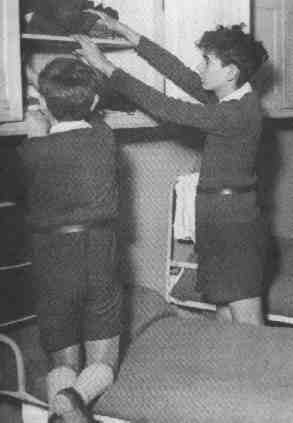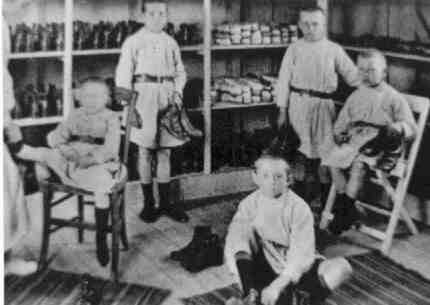
Figure 1.--This image appears to have been taken in a French or Belgian school or orphanage, probably during the 1910s. Notice the light-colored smocks and the belts worn over them. |

|
The belt was a practical garment worn primrily to hild up pants and trousers. It might also have various carrier devices attached to it to carry a range of useful items. The primary purpose, however, was to hold up pants. We also notice belts being use as a kind of fashion accessory. We notice belts being worn iver shirts, smocks, nd skirted garments for no practical purpose, but only for the fashion look. The garment most commonly worn with a non-functional belt was the tunic a very popular garment in the 19th and erly-20th centuries. We notice this in many different countries. Some smocks came with belts of the same material as the smock. In the early 20th century smocks were often worn with a leather belt. The belt had no real purpose than as a stylistic element. Wearing belts over smocks became less common in France after the 1920s. HBC has also noticed boys wearing belts over their sweaters, but was most common with smocks. This style has also been noted in Germany, but rarely in America or Britain. This is a style that HBC does not fully understand, but has begun to assess. A French HBC contributor has offered some interesting insights.
Fashion designers in many garments for both men, women, and children often mark or draw attention to the waist as a stylistic feature. Hence the belts often added to coats, raincoats and dresses. Sometimes they are somewhat useful, other times they are purely stylistic. This was popular for boys because it was a military style. See for example a Latvian boy soldier during World war I. And for the military, it was not purely stylistic. Belts were highly functional. Soldiers hung all kinds of equiopment on their beklts, canteens, satchels, guns hilsrers, sabers, and much more. And the belt had to be over their tunics or jckets xo thst they were easily accessable.
We have noted quite a few garments along which belts were worn as a non-functional ornamental accessory.
Smocks generally have a belt made in the same fabric. It is true that, I would say before WWI, in France smocks were often worn in schools and colleges with a belt. In fact I would rather say a military (or similar) belt (wide leather: in French "un ceinturon"). One must remember that France was severely defeated in 1870-71 by a German coalition, two provinces (Alsace and Lorraine) were lost. The disaster of the Franco-Prussian War (1870-71) brought about the Second French Republic which as acdemocracizing reformmintroduced the smock to French schools. "L' esprit de revanche" (revenge spirits) reigning everywhere in France and above all in the schools until 1914 when the Germand invaded Belgium and France initiating World War I. Pupils were paramilitary drilled and that spirits pervaded everywhere. Songs often had a martial air. That may explain this martial look given by the belt over the smock. Maybe it was not only the boys but also adults that had that fashion. Moving men ( removal men) or workers having to lift heavy objects often wear such belts. n a book Les disparus de Saint-Agil", one of the pupils, André Baume, 16 years old, is depicted as wearing a rough black smock tightened at the waist like a military belt ("ceinturon") with a brass buckle. The date is about June 1914.
|
Sweaters became a very popular garment for children during the 20th century. There are two ways to mark the waist when wearing a sweater. Both provide a rather military look.
Pulled down: One can pull down the sweater above the trousers or skirt and mark the waist with a belt or better with a belt above the sweater. Again in Les disparus
de Saint-Agil, but this time in the movie that was filmed just before World War II with
action taking place at this time, Sorgue, which is much younger than in the novel (I
would say 11), is wearing short trousers, knee socks, a sweater pulled down and a
military belt above with a big buckle.
Tucked inOne can also tuck the lower part of the sweater in the trousers skirts and
underline the waist by a belt in the loops on the trousers. This was mandatory in
the old times for the scouts in France and although not a scout I remember having noticed this fad in the 1950s.
Tunics were very commonly worn with belts, not all of them but most were worn with belts. We are not sure about the early-19th century, but by mid-century belts were very common. Tunics seem to be the farment most commonly worn with ornmental belts. We note both regular leather belts and matching coordinated belts worn with tunics. We don't have much information on the tunics worn with mid-19th centyry tunics. We note that the tunics worn at the turn-of-the-20th century had matching or cordinated belts. These tunics were very commonly worn with belts.
Belts were not worn over Norfolk jackets, but belts were employed as part of Norfolk styling. We first see vertical pleats and then horizontal belts to complete the Norfolk style.
HBC has noted belts being worn over sweaters in both France and Germany. This style may have been worn in other countries, although it was not common in America or Britain. It has rather a military look to it. As explained above, this might be why French boys wore belts over their smocks. The popularity of the military look in Imperial Germany (1870-1918) and after the rise of the NAZIs in 1933 may explain its popularity in Germany. We even note belts with skirted garments in Germany.