|
The blazer, cap, or tie are generally thought of when the traditional English school uniform comes to mind. It is the jumper or sweater, however, that is the most utilitarian of all school garments. Of course the sweatr varies geographically abnd is highly seasonal. Ties and caps were basically ornametal, although caps in the 1990s began to take on grater importance as the dangers of skin cancer are becoming better
inderstood. The blazer is worn to school and then generally taken off until it is time to go
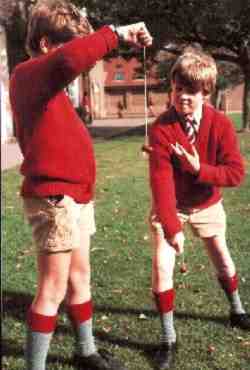
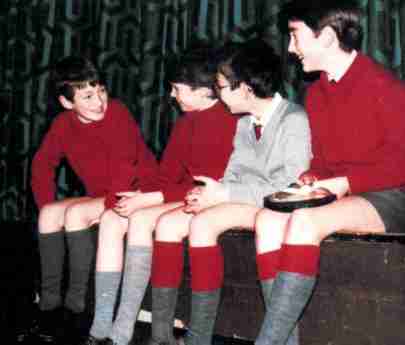
home. (This was not always the case.) The sweater, however, given the English climate is worn except for a few summer weeks and usually all day long at school. At school after school where uniforms are worn, the boys generally wore wool sweaters during the cooloer months. The English school jumper was initially a basic grey. Often the school's colors were added as trim around thgge neck or on the cuffs. Many more elaborate styles developed and brighter colors. By the 1980s, many schools had replaced grey sweaters with bright blue, red, green, and other colors. Sweaters at many schools were worn with neckties. A noticeable trend at some schools in the 1990s was to replace the wool jumper with less expensive and more casual sweatshirts--never worn with ties.
We do not have much information on sweaters during the 19th century. We believe they were primarily a school garment that became popular in the late-19th century. We have much more detailed information on the 20th century. The sweater was widely worn to school throughout the 20th century, especially after World War I when school wear began to become more casual. Styles varied by decade as sweaters increased in popularity and new styles appeared. There were substantil variations from country to country. Here different styles were popular and this was not a matter of varying time lines. We have just begun to build a time-line of sweater trends. We have detailed informstion on America and Germany, but are just beginning to develop information on other countries. Agter World War II by the 1970s we see sweaters becomong a part of the pan-European fashion trends, although cklimatic variation did provide some diversity. We also see a trend toward synthetic fibers because of the high cost cost of wool sweaters.
The use of sweaters varies greatly from country to country. This is of course a geopgraphic artifact related to climate. The northern countrues with temperate climates are those where children most commonly wear sweaters to school. Themore mortherly countrie (Britain, Canada, Russia, Scandinavia, ect.) are those where sweaters are most common. The same is true of the more southerly ltitudes, but there are fewer countries and smaller countries (Argentina, Chile, New Zealand, South Africa,ect.) located there. Of course elevation is also a factor. So you see school children in some countries at high altitudes (Bolivia, Butan, Nepal, Tibet, ect) wearing sweater. And this inckudes regions in some countries, including tropical countries (Ecuador and India). The cprevalence of sweaters not only variy from country to country, but also the tyoe and styles of sweatrs. A few countries have prove especiually impoirtant in setting sweater styles. England is by far the most important and English styles have influenced sweater styles at schools allover the world,in part because of the Briish Empire. Scandinavian countries have influenced sweater styles,but inlike Englnd, not school unofirm styles. Rather individual children wear brightly colored Scandinavian ski sweaters.
The jumper or sweater is one of the most utilitarian of all school garments. No where is it more commonly worn than in Britain. At most, but not all schools, the boys would hang their blazers up when they got to school and wear their jumpers while at school. Except for a few nice summer weeks, it is usually chilly enough that the jumpers were needed. At school after sdchool in England it was the jumper that was mostly worn during the school day during the cooler months. One of our British contributors tells me that wearing jumpers around school was not always so common as it now is. In fact at his prep school in the 1950s, he very seldom removed his school blazer, even in hot weather. They had to await permission for "shirtsleeve order". A old boy at a grammar school tells HBC that the boys there were not permitted to take off their balzers without permission of a member of staff. That was apparently why blazers seemed to wear out pretty quickly and were an ongoing expense for parents. Nowadays, with harder wrearing materials the blazers can be more durable. Some prep schools in the 1990s have dropped blazers altogether and substituted pullovers with the school crest or initials.
Sweaters are a very important school garment, in part because much of the school year is during the colder months of the year. This is a historical artifact which developed when agriculture was a more important pat of national economies than is the case today. The children, especially the boys, were less needed on the farm during the colder months than the warmer months.
|
The school jumpers worn by British boys were originally plain grey wool sweaters. Many schools continued to wear the plain grey jumpers because
they were the least expensive. This was most common at state primary and secondary schools. Even some prep schools, however, had plain grey jumpers in an effort to keep the cost of the uniform as low as possible. This was particularly common at small prep schools. British school boys have worn several styles of jumpers. The long sleeved "V" neck permitting the tie to show has been the most common since the 1960s, but several differet styles have been worn at various schools: collared sweaters, V-necks, sleevless, and
Leather epelettes.
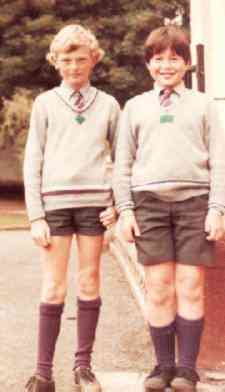
Some sweaters are pain grey without any trim. These are iften worn by boys at state schools. Eventually sweaters trimed in the school colors or with the school initials or letters became popular. These could be very polain, perhaps jyst plain grey with the school badge. Oyher schools had sweater with elaborate trim. These were worn mostly at prep schools. Boys at state schools mostly wore plain grey sweaters as they were lest expensive. In addition the state schools usually made less of a point of school identity and the school colors. The colors were most commonly placed at the neck of the jumpers. Some schools, mostly private schools, also designed the uniform jumpers with the colors on the sleeve cuff as well. A few schools in addition added the school colors at the waist.
|
Some schools in the 1980s replaced grey jumpers with colored ones to brighten up the school uniform. Colors most commonly included blue green, and red, but many other colors were used.
While wearing the jumper without the blazer was a step toward informality, many schools required that ties be worn with jumpers. The "V" neck sweater was by far the most common jumper style, prinmarily because it was designed to be worn with a necktie. Quite a number of other jumper styles were worn that did bot requuire a necktie, these were not as common, however, as the "V"-neck. Some schools, however, even required boys to wear ties with crew neck sweaters that were not designed to be worn with ties.
The school sweater was traditionally a heavy wool garment. This was generally the case hroygh the 1960s. Many of these modern colored sweaters are no longer made in wool because of the cost. Many British school children, both in state and private schools, now wear less expensive acrylic jumpers.
The sweater or jumper (in Britain) is a garment that began to become popular for school wear in the 1910s. At the time it began to replace suit jackets as school wear began to become more informal. Sweaters were also worn with suit jackets, primrily in Britain. Sweaters were at first primarily worn by boys, motly because the sweater was more of a male garment. We don't see women or girls wearing seaters to any extent before World War I, in or outside school. Probably because until after the erly-20h century, they were mostly seen as a kind of male work wear. After boys began wearing sweaters to school, given the practiclity and relative inexpense of the garment, girls soon followed. Sweaters became very common on a seasonal basis for countries in temperate areas. Boys and girls generally wear the same styled sweaters when worn as part of a uniform, of course chosing a male style--primarily the V-neck sweater. When not part of uniform, substantial gender varitions can be observed in the style chosen.
Other schools in the 1990s have replaced the wool jumper with less expensive sweatshirts with the school logo or initials. This is part of a new trend toward casual school clothing. Unlike jumpers, ties are not weorn with sweatshirts. These sweatshirts have been adopted by the more informal schools where the boys do not have to wear ties.

Navigate the HBC School Section:
[Return to the Main school uniform specific garment page]
[Return to the Main school uniform garment page]
[About Us]
[Introduction]
[Biographies]
[Chronology]
[Climatology]
[Clothing]
[Disease and Health]
[Economics]
[Freedom]
[Geography]
[History]
[Human Nature]
[Ideology]
[Law]
[Nationalism]
[Presidents]
[Religion]
[Royalty]
[Science]
[Social Class]
[Bibliographies]
[Contributions]
[FAQs]
[Glossaries]
[Images]
[Links]
[Registration]
[Tools]
[Children in History Home]