|
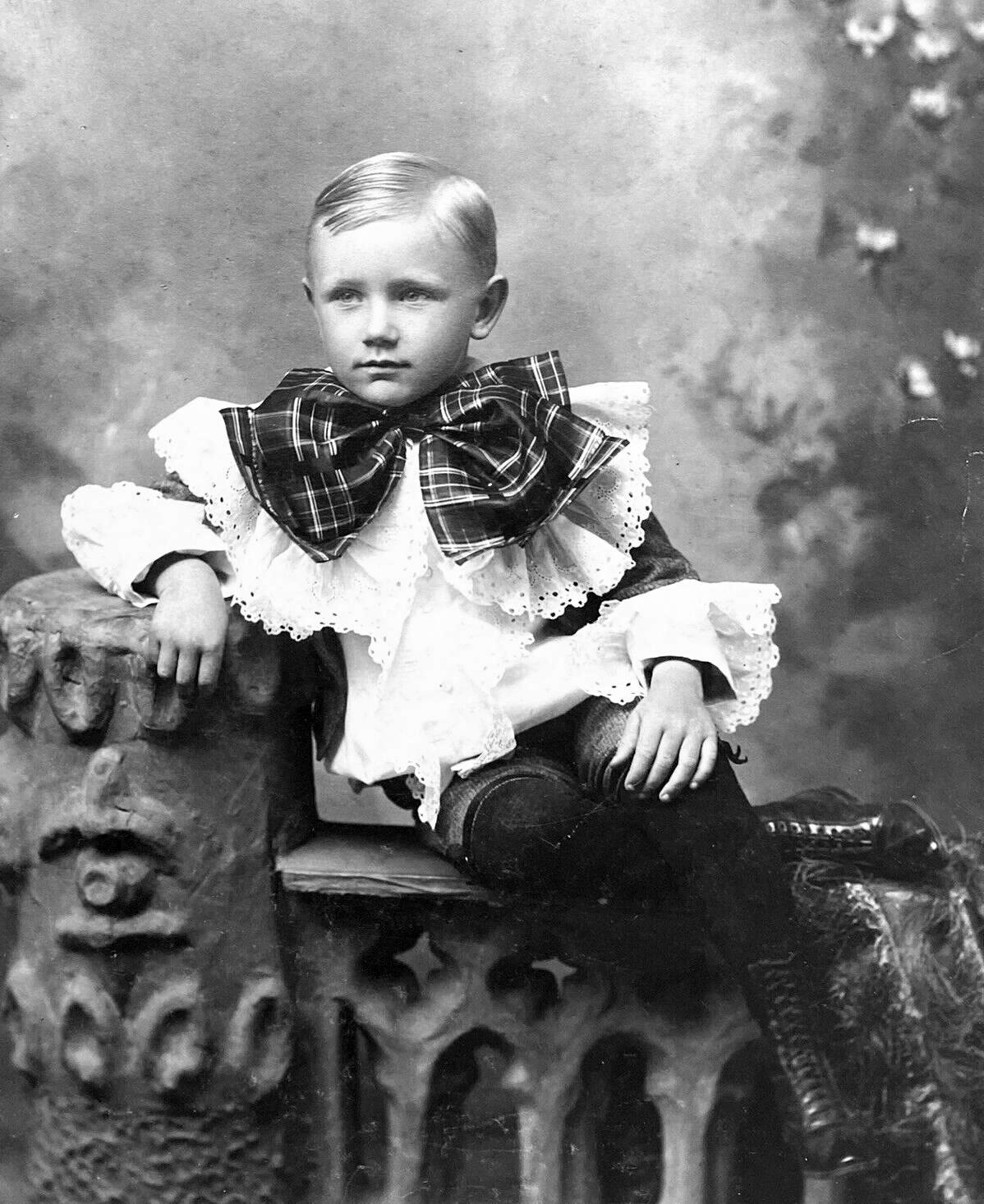
The history if bows is tied in with that of ribbions because bows are created from ribbons. A ribbon is a narrow strip or band of fine material which is finished off on all edges. They vary in width, but are commonly narrow. Different types of fabrics are used for ribbons. Ribbons are narrow pieces of fabric, commonly silk, cotton, wool, or other material, commonly synthetics in the modern era. The use of ribbons and bows began with nobility and the upper-classes. It was a symbol of wealth. This was almost by definition. They were done with satin/silk -- a kluxurious and thus exopensive fabric. Only the rich could afford them. We are not sure about the historic use of bows. There is a long history for ribboins which arecused to tiue bows. Just when ribbons began to be used ti tues biws we are not at all sure. We belkieve it began in the fench court (16th century). This was, however, adult fashion. It is only rlativly recently that we see bows beung used fir boys attire (19th century). We do not think it was common (early-19th century). This began ti change at mid-centuty). We believe the use of bows developed primarily (late-19th century. Here there were variations bepending on the type of bows involved. Bows were popular as hair adornments. Bows became enormously popular in the later half of the 19th Century. Bows are most associated of course with girls' clothing and hairstyles. Generally the largest, most prominent bows were used for girls. Bows were, however, also extensively used on boys, especially during the late 19th Century and early 20th Century as mother's sought to add a little flair to their sons' outfits. They becane a boy's fashion accesory laste-19th centuty). Girls wire huge hair bowes (early-20th century). The largest and most prominent bows were collar bows used with boys Fauntleroys suits, some almost dwarfing the boy involved. Given the ingenuity of doting mothers, a wide variety of bows were also used with many other fashions, from shoulder ties on dresses for boys before breeching to decorative shoe bows.
The history if bows is tied in with that of ribbions because bows are created from ribbons. A ribbon is a narrow strip or band of fine material which is finished off on all edges. They vary in width, but are commonly narrow. Different types of fabrics are used for ribbons. Ribbons are narrow pieces of fabric, commonly silk, cotton, wool, or other material, commonly synthetics in the modern era.
Speaking of decorative ribbonds, initially silk was the most common, today we see organza, satin, and of course polyester. Fashion historians report that the history of ribbons starts atthe earliest stages of civilization, even in the neolithic era (stone age) were weaving narrow often dense strips of fabric on small portable looms. There are imppressions of warp-faced plain weave bands (6000 BC). The earliest we have noted come from the notable Turkish archaeological site of Catal Huyuk. These seem to have been more functional than decorative items. We know litlke about the ancien era at this time. We have some information abiut the medieval era, at least the late middle ages. St. Etienne, France made light-weight ribbons. (11th century AD). This French town remains the center of theFrench ribbon-weaving industry to this day. Ribbons at this time had functional usage, bu there is some induication that there was some decorative usees. We begin to see increasinf references ti ribbions (14th and 15th centuries). It is at this time with the with the quickening of the economy that we see more tailored clothing. France had become the center of European fashion, especially the royal court (16th century). French kings and nobility began using decirative ribbons as part as fashionable dress, Eventually male usage began toi decline, esoecially after the defeat of Royalists in the English Civil War (1642-51). This continued (18th century.) Ribbons became a part of the fashion industry, but primarily a woman's fashion decorantion. Ribbons and bow became very popular (19th century). Now ribbons are everywhere (21st century). They now hold medals in place as well as bestowing honor on those most deserving. Ribbons are essential for decorating and giftings. We see awareness tokens to holiday decorations, ribbons have become a staple in almost every household. As far as fashion is concerned, we primarily see them as hairs bows for younger girls.
The use of ribbons and bows began with nobility and the upper-classes. It was a symbol of wealth. This was almost by definition. They were done with satin/silk -- luxurious and thus exopensive fabrics. Only the the well-todo could afford them. There was, however a growth of the middle-class in the 19th centuery as part of the Industrial Revolution. An agricultural country did not need a large moddle class, but an industrial country did. It needed rechnicians, ebngineers, and scientists as well as clerks, teachers, and bankers. This generated a huge and well-heeled middle class. In addition, an educated industrial work force was more productive thasn an uneducated rural work force. Increasing productivity meabn thzat workers could be paid more and enjoying small luxuries themselves. And industrial efficencies brought down the cost of clothing, meaning far more peopke could afford fashionable clothing for themselves and their children. The wealth was not equally shared, but never before in historty had so many people enjoyed such afflence. And this was especially true in America which is why Europeans migrated to the United States in the millions.
We are not sure about the historic use of bows. There is a long history for ribboins which arecused to tiue bows. Just when ribbons began to be used ti tues biws we are not at all sure. We belkieve it began in the fench court (16th century). This was, however, adult fashion. It is only rlativly recently that we see bows beung used for boys attire (19th century). We do not think it was common (early-19th century). This began ti change at mid-centuty). We believe the use of bows developed primarily (late-19th century. Here there were variations bepending on the type of bows involved. Bows were popular as hair adornments. We believe the use of bows developed primarily in the latter half of the 19th Century. Ringlet curls were common even before the turn of the 19th Century. Bowes were, however, not commonly worn with ringlets and other hair styles until after mid-century. They continue popular for girls into the 1920s, but became much less common by the 1930s. Bows for boys generally followed the much more common pattern of the bows worn by girls. The fashion of using bows for little boys began at about the same time as those for girls. The fashion, however, ended somewhat earlier for boys than girls. Neckwear was anmother common use of bows. Boys in the early 19th century often wore open collars. Neckwear and collars tended to be rather limuted and plain. The simple stock was common at mid-century. We do not begin to notice bows being commonly worn until after mid-century. Bows are noticeable in the 1870s and begin to become quite large in the 1870s. Bows seem much more popular for boys than girls. They were worn with a variety of outfits. They are espercially associayed with Fauntleroy suits, but that was just one oif the outfits they were worn with. Boys might wear large floppys bows with fancy blouses to dress up during the warm summer weather. They continued to be worn in the 1900s, but began to decline in popularity in the 1910s.
We do not yet have detailed information on foreign laguage terms for bows. We do have the German terms. The basic word for bow is die Schleife/die Schleifen. There are several related words for different kinds of bows. 'Haarschleife' is a hairbow, 'Zopfschleife' is a bow on a pigtail, a classic item for a German girl. 'Halsschleife' is a now worn as neckwear, very common in the late 19th century. 'Schuhbendelschleife' is a bnow worn on shoes. 'Schleifchen' (diminishing of a 'Schleife') is a bow worn at the sleeve of a shirt/blouse/cloth/etc. We are not familiar
with this.
Bow ribbons came any many different colors and patterns. White was a popular color.
I do not have a good understanding as to other colors used, but believe blue
and even red were used. I think yellow, orange, and green were less common. Many patterns were used. Polka dots and plaids were very especially common. Stripes were another popular pattern. HBC at this time does not know how these patterns varied over time and among countries. There may also been differences between genders, although floppy bows were more common for boys than girls.
Many different widths of ribbons were used for bows. This varied as to the use intended. Collar bow ribbon could be quite wide, although this varied over time. Hair bow ribbons could be quite thin. The whole topic of ribbons is an important one, but we have not yet found much information on this topic.
Bows are an important decorative item. Children both boys and girls during the late 19th and early 20th Century wore a wide variety of bows. The most common were collar bows. And huge collar bows are a destinctive style of the late 19th century, especially for boys. Doting mothers, however, found a wide variety of other palces to adorn their sons with children with decoraribe bows, especially the boys. Bows appeared on boys from the top of their head to their shoesand secveral places in between. There are even bows afixed to boys that HBC can't quite figure out. Sometimes a boy in fact might wear multiple bows. The most that HBC has noted has been three boys, but it is quite possible that some boys may have even worn more.
The usage of bows in boys clothing has varied widely from country to country. The collar bows worn with Fauntleroy suits were enormously popular in the United States. We see countless images of American boys wearing huge floppy bows duruing the late-19th and very eraly-20th century. We are not sure why these bows and Fauntleroy suits were so popular in America. Marxist influnced American history teachers tell students that conditions in America were terrible for working peoople. Nothing coulkd be furthr from the truth. (ember the valid metric is to cmare American workers with workers jin other ciountrirs at the time, nit modern America.) American workers were paid better than workers in any other country. This is why workers were legally flocking to America by the millions. And with so many people doing so well, mothers often from humble origins wanted to dress up the kids to the nines to show off their success. Ther may be other factors, but surely this was an imprtant factor. We see larger bows in Europe as well, but not nearly as many bows or for that matter such large bows. European bows seem most common in Engkand and France. Necwear was not the only bows. And here the situation is more mixed. Hair bows, at least for boys, were mot nearly as popular in America as the collar bows. We see them in the phoyograohic record, but not nearly as many and there was a yonger age range. The French also had large Fauntleroy collar bows and more commonly used hair bows than in America. We believe that the Italians commonly used collar bows on boys clothes in the 19th century and continued this fashion into modern times by using them with school smocks. We have a fairly substantial archive for Engkand and Germany. The English may be an exception. We see younger boys wearing collar bows, but fewer schoolage boys. The practice of sending boys of about 8 years of age away to boarding preparatory schools with strict uniform requirements rather removed the mother from fashion decesions about how her son was dressed after reaching that age. While it was the boys from affluent families that went to these preparatory schools, fashions trends for boys 8 and older were stringly influenced by the clothes they wore. Gewernan boys wore far fewer boys than the boys ijn other major countries, especiually American boys.
Both boys and girls wore bowas, especially in the late 19th-and early 20th centuries. There were substantial differences in how boys and girls wore boys. Of course the most statling use of bows were the huge collar bows boys wore. This was less common for girls. But girls wore huge hair bows which were much less common for boys. There were mzny other gender difference abd these varied over time. Generally usage was inverse. A factor here is that boys generally did not like dressng like girls. Thus when we see boys with huge cillar bows, we do not see girls with collar bows. Girls did wwear collar bows, but they were less common znd generally snaller. We see gie=rls wearing collar bows, shoulder bows, hair bows, shoe bows and other bows. Overall the bow is more associated with girls, but the huge bows worn by boys makes this general convention less pparent than it normally would be. We note variations in girls' use of bows affected by a range of factors, including age, chronology. country, social class, and other factors.

Navigate the Boys' Historical Clothing Web Site:
[Return to the Main decorative itenm page]
[Introduction]
[Activities]
[Biographies]
[Chronology]
[Cloth and textiles]
[Clothing styles]
[Countries]
[Topics]
[Bibliographies]
[Contributions]
[FAQs]
[Glossaries]
[Images]
[Links]
[Registration]
[Tools]
[Boys' Clothing Home]